
A “Pass” in medicine does not kill your residency chances. Let me be blunt: what kills them is pretending it does, shutting down, and letting the same problems repeat on later rotations.
You are not the first student who walked out of an internal medicine clerkship with a disappointing grade and a sick feeling in your stomach. I have watched this play out dozens of times: one mediocre evaluation on a core rotation, followed by either a systematic rebuild… or a slow-motion collapse across the rest of the year.
The difference is not talent. It is strategy.
You want a roadmap for:
- How to interpret that “Pass” honestly
- How to repair trust with faculty and residents
- How to use later rotations to actively help your residency application instead of just “hoping it works out”
That is what we are going to do. Step by step.
Step 1: Stop Guessing Why You Got a Pass
Most students guess wrong.
They blame the attending who “just doesn’t honor people,” the shelf exam, or the rotation being “too malignant.” Sometimes those are real factors. Usually they are background noise covering a more fixable pattern.
Your first job is to get specific, written, and verbal feedback. Not vague vibes.
1. Pull the record
Do this today:
- Log in to your evaluation portal.
- Download every comment from:
- Attendings
- Residents
- Fellows
- Nurses (if your school includes them)
- Copy everything into a single document. Remove names. Just behaviors.
Then categorize comments into buckets. Use these four:
- Knowledge / Clinical reasoning
- Professionalism / Reliability
- Work habits / Initiative
- Communication / Teamwork
You are looking for patterns. For example:
- “Needed more prep before presentations.”
- “Not always on time for pre-rounds.”
- “Quiet during rounds, did not volunteer plans.”
Three versions of the same problem count as one real issue. That is good news. You do not have 10 problems. You have 1–3.
2. Get an honest debrief from someone who watched you
Within one week, do this with one of:
- Clerkship director
- Site director
- Trusted attending or senior resident who worked with you
- Academic advisor / dean for students
Send a short, professional email:
Subject: Follow-up on Medicine Clerkship Performance
Dear Dr. [Name],
I wanted to thank you for the opportunity to work with you on the [Medicine] service. I received a final grade of Pass and I would really like to improve concretely for my upcoming rotations.
Would you be willing to meet for 15–20 minutes (in person or via Zoom) to review specific behaviors I can change on the wards? I am looking for direct, actionable feedback, even if it is tough to hear.
Thank you for your time and mentorship,
[Your Name], MS3
When you meet, do not defend yourself. You are there to collect data, not to win a debate.
Ask targeted questions:
- “If I had been an Honors-level student on your team, what would you have seen me do differently on a typical day?”
- “Were there points in the rotation where you or residents hesitated to trust me with more responsibility? What triggered that?”
- “If you had to pick the top two behaviors holding me back, what are they?”
Write down exact phrases. If someone says, “You seemed disengaged,” that word matters. Because that is exactly what later attendings will be subconsciously judging.
Step 2: Decide What Story This “Pass” Will Tell
Programs do not automatically blacklist you for a Pass in medicine. What they care about is the trajectory and the story.
You have two options:
- Option A: Passive story – “I did fine, got a Pass, moved on, did about the same later.”
- Option B: Redemption arc – “I was average early. I took it personally, overhauled my approach, and everything after that shows clear growth.”
You know which one residency PDs respect more.
Let us be very clear:
A Pass in medicine + Honors in later core rotations + strong narrative of growth = still competitive for many fields.
A Pass in medicine + more Passes + generic application language = red flag.
So your strategy is simple:
- Turn later rotations into an obvious upward trend.
- Make that trend visible:
- On your transcript
- In comments from attendings
- In your MSPE
- In your personal statement (if needed)
- In your letters of recommendation
That requires an intentional re-design of how you show up on every clerkship from now on.
Step 3: Build a “Trust-Builder” Playbook for Each Rotation
Residents and attendings do not care about your grade label as much as this:
“Can I trust this student with my patients, my time, and my team?”
Trust is built in predictable ways. If you keep “winging it,” you are gambling. Stop gambling. Use a structured approach that you repeat on every rotation.
A. Start-of-rotation script: reset your identity
You need to walk into your next rotation differently.
On Day 1 (or 2), pull aside the senior resident or attending for 5 minutes. Say something like:
“Dr. [Name], I wanted to share my goals for this rotation. I am coming off of medicine where I received a Pass. I got specific feedback that I needed to [example: speak up more on rounds and be more proactive with follow-up].
For this month, my goals are to:
- Be fully prepared for every patient I present
- Take ownership of follow-up items
- Ask for feedback weekly so I can correct quickly
If you notice me slipping into old habits, I would really appreciate you telling me directly so I can fix it in real time.”
You have just:
- Shown insight
- Declared a growth plan
- Invited coaching
- Reduced the chances people quietly judge you without telling you
This is how you rebuild trust before you even start proving yourself.
B. Daily non-negotiables: things Honors students do that Pass students “mean to do”
Here is the uncomfortable truth: most “Pass” students know what they should do but do it inconsistently. Honors students do the same things every single day.
Adopt these non-negotiables:
Pre-round like it actually matters
- Know:
- Overnight events
- Vital sign trends
- New labs and imaging
- Have a one-sentence assessment in your head for each problem before you open your mouth on rounds.
- If your weakness is disorganized thinking, use a template:
- ID statement
- Overnight events
- Subjective
- Objective (relevant positives/negatives)
- Assessment by problem
- Plan with 2–3 concrete steps for each big problem
- Know:
Close the loop on every task you touch
Residents notice who creates work and who eliminates it.
- If you order something, check it.
- If you say “I’ll follow up with X,” write it on your to-do list with time.
- Message the team: “CT chest resulted. No PE. Updated note.”
Early in the year, I saw one student transform from “forgetful” to “rock solid” just by using a simple notebook with three columns:
- Task
- Time due
- Check box
Old-school. Effective.
Speak up once per patient with a clear clinical thought
Many “Pass” students are quiet, then later say, “I knew that.” That does not count. The team cannot read your mind.
Force yourself:
- On each patient, say either:
- “Given her creatinine is up from 0.8 to 1.3 and urine output is down, I am concerned about pre-renal AKI from over-diuresis. I would suggest holding Lasix today and getting urine electrolytes.”
- Or: “I do not know the best choice here, but I thought of X vs Y. Can you walk me through how you decide?”
The content matters less than the evidence of active thinking.
- On each patient, say either:
Be predictably present
- Show up 10–15 minutes before the earliest resident.
- Offer to help cross-cover tasks when your work is done.
- Never disappear without telling someone where you went (even if it is just, “I am going to grab lunch; back at 1:00.”)
Attendance/professionalism dings are the dumbest way to lose trust. Fixable in 24 hours.
C. Weekly feedback ritual: force course correction
Waiting until the end-of-rotation evaluation is how you end up with “surprise” Passes.
Create a weekly script. On the same day each week (say, Thursday), say to your senior:
“I want to make sure I am improving for you and the team. Could you give me two things I am doing well that I should keep, and two things I need to change before the end of the rotation?”
Then:
- Write down what they say, verbatim
- Repeat it back: “So, focus on [better time management pre-rounding] and [shorter, more structured presentations]. Got it.”
- Act on it the next day. No delay.
This single habit is the difference between a doomed rotation and a salvageable one.
Step 4: Target Rotations That Can Actively Repair Your Application
Not all later rotations are equal when it comes to repairing a mediocre medicine grade.
You want rotations that:
- Generate high-yield narrative comments
- Offer strong letter of recommendation (LOR) potential
- Are close enough in time that PDs see them as part of the same “clinical year story”
| Rotation Type | Impact Potential | Best Use Case |
|---|---|---|
| Sub-I in Medicine | Very High | Directly counters earlier Medicine Pass |
| Sub-I in Desired Field | Very High | Shows specialty-level readiness |
| Surgery or ICU | High | Demonstrates work ethic / acuity skills |
| Outpatient IM/Clinic | Moderate | Good for communication and continuity |
| Electives (easy) | Low | Fine for GPA, weak for trust rebuilding |
1. Medicine Sub-Internship (if you can get it)
If your school allows a medicine sub-I after your third-year medicine clerkship, this is your best chance at redemption.
Approach it like this:
Before it starts, email the sub-I director:
“I previously received a Pass in the core medicine clerkship and have been working actively on improving [brief list]. My goal for this sub-I is to demonstrate that I can function at an intern level. I would appreciate any guidance on expectations so I can prepare properly.”
On Day 1, repeat the “goals and feedback” script with your senior and attending.
Take fewer patients early, but own them completely. It is better to crush 3 patients than flail with 8.
If you get a strong evaluation and letter from this rotation, PDs tend to weigh that more heavily than your earlier Pass. Because sub-I work is closer to residency reality.
2. Sub-I or Acting Internship in Your Intended Specialty
If you already know your target specialty (e.g., IM, FM, EM, surgery, OB/GYN, psych):
- Schedule at least one high-quality sub-I or away rotation where people are known for writing detailed letters.
- Make sure the program has a track record of your school’s students rotating there. This makes your context clearer to them.
A medicine Pass is less lethal if your specialty-specific rotations show clear strength and your letters say:
“This student performed at or above the level of our interns.”
That line overrides a lot of earlier noise.
Step 5: Convert Later Rotations into Powerful Letters of Recommendation
You do not just need to “do better.” You need other people to notice, document, and say it in writing.
A. Choose letter writers strategically
You want 2–3 of the following:
- One strong letter from a later core rotation or sub-I (especially medicine or your chosen specialty)
- One from a faculty member who saw your improvement over time
- One from a program director / clerkship director if they know you well
Avoid letters from:
- Short shadowing experiences
- Electives where you never functioned on the front line
- Attendings who liked you personally but barely saw you clinically
B. Make it easy for them to highlight your growth
When you ask for a letter, do not just say “Can you write me a strong letter?” That is lazy.
Instead:
Ask in person or by video if possible.
Use language like:
“Dr. [Name], I am applying in [Specialty]. I previously received a Pass in my third-year medicine rotation but have worked hard to improve my clinical skills, ownership, and reliability on the wards.
You have seen me on [later rotation], and I was hoping you would feel comfortable writing a strong letter that comments on my current level and any growth you have seen.”
Provide a short LOR packet:
- CV
- Personal statement draft (if available)
- A one-page bullet list:
- “Strengths you mentioned on feedback”
- “Areas I worked to improve since early rotations”
- “Specific cases or moments we shared that stood out”
You are not scripting their letter. You are reminding them of concrete reasons to trust you now.
Step 6: Manage How the “Pass” Appears in Your Application
You have two levers:
- Reality (your evaluations and trends)
- Framing (how you and your school describe them)
A. The MSPE (Dean’s Letter)
Your MSPE will usually list:
- Clerkship grades
- Narrative comments
- Possibly an explanation if there were academic concerns
You cannot write the MSPE. But you can influence what it says by:
- Meeting with your dean / student affairs office early
- Sharing:
- What feedback you received
- What you changed
- Evidence of improvement (later grades, letters, comments)
Ask directly:
“I know my early medicine grade was a Pass. Since then, my [family medicine, sub-I, ICU] rotations have been stronger, and attendings have commented on [X, Y, Z improvements]. I want residency programs to see this trajectory accurately. Is there a way to reflect that growth clearly in my MSPE narrative?”
Deans are often willing to include language like “demonstrated marked improvement over the course of the clinical year.”
That line helps.
B. Your personal statement: when to address it and when to shut up
Do not build your entire personal statement around one Pass in medicine. That is overcorrecting.
Address it briefly only if:
- You had a clear, specific cause (e.g., health issue, family crisis, major learning curve)
- You have clear, objective evidence of improvement afterward
If you address it, use a clean, controlled paragraph:
“Early in my third year, I earned a Pass in internal medicine. My feedback highlighted that I needed to communicate my clinical reasoning more clearly and take greater ownership of follow-up tasks. I took this seriously and redesigned my approach to each rotation. On subsequent clerkships, including my medicine sub-internship and ICU rotation, I consistently received feedback that I was functioning at the level of an intern in terms of preparation, reliability, and patient care. That experience reshaped how I show up for my team and my patients.”
Then move on. The rest of the statement should be about who you are now, not what went wrong then.
Step 7: Be Realistic About Specialty Competitiveness
Some of you are asking the quiet question: “Does this Pass mean I cannot match [insert competitive specialty]?”
The answer depends less on the Pass and more on everything around it:
- USMLE/COMLEX scores
- Other clerkship grades
- Research in your chosen field
- Strength of letters
- School reputation
To keep this practical, here is a rough guide.
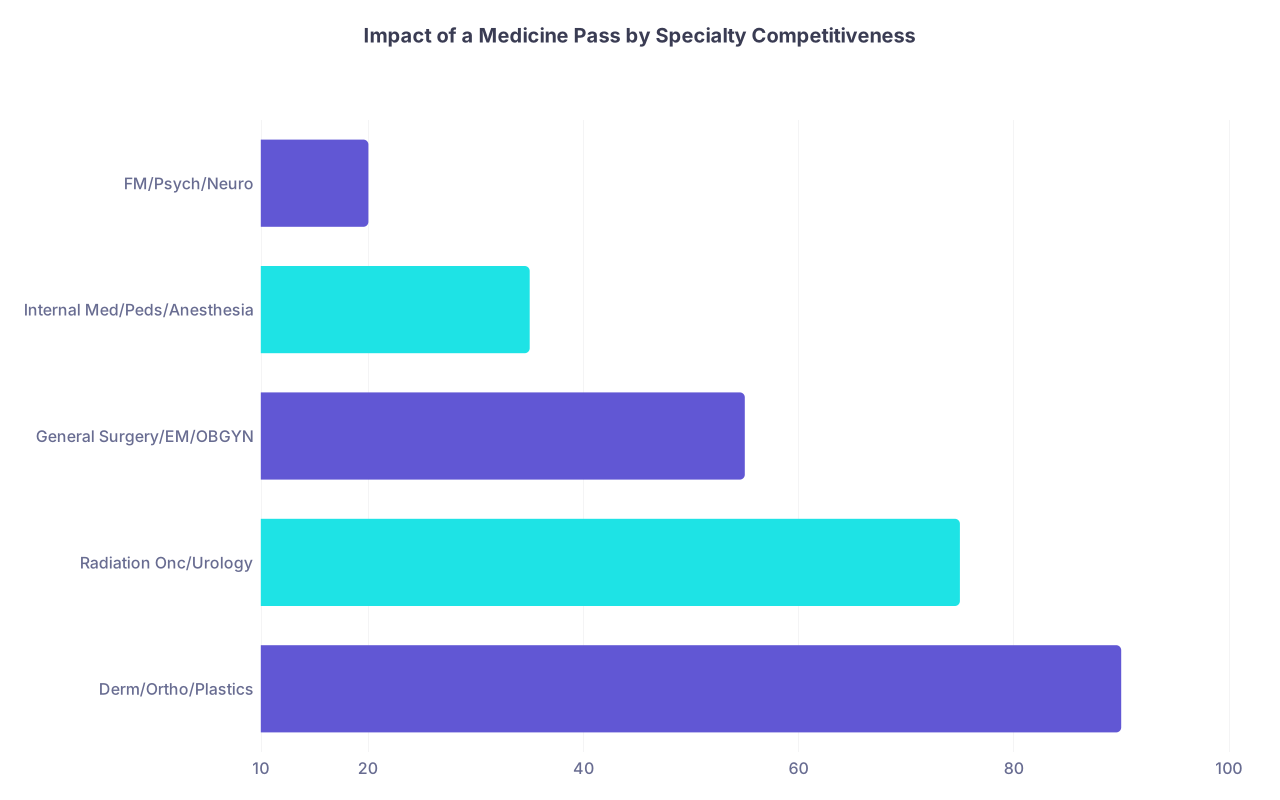
| Category | Value |
|---|---|
| Derm/Ortho/Plastics | 90 |
| Radiation Onc/Urology | 75 |
| General Surgery/EM/OBGYN | 55 |
| Internal Med/Peds/Anesthesia | 35 |
| FM/Psych/Neuro | 20 |
Interpretation (approximate “risk” weight of a Medicine Pass out of 100):
- Derm / Ortho / Plastics (~90)
- A Pass in medicine will hurt unless:
- Your scores are stellar
- You have elite research and letters
- Later rotations are outstanding
- A Pass in medicine will hurt unless:
- Rad Onc / Urology (~75)
- Not ideal, but still survivable with a strong rest-of-application.
- Gen Surg / EM / OB-GYN (~55)
- Concerning but fixable with:
- Excellent sub-I in that specialty
- Strong Step 2
- Great LORs
- Concerning but fixable with:
- IM / Peds / Anesthesia (~35)
- Many applicants have mixed clerkship records. Trend and letters matter more.
- FM / Psych / Neuro (~20)
- Least likely to be decisive by itself.
If your dream field is extremely competitive and your overall profile is average, you have two concrete options:
- Go all-in with a very deliberate, high-intensity improvement plan and maximal networking in that field.
- Dual apply strategically to a less competitive field you would actually be willing to train in.
That decision should not be made in a vacuum. Sit down with:
- A specialty advisor
- A PD you trust
- Your dean’s office
Bring your numbers, grades, research list, and rotation calendar. Ask directly: “Would you, as a PD, interview this application for [specialty]?”
You need that honesty early, not in October.
Step 8: Protect Your Headspace So You Do Not Repeat the Same Mistakes
A single disappointing grade can burrow into your brain and quietly sabotage your behavior.
You start thinking:
- “I am just average on the wards.”
- “They probably already think I am a Pass student.”
- “If I speak up and I’m wrong, I will look stupid again.”
That mindset is dangerous. It leads straight back to the exact behaviors that caused the Pass.
You need a simple mental protocol for each new rotation:
- New rotation, clean slate (for behavior)
- Assume no one has memorized your prior grades. They are judging today only.
- Active identity shift
- Before Day 1, literally write:
- “On this rotation, I am the student who:
- Shows up early
- Owns my patients
- Speaks up with at least one idea per patient
- Asks for feedback weekly”
- “On this rotation, I am the student who:
- Before Day 1, literally write:
- End-of-day 3-minute review
- Ask yourself:
- What did I do today that built trust?
- Where did I drop a ball or hesitate?
- What is one thing I will do differently tomorrow?
- Ask yourself:
You do not need therapy-deep processing here. You need consistent micro-corrections that keep you from slipping back into the quiet, hesitant, or disorganized patterns that led to your Pass.
Step 9: Use One Rotation as Your “Proof of Concept”
You do not need to magically transform every rotation at once. You need one clear, documented example of:
- You came in with a plan
- You executed it
- Faculty noticed and wrote it down
Pick your next major rotation (medicine sub-I, ICU, surgery, or your target specialty) and make that your proof of concept.
Here is the protocol:
One week before:
- Review your prior feedback.
- Make a short 1-page checklist labeled: “Mistakes I do not repeat.”
- Email your senior/attending a short note of your goals, or at least prepare your Day 1 script.
During Week 1:
- Over-prepare. Slightly more than feels comfortable.
- Stay later than you are used to in order to close loops on tasks.
- Ask for feedback at the end of Day 3: “Is there anything I have done so far that is worrying, or that would keep me from being an honors-level student on this team?”
During Week 2–3:
- Increase your cognitive load gradually (more patients, more ownership).
- Ask for concrete opportunities: “Could I lead family updates on Mr. X today?” “Can I write the first draft of that discharge summary?”
Final week:
- Ask your attending directly:
“Comparing how I started this rotation to how I am now, have you seen specific growth that you would feel comfortable commenting on in your evaluation or a letter?”
- Ask your attending directly:
This is how you create documented evidence that your medicine Pass was an early-stage version of you, not the final one.
Your Next Step Today
Do not just think about this. Take a specific action in the next 30 minutes that changes your trajectory.
Do this:
- Open your evaluation portal and gather every written comment from your medicine rotation into a single document.
- Label each line as Knowledge, Professionalism, Work Habits, or Communication.
- Circle the one category that shows up most often.
That category is your first repair target.
Then write one concrete behavior you will change on your very next day in the hospital that directly attacks that pattern.
That is how you stop being “the student who only got a Pass in medicine” and start becoming “the student who used an early setback to become one of the most reliable people on the team.”