
How to Turn a Last‑Minute Away Rotation into a Strong Interview
It is two weeks before your away starts. You scrambled to get this spot after another rotation fell through. You barely know the schedule, you do not know the residents, and your housing is a friend-of-a-friend’s couch.
But this program is on your rank list. Maybe top 3. Maybe number 1. And you know the reality: this “audition rotation” might be your only real shot at showing them who you are before interview season.
You are late to the game. Other students have had these spots locked for months. Some already rotated here in July and August. You are walking in cold.
Fine. Here is how you turn a last‑minute away into a strong interview anyway.
Step 1: Get Organized Before Day 1 (In 72 Hours or Less)
You cannot control the timing. You can absolutely control how prepared you walk in.
1.1 Clarify what this program actually values
Do this before you touch Anki or UpToDate.
Go to the program’s website. Write down:
- Their stated “values” or mission
- Call structure and rotation layout
- Any mention of: research, underserved care, operative volume, critical care, etc.
Check FREIDA and recent resident bios:
- What are they flexing? Research? Global health? Procedures? Fellowship placement?
Look at faculty/resident interests:
- Who does medical education?
- Who runs the QI projects?
- Any recurring themes: trauma, palliative care, transplant, etc.
You are not doing this for fun. You are building a target.
You need to know:
- What kind of student they like
- What stories/skills of yours actually match what they claim to care about
1.2 Fix your “on-paper” footprint quickly
Within 72 hours, you should have the following ready to send if asked:
- A clean, 1-page CV (no typos, no clutter)
- Updated ERAS-style experiences list (just for yourself, to talk consistently)
- A 2–3 sentence “who I am + why your specialty + what I want” summary
Example summary:
“I am a fourth-year at [Your School] planning to apply to EM. I am most interested in high-acuity care and resident teaching; I have been a simulation TA for two years. Long term, I want to work in a busy academic ED with a strong role in medical education.”
You will reuse this 100 times. On day 1. In hallways. During “tell me about yourself.”
1.3 Prepare a tight, realistic study plan
You have limited time. You are not going to relearn all of Step 1.
Focus on:
- The most common conditions for the specialty
- The first 24–48 hours of management
- Bread-and-butter differentials and orders
Pick one high-yield resource and one question bank. Then stop hunting.
| Specialty | Core Resource | Question Source | Daily Time |
|---|---|---|---|
| EM | EMRA Basics | Rosh/AMBOSS EM | 45–60 min |
| IM | Step-Up to Med | UWorld IM | 60–90 min |
| Surgery | Surgical Recall | TrueLearn Surg | 45–60 min |
| OB/GYN | UWise notes | UWise Qs | 45–60 min |
| Peds | BRS Peds | UWorld Peds | 45–60 min |
Non-negotiable:
- 1 hour per day pre-rotation
- 30 minutes per day during the rotation (even if it is 15 in the morning, 15 at night)
You are building “pattern recognition” and confidence, not brute memorization.
Step 2: Set the Tone in Week 1 – Without Being That Student
Your goal in the first 3 days: become the student people want to work with. Not the smartest. The easiest to trust.
2.1 Day 1 script: what you actually say
When you meet your senior/residents:
“Hi, I am [Name], visiting from [School]. I am applying [this cycle / next year] in [Specialty]. I know I am coming in late in the season, so my goal is to work hard, be useful, and learn how things work here. Please tell me directly if there is anything I can do better or differently.”
Short. Honest. Clear.
You just:
- Signaled self-awareness (you know you are late)
- Showed you can take feedback
- Framed yourself as adding value, not just extracting it
2.2 Understand what residents actually care about
Residents do not care about your Step 1 score on day 1. They care about:
- Are you going to slow them down?
- Are you going to dump work on them?
- Can they trust you with small tasks and not double-check everything?
So your early priorities:
Reliability
- If they say “pre-round on beds 3 and 4” – you do it, fully, on time
- If you do not know how, you ask immediately, not 40 minutes later
Communication
- “I have not done that before—can you show me once?”
- “I put in the orders for X and paged Y; I will follow up in 10 minutes.”
No drama
- You do not complain about other students, nurses, call, or schedule
- If something is unsafe, speak up. If it is just annoying, eat it.
2.3 Carve out your role quickly
On day 1 or 2, ask your senior:
“What does a really strong student look like on this rotation to you? And what do students do that is actually not helpful?”
Then listen. Then write down what they say on your phone when you step away.
You are getting the answer key to:
- How to impress this specific team
- What to avoid doing (that no handbook will tell you)
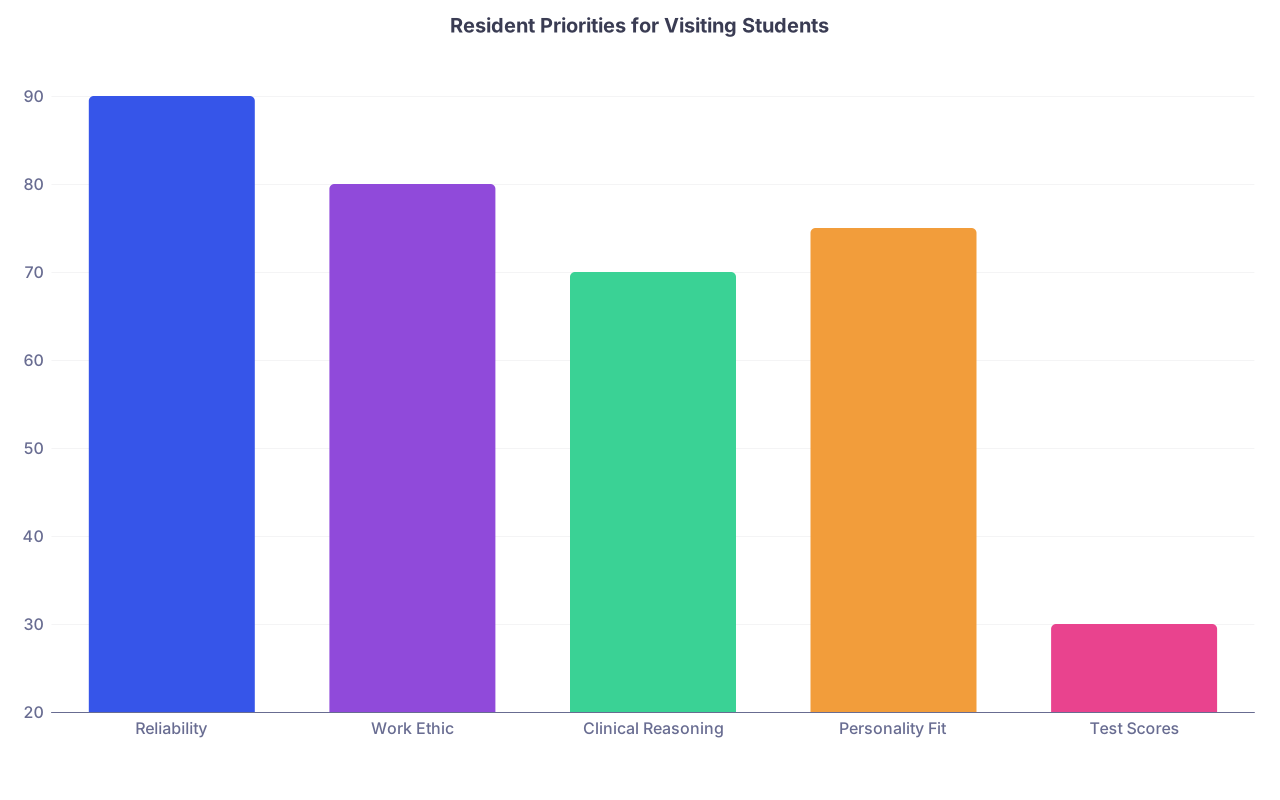
| Category | Value |
|---|---|
| Reliability | 90 |
| Work Ethic | 80 |
| Clinical Reasoning | 70 |
| Personality Fit | 75 |
| Test Scores | 30 |
Step 3: Use Every Patient as an Interview Rehearsal
A last-minute away is basically a month-long, extended interview disguised as a rotation. Every patient is a chance to prove how you think.
3.1 Standardize your presentations
Not fancy. Just consistent and sharp.
Use this mental template for almost every patient:
- One-liner: who they are + what is happening right now
- Brief relevant history (3–5 key points)
- Focused exam (what changes management)
- Problem list (prioritized)
- Assessment and plan for top 2–3 problems
Then add this sentence at the end:
“If this were my patient, I would start with X and Y, and I would watch for Z. Does that seem reasonable? Anything you would add or change?”
Reason:
- You demonstrate independent thought.
- You invite correction without being defensive.
- You practice the way you will have to talk on interview day.
3.2 Build a “story bank” while you work
You need specific cases you can talk about in interviews. Not vague “I love teamwork” fluff.
During the rotation, keep a simple note on your phone titled: “Away Rotation Cases.”
For each memorable patient, jot:
- Patient type: “65-year-old with NSTEMI, language barrier”
- What you did: “Led family conversation with interpreter, clarified code status”
- What you learned: “How to handle relatives disagreeing; managing my own discomfort”
- Takeaway line: “I realized my job is not to win arguments, but to align care with the patient’s values.”
By the end of 4 weeks, you will have 5–10 sharp, usable stories.
These become:
- Interview answers
- Personal statement content
- Talking points with PDs and faculty
Step 4: Make Faculty Remember You Without Being Obnoxious
Programs rank people they remember. Your job is to be memorable for the right reasons.
4.1 Get facetime early, not just in week 4
Do not wait until the last three days to introduce yourself to faculty.
Strategy:
- Identify 2–3 faculty with overlapping interests (education, global health, ICU, etc.).
- After you have worked with them once or twice, ask:
“Dr. [Name], I am really enjoying seeing how you run the team. Would you mind if I set up 10–15 minutes sometime this week to ask you a few questions about your path in [specialty] and how to get the most from this away, especially since I came into the season a bit late?”
Not a generic “can we meet.” It is focused, time-limited, and specific.
- Show up to that meeting with:
- 2–3 real questions (not “what advice do you have”)
- Printed 1-page CV in your bag (only hand it over if they ask or the context fits)
- One case or moment from the rotation you found meaningful
4.2 Ask better questions than other students
Examples of good questions:
- “What distinguishes the residents who thrive here versus those who struggle?”
- “What made you stay here as faculty instead of going elsewhere?”
- “If you were in my shoes—coming into away rotations late—how would you approach interview season?”
Bad questions:
- “How competitive do you think I am?” (They will dodge.)
- “What Step score do I need?” (Also unhelpful.)
- “So, how is the program?” (Vague and lazy.)
4.3 Signal interest in the program without sounding desperate
Once you are sure you genuinely like the place, you can say this to a faculty member or PD near the end:
“I came into this rotation at the last minute, but it has been one of the strongest fits I have seen. The resident culture and teaching style here match exactly what I am looking for, and I would be very interested in training here.”
Direct. Not begging. But they will remember.
Step 5: Turn a Last-Minute Rotation into Actual Interview Capital
This is where most students blow it. They rotate. They leave. They assume “if they liked me, they will remember.”
No. People are busy. You must convert goodwill into something that matters on rank day.
5.1 Secure at least one meaningful letter of recommendation
You want at least:
- 1 letter from this away if things went well
- Preferably from:
- Clerkship director
- Program director
- Core faculty who actually worked with you closely
How to ask (in person if possible):
“Dr. [Name], I have really valued working with you and your team. I am applying in [Specialty] this cycle, and this rotation has been a major part of confirming that. If you feel you know my work well enough to write a strong letter on my behalf, I would be very grateful.”
Key word: strong. It gives them an out if they are lukewarm.
If they say yes:
- Ask what they need: CV, personal statement draft, bullet points
- Send them:
- CV
- ERAS experiences list
- 3–5 bullet points of things you did on the rotation that might help them remember your work
5.2 Understand how much this away will actually move your rank
Honest breakdown:
, Research/Other](https://cdn.residencyadvisor.com/images/articles_svg/chart-relative-impact-of-away-rotation-on-interview-chan-3285.svg "Relative Impact of Away Rotation on Interview Chances")
| Category | Value |
|---|---|
| Performance on Away | 30 |
| Letters from Away | 20 |
| Step Scores | 25 |
| [Home Clinical Grades](https://residencyadvisor.com/resources/best-clerkships-match/how-pds-read-your-clerkship-grades-when-screening-eras-files) | 15 |
| Research/Other | 10 |
For many programs, especially competitive specialties, a strong away can:
- Turn a borderline application into an interview
- Push you up among similar candidates
- Override slightly lower Step 2, if they trust you clinically and personally
Your goal is to check all three of these boxes by the end:
- Someone would vouch for you with “I would be happy to have them as a resident”
- You have at least one strong letter
- You have made your interest known clearly but professionally
Step 6: Handle Being Late in the Season Without Looking Weak
Programs know when you rotated. They are not stupid.
What you need is a clear, confident narrative that makes your timing sound intentional, not desperate.
6.1 Build your “why I rotated late” explanation
You will hear this question in some form:
- “So when did you rotate with us?”
- “Were we your first away or later in the season?”
Your answer needs 2 parts:
- A straightforward reason (schedule/logistics, not drama)
- A positive spin toward them
Examples:
“I had a required sub-I early in the year, so this ended up being my later away. It actually worked out well because I had more experience under my belt coming in, and it confirmed for me that this kind of program structure is what I want.”
“Housing and timing were tricky for me, so I ended up here a bit later. Honestly, I am glad it happened that way—it was one of my last rotations before interviews, and it really sharpened what I am looking for in a program.”
Do not overshare:
No complaining about your school, scheduling office, or other programs.
6.2 Control how your story spreads
Residents talk. PDs listen.
If someone asks casually, “So what made you come here so late?” you say some version of the above. Every time.
You are aiming for:
- Consistency
- Calm
- No victim narrative
Step 7: Convert Rotation Relationships into Interview Advantage
Most students walk away from an away with loose connections. You want functional ones.
7.1 Post-rotation follow-up the right way
Within 3–5 days of finishing:
Email:
- The PD (if you had interaction)
- The clerkship/rotation director
- Any faculty who spent meaningful time teaching you
- At least one senior resident you worked closely with
Template:
Subject: Thank you – [Your Name], Visiting Student
Dear Dr. [Name],
Thank you again for the opportunity to rotate with your team on [service] last month. I appreciated the emphasis on [specific thing: bedside teaching, autonomy in presentations, feedback style, etc.], and working with your residents confirmed that [Program Name] is exactly the type of environment where I hope to train.
I will be applying in [Specialty] this cycle and will be very excited to see [Program Name] on my ERAS list. Thank you again for your time and teaching.
Best regards,
[Name]
[School]
Short. Specific. Signals interest without begging.
7.2 Use your away intelligently during interviews (anywhere)
On the interview trail, you will get:
- “Tell me about a time you worked on a team.”
- “What did you learn from your away rotations?”
- “What kind of program environment fits you best?”
Your away gives you:
- Concrete resident culture examples (“At [Program], seniors routinely pulled me aside after cases to debrief, and that kind of feedback culture is what I am looking for.”)
- Real cases that show growth
- Proof that you understand different program structures
Use it.
Step 8: If Things Go Badly – How to Salvage It
Sometimes the away is a disaster. Wrong fit, toxic attending, you froze on a key day. That does not mean the interview is dead everywhere.
8.1 Identify what actually went wrong
Do not catastrophize. Ask yourself:
- Was the problem:
- A single interaction?
- A systemic issue with the team?
- My performance (knowledge, work ethic, attitude)?
If you trust one resident or faculty, you can ask privately:
“I would really appreciate honest feedback. Are there specific things I did this month that you think might hold me back as an intern if I do not address them?”
Then shut up and listen. Do not defend. Do not explain.
8.2 Decide whether to seek a letter or not
If the rotation was truly bad:
- Do NOT ask for a letter “just to have one” from there
- A lukewarm or negative letter can hurt you far more than no letter
Instead:
- Double down on strong letters from home or other rotations
- Use what you learned to improve before interviews
8.3 Reframe the experience on the trail
If you are asked about challenges:
- Use this away rotation as a “what I learned” story, not a trauma dump
Example:
“On one of my away rotations, I struggled at first with the pace and expectations on rounds. I received very direct feedback that my plans were not specific enough, and that I needed to anticipate next steps. I spent the next two weeks focusing on pre-rounding more thoroughly and thinking several steps ahead. By the end of the month, the same attending commented that my plans had become much more focused and actionable. It taught me to respond to critical feedback quickly and specifically, which I expect will be essential as an intern.”
You turn a bad month into evidence that you can self-correct. That is interview gold.
Step 9: Build a Simple Weekly System During the Rotation
Last thing. You do not need a perfect productivity setup. You need a minimal, repeatable system.
9.1 Weekly check-in (15 minutes, same time every week)
Once a week, ideally Saturday or Sunday, ask yourself:
- “Who knows my work well this week?”
- “Who have I impressed? Who have I annoyed?”
- “What feedback did I get, explicitly or implicitly?”
- “What is one specific behavior I will change next week?”
Write answers in a note on your phone. That is it.

| Step | Description |
|---|---|
| Step 1 | End of Week |
| Step 2 | Reflect: Who saw my work? |
| Step 3 | Identify Feedback |
| Step 4 | Choose 1 Behavior to Improve |
| Step 5 | Implement Next Week |
9.2 Daily micro-goals
On your walk into the hospital, pick ONE micro-goal for that day:
- “Today I will present every patient with a clear assessment and plan.”
- “Today I will write down every question I cannot answer and look up 3 of them.”
- “Today I will help the intern with discharge summaries.”
Micro-goals keep you improving without burning out.
The Bottom Line
A last‑minute away rotation is not ideal. But it is not a death sentence for your match chances. I have seen students who scrambled into late away spots end up in their top-choice programs, while others with early, perfectly planned rotations faded into the background.
Your advantage will not come from timing. It will come from:
- Being relentlessly reliable in week 1
- Using every patient as a rehearsal for interview-style reasoning
- Making faculty and residents remember you for specific, positive things
- Converting that goodwill into letters and clear signals of interest
Do that, and a “last-minute away” becomes less of a scramble and more of a weapon.
Here is your next concrete step:
Open your calendar right now and block off 60 minutes in the next 48 hours labeled “Away Prep – Program Deep Dive + 2-3 Sentence Pitch.” During that hour, research your program, write your personal summary, and decide exactly how you will introduce yourself on day 1. That single hour will change the entire tone of your rotation.