
The way most students ask for clerkship feedback is useless for letters of recommendation. You are probably doing it wrong.
“Any feedback for me?”
“Just keep reading and seeing patients, you’re doing great.”
That exchange helps exactly no one. It does not improve your performance, and it definitely does not give the attending anything specific to write in a strong LOR.
You want feedback that:
- Actually changes how you work on the floor, and
- Translates directly into concrete, positive phrases in your letters.
You get that by being targeted, structured, and a little shamelessly direct.
Let me walk you through a system that works.
The Real Goal: Feedback That Becomes LOR Content
Stop thinking of “feedback” as warm fuzzy comments about your growth. You are in the residency application phase. Feedback is raw material for:
- Your LORs
- Your MSPE comments
- Your ERAS experiences descriptions
- Your interview stories
So the question is not “How do I get more feedback?”
The question is “How do I engineer my clerkships so attendings have specific, high-yield things to say about me?”
Good letters contain:
- Clear behaviors (“presented 4–5 patients independently on rounds”)
- Comparisons (“top 10% of students I’ve worked with”)
- Growth arcs (“came in quiet, finished the rotation leading sign-out”)
- Specialty-aligned traits (surgery: work ethic, resilience; peds: communication with families, patience, etc.)
Your job: repeatedly nudge attendings toward seeing and articulating these things. That starts long before you ever say “Can I have some feedback?”
Step 1: Decide What You Want Your Letters To Say
If you do not know what kind of resident you are trying to look like on paper, you will get vague, generic letters.
Start with your target specialty. Then work backward.
| Specialty | Core Traits to Highlight |
|---|---|
| Internal Med | Clinical reasoning, ownership |
| General Surg | Work ethic, grit, technical interest |
| Pediatrics | Communication, empathy, patience |
| EM | Poise under pressure, efficiency |
| Psychiatry | Listening, insight, alliance |
You should have 3–5 “headline traits” you want to be known for. For example:
Applying to IM:
- Takes ownership of patients
- Strong clinical reasoning
- Reliable, anticipates team needs
Applying to EM:
- Efficient, handles multiple patients
- Calm under pressure
- Strong communication with nurses and consultants
Once you pick your traits, translate them into observable behaviors.
Example – “Ownership” becomes:
- Calls patient’s family with updates (with permission)
- Checks labs before rounds without being asked
- Follows up on consult recs and updates the team
Write these down somewhere (I like a note on your phone labeled “LOR storyline”). Because these are what you will ask for feedback on.
Step 2: Set Up the Rotation for Feedback From Day 1
Most students wait until week 3–4 to think about feedback. That is late. You want to front-load expectations and plant seeds.
Day 1 Script: The 60-Second Setup
You will say some version of this to your attending or senior early in the first week:
“I am planning to apply to [SPECIALTY], and I am working on improving a few specific things this year:
- [Trait/skill #1],
- [Trait/skill #2].
If you notice anything I could adjust in those areas as we work together, I would really appreciate any concrete feedback, even if it is brief.”
That does three things:
- Signals seriousness without sounding needy
- Gives them a lens to view you through
- Makes it easier for them to give specific feedback later (“You asked about X, here is something I noticed…”)
You have just turned “random rotation” into “data collection for residency narrative.” Good.
Step 3: Ask for Micro-Feedback, Not End-of-Rotation Sermons
The worst time to ask for feedback is the last day when the eval is already submitted. The second worst is mid-rotation with a vague “How am I doing?”
You want micro-feedback tied to specific tasks, early and often.
Good vs Bad Questions
Bad:
- “Do you have any feedback for me?”
- “How am I doing overall?”
Good:
- “Could you give me one thing to tighten up in how I present new patients?”
- “When I explained the plan to that family, was there anything I could have done differently?”
- “I’m working on being more efficient on prerounds. Anything you see that is slowing me down?”
The formula is:
Task + Goal + One Small Ask
Examples:
- “For the last two days I’ve been trying to make my assessments more problem-based. After this next patient, can you give me one suggestion on how to sharpen that?”
- “I’m focusing on being clear and concise during sign-out. Could you tell me one thing to cut or add after you hear me tonight?”
You are showing:
- Intentionality
- Ability to receive criticism
- Growth mindset (the real kind, not the buzzword kind)
These same themes show up beautifully in letters.
Step 4: Use the “Feedback Sandwich” Fix That Actually Works
The classic “compliment–criticism–compliment” thing is overused and fake. Ignore that.
Instead, train your attendings to give you PPP Feedback:
- Positive: What to keep doing
- Problem: What is not working
- Plan: What to try next
You can prompt it yourself:
“On my H&P for that new admit, could you give me:
- one thing I did better compared to earlier in the week,
- one thing that still needs work, and
- one specific thing I should do differently next time?”
Concrete. Bounded. Easy to answer.
When they give you that feedback, do not argue. Do not explain. Do not tell them how tired you are. You write it down, thank them, and then actually implement it within 24–48 hours.
Later, you can circle back:
“You had mentioned earlier that my plan sections were too long. I’ve been trying to tighten them. Has that been better the last couple of days?”
Now they see:
- Responsiveness to feedback
- Visible improvement
- A clear “before and after” arc
That “arc” is letter gold. Expect sentences like “They actively sought feedback and made rapid, noticeable improvements in their presentations over the course of the rotation.”
Step 5: Engineer Moments They Can Write About
Letters need stories, not vibes. You want attendings to remember specific instances that illustrate your traits.
This is where you get proactive. You look for opportunities and then connect them to your feedback goals.
Examples of “Letter-Worthy” Moments
- You volunteered to call a difficult family and de-escalated a tense situation
- You caught an important lab or imaging result early and advocated for a plan change
- You stayed late to help a cross-cover resident stabilize a crashing patient
- You took initiative to start a simple QI project or patient-education handout on the rotation
When something like that happens, you do not just let it disappear.
The next day, you ask targeted feedback:
“Yesterday when I updated that family about the new diagnosis, I was trying to be honest without overwhelming them. How do you think that conversation went, and what would you have done differently in my place?”
or
“Last night when we admitted that septic patient, I tried to move quickly through orders. Is there anything you noticed that I should adjust in my approach to sick patients?”
Then, weeks later, that attending is sitting down to write your letter. What comes to mind? Those exact moments and the follow-up conversation.
They remember:
- The situation
- Your behavior
- Your reflection and adjustment
That is the difference between “hard working, team player” and “During a complex admission of a septic patient, they quickly generated an appropriate differential, anticipated necessary orders, and sought feedback the next day about how to optimize their approach to critically ill patients.”
Step 6: Time Your “LOR-Targeted Feedback” Ask
There are three key timing windows:
- Early (Week 1–2): Set expectations and goals
- Mid-Rotation (Week 2–3): Calibrate and adjust
- Pre–LOR Request (Final week or shortly after)
By the final week, you should already know whether this is a realistic LOR writer. Signs they are a good choice:
- You have worked with them enough (at least 2–3 weeks)
- They have seen you handle complex or challenging situations
- They have already given you some concrete feedback
If you are going to ask for a letter, you first ask for global feedback that is LOR-shaped.
Here is how that conversation might go:
“I am applying to [SPECIALTY] this cycle and I have really appreciated your feedback this month. As I wrap up, could you tell me:
- What you see as my biggest strengths as a future [specialty] resident, and
- One or two areas I should focus on improving before residency?”
That does two things immediately:
- Gives you a realistic sense of how they view you
- Gives them language they will reuse in a letter (they often copy-paste their own phrasing mentally)
If their answer sounds generic, lukewarm, or strained, you do not have to ask them for a letter. That is your quiet filter.
Step 7: When You Actually Ask for the Letter
Once you have gotten that end-of-rotation feedback and it sounds strong, you ask for the letter in a way that continues the same theme: targeted, concrete, and easy to execute.
You do not say:
- “Can you write me a strong letter?” and then disappear
You do say something like:
“I am planning to apply in [SPECIALTY] and would be honored if you felt able to write a strong letter of recommendation on my behalf.
I have been working on being [trait 1], [trait 2], and [trait 3] this year. If you feel you can comment on those, I would really appreciate it.”
Then you send a follow-up email that:
- Thanks them
- Reminds them of:
- Your specialty
- Your targeted strengths
- A few specific patient or rotation moments that illustrate those
You are not writing your own letter. You are giving them hooks and memory triggers.
Example follow-up email structure:
- Brief thank you
- One sentence: applying to [specialty], rotation dates
- Bullet list of 3–5 things you worked on (e.g., ownership of patients, communication with families, efficiency in ED)
- 2–3 specific cases or situations they might recall
- Attach CV and personal statement draft if ready
You have now aligned:
- Your feedback conversations
- Your growth arc
- Their eventual letter content
All without being obnoxious.
Step 8: Use Feedback to Tighten Your ERAS Narrative
This is the part most students skip. Big mistake.
The high-yield feedback you receive on clerkships is not just for that rotation. It is ammunition for your ERAS and interviews.
You should be actively tracking:
- Strengths that keep getting mentioned by attendings
- Weaknesses you actually improved over time
- Specific stories that impressed people on the team
I tell students to keep a simple running log. Something like:
| Date | Rotation | Who Gave Feedback | Key Strength | Key Growth Area |
|---|---|---|---|---|
| 6/10 | IM | Dr. Patel | Clear plans | Time management |
| 7/03 | EM | Dr. Rivera | Calm in chaos | Handoffs detail |
| 8/21 | Peds | Dr. Lee | Family communication | Speaking up sooner |
Later, you pull from this for:
- ERAS experiences (“Received consistent feedback on X, improved by doing Y…”)
- Personal statement anecdotes
- Interview answers (“Tell me about a time you received constructive feedback”)
This is how you keep your application coherent. The same traits appear:
- In your own writing
- In your interview narratives
- In your letters and MSPE
Programs notice that consistency. It looks deliberate and mature.
Step 9: Handle Negative or Harsh Feedback Without Imploding
At some point, someone will give you feedback that stings. Maybe they say you seem disorganized. Or not confident. Or too quiet.
This is not a failure. This is a gift, if you handle it correctly.
Do not:
- Argue in the moment
- Make excuses (“I was just post-call…”)
- Visibly sulk or shut down
Do this instead:
Clarify quietly:
- “Can you give me a specific example, so I can understand it better?”
- “What would a more organized student look like in that situation?”
Reflect it back:
- “So I am coming across as [X]. I would like to work on [Y behavior] to change that.”
Follow up later:
- “You mentioned last week that my plans were hard to follow. I have tried to structure them around problem lists this week. Has that been better from your perspective?”
If they see visible improvement, what happens?
They tell residency programs:
“Initially, they struggled with [X], but once we discussed it they made rapid progress. I am confident they will adapt quickly in residency.”
Programs love that sentence. No one believes you are perfect. They care whether you improve when corrected.
Step 10: Adapting the Approach to Different Personalities
Not all attendings are created equal. You will see at least three broad types.
1. The Teacher-Type Attending
They love feedback. They already give it. With them, you can be very direct and frequent.
- Ask for mini-feedback after new tasks
- Ask them openly about residency expectations
- Use them as “practice” for more guarded faculty later
2. The Busy, Detached Attending
They run between OR, clinic, and conference. You barely see them.
- Catch them at predictable times (end of case, after rounds sign-out)
- Keep asks very short: “One quick suggestion on my presentations?”
- If they delegating teaching to residents, ask the resident for micro-feedback, then update the attending:
“I have been working on X after Dr. Resident suggested it; if you notice anything else, please let me know.”
When you ask for a letter from this type, you need to be sure they have truly seen your work. If not, better to choose someone else.
3. The Intimidating or Abrasive Attending
Everyone warns you: “They’re tough.”
Here is the reality: these people sometimes write the best letters, because their praise is rare and taken seriously.
Strategy:
- Ask very pointed, very concrete questions
- Do not be too soft or apologetic
- Respect their time like it is gold
Example:
“Dr. X, I know you are direct so I will be as well. I am applying to [SPECIALTY] and want to work on [trait]. From what you have seen so far, is there anything that would hold me back as an intern, and one thing I could start doing this week to improve it?”
If they give you a harsh critique and you respond by improving, they remember that. If you ever hear that person say you are “solid” or “strong,” that is usually an A+ from them. Letter material.
Step 11: Use Structured Tools When Available (And Hack Them When They Are Not)
Some schools or services give you structured feedback forms (mini-CEX, clinical encounter cards, etc.). Use them strategically:
- Pick forms that emphasize skills you care about (communication, clinical reasoning, etc.)
- Ask attendings to fill them right after a high-yield encounter (family meeting, critical event, teaching moment)
- Collect them and look for repeated phrases – these often show up in MSPEs and LORs
If you do not have official tools, make your own lightweight versions:
- A quick one-page sheet with:
- “Strengths observed today”
- “One thing to improve”
- “Specific situation this refers to”
Hand it to an attending or senior with:
“Could you jot down one strength and one area to improve based on today? I am collecting these to track my growth for residency.”
You are essentially building your own feedback dataset.
Step 12: When You Are Short on Time Left in Clerkships
If you are late M4 or just before application deadlines and realize you have not done any of this, do not panic. You still have moves.
On current rotations, start now with:
- A clear early conversation about goals
- One or two intense weeks of targeted feedback asks
For past attendings who might write letters:
- Email them with:
- Rotation dates
- 2–3 specific patients or experiences you shared
- What you have worked on since that rotation based on their past feedback
- Email them with:
You can say:
“During my rotation on your service in May, you gave me feedback about [X]. Since then, I have been actively working on [Y]. On my recent [rotation], my attending described my [skill] as a strength. I wanted to thank you for starting that process and ask if you would feel comfortable writing a letter of recommendation for my [SPECIALTY] application.”
That closes the loop and reminds them they already participated in your growth story.
Visualizing the Feedback–LOR Pipeline

| Step | Description |
|---|---|
| Step 1 | Define Target Traits |
| Step 2 | Seek Micro-Feedback on Specific Tasks |
| Step 3 | Implement Changes and Show Growth |
| Step 4 | Engineer Memorable Clinical Moments |
| Step 5 | Global Feedback at Rotation End |
| Step 6 | Request Targeted LOR Highlighting Traits |
| Step 7 | Consistent Narrative in ERAS and Interviews |
And one more to show how often you should realistically be asking for micro-feedback:
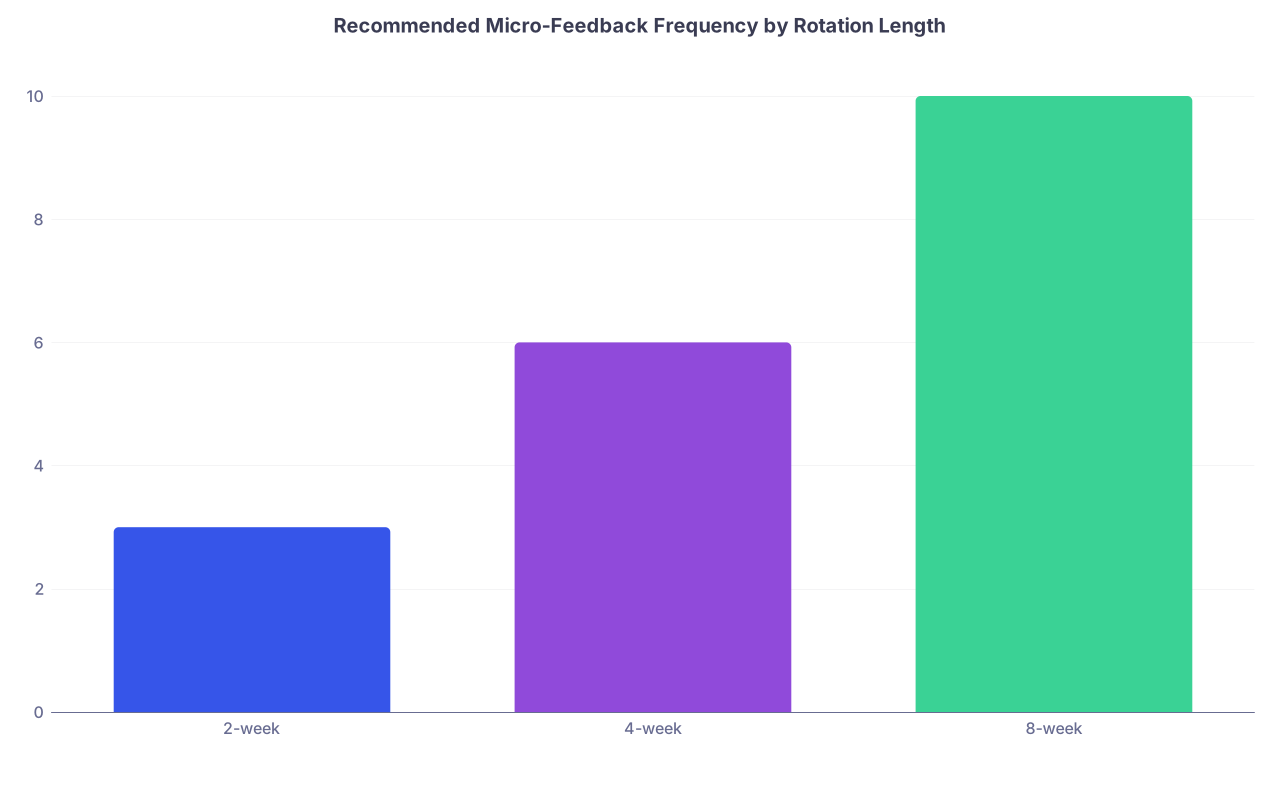
| Category | Value |
|---|---|
| 2-week | 3 |
| 4-week | 6 |
| 8-week | 10 |
Think of those as minimum targets, not maximums.
Three Things To Do On Your Very Next Rotation
Do not overthink this. Implement these three steps on day 1 of your next clerkship:
- Tell one attending or senior what you are trying to get better at for residency (2–3 specific traits).
- Ask for one piece of micro-feedback tied to a concrete task within the first 48 hours.
- Act on that feedback and circle back within a week: “Has this improved from your perspective?”
You will immediately separate yourself from the mass of “Any feedback?” students.
Key Takeaways
- Generic questions get generic feedback and generic letters. Ask focused, behavior-based questions tied to your specialty goals.
- Feedback is not the endpoint; visible improvement is. Attendings write about the arc, not the moment.
- If you engineer specific, memorable clinical moments and then prompt reflection on them, you hand your attendings ready-made material for strong, detailed LORs.