
Using a Research Elective to Patch Gaps in Core Clinical Rotations
It is mid-August of fourth year. ERAS opens in a few weeks.
You are staring at your transcript and your CV, and your stomach drops.
On paper, the problem is obvious:
- A mediocre Internal Medicine clerkship evaluation.
- A “Pass” in Surgery with comments like “quiet on rounds.”
- No strong narrative comments from core rotations that scream “this student will crush residency.”
But what is on your schedule for the fall?
A research elective. Originally chosen because “it will look good” and “I might get a publication.”
Let me be blunt: used passively, a research elective is just a vacation with a PubMed citation.
Used correctly, it is one of the few remaining tools you have to fix weaknesses from third year and upgrade your residency story before programs rank you.
This is how you turn that research elective into a targeted patch for your core clinical gaps.
Step 1: Diagnose Your Real Problem (Not the One You Tell Yourself)
You cannot fix what you will not name. So start there.
Pull up three things right now:
- Your MSPE (or draft)
- Core clerkship evaluations and grades
- The list of programs and specialty you are applying to
Now, identify your actual weaknesses. Not vague “I guess my surgery eval was bad.” I mean concrete, written, and theme-based.
Look for:
- Repeated phrases: “quiet,” “needs to take more ownership,” “could improve efficiency,” “needs to read more,” “requires closer supervision.”
- Missing themes: Nothing about “team leader,” “excellent communication,” “strong clinical reasoning,” “reliable,” “proactive.”
You are looking for patterns that residency program directors will definitely notice.
Common problem profiles I see:
The Quiet Technician
- Technically fine. Shows up on time.
- Comments: “pleasant,” “quiet,” “did what was asked.”
- Gaps: initiative, ownership, leadership, communication.
The Slow Clinician
- Good attitude, but…
- Comments: “needs to improve efficiency,” “slow to develop plans,” “sometimes overwhelmed by volume.”
- Gaps: throughput, prioritization, basic bread-and-butter knowledge.
The Story Problem
- Evaluations from your target specialty are “OK” but not strong.
- Perhaps your best evals are in a different specialty you are not applying to.
- Gaps: evidence that your chosen specialty has really seen you at your best.
The Red Flag Rotation
- One truly bad clerkship: low grade, mediocre narrative, or borderline professionalism comment.
- Gaps: you need a clear, recent counterexample in a similar clinical domain.
Write your profile down in 1–2 sentences. For example:
“I am applying to IM with average IM and Surgery clerkship comments, described as quiet and not very proactive. I need a recent, strong, specialty-aligned evaluation that shows ownership and communication.”
Now we know what the research elective must accomplish.
Step 2: Redesign the Research Elective Around Clinical Repair
Most students treat research electives as:
- “Do data entry.”
- “Maybe write an abstract.”
- “Hope they write me a strong letter because I was ‘hardworking.’”
That is lazy design. You need to treat this like rehab for your clinical reputation.
Your research elective should be engineered with 3 explicit goals:
- Generate a new, high-quality clinical evaluation from a credible attending in or adjacent to your target specialty.
- Create specific evidence that contradicts your core-rotation weaknesses (initiative, communication, ownership, speed, etc.).
- Produce at least one tangible outcome you can mention in your personal statement or interviews (project, abstract, poster, or defined role).
To do that, you need to negotiate the structure of the elective before you start.
A. Choose the Right Research Elective
Not all “research” is equal for this purpose.
Ideal features:
Specialty-aligned
- Applying to IM? Research in cardiology, hospital medicine, oncology, pulm/crit, etc.
- Applying to EM? ED operations, sepsis pathways, imaging utilization.
- Applying to surgery? Outcomes research, quality improvement, perioperative care.
Embedded in a clinical department, not pure bench science in a separate building
- You want your PI/mentor to be a clinician who sees patients and sits on residency committees or knows those who do.
Includes clinical exposure, not just database / bench work
- Chart review with case discussions.
- Clinically focused team meetings.
- Shadowing attached to the project (rounds, clinics, OR).
Red flag elective: “Basic science in a lab with a PhD who does not know what an ERAS letter looks like.” That will not patch clinical gaps.
If your current research elective is badly matched, change it. Even now. Email your dean’s office or clinical education office and ask what clinical research electives are still open in your target department. You do not need 3 months. A 4-week well-structured clinical research elective is enough if used correctly.
B. Have the “Design the Elective” Conversation Before Day 1
You need to talk to your research mentor like a resident would talk to a chief about a remediation plan: directly and with a goal.
Send an email like this:
Dear Dr. X,
I am looking forward to starting the research elective with you in September. I wanted to share my goals so we can structure the elective to be as high-yield as possible.
I am applying to Internal Medicine this cycle. My core Medicine clerkship went fine but my evaluations describe me as somewhat quiet and not always taking full ownership of patients. My main goal for this elective is to demonstrate growth in those areas in a clinical context, in addition to contributing meaningfully to your project.
Would it be possible to:
- Involve me in regular clinical discussions (rounds, case review, or clinic) related to the project, and
- Give me responsibility for a defined component of the project that I can own from start to finish?
I would really value any feedback along the way about how I am doing, both clinically and professionally, so I can improve before residency.
Best regards,
[Your Name]
This does three things:
- Signals that you know your weaknesses and are working on them.
- Gives your mentor a framework to observe and later write about.
- Moves the elective from “random tasks” to “structured, goal-oriented experience.”
If they respond enthusiastically, you are in good shape.
If they dodge or say “we’ll see,” you need to push politely for at least one clinical-connected piece (rounds, clinic, multidisciplinary meetings, etc.).
Step 3: Build Clinical Credibility Inside the Research Elective
You are not on a standard ward team. So you must manufacture situations where your clinical behavior can be seen and evaluated.
Here is the protocol.
1. Attach Yourself to Clinical Context Whenever Possible
Wherever there is a patient, a chart, or a case, insert yourself.
Ask:
- “Can I attend your clinic on days related to this project?”
- “Are there case conferences or tumor boards I can join?”
- “Could I sit in on rounds for patients we are including in the study?”
Then, at those clinical encounters:
- Arrive early. Review the charts of any patients tied to your project.
- Prepare 1–2 succinct points per patient:
- Key problem list.
- One focused question (diagnosis, management, guideline).
- After rounds/clinic, briefly ask, “Can I run a quick assessment and plan on one of the cases we saw to make sure I am thinking like an intern?”
You are trying to show:
- Clinical reasoning.
- Curiosity.
- Ability to integrate evidence and patient care.
Your mentor may not formally evaluate you like a clerkship attending, but these impressions absolutely show up in letters and hallway conversations with PDs.
2. Own a Clear, Bounded Piece of the Project
This is non-negotiable.
You must not be “extra pair of hands did some data.” That is invisible.
Pick something where you are clearly responsible:
- Designing and piloting a data abstraction form.
- Screening all charts and making inclusion/exclusion decisions (with attending oversight).
- Leading a small QI intervention (e.g., implementing a new discharge checklist, creating an order set, building a patient education tool).
Own it from start to near-finish. Then, push for presentation.
For example:
- “Can I present preliminary data at the next division meeting?”
- “Could I summarize our early findings in a short PDF that we might turn into an abstract?”
Why this matters: PDs love phrases like “took ownership,” “drove the project forward,” “worked with minimal supervision after initial guidance.” You need to give your mentor real behaviors to back those phrases.
Step 4: Directly Target the Weaknesses from Your Clerkships
Let’s link typical rotation weaknesses to concrete actions on a research elective.

If your evaluations say “quiet” or “not proactive”
Your job: become the most visible and constructively vocal person on the research team.
Actions:
- Speak up at every weekly meeting at least once:
- Ask one clarifying question about the data.
- Offer one suggestion on workflow or analysis.
- Volunteer for next steps before being assigned:
- “I can draft that email to IT.”
- “I can screen the next 30 patients this week and report back.”
- After shadowing or clinic, summarize your learning:
- “Today I noticed we struggled with X in the workflow. Would it be helpful if I drafted a checklist or template to reduce that?”
Then tell your mentor you are intentionally working on being more proactive. That way, when they see the change, they can contextualize it as growth, not a fluke.
If your evaluations say “slow,” “needs to improve efficiency,” or “overwhelmed”
Use the research environment to train throughput and organization in a lower-risk setting.
Actions:
- Set explicit mini-deadlines with your mentor:
- “I will review 50 charts by Friday with complete data abstraction.”
- “I will have a first draft of the data dictionary by Tuesday.”
- Time yourself doing tasks. Aim to get faster without losing accuracy.
- Ask for feedback on efficiency:
- “On a scale from 1–10, how efficiently am I working on this compared with residents you have worked with?”
- “Where am I losing time or overcomplicating things?”
Document your progress:
- Week 1: It takes you 30 minutes per chart.
- Week 3: You are down to 10–15 minutes.
Then, at the end of the elective, explicitly tell your mentor:
“One of my weaknesses earlier in third year was efficiency. I have worked on that this month by moving from 30 minutes per chart review to 12 while maintaining accuracy (per your review). If you feel comfortable, I would appreciate if you could mention that improvement in any letter you might write.”
You are feeding them ammunition.
If your weakness is specialty-specific (weak IM eval, applying to IM; weak Surgery eval, applying to Surgery)
You need to demonstrate you can thrive under an attending in or adjacent to that specialty doing clinically flavored work.
Actions:
- Make sure your research questions, discussions, and reading are clearly linked to day-to-day clinical decisions in that specialty.
- Ask at least weekly:
- “How would an intern in [specialty] be using this evidence in real-time on rounds?”
- “What are 3 bread-and-butter diagnoses in [specialty] you think I should master now?”
Then structure your work to practice those:
- For IM: case-based chart review focused on heart failure, COPD, pneumonia, diabetes.
- For Surgery: perioperative management, post-op complications, ERAS protocols.
- For EM: triage decisions, imaging utilization, sepsis, chest pain.
You want your mentor to be able to say:
“In the context of this clinical research project, [Name] demonstrated strong internal medicine reasoning and an excellent grasp of bread-and-butter inpatient problems.”
That line directly counters a mediocre clerkship narrative.
Step 5: Engineer a Strong Letter That Actually Patches the Gap
Do not assume a good research experience automatically equals a good letter. I have seen “excellent” students get useless letters that say nothing beyond “helped with data.”
You need to coach the letter indirectly.
A. Ask for the Letter the Right Way
Timing: Ask about 2–3 weeks into the elective if you are doing well, or toward the end if the relationship was slower to develop.
Say this:
“Dr. X, I am applying to [specialty] this cycle. Given the amount of time we have worked together and the responsibilities I have had on this project, would you feel comfortable writing me a strong, clinically oriented letter of recommendation?”
Then add:
“I would especially value anything you can say about how I take ownership, communicate, and apply clinical reasoning, because those are areas I have worked to improve since my core clerkships.”
If they hesitate, do not push. Better a missing letter than a lukewarm one. But most will say yes if you have done the work above.
B. Provide a Short, Targeted Letter-Brief
Do not send a 4-page brag sheet. Send a one-page, tightly focused document that helps them write the letter you need.
Include:
- Your specialty and programs tier range (e.g., “mid-tier academic IM with some university programs”).
- Your known weaknesses and how you have addressed them during this elective.
- 3–5 specific examples from the elective:
- Took ownership of X project component.
- Presented Y at division meeting.
- Improved from slow/insecure to efficient/independent in Z task.
Sample bullet list you might send:
- “Early feedback from core IM: described as quiet, hesitant to volunteer plans. On this elective, I:
- Led weekly summaries of our findings at the research team meeting.
- Independently reviewed and abstracted 180 patient charts with 98% accuracy on random attending audit.
- Presented a 10-minute talk on guideline-based management of heart failure readmissions to the division.
- Developed a discharge checklist based on our findings that is being piloted on the medicine ward.”
You are not writing the letter for them. You are making it hard not to write a strong one.
Step 6: Reframe the Research Elective in Your Application Narrative
The work is not done when the rotation ends. You still have to sell it.
Two places matter most:
- Personal statement
- Interviews
A. Personal Statement: One Targeted Paragraph
Do not make your statement “all about research.” That will backfire unless you are applying physician-scientist.
Instead, use one tight paragraph that shows conscious growth:
“During my core Internal Medicine clerkship, I received feedback that while I worked hard, I often hung back during rounds and did not consistently voice my assessment and plan. I deliberately chose a fourth-year clinical research elective in hospital medicine to address this. Over the month, I took ownership of a chart-review project evaluating readmissions for heart failure, led weekly presentations of our evolving data, and practiced presenting full assessments and plans on the patients we studied. This experience forced me to think like an intern—prioritizing problems, backing my decisions with evidence, and communicating clearly with a multidisciplinary team.”
That paragraph does three things:
- Acknowledges the gap (shows insight).
- Describes specific action (shows agency).
- Connects the research elective to clinical development (not just “publication chasing”).
B. Interviews: Have a Concrete Before/After Story
Program directors love growth arcs.
Prepare a 60–90 second story:
- What the initial problem was (quiet, slow, unsure).
- What you intentionally did during the research elective to address it.
- How you now behave differently in clinical settings.
Example skeleton:
“On my third-year surgery rotation, my feedback was that I was too passive on rounds. I knew that would not fly as an intern. During my fourth-year clinical research elective in trauma, I made it a goal to speak up with a full assessment and plan on at least one patient at every meeting and conference. My attending and I built this into the elective; he would cold-call me on patients in our registry and ask me how I would manage them on the trauma service. Initially, I stumbled. By the end of the month, I was consistently presenting organized plans and adjusting them based on feedback. That practice carried over to my sub-I, where my team commented that I drove discussions instead of waiting to be asked.”
That is how you convert a weak clerkship into a story of growth instead of a silent liability.
Step 7: Use the Elective to Generate Tangible Output (Even if Small)
Programs like deliverables. Presentations, posters, even internal talks signal follow-through.
You do not need a first-author NEJM paper by September. That is fantasy. You need something to point to.
Realistic, high-yield outputs from a 4–8 week elective:
- Internal medicine residents’ noon-conference talk
- Division meeting research-in-progress presentation
- Abstract submitted to a regional meeting (ACP chapter, SGIM regional, specialty organization)
- Small QI project with a pre/post metric
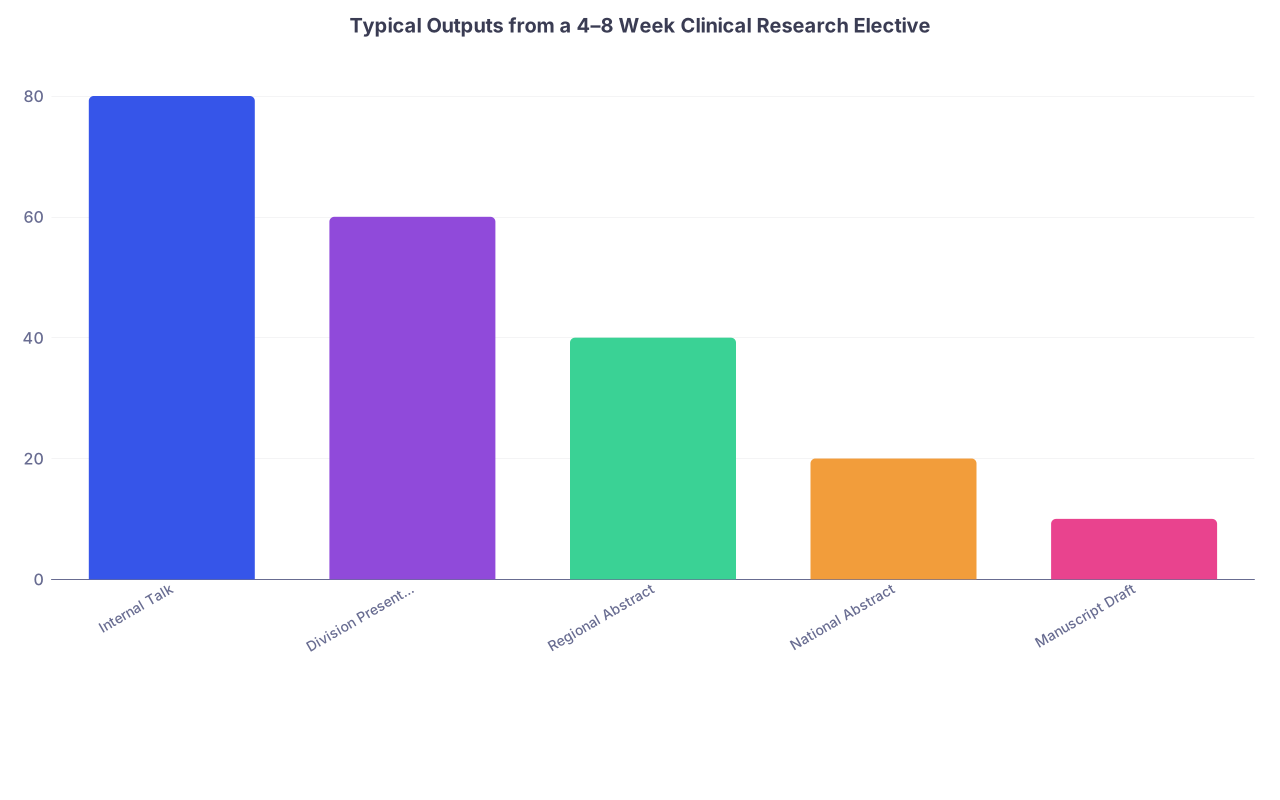
| Category | Value |
|---|---|
| Internal Talk | 80 |
| Division Presentation | 60 |
| Regional Abstract | 40 |
| National Abstract | 20 |
| Manuscript Draft | 10 |
Even an internal talk can be framed in ERAS under “Presentations” and discussed in interviews:
“During my research elective, I gave a 15-minute talk at our hospital medicine conference on our early data about readmissions and how it might change our discharge process for patients with heart failure.”
Concrete. Verifiable. Demonstrates initiative and communication.
How This Plays in Program Directors’ Heads
Let me translate this into the mental calculus of a PD scanning your file.
Baseline worry from your core clerkships:
- “Quiet, maybe not ready to act like an intern.”
- “Middling IM eval, nothing standout, not sure they can handle my service.”
Then they see:
A recent, specialty-aligned letter describing you as:
- Proactive
- Taking ownership
- Communicating effectively
- Thinking like an intern
A personal statement acknowledging earlier passivity and describing deliberate work to fix it.
A research entry that actually looks clinical:
- “Clinical outcomes in heart failure readmissions; 4th-year student responsible for chart review, data abstraction, and presenting findings at division meeting.”
Stronger performance on a sub-I (ideally) that matches the research-letter narrative.
Their internal dialogue shifts from:
“I am not sure this student is ready.”
to:
“They had some typical third-year hesitancy, but they identified it early, got a mentor, and improved. I am less worried now. They are coachable and already thinking like an intern.”
That is all you are aiming for. Not perfection. Plausibility and momentum.
A Quick Comparison: Passive vs Engineered Research Elective
| Feature | Passive Elective | Engineered Elective |
|---|---|---|
| Role definition | “Help with data when needed” | Clear, owned project component |
| Clinical exposure | None or casual shadowing | Regular clinics/rounds/conferences linked to project |
| Feedback | Rare, unstructured | Requested weekly, targeted to known weaknesses |
| Letter content | “Worked hard, helped with project” | “Took ownership, improved X, strong clinical skills” |
| Impact on clerkship weaknesses | Minimal | Directly addresses and counters prior gaps |
| Talking points for interviews | “I did research in X” | Specific growth story and clinical application |
Your job is to move yourself firmly into column two.
Bringing It All Together
You are not going to rewrite your entire clinical history in one research elective. But you can do three very practical things:
- Generate one excellent, recent, specialty-aligned evaluation that shows you at your best.
- Create a coherent growth narrative around known weaknesses from core rotations.
- Produce tangible outputs that signal initiative and follow-through.
That is what “using a research elective to patch gaps in core clinical rotations” actually looks like.
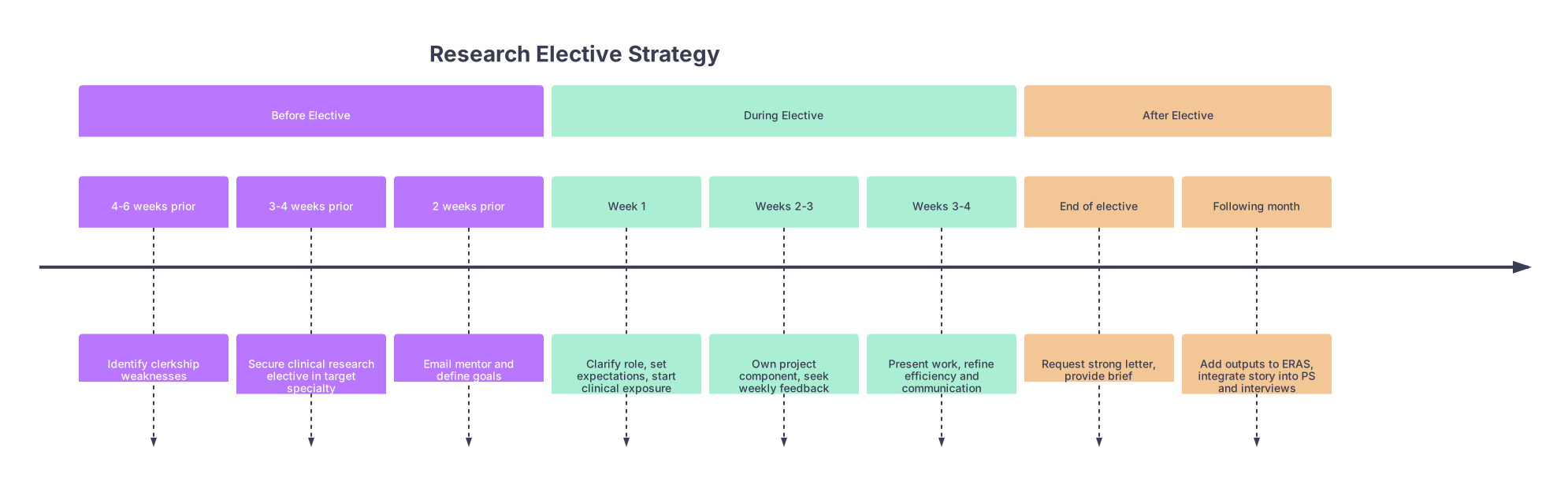
| Period | Event |
|---|---|
| Before Elective - 4-6 weeks prior | Identify clerkship weaknesses |
| Before Elective - 3-4 weeks prior | Secure clinical research elective in target specialty |
| Before Elective - 2 weeks prior | Email mentor and define goals |
| During Elective - Week 1 | Clarify role, set expectations, start clinical exposure |
| During Elective - Weeks 2-3 | Own project component, seek weekly feedback |
| During Elective - Weeks 3-4 | Present work, refine efficiency and communication |
| After Elective - End of elective | Request strong letter, provide brief |
| After Elective - Following month | Add outputs to ERAS, integrate story into PS and interviews |

Your Next Step Today
Do one concrete thing now:
Open your last two core rotation evaluations and write down the exact phrases that could make a PD hesitate.
Then draft a 5–6 sentence email to your upcoming or current research mentor that:
- Names those weaknesses.
- States explicitly that you want to use the elective to improve them.
- Asks to build clinical exposure and a clear owned role into the elective.
Send that email. Today.
That one message is the pivot between a wasted “research month” and an actual repair plan for your residency application.