
Low Shelf Scores but Strong Clinical Skills: Positioning Strategy
Low shelf scores are not a death sentence. Failing to use your clinical strengths to neutralize them is.
I have seen students with mediocre shelves match dermatology because their clinical performance and strategy were excellent. I have also watched students with the same score profile sink themselves by pretending the numbers did not matter. Same scores. Different positioning.
You are not trying to hide your shelf performance. You are trying to make it one part of a much bigger, more compelling story: “I am a high-functioning, clinically strong, team-oriented resident you want on your service.”
Here is how to do that step by step.
Step 1: Get Clear on What You Are Really Up Against
Programs do not care about shelves in isolation. They care about what your evaluation package, as a whole, predicts about you as a resident.
For most core clerkships you have 3 major buckets of evaluation:
- Clinical performance
- Ward evaluations
- Narrative comments
- Final clerkship grade (often heavily clinical-weighted)
- Objective exams
- NBME shelf scores
- Sometimes in-house exams
- Global signals
- Step 2 CK score
- Class rank / quartile (if reported)
- AOA / Gold Humanism (if applicable)
Your problem is not “low shelves.” Your problem is:
“Does my record raise questions about my fund of knowledge or reliability under testing pressure?”
You respond to that in one of three ways:
- Overwhelm the concern with:
- Strong Step 2
- Excellent clinical evaluations
- Stellar letters
- Reframe the concern:
- Show trajectory (scores improving)
- Explain specific obstacles (briefly, professionally)
- Compartmentalize the concern:
- Keep it limited to one or two rotations
- Avoid a pattern of weak performance across everything
Start by mapping your actual situation.
| Area | Status (Example) |
|---|---|
| Shelf scores (overall) | Mostly 20–40th percentile |
| Clinical evals | Consistently excellent |
| Step 1 | Pass |
| Step 2 CK (current/plan) | Not taken / target 245+ |
| Letters of rec | 1 strong, 2 average |
| Target specialty | Internal Medicine |
Be honest with yourself on that table. No one else will see it, but your entire strategy depends on it.
Step 2: Decide Your Core Narrative and Stick to It
You need a simple, repeatable narrative that every part of your application reinforces. If you do not own your story, programs will write one for you: “smart but lazy”, “good talker but weak knowledge”, “not serious about academics.”
With low shelves but strong clinical skills, your core narrative should be something like:
“I am a strong clinical performer whose hands-on work, judgment, and reliability on the wards consistently exceeded what my early test scores predicted. I recognized that discrepancy, corrected it, and now my trajectory and Step 2 reflect where I actually operate.”
Notice what that does:
- Admits there was a signal (lower shelves).
- Puts them explicitly in the past.
- Points to improvement and alignment between scores and performance.
You will push this narrative into:
- How you behave on rotations now
- Who you pick for letters
- What goes into your MSPE (Dean’s letter) and any addendum
- Your personal statement
- Your Step 2 timing and score
If your shelves were low across the board but you improved over time, your modified narrative might be:
“I had a slower start adapting to NBME-style exams in clerkships, but my clinical performance was strong from the beginning. I built a deliberate system to close that gap, which is why my later shelves and Step 2 CK are significantly stronger.”
Key point: your story is “gap identified, gap addressed, gap closed.” Not “tests are dumb, I am a hands-on learner.”
Step 3: Use Clerkships as Live Auditions, Not Just Rotations
Your clinical strengths only help if the right people notice and document them.
You are in the category: “Sell your strengths through humans, not through numbers.” That means:
On Every Rotation, Do These 6 Things
Front-load effort in Week 1–2.
- Residents and attendings form an impression fast.
- Show up early, know your patients cold, volunteer for tasks.
- Make it very obvious that you are the diligent, reliable one.
Ask explicitly for growth-focused feedback.
- “Dr. Rivera, I am really trying to become excellent at XYZ. What is one specific thing I can do better this week?”
- Then actually do it. People remember students who change in response to feedback.
Be the communication hub.
- Confirm orders were placed.
- Update families when appropriate.
- Close loops: “The CT is scheduled for 3 pm; I will re-examine him afterward and update the note.”
- Residents will write “excellent team player” without thinking twice.
Own one or two things clinically.
- On medicine: become the “electrolytes” person or the “heart failure” person for your patients.
- On surgery: wound care, pre-op workup, or post-op orders (within your role).
- Depth on a few topics beats superficial knowledge of everything.
Protect your reputation during downtime.
- Do not complain on rounds.
- Put your phone away. Especially when someone is teaching.
- If you must leave early to study, be transparent: “Resident X, is there any work I can help with before I go study for the shelf for a few hours?”
Tell them you value clinical growth more than scores, but you are working on both.
- “I care a lot about being clinically strong; I am also working hard to make sure my test scores reflect that.”
You want your eval comments to read like this:
- “Best student we have had this year.”
- “Functioned at the level of an intern.”
- “Patients and staff loved working with her.”
- “Showed significant growth in knowledge and independence.”
That language is powerful ammunition against modest shelf scores.
Step 4: Engineer Letter Writers Who Can Cover Your Weak Spot
Letters of recommendation are the single best way to reframe low shelves.
Your ideal letter from a core clerkship faculty should contain, in some form:
- Strong endorsement:
- “I recommend him without hesitation for residency in X.”
- Concrete examples of clinical excellence:
- “He picked up subtle findings, anticipated problems, and was proactive with patient care.”
- Explicit comparison:
- “Among the top 10% of students I have worked with in the last 5 years.”
- Acknowledgment and reframing of test performance (if appropriate):
- “While his shelf exams were not the highest in his cohort, his clinical reasoning and day-to-day performance were outstanding and more predictive of his future success as a resident.”
How to get that:
- Choose letter writers who actually saw you work. A famous name who barely remembers you is almost always worse than a mid-level faculty who watched you grind for 4 weeks.
- Ask strategically. Do not say, “Can you write me a letter?” Say:
- “Dr. Lee, I am applying to family medicine. My clinical strengths have been a major part of my growth in medical school, and I know my shelf scores do not fully reflect that. Based on our rotation together, would you feel comfortable writing me a strong letter that speaks to my work ethic, clinical judgment, and growth?”
- If they hesitate, thank them and do not use them. Weak letters kill borderline files.
Step 5: Use Step 2 CK as Your Counterpunch
If your shelves were weak, Step 2 CK is not optional. It is your fix.
You want your Step 2 CK story to be:
- Higher than your shelves would predict.
- Taken early enough to appear on your ERAS (unless you have a very specific strategic reason not to).
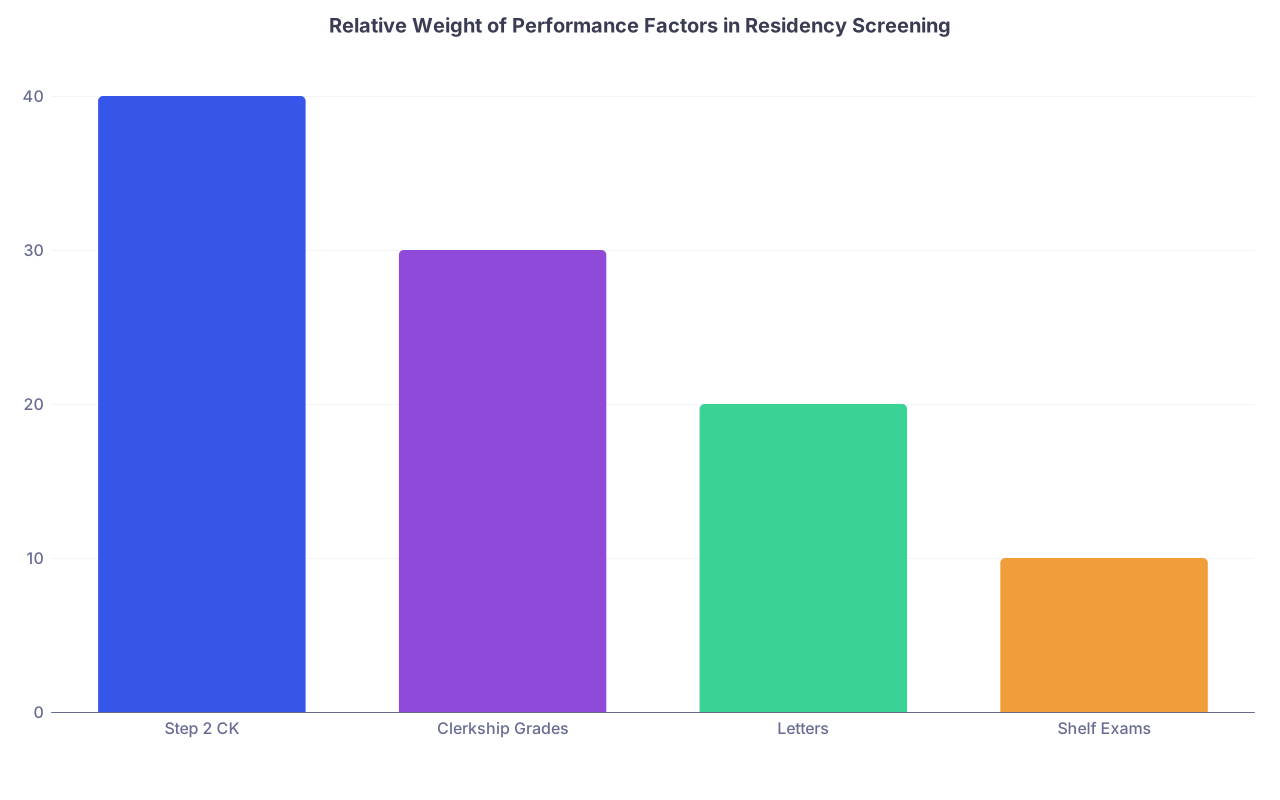
| Category | Value |
|---|---|
| Step 2 CK | 40 |
| Clerkship Grades | 30 |
| Letters | 20 |
| Shelf Exams | 10 |
(Those percentages are conceptual, not official, but they reflect how many programs think.)
If You Have Not Taken Step 2 Yet
You must:
Schedule Step 2 before ERAS submission if you realistically can score:
- Competitive fields: at or above your target specialty’s average.
- Less competitive fields: comfortably above 230–240, depending on the year and your school’s context.
Study like your application depends on it. Because it does.
- Treat it as your full-time job for 4–6 weeks minimum if possible.
- Use your shelf weaknesses to guide your Step 2 prep:
- Low surgery/OB shelf → heavy emphasis on those sections in UWorld.
- Pattern of weak pharmacology → Anki or targeted review daily.
Tell your advisors your plan in concrete terms.
- “My shelf scores were mostly in the 20–40th percentile early on, but I have been trending up. I am taking Step 2 on [date] with a target of 245+. I am doing [specific study plan].”
If You Already Took Step 2
Three scenarios:
Step 2 is much stronger than shelves (best case).
- Example: shelves mostly 20–40th percentile, Step 2 = 245.
- Narrative: “My shelves underestimated my knowledge; my Step 2 reflects my true testing performance now that I had time to consolidate material.”
Step 2 roughly matches your shelves.
- Example: shelves 30–50th percentile, Step 2 = 225–230.
- You cannot spin this as “misleading shelves.” You position yourself as:
- Solid, clinically strong, reliable.
- Targeting programs where this is acceptable and clinical letters carry more weight.
- Strategy: More away rotations, stronger in-person auditions, careful program list.
Step 2 is worse than shelves.
- This is more serious. Your clinical strengths need to be spectacular and well-documented.
- You probably need:
- Very realistic specialty choice.
- Heavy reliance on home program support.
- Extra explanation (advisor or MSPE addendum).
Step 6: Frame the Story in Your MSPE, Personal Statement, and Interviews
You do not write your MSPE, but you can influence it indirectly and you fully control your personal statement and interview responses.
MSPE (Dean’s Letter)
Work with your Dean’s office or advisor to:
- Ensure your clerkship comments reflect concrete clinical strengths.
- Where possible, have an advisor include a short, factual explanation of shelves if there was a clear context (illness, family issue, late adaptation) and there is a documented upward trend.
- Avoid long, defensive narratives. Two to three sentences maximum.
Example wording you can suggest to an advisor (they might revise it):
“Early in the clerkship year, [Student]’s performance on shelf exams was below his clinical performance. Recognizing this discrepancy, he worked deliberately with faculty and peers to strengthen his exam strategies, resulting in improved performance on later clerkship exams and Step 2 CK.”
Personal Statement: What You Should and Should Not Do
Do:
- Focus primarily on:
- Why this specialty fits you.
- Concrete clinical experiences that show your strengths.
- How you function in a team, deal with hard situations, grow over time.
Optionally, one brief paragraph can mention your growth if:
- There is a clear upward trajectory.
- Step 2 or later shelves back it up.
Example:
“My early clerkship year was not perfect. I struggled to adapt to NBME-style exams and at times my shelf scores did not match the clinical evaluations I was receiving. I changed my study approach, sought structured feedback from residents, and built a system that integrated my daily clinical work with more active review. The result was a steady improvement in both my exam performance and efficiency on the wards, culminating in a Step 2 CK score that better reflects my current fund of knowledge.”
Do not:
- Complain about exams.
- Blame the system.
- Spend more than 3–4 sentences on this. Your personal statement is not a test-score autopsy.
Interview Strategy: Practice This Answer Now
You will almost certainly get some variant of:
“Can you talk about your clerkship exam performance?”
or
“I notice your shelves were a bit inconsistent. What happened there?”
Your answer should be tight, non-defensive, and structured:
Acknowledge, briefly.
- “Yes, early in third year some of my shelf scores were lower than I would have liked.”
Context, not excuses.
- “I was transitioning from pre-clinical pattern-recognition studying to application-based NBME questions while also learning how to be useful on the wards. I underestimated how different that would be.”
Concrete corrective actions.
- “I built a very specific plan: I switched to daily UWorld questions tied to my patients, reviewed missed questions the same day, and met with faculty and residents to target weak areas.”
Outcome and trajectory.
- “That is why my later shelves and Step 2 are stronger, and why my clinical evaluations remained consistently high. I am now much better at integrating day-to-day clinical work with ongoing knowledge consolidation.”
Link back to residency.
- “That experience made me more intentional about continuous improvement. It is the same mindset I will bring to residency: identify gaps quickly, get feedback early, and close the loop.”
Practice this answer out loud until you can say it without sounding rehearsed or defensive.
Step 7: Use Electives and Sub-I’s to Lock in Your Brand
If your shelves were weaker, your sub-internships (sub-I’s) and audition rotations are not optional extras. They are your primary evidence to programs that you function at or above intern level.
Target:
- At least one sub-I in your chosen specialty at your home institution.
- 1–2 away rotations at realistic programs where you would be happy to match.
On these rotations:
Act like a safe, humble, early intern.
- Own patients end-to-end (within your role).
- Anticipate tasks. Write notes. Call consults with supervision.
- Never fake knowledge. Saying “I do not know, but I will look it up and get back to you” is far better than guessing.
Tell the clerkship director or program director your story succinctly.
- Not on day 1. After you have shown your work.
- “Dr. X, my clinical strengths have always been the best part of my performance. My shelves early in third year were lower than ideal, but I have worked hard to close that gap; I hope my performance here reflects that growth.”
Ask explicitly for feedback mid-rotation.
- “I want to make sure I am performing at or above the level expected for a sub-I. Is there anything specific I need to change in the next two weeks to be there?”
You want the rotation director to feel they are taking almost no risk ranking you highly. That is how you beat your numbers.
Step 8: Build a Program List that Matches Your Actual Profile
Reality check: you can position yourself brilliantly and still miss if you aim only at hyper-competitive programs that lean heavily on Step 2 and shelves.
You need a program list that is:
- Balanced by competitiveness
- Reach, target, and safety programs
- Rich in programs that value clinical strength
- Community programs
- Mid-tier academic centers that know your school and trust its evaluations
- Aligned with your letters
- If your best letter is from a community IM program, strongly consider similar programs elsewhere.
| Program Type | Emphasis on Scores | Emphasis on Clinical/Letters |
|---|---|---|
| Top-tier academic university | Very High | High |
| Mid-tier academic | High | High |
| Community with academic tie | Moderate | Very High |
| Pure community | Moderate-Low | Very High |
You do not avoid academic programs entirely. But you stop pretending you are a lock for the top ten in the country if your numbers do not remotely support that.
Use your Dean’s or specialty advisor’s data:
- Where have students with similar Step 2 and shelf profiles matched in the last 3–5 years?
- Which programs reliably value strong clinical letters over perfect scores?
Base your list on that, not on fantasy.
Step 9: Do Damage Control on Any Truly Low Outliers
If you have:
- A shelf failure
- A remediation
- A leave during clerkships
You cannot bury those. You also do not need to make them the centerpiece of your application.
Protocol:
Talk to your Dean’s office.
- Ask how the failure/remediation will appear in your MSPE.
- Ask whether an addendum or advisor letter is appropriate.
Create a one-paragraph personal explanation (for interviews, not necessarily the personal statement) that hits:
- What happened.
- What you learned.
- What you changed.
- How outcomes since then show that you fixed the problem.
Make sure your narrative is consistent everywhere.
- MSPE language, any addendum, your interview answers should all line up.
What you avoid:
- Blaming others.
- Over-sharing personal details.
- Long, emotional narratives.
Concise. Professional. Growth-focused.
Step 10: Daily Behavior Protocol for the Rest of Clerkships
If you are still in clerkships now and shelves are already mediocre, you do not have the luxury to “wait and see.”
Here is a weekly operating rhythm you can start tomorrow.
Daily (On Rotation)
- Pre-round: know every lab, image, and overnight event for your patients.
- For each patient, identify one learning question and answer it with:
- UptoDate
- A quick guideline review
- A short primary article (even just the abstract)
- Tie that learning directly into your note or your plan.
- Write down 3–5 shelf-style questions per day that your cases raise and drill them that evening.
5 Days per Week (Shelf/Step 2 Prep)
- 20–40 UWorld questions in timed, random blocks.
- Review every missed question:
- Why you missed it (knowledge vs. reasoning vs. carelessness).
- One specific take-away fact or concept you add to your running notes/Anki.
Weekly
- Ask one resident and one attending for specific, behavior-level feedback.
- Adjust at least one thing based on that feedback.
- Track your own progress in a simple doc:
- “This week I improved X; next week I will work on Y.”
You are building a pattern: feedback → change → improvement. Programs love that.
Two Things to Remember
You are not the sum of your shelf scores.
Programs are looking for residents, not test-taking robots. If your clinical skills are genuinely strong and consistently documented, you have leverage. Use it.You must own your weaknesses and your fixes.
Do not hide from the shelves. Acknowledge them, show how you responded, and make it impossible for anyone to doubt how you perform on the wards.
If you commit to that, low shelves become a plot point in your story, not the ending.