You are two rotations into MS3, staring at your evaluations on OASIS or MedHub.
Shelf scores: mediocre.
Comments: “quiet,” “needs to read more,” “solid but not outstanding.”
You can feel the narrative forming in your head: I blew it. My chances at a good residency just took a hit.
Stop that. You are not done. You are at the point where decisions actually matter.
Here is the play: you will not magically “be more confident” or “work harder.” You will use each remaining rotation as a controlled experiment to fix specific problems. Rotation by rotation. Skill by skill. You will build a clear story for programs: I started rough, then figured it out, then took off.
That story matches what PDs actually like: growth, self‑correction, and an upward trend.
Let us build that blueprint.
Step 1: Diagnose Why Your Start Was Rough
Before you start fixing things, you need a brutally honest diagnosis. One evening, no distractions, and you write this down. Not in your head. On paper.
Break it into four buckets:
- Knowledge / Shelf performance
- Clinical skills / “On the wards”
- Professionalism / Work habits
- Communication / Team dynamics
For each bucket, answer these questions in 1–2 sentences:
- What went objectively wrong? (Low shelf score, “disorganized,” “seems disengaged,” etc.)
- What actually caused it? (Not reading, anxiety, sleep, disorganization, poor feedback seeking.)
You will usually find patterns. Examples I see constantly:
- “I never had a reading plan, just random UWorld questions at midnight.”
- “I pre‑rounded slow, so I was always behind and looked scattered.”
- “I avoided asking questions so I would not look dumb; I ended up looking disengaged instead.”
- “I had no script for presentations, so they came out rambling and incomplete.”
Good. You want that level of clarity. Because now you are going to build a rotation‑by‑rotation correction plan around those problems.
Step 2: Understand What Actually Matters for Residency
You are not trying to win MS3 for its own sake. You are trying to rescue and then strengthen your residency application.
Here is what most PDs (and selection committees) actually look at for core clerkships:
| Component | Impact on Application |
|---|---|
| Clerkship grades (esp. core IM, Surgery) | High |
| Narrative evaluations / comments | High |
| Shelf scores | Moderate–High |
| Letters of recommendation | Very High |
| Trend over time (upward vs flat) | High |
Translation:
- One bad rotation is not fatal.
- A downward trend is.
- Flat “meh” performance across the whole year is also a problem.
Your mission:
Turn the rest of MS3 into:
- Consistent Honors or at least HP with strong narrative comments
- Clear upward trajectory: “Started average, then really excelled”
- 1–2 killer letters from key rotations (usually IM, Surgery, or the field you want)
Everything in this blueprint is aimed at those outcomes.
Step 3: Global Fixes Before You Touch the Next Rotation
There are a few system‑level changes that help every single clerkship.
3.1 Build a non‑negotiable weekly schedule
Stop “fitting in” studying around the day. It never works. You schedule it like a procedure.
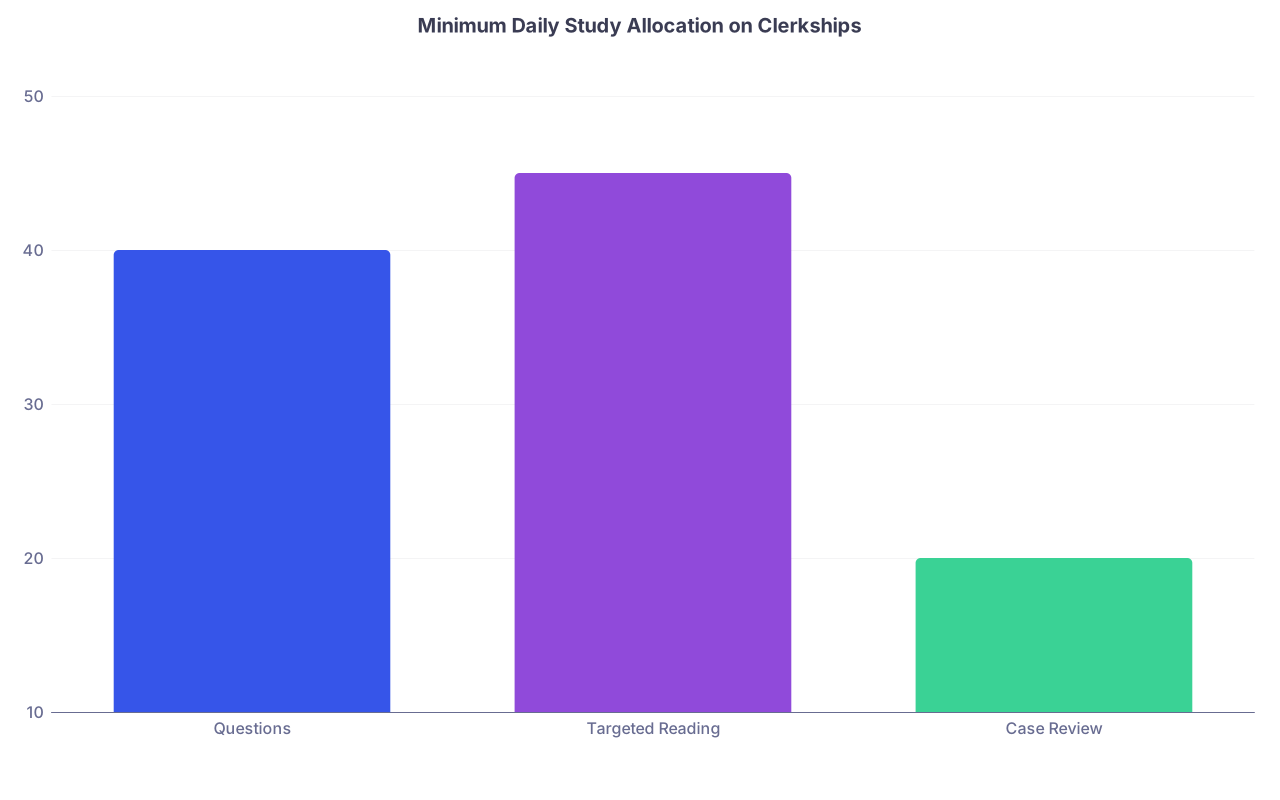
Minimum viable structure for any rotation:
- Daily
- 20–40 questions (UWorld/AMBOSS) tied to that clerkship
- 30–45 minutes reading (textbook chapter or high‑yield review)
- Weekly
- One longer block (2–3 hours) of “deep study” on a day off or lighter day
- Review of missed questions + create a 1‑page fact sheet
Use something like this:
| Category | Value |
|---|---|
| Questions | 40 |
| Targeted Reading | 45 |
| Case Review | 20 |
If you have been under that total, do not act surprised by weak shelf performance.
3.2 Standardize how you prepare for each day
Night before:
- Review your patients: labs, imaging, meds, overnight events.
- Write out bullet‑point versions of your presentations.
- Pick one topic from your patient list to read about for 15–20 minutes.
Example: your patient has GI bleed → “upper vs lower GI bleed initial workup and transfusion thresholds.”
Morning:
- Arrive early enough that pre‑rounding never feels rushed.
- That one change alone makes students look dramatically more competent.
3.3 Fix your presentation template
Stop improvising. Use a rigid template at first.
For SOAP in IM/FM:
- S: One sentence on overnight events + current complaint
- O: Vitals, I/O, exam by system (relevant positives/negatives)
- A: Problem‑based list with brief reasoning
- P: Specific next steps for each problem
For Surgical patients:
- Post‑op day X from Y procedure
- Overnight events (pain, nausea, flatus/BM, drains)
- Vitals trends, I/O, relevant exam (especially wound, drains, abdomen)
- Plan: pain, diet, mobility, DVT prophylaxis, lines/tubes/drains, disposition
Practice out loud at home for 2–3 patients each night. Yes, that sounds tedious. It works.
Step 4: Rotation‑by‑Rotation Comeback Plan
Now the core of this: how to use each major core clerkship as a deliberate step toward a stronger residency application.
I will assume you still have at least IM, Surgery, Ob/Gyn, Psych, Peds, and maybe FM ahead. Adjust as needed.
Internal Medicine: Your Turnaround Anchor
If you had a rough start, IM is where you start rewriting your narrative. PDs read IM comments very closely, even if you are not going into IM.
Your goals on IM:
- Earn at least HP, ideally Honors
- Get one strong letter (if you like IM or just need a solid medicine letter)
- Prove that you can think systematically and own your patients
Specific protocol:
Pre‑rotation homework (1 week before)
- Watch or skim a concise IM clerkship resource (OnlineMedEd videos, etc.).
- Do 20–30 IM questions per day for 5 days. Low stress, just exposure.
- Build a 1–2 page “admission H&P checklist” cheat sheet.
Week 1: Overcorrect on reliability
- Always know your patients cold. Never be surprised by labs you “didn’t see yet.”
- After rounds, ask your senior directly:
“What does an outstanding MS3 look like on your team? What would they do that an average student does not?”
- Write down the answer. Start doing those things immediately.
Week 2: Sharpen clinical reasoning
- For each admission, write a very short problem representation and differential in your notebook:
“65M with hx CAD, DM2 presenting with acute SOB and orthopnea → think CHF exacerbation vs pneumonia vs PE.”
- Then write “Why not” for your top 2 alternative diagnoses.
You will use those lines when attendings ask “What else could this be?”
- For each admission, write a very short problem representation and differential in your notebook:
Week 3–4: Target honors‑level behaviors
- Pre‑chart orders (in your notes, not the EMR) before rounds.
- Volunteer for small ownership tasks: calling family with updates (supervised), tracking down old records, coordinating consults.
- End each week with a 5‑minute feedback conversation:
“I’m aiming to finish this rotation at a higher level than I started the year. Can you share one thing I improved and one thing to focus on next week?”
Collect the comments. You want that “clear improvement over the month” line in your eval.
Surgery: Prove Work Ethic and Grit
Surgery grades and comments signal more than technical interest. They show: can you work hard, stay composed, and be a functional part of a high‑stress team.
Your goals on Surgery:
- Show drastic improvement in professionalism and reliability
- Get at least solid comments like “hard‑working, prepared, pleasant to work with”
- If you want surgery, you need at least one surgeon willing to write for you
Specific protocol:
Prepare the technical basics
- Learn how to tie knots (instrument and two‑hand) before Day 1. Practice with string and a doorknob if you must.
- Memorize sterile technique steps. Watch 2–3 OR etiquette videos and take notes.
Make the mornings boring
- Pre‑round early. These are quick but detail‑heavy.
- Have a mini‑template for common postop checks: pain, nausea, diet, flatus/BM, voiding, ambulation, drains, incision, DVT prophylaxis.
In the OR: upgrade from “extra body” to “asset”
- Before each case, read a ONE‑page summary: indication, key steps, anatomy at risk, common complications.
- Right before the case, ask the resident quietly:
“Anything specific I can focus on or help with during this case?”
- During closure, always be ready to suture if offered. If you are slow, say:
“I am still working on speed, but I would like to try and appreciate any pointers.”
Control your attitude I have seen average students get great surgery evals because they never complained, stayed late without fuss, and were actively helpful.
If your first surgery week is rough, do not disappear. Ask a trusted resident:
“I am trying to improve from a slow start. Can you tell me one thing that would make me more helpful to the team?”
Then implement it the same day. People notice.
Pediatrics: Shine on Communication and Empathy
Peds rewards warmth, patience, and family communication. It is also a good place to create contrast: if your early evals say “quiet,” Peds is where you can flip that.
Your goals on Peds:
- Demonstrate improved bedside manner and clear communication
- Get comments like “excellent with families,” “connects well with patients”
- Build one more data point in your “upward trend” story
Specific protocol:
Standard pediatric exam script
- Have age‑specific checklists: newborn, toddler, school‑age, adolescent.
- Practice explaining what you are doing at the child’s level.
Example: “I’m going to listen to your belly, it might tickle.”
Own family updates (supervised)
- Ask your resident if you can lead a daily family update (then present your plan to the team first).
- Focus on:
- Plain language (“lung infection” instead of “pneumonia” unless they ask)
- Clear next steps (“Today we are watching fever, fluids, and breathing.”)
Shelf prep strategy
- Peds shelves punish vague knowledge. Use a Qbank + one structured resource.
- Aim for:
- 20–30 Peds questions / day
- 1–2 high‑yield topics / day (vaccines schedule, developmental milestones, common infections, asthma, bronchiolitis, dehydration)
You want to leave Peds with narrative proof you can communicate and care for vulnerable patients effectively.
Ob/Gyn: Show You Can Learn Fast and Handle Discomfort
Ob/Gyn compresses a lot: clinic, L&D, OR. Students often look lost. That is an opportunity for you to stand out simply by being prepared and adaptable.
Your goals on Ob/Gyn:
- Demonstrate you can adapt to different clinical environments quickly
- Show maturity around sensitive topics (pregnancy loss, sexual health)
- Build more strong comments on teamwork and professionalism
Specific protocol:
Before the rotation
- Learn a basic prenatal visit flow and common triage complaints: vaginal bleeding, decreased fetal movement, contractions, ruptured membranes.
- Memorize the big red‑flag scenarios: preeclampsia, ectopic pregnancy, postpartum hemorrhage.
On L&D
- Have a mental script for H&P on triage patients.
- Offer to help with simple but time‑consuming tasks: fetal heart tone checks, tracking down labs, coordinating ultrasounds.
For uncomfortable exams (pelvic, breast)
- Watch how attendings explain the exam and consent.
- Practice clear, respectful phrasing:
“This exam helps us figure out why you are having pain/bleeding. I will explain each step before I do anything, and you can tell me to stop at any time.”
Ob/Gyn is a good place to get comments about maturity, professionalism, and patient respect. Those play well in any specialty.
Psychiatry: Repair “Quiet” or “Anxious” Impressions
Psych grades are often narrative‑heavy and highlight interpersonal skills. This is your test‑bed to fix any early comments about being withdrawn, anxious, or overly stiff.
Your goals on Psych:
- Show clear improvement in interviewing and rapport‑building
- Get comments like “developed strong interviewing skills over the rotation”
- Practice presenting complex, nuanced cases succinctly
Specific protocol:
Use a structured interview
- SIGECAPS, psych ROS, safety assessment (SI/HI), substance use, social situation.
- Have a 1–page laminated or pocket card checklist early on. No one will care.
Practice reflective statements
- “It sounds like…”
- “You are telling me…”
- “That must have been very difficult when…”
Those little moves shift you from robotic to human in about a week.
- Presentation approach
- One clear sentence: “This is a 35‑year‑old man with a history of depression presenting with 2 weeks of worsening suicidal ideation in the context of job loss.”
- Then:
- Key symptoms
- Functioning
- Risk assessment
- Differential and why you think top 1–2
Ask your attending after your first week:
“You have seen a lot of students. What would move me from ‘average’ to ‘excellent’ on your rotation over the next couple weeks?”
Take the answer seriously and implement it.
Family Medicine: Show You Can Function Like a Junior Intern
FM often simulates outpatient intern life. It is underrated as a place to prove you can manage time, handle multiple patients, and think broadly.
Your goals on FM:
- Demonstrate clinic efficiency and basic outpatient management
- Get “ready for residency” style comments
- Practice documentation and counseling that you can talk about on interviews
Specific protocol:
Timeboxing patient encounters
- Early weeks: aim for 15–20 minutes per patient.
- Pre‑chart a quick problem list and med review before walking into the room.
Focus on counseling
- Smoking cessation, weight, diabetes control, BP management.
- Develop 2–3 go‑to scripts for each topic.
Ask to practice documentation
- Write full notes (even if not used) and ask the preceptor to skim and give one tip per day.
- Programs love hearing “By the end of FM, I was writing full outpatient notes and managing my own mini‑panel.”
Step 5: Build an Upward Trend Story for Your Application
You are not just trying to “do better.” You are collecting evidence for a narrative you will use in:
- Your personal statement
- Your ERAS experiences descriptions
- Your MSPE (Dean’s letter) conversations
- Interviews
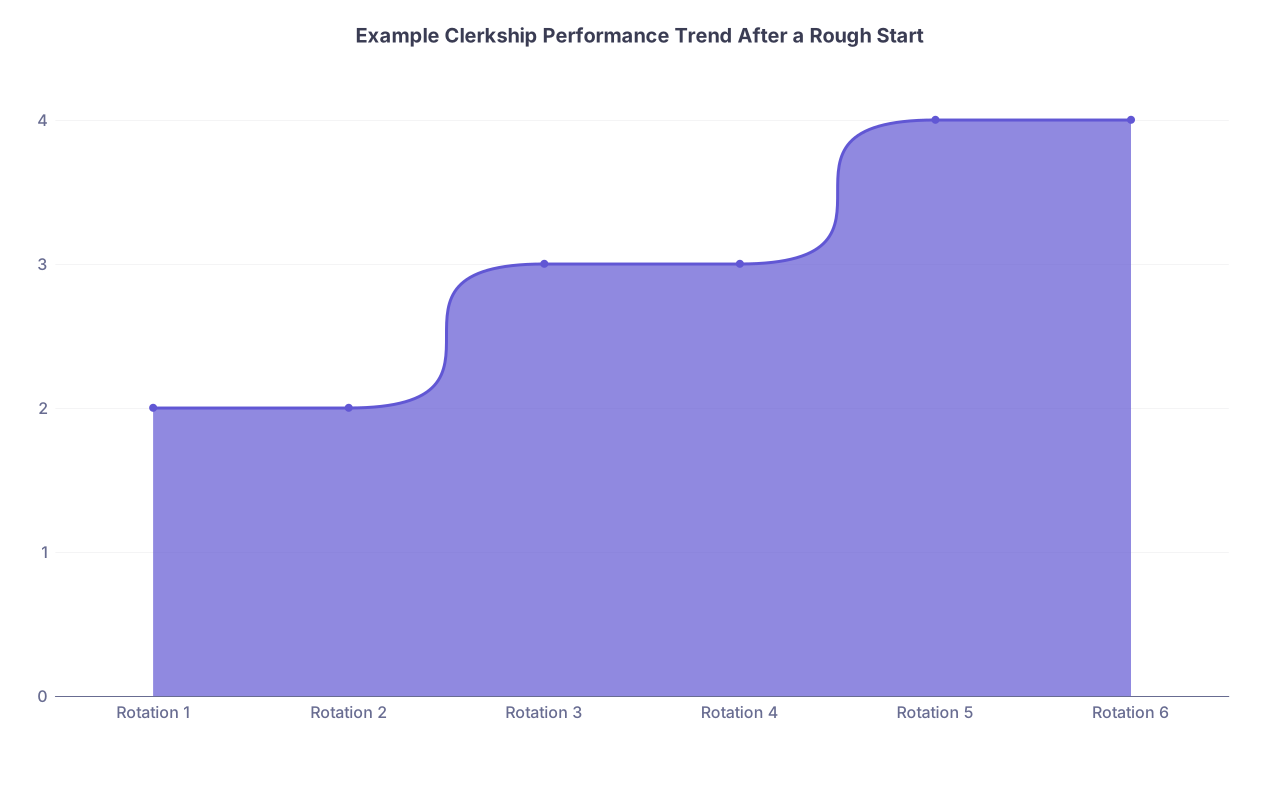
You want your timeline to look like this:
| Category | Value |
|---|---|
| Rotation 1 | 2 |
| Rotation 2 | 2 |
| Rotation 3 | 3 |
| Rotation 4 | 3 |
| Rotation 5 | 4 |
| Rotation 6 | 4 |
(Where 1 = Fail/Low Pass, 2 = Pass, 3 = High Pass, 4 = Honors.)
If your first two rotations are “2, 2,” your job is to stack “3, 3, 4, 4” afterward and make sure comments mention improvement.
Concrete actions to support that story:
Get feedback early and document it
- Each rotation: written list of “Feedback I received” and “What I changed.”
- Keep this in a simple document. You will use specific examples in interviews.
Target 2–3 strong letters strategically
- IM or Surgery (core academic letter)
- Your intended specialty
- A third from where you clearly improved a lot (if relevant)
When asking for letters, frame it:
“I started my clinical year a bit rocky, but rotations like this one have helped me grow a lot. If you feel you can comment on that improvement and on my current level of performance, I would be grateful for a letter.”
You are reminding them to highlight your trajectory, not just static performance.
- Prepare a tight “rough start” narrative for interviews
You do not whine. You do not blame. You do this:
- One sentence: what went wrong
- Two–three sentences: what you did to fix it
- One sentence: where you are now
Example:
“My first clerkship was a rough adjustment. I was disorganized, my studying was unfocused, and it showed in my shelf score and evaluations. I sat down with my advisor, rebuilt my daily schedule, standardized my patient presentations, and started seeking specific weekly feedback. Since then I have honored my last two core rotations, and my comments reflect much stronger clinical reasoning and teamwork. The early stumble ended up forcing me to build systems I plan to carry into residency.”
PDs respect that. It shows insight and work.
Step 6: Protect Your Bandwidth (So You Can Actually Execute)
None of this works if you are half‑burned‑out, sleeping 4 hours a night, and running on caffeine and dread.
Basic but non‑optional:
- Sleep: 6 hours minimum. If you are routinely under that, fix it before you try to do anything fancy.
- Exercise: 2–3 short sessions per week. 20 minutes. I do not care what, as long as it gets your heart rate up.
- Boundaries: you do not need to study 6 hours every post‑call evening. Tight, focused 60–90 minutes beats 4 hours of scrolling between Anki and Instagram.
If you feel yourself slipping into real depression or anxiety, you get help early. Not after you fail a clerkship. Talk to student health, counseling, trusted faculty. I have seen too many students try to “power through” and silently implode.
Step 7: Map the Rest of MS3 and Early MS4
You are not just saving MS3. You are staging MS4 and your application.
Use a simple planning flow like this:

| Step | Description |
|---|---|
| Step 1 | Rough Start MS3 |
| Step 2 | IM: Anchor Turnaround |
| Step 3 | Surgery: Demonstrate Work Ethic |
| Step 4 | Peds/ObGyn/Psych/FM: Round Out Skills |
| Step 5 | Identify Best Letter Writers |
| Step 6 | Schedule MS4 Sub-I/Aways Strategically |
| Step 7 | Craft Upward Trend Narrative |
| Step 8 | Stronger Residency Application |
Concrete map:
- Use IM/Surgery as your anchor rotations for grades + letters.
- Use Peds/Psych/ObGyn/FM to fill in gaps: communication, counseling, outpatient care, team dynamics.
- Aim to finish MS3 with:
- At least a couple Honors and solid HPs
- Strong, specific comments about improvement
- 2–3 identified letter writers
- Then schedule:
- Sub‑I early MS4 in your intended field or IM if undecided.
- Optional away rotation if you are targeting a competitive specialty or geographic shift.
Quick Reality Check
I have seen:
- Students who literally failed their first clerkship match into solid categorical IM, EM, even anesthesia. Because they fixed the process and surged upward.
- Students with straight Passes in the first half of MS3 finish the year with Honors in IM, Surgery, and a sub‑I, then match into competitive fields.
- And students with a rough start who decided it meant they were doomed, coasted at “meh,” and gave PDs no reason to take a chance on them.
You cannot control the past. You can control whether the next rotation is just “another month” or a deliberate step in your comeback story.
FAQs
1. If my first two clerkships were straight Passes, can I still match into a competitive specialty?
Yes, but you do not have margin to stay average. You will likely need:
- An upward trend in clerkship grades (Honors/HP in later cores).
- Excellent letters from your chosen specialty and from IM or Surgery.
- Strong Step 2 score and solid research / extracurriculars.
Your comeback blueprint becomes mandatory, not optional. You use every remaining rotation as a chance to move from “fine” to “clearly stronger than where I started.”
2. When should I ask for letters if my performance early in the rotation was weak?
Ask near the end of the rotation, but only after you have evidence of improvement. In your ask, you can say:
“I know I was slower at the beginning of the rotation, but I have worked hard to improve. If you feel you can comment on my growth over the month and my current performance, I would really appreciate a letter.”
If they hesitate, thank them and ask someone else. A lukewarm letter is worse than no letter.
3. How do I know if I should repeat or remediate a rotation versus just moving on?
If you failed a rotation or the narrative comments are frankly concerning (questions about professionalism, reliability, honesty), you need a serious conversation with your dean or clerkship director. Sometimes:
- A repeat can demonstrate growth if you crush it the second time.
- Other times, the better strategy is to move forward, excel in subsequent rotations, and let the MSPE frame the failure as an early adjustment issue that you corrected.
Do not decide this alone. Bring your evaluations, your exam scores, and your goals to someone who has watched match cycles before. Then commit to the plan and execute.
Key points to carry out of this:
- Diagnose the real causes of your rough start, then fix them systematically with global changes and rotation‑specific protocols.
- Use IM and Surgery as anchor rotations to establish your turnaround, then leverage the rest of MS3 to round out your skills and accumulate strong comments and letters.
- Build and repeatedly reinforce an upward‑trend narrative—supported by actual performance—that you can hand to programs as your comeback story.