
Your entire grade for a month of your life should not depend on one tired resident who barely knows you. But it often feels like it does.
Let me just say the scary part out loud: yes, a resident can absolutely write you a mediocre evaluation after a conflict. It happens. To good students. To “perfect-on-paper” students. Sometimes for reasons that have more to do with the resident’s mood than your performance.
But here’s the part that tends to get lost in the 3 a.m. doom-spiral: a single mediocre eval almost never destroys your career, your clerkship grade, or your chances at residency. It feels catastrophic. It usually isn’t.
Let’s walk through this like two people who are both mildly freaking out but still want the truth.
First: How Bad Is “Mediocre,” Really?
This is where our brains go off the rails. You see “meets expectations” and your mind translates it to “they hate me, I’m doomed, I’ll never match.”
That’s… not how faculty interpret it.
On most clerkship forms, “meets expectations” is literally designed to be average. Not bad. Not great. Just normal, functioning, on-track medical student. The problem is, we’re wired to think if it’s not “outstanding,” it’s basically a failure.
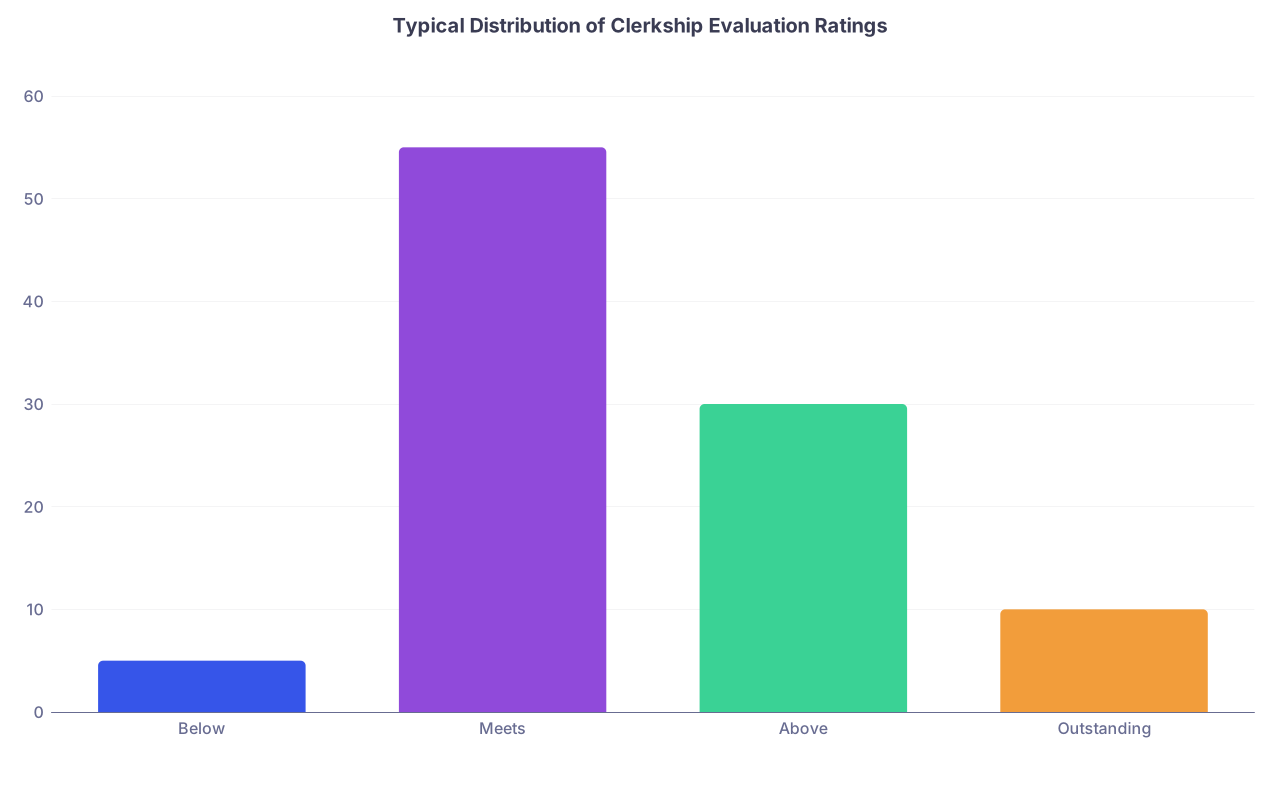
You know what most attendings and program directors are actually used to seeing?
| Category | Value |
|---|---|
| Below | 5 |
| Meets | 55 |
| Above | 30 |
| Outstanding | 10 |
So yes, “meets expectations” is the most common category. It doesn’t jump off the page as “this person is terrible.” It says “this person showed up, did their job, is learning appropriately.”
Where you get into more concerning territory is when there are:
- Multiple “below expectations” boxes checked
- Negative narrative comments (unprofessional, unreliable, unsafe)
- A pattern across multiple rotations, not just one
A single resident giving you “meets expectations” plus some lukewarm comments after a conflict? Annoying. Anxiety-inducing. But probably not fatal.
What Actually Happens After That Evaluation Is Submitted
Here’s where the fear kicks in: “They’re going to show this to every residency program. My career is over.” No. Not how this works.
Most schools have at least a half-decent system to buffer resident bias. Is it perfect? No. Is it usually better than your nightmares suggest? Yes.
Typically, this is the chain:

| Step | Description |
|---|---|
| Step 1 | Resident Submits Eval |
| Step 2 | Clerkship Admin Review |
| Step 3 | Clerkship Director Review |
| Step 4 | Grade Calculation |
| Step 5 | MSPE Compilation |
| Step 6 | Residency Programs Read Summary |
A resident clicks submit. That doesn’t auto-beam your doom directly into ERAS.
Clerkship directors usually look at all evals for a rotation together. They see patterns. They compare your performance across team members. A single resident saying “meh” while an attending says “strong performance” and a nurse notes “great with patients” is weighed accordingly.
A few ways this often plays out in real life:
- The resident writes a short, bland eval. The attending writes a stronger one. The director leans on the attending and other team members.
- The resident dings you on “teamwork” but there’s no narrative comment, no documentation, and no one else mentions it. It becomes background noise.
- If an eval is clearly out of line with others, some directors literally throw it out mentally or discount it heavily.
The only time a mediocre eval really bites is when it’s:
- Consistent with other weak evals
- On a core specialty you’re applying into, and
- Paired with negative narrative comments
Even then, it’s not automatically game-over. It just might require more damage control and better letters elsewhere.
That Conflict With the Resident: How Much Does It Matter?
You probably keep replaying the exact moment: the eye-roll, the curt comment, the time they snapped at you for not pre-charting perfectly or missing some obscure lab.
Here’s the harsh part: from your side, it was a big emotional event. From their side, it might have been one tense moment in a 28-hour call where they were drowning in pages and consults. They may not even remember the details when they fill out your eval. Sometimes they do, sure. But not always.
Most residents write evaluations fast. End of the month. Six students at once. Half on their phone. It’s lazy and imperfect and very, very human.
What that means for you: a conflict increases the chance of a blah evaluation, or them not going out of their way to praise you. It doesn’t automatically mean they sit down thinking, “How can I destroy this student’s life?”
And if they do? That tends to show up as something more dramatic than just “meets expectations.”
Worst-Case Scenario: The Truly Unfair Evaluation
Let’s actually look at the nightmare scenario, because pretending it can’t happen doesn’t help.
Imagine this: you advocated for a patient when your resident seemed dismissive. They took it personally. For the rest of the rotation, they were cold and passive-aggressive. End of the month, you get your eval:
- Multiple “below expectations” checked
- Comments like “defensive when receiving feedback,” “difficulty working with team,” “needs to improve professionalism”
You read it and feel your stomach fall through the floor. Because it doesn’t match how you acted, how nurses treated you, what the attending said, or your evals from every other rotation.
Now what?
This is where you stop thinking like prey and start thinking like a future colleague.
You don’t write a five-paragraph emotional email. You also don’t just silently accept it if it’s truly inaccurate and harmful.
You gather context:
- Compare this eval to others from that rotation
- Look at evals from previous rotations – are they consistently positive?
- Think about whether anything in your behavior could be reasonably seen that way (not to blame yourself, but to be realistic)
If this eval is clearly an outlier, you have more power than you think.
You can:
- Talk to your clerkship director. Calmly. Factually. “This evaluation doesn’t align with feedback I received during the rotation or with my other evaluations. I’m concerned about the impact on my record and want to understand how much weight this carries, and if there’s any way to address potential bias.”
- Describe the conflict if relevant, again calmly. Not “this resident was evil,” but “we had a disagreement about X; I tried to resolve it by Y.”
- Ask if they can:
- Add an addendum
- Seek input from the attending or others
- Clarify context in your file
Some schools will adjust or contextualize. Some won’t. But doing nothing and just quietly panicking helps no one, least of all you.
How Residency Programs Actually Read This Stuff
Here’s the huge disconnect: you read one line in an eval and spiral for weeks. Program directors read 40 MSPEs in a single afternoon and half the language blends together.
They mostly see:
- Final clerkship grades (Honors/High Pass/Pass)
- Narrative summaries in the MSPE (“generally strong student who improved over the course of the year”)
- Big red flags (professionalism issues, patient safety, major concerns)
- Patterns: always “solid,” or improving, or all over the place
They are not combing through every single individual resident comment from third-year psych. That volume of detail would crush them. They skim for signal.
What does stand out?
- Multiple comments across rotations that say the same concerning thing
- A single really concerning comment that’s clearly serious (lying, unsafe practice, anger issues)
- Major inconsistencies between letters and MSPE (“glowing” letter but MSPE calls you chronically late and disengaged? People notice.)
What doesn’t stand out?
- One resident who called you “good” instead of “exceptional”
- One borderline/average eval in a sea of strong ones
- A non-core rotation where you got “meets expectations” on teamwork and the rest are fine

So no, a single mediocre evaluation is not the glowing neon sign your brain thinks it is. It’s more like one pixel in a big, blurry image.
Protecting Yourself Going Forward (Without Becoming Paranoid)
You can’t time-travel and fix that one eval. But you can make it matter less.
Here’s what actually shifts the balance:
You make sure this is the exception, not the rule.
That means:
You lean hard into consistency. Show up early. Volunteer for the unglamorous tasks. Be teachable. You know the drill. Not to please everyone (you can’t), but to make a clear pattern of reliability.
You collect strong letters from people who genuinely know you. Attendings, not just residents. People who saw you on your best days and can write: “She was one of the top students I’ve worked with in the past few years.” That sentence wipes out the power of a random “meets expectations” checkbox.
You learn how to talk about the conflict if it ever comes up. No defensiveness. No bitterness. Something like:
“We had a difference in communication style on that team, and I realized I needed to be more proactive about clarifying expectations early. I’ve been much more intentional about that on later rotations, and the feedback since then has been very positive.”
That sounds mature. Teachable. Human. Program directors are not looking for flawless robots. They’re looking for people who can take a hit, learn, and keep functioning.
| Pattern | Risk for Residency Match |
|---|---|
| One mediocre eval, rest strong | Low |
| Several mediocre evals, no negatives | Moderate |
| Multiple negative evals, same theme | High |
| Documented professionalism concerns | Very High |
You want to live firmly in that first row. One mediocre eval in a pile of strength. That is not a career-ender.
What If This Rotation Is In The Specialty I Want?
This one stings more. You’re applying internal medicine, and the bad eval is from medicine. Or you want OB/GYN and had a conflict on OB/GYN. It feels more personal, more damning.
Reality check:
The rotation grade and eval matter more when it’s your chosen field, yes. But even then, one resident’s opinion is just one data point.
What you do then:
You double down on getting:
- An excellent attending letter in that specialty, from someone who really knows your work
- Good sub-I performance with clear documentation of improvement
- Strong narrative in your MSPE or dean’s letter highlighting your strengths in that field
If your school’s MSPE mentions anything vague like “had an interpersonal conflict on one rotation,” it is much less fatal when followed by: “She demonstrated clear growth in communication and teamwork skills on subsequent sub-internships, where evaluations described her as an integral and reliable team member.”
I’ve seen applicants match into competitive specialties with less-than-perfect evals in that very field because their later performance told a better story.
| Category | Value |
|---|---|
| Letters | 30 |
| Clerkship Grades | 20 |
| Board Scores | 20 |
| Personal Statement | 10 |
| Interviews | 20 |
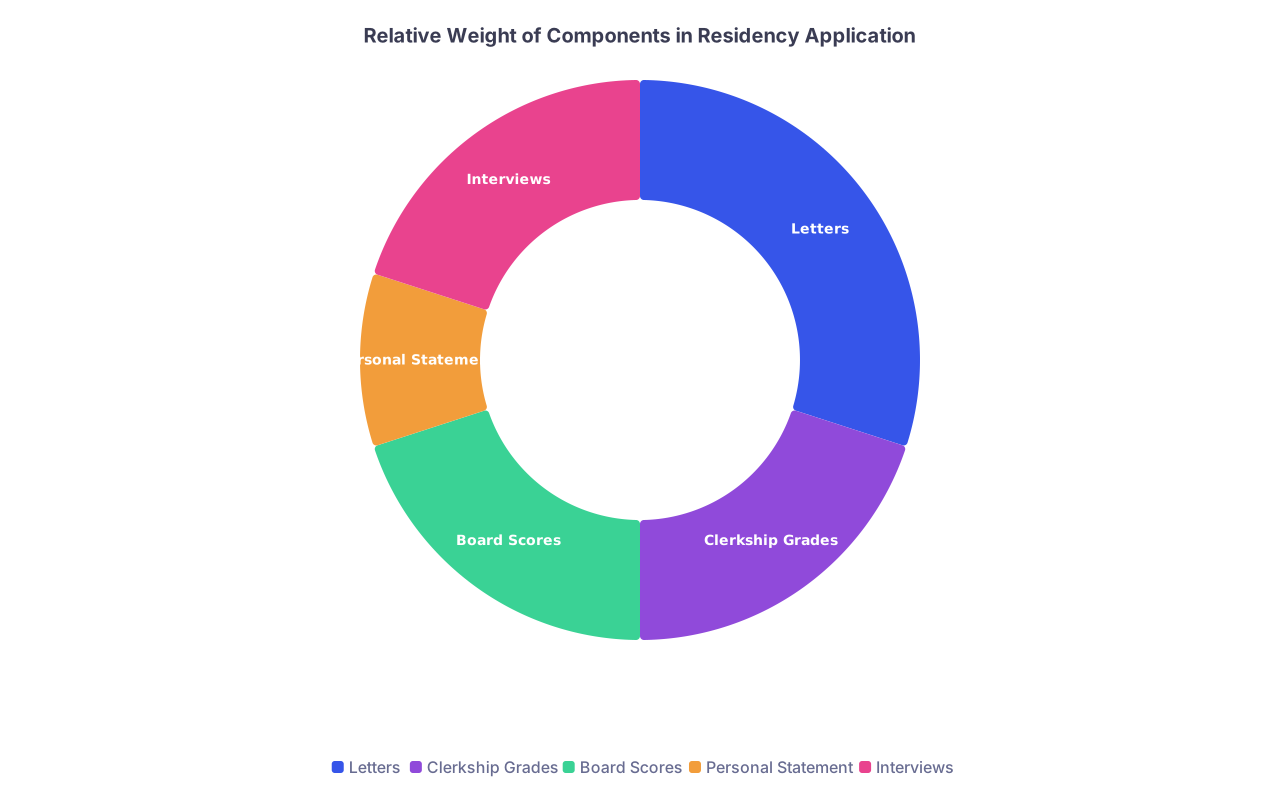
Letters and overall impression matter more than a single datapoint from one resident.
When It Is Worth Losing Sleep (And When It Isn’t)
You can’t avoid worrying. I get that. But you can at least aim your worry at the right targets.
You should take this seriously and seek help if:
- The eval mentions unprofessional behavior, safety issues, or serious interpersonal problems
- This isn’t the first time you’ve gotten feedback like this
- You genuinely don’t understand where the feedback came from
Then you sit down with a trusted advisor, dean, or mentor and dissect it. Painfully. Honestly. That’s how you prevent a pattern.
But if what you’re dealing with is:
- Mostly “meets expectations” boxes
- Vague or generic comments
- One rotation where you didn’t click with the team after a conflict
Then your job is not to obsess over that eval. Your job is to drown it in better data. Better rotations. Better letters. A better pattern.

How to Sleep Tonight (Or At Least Sleep Some)
Let me just answer the question you’re actually asking underneath all this:
“Is this the thing that ruins everything?”
Almost always: no.
It’s usually the thing that:
- Teaches you how fragile these dynamics can feel
- Forces you to be more proactive with feedback
- Motivates you to find mentors who will go to bat for you
- Becomes one line in a story that otherwise says, “solid, capable, improving, human”
You are allowed to be upset. To replay the conflict. To stalk your evaluations portal. That’s kind of the tax we all pay in this process.
But don’t give this one resident more power than they actually have.
Focus on:
- Building a strong, consistent record from here forward
- Getting powerful letters from people who truly know you
- Learning how to talk calmly about any conflict or mediocre eval if asked
- Asking for help if there’s a real pattern or a truly unfair/serious evaluation

If You Remember Nothing Else
One resident’s mediocre evaluation after a conflict does not define your career.
Patterns do. Growth does. Strong letters do.
So let this bother you for a bit. Then make it small by everything you do next.