
It’s late. You’re staring at ERAS, that dumb red exclamation mark next to “Letters of Recommendation,” and your stomach is in your throat.
You’ve got:
- One glowing letter from a subspecialty or elective (Derm, Rheum, Heme/Onc, whatever).
- And then… a pile of “meh” from core rotations. Or worse: attendings who barely know your name, or haven’t answered your email, or said, “Sure, happy to,” three months ago and then disappeared into the void.
And now your brain is doing the full spiral:
“Programs want core letters. Everyone else has 3–4 strong letters from their core clerkships. I only have this one great non‑core letter. Are they going to think I’m weak clinically? That I couldn’t impress anyone on IM or Surgery? Am I about to tank my entire application because of letters?”
Let’s walk through this without pretending everything is perfect, but also without catastrophizing ourselves into paralysis.
1. How Bad Is It Really To Have Your Best LOR from a Non‑Core?
Let me be blunt: it’s not ideal. Programs like core letters because:
- They’re standardized: they know what IM, Surgery, Peds, FM letters usually say.
- They’re about bread‑and‑butter clinical work.
- They come from rotations everyone has done, so comparisons are easier.
But. That doesn’t mean a strong non‑core letter is useless or suspicious.
I’ve seen:
- An MS4 match into IM with their best letter from Rheumatology because that attending actually knew them and wrote very specifically.
- Someone match into EM with their strongest letter from an Ultrasound elective.
- A future pediatrician whose best narrative was from an Adolescent Med elective, not the core Peds rotation.
Programs care more about:
- Strength and specificity of the letter
than - Whether the rotation was labeled “core” on your transcript.
A generic core letter that says:
“Pleasure to have X on service. Arrived on time. Will be a good resident.”
…is less helpful than a detailed non‑core letter that says:
“I worked with X daily for four weeks. They independently managed complex patients, led rounds, and their notes were at or above intern level. I would rank them in the top 5% of students I’ve worked with in the last five years.”
So no, having your best letter from a non‑core is not some automatic red flag. It just means you have to be a little more intentional with the rest of your application.
2. What Programs Actually Look For in Letters (Beyond the Mythology)
You’re probably imagining PDs sitting around going, “If there’s no strong IM letter, instant reject.” That’s not how this works.
They usually want letters that show:
Clinical reliability
Can you function on the wards? Show up, follow through, not be a disaster?Comparative language
“Top 10% of students,” “one of the strongest I’ve supervised,” that stuff.Specialty‑relevant traits
- For IM: clinical reasoning, ownership, communication
- For Surgery: work ethic, grit, ability to handle feedback
- For Peds: team player, family communication, patience
- For EM: poise under pressure, efficiency, teamwork
Someone sticking their neck out
Phrases like “I strongly recommend without reservation” actually matter.
Can a non‑core rotation show those things? Absolutely. Especially if:
- It was inpatient or consult heavy
- You saw complex patients
- You worked closely with the attending or team
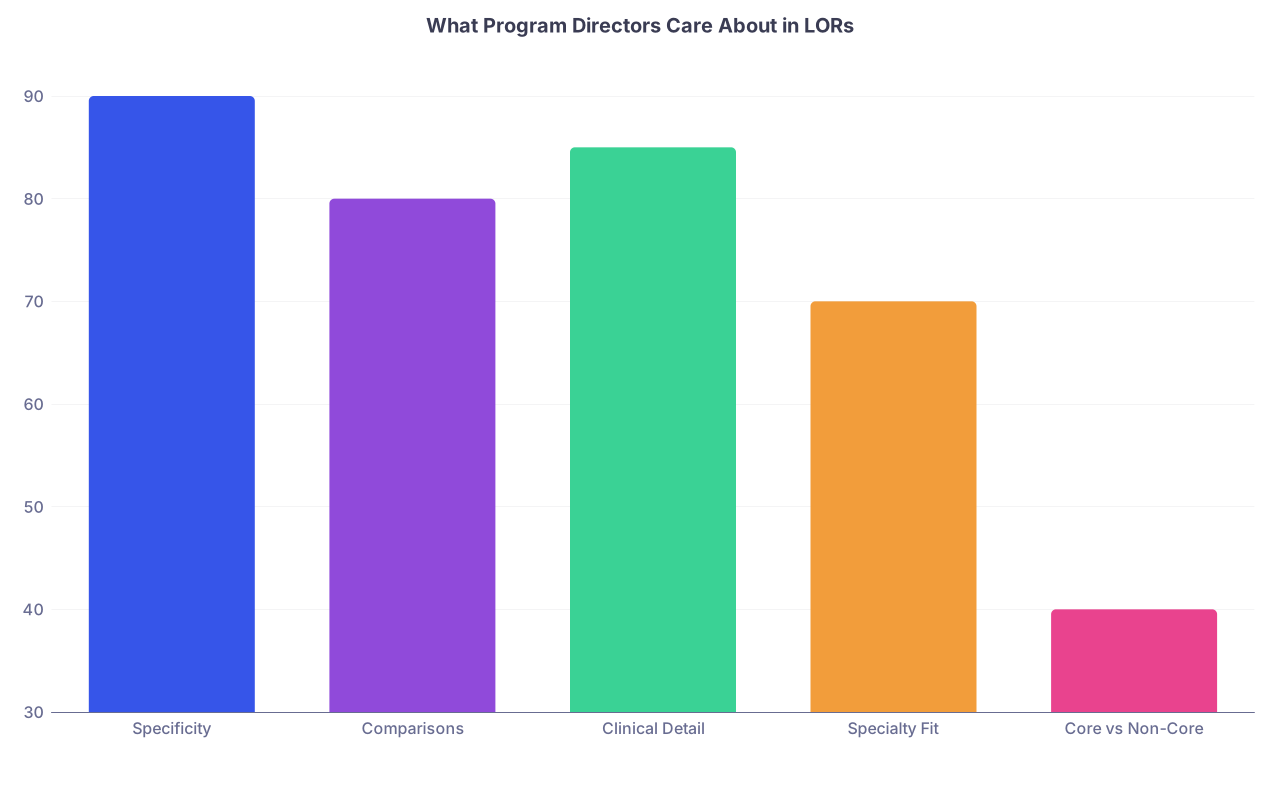
| Category | Value |
|---|---|
| Specificity | 90 |
| Comparisons | 80 |
| Clinical Detail | 85 |
| Specialty Fit | 70 |
| Core vs Non-Core | 40 |
Notice how “core vs non‑core” is last in that list. It’s not irrelevant, but it’s not the hill your application lives or dies on.
3. Worst-Case Scenarios You’re Probably Replaying (And What’s Actually Likely)
Let’s go straight into the nightmare scenarios your brain is feeding you.
Fear #1: “Programs will assume my core letters are bad if my only strong one is non‑core.”
Reality: They don’t see “only strong” vs “weak.” They just see the letters you submit. They’re not psychic. They don’t know the gossip behind your inbox.
If you send:
- 1 excellent non‑core letter
- 2 decent, slightly generic core letters
You know which is “strongest.” They just see three letters, one of which clearly stands out more.
They’re not sitting there asking, “But why isn’t their absolute best letter from IM?” They’re asking, “Do these letters, overall, convince me this person will function as a resident here?”
Fear #2: “No strong core letter means they’ll think I have poor clinical performance.”
Reality: They have other data:
- Clerkship grades and honors
- Your MSPE narrative
- Shelf scores or comments
If your core performance was okay/solid but not superstar, your letters will match the rest of the file. That’s normal. Not everyone is a unicorn.
Where programs really worry is inconsistency:
- Honors in everything + lukewarm letters
OR - Mediocre grades + letters claiming “top 1% ever” (which looks fake)
If your grades and MSPE narrative are aligned with “good, not legendary,” and you’ve got one standout non‑core letter, that’s actually a coherent story. Not a scandal.
Fear #3: “This means I messed up my clerkship year and it’s too late to fix.”
Reality: You can’t re‑run third year. But you’re not stuck either.
You can still:
- Get a strong sub‑I / acting internship letter
- Ask for a letter from a later AI or away rotation
- Strategically not use a letter that’s clearly harmful or extremely generic
- Use your personal statement and experiences to highlight clinical growth
You do not need four “God‑tier” letters. Most applicants don’t have that.
4. Strategy: How To Build a Letter Set When Your Best One Is Non‑Core
So, given the mess you actually have, what should you do?
Let’s break it into practical moves.
A. Know what your target specialty prefers
Some specialties are stricter with “core” expectations than others.
| Specialty | Typical Preference |
|---|---|
| Internal Medicine | 1–2 IM letters, others flexible |
| General Surgery | 1 surgery letter mandatory, often 2 |
| Pediatrics | 1 Peds or related, others flexible |
| EM | 1–2 SLOEs from EM rotations |
| FM | Very flexible, any solid clinical letters |
So if:
- You’re applying IM and your killer letter is from Cardiology or Rheum → honestly, that’s fine. Still clinically IM‑adjacent.
- You’re applying Surgery and your best letter is from Radiology → less ideal, but still usable alongside at least one surgery letter.
- You’re applying Peds with a great letter from Adolescent Med or NICU → that’s actually great.
If you’re applying something very competitive (Derm, Ortho, ENT), then letters from within or near the specialty are gold, and the “core” thing matters a bit less because they’re obsessed with their own people.
B. Plan your lineup like this
General priority order (you’ll adapt to your situation):
- One strong letter from specialty or specialty‑adjacent (even if non‑core)
- One decent letter from the most relevant core (IM for IM, Surgery for Surgery, etc.)
- One additional solid clinical letter where the writer actually knows you
- Optional: research/mentor letter if it fills a gap in your story
If your non‑core letter is truly your best:
- Use it for every program where it makes sense, even if it’s not core.
- Don’t “save” it. That’s self‑sabotage.
C. Don’t obsess over a “bad” letter you haven’t seen
If you waived your right to see them (as you should), you’re guessing. Sometimes students are convinced an attending didn’t like them because they weren’t super talkative, then the letter ends up being totally fine.
Real red flags are:
- The attending directly says, “I don’t know you well enough to write a strong letter.”
- Or: “I can only write you a neutral letter.”
In that case, you listen. Don’t use it if you have any alternative.
If they said, “Happy to write” and didn’t warn you it would be weak, it’s almost never a torpedo. It might just be generic. Generic is not great, but it’s not death.
5. How To Ask for Better Letters on Short Notice (Without Sounding Desperate)
If you still have time before ERAS submission or before you assign letters to programs, this is where you can claw back some ground.
Step 1: Identify the best realistic targets
Think:
- Who saw you a lot? (daily rounds, small team, clinic 1:1)
- Who gave you good informal feedback?
- Who already knows your name without looking at your badge?
Those are 10x better letter writers than “big‑name chair who saw me twice.”
Step 2: Ask in a way that nudges them toward a strong letter
The actual words matter. You want to ask:
“Would you feel comfortable writing a strong letter of recommendation for my residency application in [specialty]?”
If they say:
- “Yes, absolutely.” Good.
- “I can write you a letter.” (no “strong”) → that’s a maybe. Decide if you need it.
- “I don’t know you well enough” → believe them. Move on.
Step 3: Give them ammo
When they agree, send:
- Your CV
- A short paragraph about what you hope they can highlight (e.g., clinical reasoning, work ethic, improvement over the rotation)
- Your personal statement draft if you have it
- A reminder of 1–2 specific cases you worked on that went well
This often turns a “meh” letter into something more concrete and supportive.
6. How To Handle This in Your Overall Application Story
Programs read everything together. So you want all of this to make sense as one narrative:
- Personal statement
- Experiences section
- MSPE
- Letters of recommendation
- Transcript / grades
If your only truly strong letter is from a non‑core clerkship, you can:
Lean into that rotation in your narrative
Mention how that experience shaped you, the responsibility you had, the feedback you got. Let it be a highlight, not some weird outlier.Use experiences to back up what that letter says
If your letter talks about you taking ownership or leading family meetings, include experiences that show similar traits.Don’t apologize in your personal statement
Don’t write, “I know my core letters are not as strong.” That just draws attention to something they weren’t even thinking about.
If your application overall shows:
- Solid clinical performance
- Clear specialty interest
- Growth and maturity
Then one standout non‑core letter honestly just looks like… you really clicked with that team. Which happens all the time.
7. When You Should Actually Be Worried (And What To Do Then)
There are cases where letters start to become a real concern. Signs:
- You have multiple marginal or poor evaluations in your MSPE.
- You know for a fact an attending wrote something negative.
- You struggled repeatedly on core rotations and feedback reflects that.
If that’s you, then:
- Talk to your dean or advisor now. Not in three weeks.
- Be very direct: “I’m worried my letters and MSPE will limit my interviews. What can we realistically do?”
- Ask if they can advocate for you with certain programs or help you strategize a wider application list.
You may need to:
- Apply slightly broader or to less competitive programs.
- Use sub‑Is / AIs to generate one or two very strong later letters.
- Be prepared to explain growth honestly if asked in interviews.
But that’s still not, “You’re done, you’ll never match.” It just means you’re not in the easy lane and you need to play the game more strategically.
FAQ (Exactly 4 Questions)
1. Should I ever not use my strongest non‑core letter because it’s “not core”?
No. If it’s clearly your best, use it. A strong, specific letter from a non‑core clerkship is more valuable than a tepid, vague one from a core rotation. The only exceptions are:
- EM, where SLOEs from EM are the priority
- Programs that explicitly require certain letters (e.g., “two from IM faculty”) — in those cases, meet the requirement first, then add your non‑core.
2. What if I only have one decent core letter and the rest are all non‑core or research?
That’s not unusual. Many students end up with:
- 1 from the specialty / sub‑I
- 1 from IM or Surgery (depending on what they’re applying into)
- 1 from a non‑core or research mentor
If your research letter writer knows you clinically (e.g., you saw patients together), that helps a lot. If not, use it as a fourth letter where programs allow it, not your primary clinical reference.
3. Is it okay if my strongest letter is from a faculty in a different specialty than the one I’m applying to?
Usually yes, as long as they speak to your clinical abilities and work ethic. For example:
- Applying IM with a strong Rheum or Cardio letter — totally fine.
- Applying Peds with a strong FM or Adolescent Med letter — fine.
- Applying Surgery with your best letter from Radiology — not ideal, but still usable; just make sure you have at least one surgeon letter.
Programs like seeing someone who really believes in you, even if it’s not the same specialty.
4. How many letters do I actually need, if some are just “okay”?
Most programs want 3 letters; a few allow or encourage 4. It’s better to have:
- 2 strong + 1 okay
than - 1 strong + 2 obviously weak or weird.
Don’t chase quantity over quality. If one potential letter writer gave you the vibe that they’d only write a neutral or uncertain letter, skip them unless you literally have no other option. A small set of consistent, supportive letters beats a larger, mixed bag.
Key Takeaways
- A strong non‑core letter is an asset, not a liability — use it.
- Slightly generic core letters won’t kill your application if the rest of your file is solid.
- You still have leverage: sub‑Is, careful letter selection, and a coherent narrative can pull a lot more weight than you think.