
Early MS3 performance does not have the final word on your match story—unless you let it.
I’m going to say the scary part out loud: yes, early bad evaluations, average shelf scores, or a rocky start on rotations can hurt. Program directors are not blind. MS3 matters a lot.
But here’s the part no one emphasizes enough: most applications are messy. Most stories are not straight lines. And I’ve seen people with legit dumpster-fire starts to third year still match very well—because they changed the trajectory, not the past.
You’re here because you’re doing the mental math at 1 a.m.:
- “I got a Pass on my first clerkship. Honors feels gone.”
- “My preceptor didn’t like me. Is that who I am now?”
- “I want a competitive specialty. Did I just nuke my chances?”
- “Is this all going in some permanent file every PD will see?”
Let’s walk through what actually matters for residency and what you can still salvage. Which, by the way, is more than your brain is telling you right now.
What “Underperforming” in Early MS3 Actually Means (And Doesn’t)
First, let’s define what we’re freaking out about.
Underperforming can look like:
- Pass or Low Pass on your first one or two clerkships
- Mid or low-tier clinical comments (“quiet,” “needs to improve efficiency”)
- Shelf scores barely passing or below the class average
- Struggling with basic workflow: notes late, orders missed, always a step behind
- A bad eval from one attending who clearly didn’t like you
Here’s the part your catastrophizing brain skips: program directors rarely care about one bad block. They care about patterns and direction.
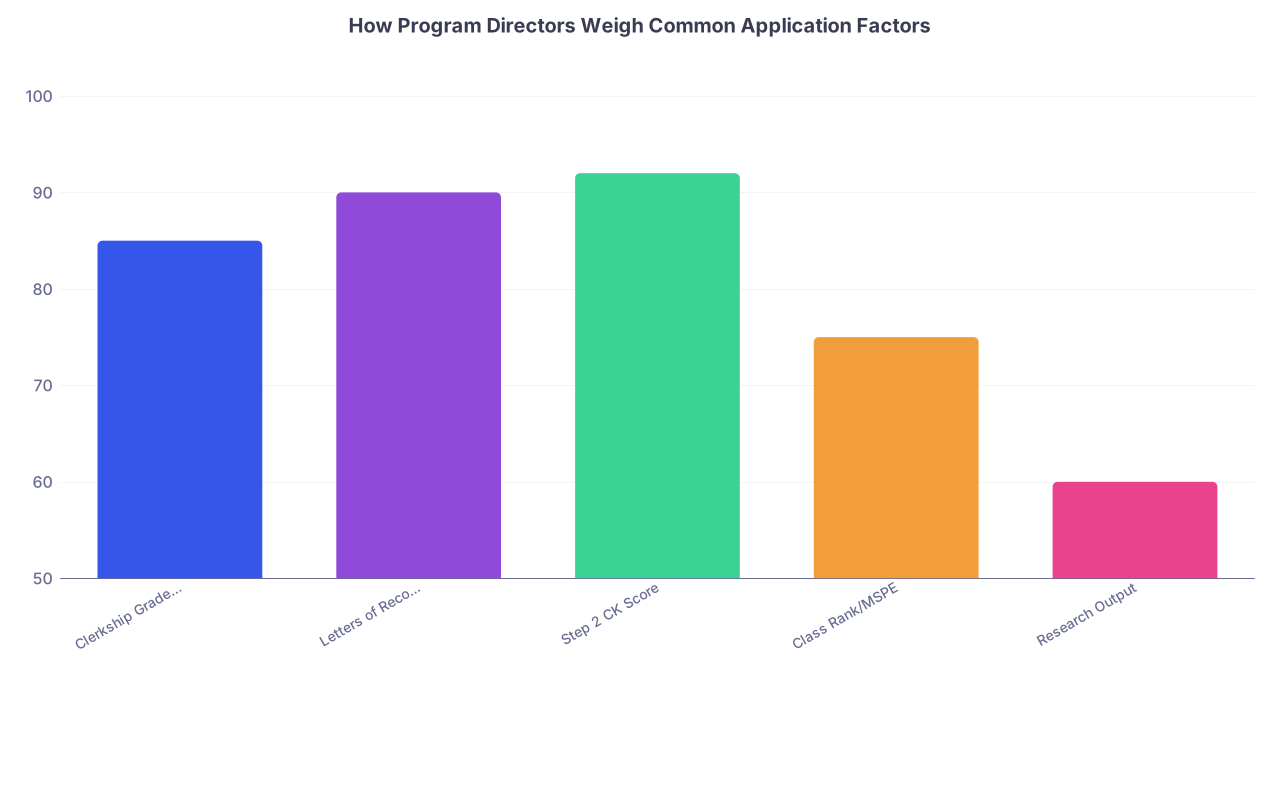
| Category | Value |
|---|---|
| Clerkship Grades Trend | 85 |
| Letters of Recommendation | 90 |
| Step 2 CK Score | 92 |
| Class Rank/MSPE | 75 |
| Research Output | 60 |
Are your early clerkships part of the story? Yes. Are they the whole book? No.
They don’t see: “Pass in Surgery → doomed.”
They see: “Pass, then High Pass, then Honors” versus “Honors, then Honors, then Honors” versus “Pass, Pass, Pass.”
Upward trend is a thing. And it matters more than your first stumble.
The worst-case mental spiral (that’s not actually real)
The movie in your head goes like this:
One bad clerkship → no honors → no AOA → mediocre letters → mid-tier Step 2 → no interviews → unmatched → life over.
Reality looks more like:
A couple of shaky clerkships → you panic → you either adapt and climb, or you stay in panic mode and plateau.
The disaster isn’t the early bad grades. It’s when people never pivot.
The Harsh Truth: Some Damage Is Done… But The Window Is Still Open
Let me be blunt: some things you probably can’t fully “fix” if you’re late in MS3 or early MS4.
You usually can’t:
- Retroactively change Pass to Honors
- Re-write that one terrible eval where someone called you “disengaged”
- Suddenly become AOA if your school uses strict cutoffs and your preclinical/MS3 grades aren’t there
- Pretend your rank and MSPE don’t exist
But you can:
- Change the rest of your clerkship evaluations
- Crush key rotations that matter most for your specialty
- Get strong letters that outweigh OK grades
- Use Step 2 as a “this is who I am now” signal
- Tell a coherent “early struggle → later growth” story in your application and interviews
Your story is not “I was perfect.”
Your story becomes “I struggled, I adapted, and here’s the evidence.”
And yes, programs love that. They’re training physicians, not just scanning for robots with straight-Honors transcripts.
Which Clerkships Actually Move the Needle for Residency?
If you feel like you already screwed up your “important” rotations, you’re probably overgeneralizing.
Some rotations matter a lot. Some barely register.
| Clerkship Type | Impact on Most Matches | Notes |
|---|---|---|
| Core clerkship in your desired specialty | Very High | Grades + letters are huge |
| Medicine (for most specialties) | High | Seen as a proxy for clinical ability |
| Surgery (for surgical fields) | High | Especially for gen surg/ortho/ENT |
| Sub-Is/Acting Internships (MS4) | Very High | Often more important than early MS3 |
| Early non-related core (e.g., Psych for EM applicant) | Moderate/Low | Matters, but not decisive |
So if you’re:
- EM-bound and you underperformed in early Family Med and Psych? Annoying, not fatal.
- IM-bound and had a rocky OB/GYN? Definitely not ideal, but not a coffin nail.
- Surgery-bound and your first clerkship—Surgery—was a Pass with mediocre comments? That stings more. But still not done.
Because you still have:
- Sub-Is in your target field
- Strong letters you can chase
- Step 2 CK
- MS4 rotations to prove “I’m not who I was in month 1 of MS3”
The clerkships that can actively repair your story
Certain rotations are big levers if you use them right:
- Your core IM rotation (for basically every specialty)
- Your core specialty clerkship (if you haven’t done it yet)
- Sub-Is in that specialty
- Away rotations in that specialty (for some fields like ortho, EM, derm, ENT)
Those are where you want to show, clearly: “I figured it out. Look at me now.”
How to Change the Trajectory (Not Just “Work Harder” Nonsense)
“Just work harder” is useless advice. You’re probably already grinding.
The shift that matters is behavioral, not just time spent.
1. Fix the stuff attendings actually care about
Most early MS3 “underperformance” isn’t about intelligence. It’s about not looking like part of the team yet.
On upcoming rotations, obsess over these:
- Reliability: show up early, stay until dismissed, be predictable. Never be the person they have to chase.
- Ownership: know your patients cold. Labs, imaging, overnight events, plan. Make it impossible for someone to say you’re “passive.”
- Communication: check in with residents. Ask, “Hey, is there anything I can do to make your life easier this afternoon?” Then actually do it.
- Basic skills: practice presentations out loud. Ask for feedback early, not in the last week when it’s too late.
The unspoken metric attendings use is: “Would I trust this person on my team at 3 a.m. with a sick patient?”
You don’t have to be perfect. You have to look like you’re on your way there.
2. Be uncomfortably direct about wanting to improve
You know what actually changes evals? Not mind reading. Talking.
Early in a rotation, say something like:
“I had a slower start earlier this year and I’m really working on improving my clinical reasoning and efficiency. I’d really appreciate any blunt feedback in the first week so I can adjust quickly.”
Yeah, it feels vulnerable. Do it anyway.
I’ve watched this exact line flip an attending from “meh” to “okay, I’m going to invest in this student.” People love a comeback story.
3. Identify what went wrong, specifically
“Underperforming” is vague. “I ramble during presentations and miss key data” is actionable.
Go back to your bad evals and look for patterns:
- “Quiet” / “reserved” → you’re not speaking up enough on rounds or in teaching
- “Needs to improve efficiency” → your notes are slow, or you’re behind on patient updates
- “Limited differential diagnosis” → you’re not thinking broadly out loud, even if you are in your head
Then, for each pattern, create one concrete behavior to change next rotation.
Example: if your diff dx is weak, tell your resident, “On the next new patient I present, can I walk through my differential and you stop me where it falls apart?”
Awkward? Absolutely.
Effective? Yes.
Using MS4 and Step 2 to Rewrite the Narrative
You’re worried because clerkships feel final. They’re not.
MS4 and Step 2 are two of your biggest “I changed” megaphones.
Step 2 CK: Your academic redemption arc
If your early shelves were rough, Step 2 is your chance to scream, “Look, I can master this.”
A mediocre Step 1 + strong Step 2 is a classic comeback signal. Program directors literally comment on this in rank meetings.
If you know your clerkship grades are mid-tier, treat Step 2 like a priority project, not an afterthought.
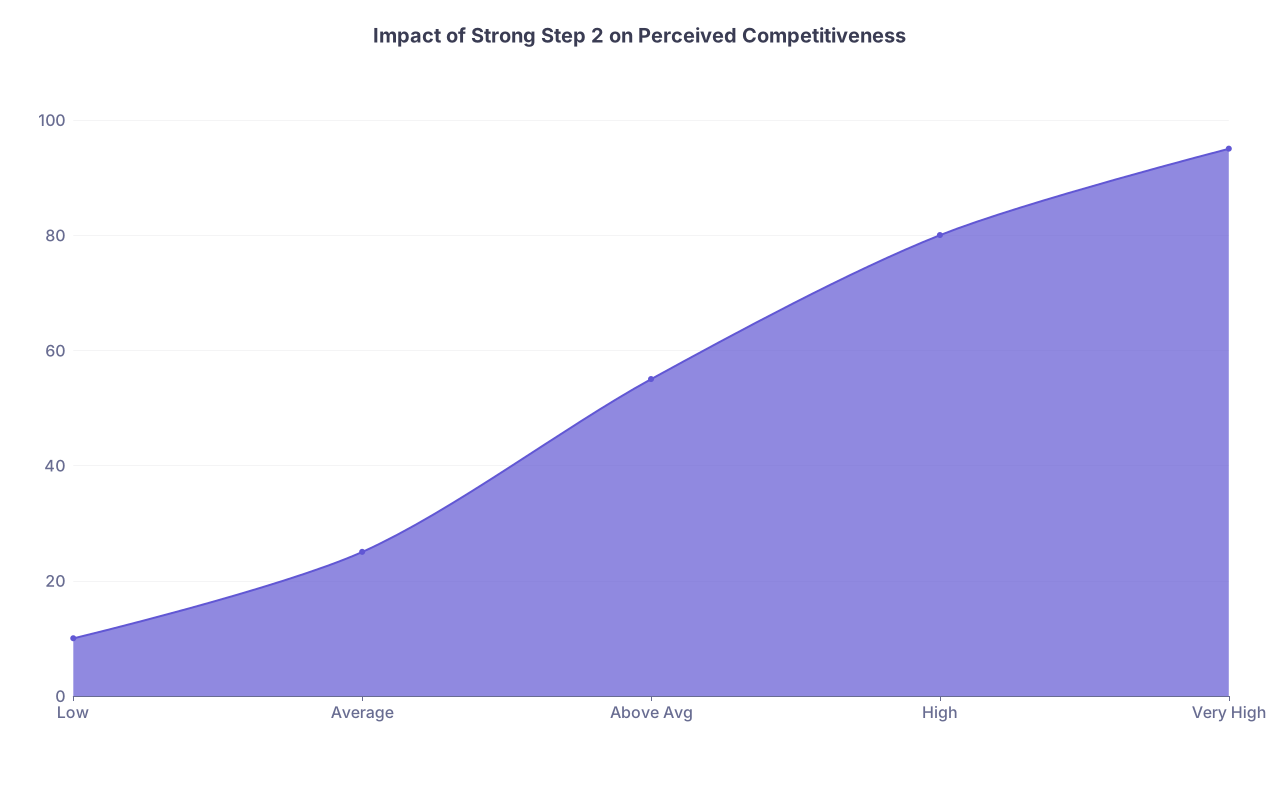
| Category | Value |
|---|---|
| Low | 10 |
| Average | 25 |
| Above Avg | 55 |
| High | 80 |
| Very High | 95 |
You don’t have to ace it. But showing clear improvement from your shelves and Step 1 helps a lot.
Sub-Is and away rotations: where you become “real” to programs
For residency match, especially in more competitive fields, these rotations matter more than that random early Psychiatry Pass.
On a sub-I, your goals shift:
- Show stamina: act more like an intern, not just “the student”
- Own tasks: you’re not just shadowing anymore; you’re moving things forward
- Build one or two deep relationships for letters, not trying to impress everyone superficially
If you struggled early, this is where you need to be annoyingly proactive about feedback.
Week 1 or 2 on your sub-I, say:
“I’m really hoping to use this month to show the growth I’ve had since the start of third year. Could you tell me one thing I’m doing well and one thing I should fix this week so I can course-correct early?”
I’ve heard attendings write glowing letters that literally say, “Student started slower earlier in MS3 but showed remarkable growth by the time they rotated with us—ready for residency.”
That kind of line neutralizes the stain of earlier evals.
How to Talk About Early Struggles in Your Application Without Sounding Like a Train Wreck
You’re probably scared ERAS will expose every flaw and then they’ll ask you in every interview, “So… what happened in Surgery?”
Here’s the thing: you can address it, but the way you frame it matters.
Bad version:
“I struggled with time management, was overwhelmed, and my grades suffered. It was a really hard time.”
Better version:
“Early in my third year, the transition from the classroom to the wards was harder than I expected. My first rotation evaluations reflected that I was slower with tasks and less confident in my clinical decisions. I took that feedback seriously: I met with mentors, focused on structuring my presentations, and deliberately sought more responsibility on subsequent rotations. Over the rest of the year, my evaluations and clinical performance improved significantly, and I now feel much more prepared to function as an intern.”
Notice:
- You acknowledge it without being dramatic
- You show insight (not blame)
- You show behavioral changes
- You point to evidence of improvement (later evals, letters, sub-Is)
You don’t need to write a whole personal statement about one bad clerkship. You just need a clean, mature paragraph if it’s a clear pattern that must be addressed.
Matching With an Imperfect MS3: Realistic, Not Fantasy
Let’s be honest: if you’re aiming for derm, plastics, ortho, ENT, ophtho, neurosurg, and your early MS3 and preclinical grades are mediocre, you are climbing a steeper hill. That’s reality.
But even there, I have seen:
- A student with mostly Passes early, who flipped to Honors on IM + two strong sub-Is, crushed Step 2, did two away rotations, and matched mid-tier general surgery.
- A student who barely passed their surgery clerkship, then did amazing on EM rotations and matched EM very happily at a solid academic place.
- A student who was told, bluntly, “You’re not competitive for derm,” pivot to IM, lean into that, and end up GI fellowship-bound at a great program.
The story is not always, “I salvaged everything and matched Harvard ortho.” Sometimes the win is: “I changed specialties and still built a life I like.”
That’s allowed. You’re not failing if your target moves.
Visualizing Your Next Steps (So You Don’t Just Sit in the Panic)
Here’s the rough flow of what you’re dealing with right now:

| Step | Description |
|---|---|
| Step 1 | Early MS3 Underperformance |
| Step 2 | Identify Patterns and Causes |
| Step 3 | Targeted Behavior Changes on Next Rotations |
| Step 4 | Improved Clerkship Evals and Letters |
| Step 5 | Strong Step 2 CK Focus |
| Step 6 | High-Impact Sub Is and Aways |
| Step 7 | Application Narrative - Growth Arc |
| Step 8 | Residency Interviews and Match |
Your job isn’t to magically erase A. Your job is to make everything from C onward so strong that A looks like the prologue, not the plot.
FAQ (Exactly 5 Questions)
1. I got a Pass on my first core clerkship. Is Honors basically gone for me now?
No. Honors is usually rotation-specific, not retroactively determined by your first mistake. I’ve seen students start with a Pass in Surgery, then Honor Medicine, Psych, and EM. What can be affected is AOA or class rank if your school weighs MS3 heavily. But individual Honors are absolutely still on the table if you apply what you learned from that first rotation.
2. Will program directors see that one terrible eval comment that makes me look awful?
They’ll see whatever your school includes in the MSPE (Dean’s Letter). Many schools summarize themes rather than dropping in every ugly sentence. If there’s a clearly outlier comment, sometimes it gets softened in the narrative. But assume they’ll see some version of it. Your defense is not to hide it; it’s to make sure your later evaluations and letters contradict that single outlier by showing consistent growth.
3. Should I delay Step 2 to study more if my clerkship grades are weak?
If your clinical performance is mid-tier and your practice scores are also mediocre, Step 2 is one of your biggest tools to prove you’ve improved academically. Delaying can make sense if you genuinely need more time and your school allows it. But don’t drag it out endlessly. Set a clear target range (based on practice NBME scores) and a test date to aim for. Better a solid Step 2 that’s ready in time for applications than a perfect fantasy score that never happens.
4. Do I need to mention my early underperformance directly in my personal statement?
Only if it’s a pattern that would raise questions and you have a real story of growth, not just excuses. One Pass among mostly good grades? Ignore it. Multiple weak rotations followed by clear improvement and strong letters? A short, mature paragraph in your MSPE addendum, personal statement, or secondary essays can help frame it as “growth” instead of “mystery red flag.” Keep it concise, factual, and focused on what changed.
5. Is it too late in late MS3/early MS4 to change specialties if I realized my initial target is now unrealistic?
It’s not too late, but you have to be aggressive and intentional. Talk to mentors now, not three months from now. Ask: “With my current grades and scores, where am I realistically competitive?” Once you pivot, line up sub-Is in the new field, get at least 2 strong specialty-specific letters, and, if possible, tailor your electives to support that choice. Students switch from “aspiring derm” to “all in on IM” every single year and still match well. The worst move is clinging to a fantasy specialty and ending up with a weak backup plan and a terrifying Match Week.
Key points, so your brain has something concrete to hold onto:
- Early MS3 underperformance hurts, but it doesn’t lock in your fate; trends and growth matter more than month 1.
- Use upcoming core rotations, sub-Is, and Step 2 as deliberate “I am not who I was” proof, and chase strong letters that back that up.
- If your original specialty target no longer fits your record, a smart pivot is not a failure—staying rigid and hoping for a miracle is.