
The fantasy that every sub‑I attending will remember you perfectly is a lie.
Let me just rip the Band‑Aid off: you are not crazy for worrying that your sub‑I attending barely remembers your name, let alone your “strong fund of knowledge and excellent teamwork.” This happens all the time. To good students. On “audition” rotations. At big‑name programs.
And yes, it can feel absolutely terrifying when you’re trying to line up letters for residency.
I’ve watched people come off a brutal sub‑I at a place like MGH or UCSF, give everything they had, and then six weeks later the attending writes back, “Remind me what rotation you were on with me?” Cue the spiral: If they don’t remember me, my letter will be garbage. If my letter is garbage, I won’t match. If I don’t match…
Let’s walk through this like honest adults who are quietly panicking but still want to win.
The ugly truth: attendings forget people. A lot.
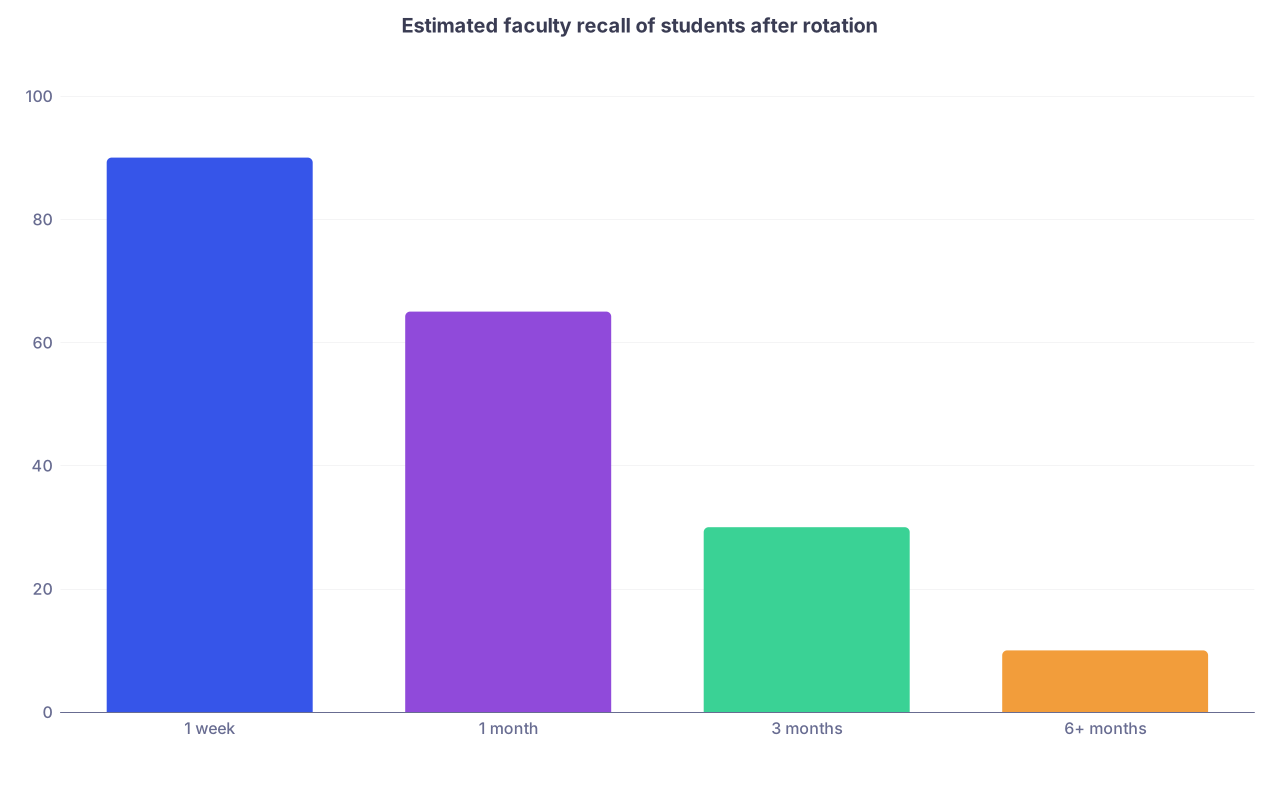
| Category | Value |
|---|---|
| 1 week | 90 |
| 1 month | 65 |
| 3 months | 30 |
| 6+ months | 10 |
Here’s the part nobody tells you when they say “get a strong letter from your sub‑I”: your attending is often supervising:
- 3–6 students
- 2–4 residents
- A full patient list
- Hospital committees
- Their research
- Their actual life outside the hospital (allegedly)
You? You’re there for 4 weeks, maybe 2 if it’s a busy service. You present politely on rounds, you write notes, you pre‑round. Then you vanish back into the mist of “That med student… what was their name?”
And yet, these are the people you’re supposed to beg for high‑stakes letters that shape your entire match.
So yes, it’s common that:
- They don’t remember specifics about you.
- They forget what month you rotated.
- They mix you up with another student.
- They remember “the enthusiastic one who always stayed late” but not your actual name.
This is not proof you were mediocre.
This is proof they are overworked, under‑slept, and have too many learners rotating through.
The dangerous move is not that they don’t remember you.
The dangerous move is you doing nothing about it and hoping they somehow write you a stellar letter anyway.
How “not remembering you” actually shows up
I’ve seen the whole spectrum.
There’s the obvious stuff:
- You email asking for a letter, and they reply, “Can you send me a copy of your CV and a reminder of what rotation we worked together on and when?”
- They say, “Happy to help, but I work with a lot of students. Can you remind me of some of the cases we took care of together?”
And then there’s the scarier, subtle version:
- They say “Of course!” right away.
- They don’t ask for more info.
- They submit a letter that is generic enough it could be about anyone with a pulse.
That second scenario freaks me out way more.
Because programs can smell that letter. And if too many of your letters read like “hardworking, pleasant, team player,” it doesn’t tank your entire application… but it absolutely doesn’t help you stand out in a competitive field.
So if you’re already thinking, my sub‑I attending won’t remember me, honestly, you’re already ahead. You’re seeing the risk before it hits you.
Now we deal with it.
Step 1: Stop assuming a “maybe” letter is better than no letter
This is the biggest mental trap: “Any letter from a big‑name place is better than nothing.”
No. Sometimes a vague letter from a brand‑name department is worse than a detailed, specific letter from someone at your home institution who actually knows you.
Programs care about signals and specifics, not just letterhead.
Here’s what they look for when they read your letters:
- Do they clearly describe how the writer knows you?
- Are there specific examples of your work, not just adjectives?
- Is there a sense of comparison: top third, top 10%, “among the best I have worked with”?
- Does the writer sound like they actually supervised you, or like they’re filling a template?
A “meh” letter from an attending who barely remembers you checks almost none of these boxes.
So if you’re worried your attending doesn’t remember you, treat that as a yellow light, not a green one. You don’t automatically abandon the letter, but you don’t blindly count it as one of your main anchors either.
Step 2: Make it impossible for them to forget you (retroactively)
Yeah, I know, you’re probably reading this after the rotation ended. Which is exactly when the panic sets in: I should’ve stayed late more. I should’ve spoken up in rounds. I should’ve…
Too late for that part. But not too late to jog their memory in a way that actually works.
When you email them for a letter, you cannot send a bland one‑liner like:
“Hi Dr. X, I really enjoyed my time on the service with you. Would you be willing to write me a strong letter of recommendation?”
Weak. You’ve given them zero handles to grab onto.
You need to do the cognitive lifting for them.
Here’s the structure that actually helps a forgetful attending remember you well enough to write something useful:
- Clear context of who you are and when you worked together
- Specific things you did on the rotation
- What you’re applying for and why you’re asking them specifically
- Attachments that make writing the letter brain‑dead easy
Something like:
Hi Dr. Smith,
I was the fourth‑year student on the September General Surgery sub‑I at County who pre‑rounded on the ICU patients and presented Mr. J with the perforated ulcer we took to the OR on 9/18. I also helped manage Ms. R’s post‑op ileus— you taught me the “never trust the post‑op belly” rule, which I still quote.
I’m applying to General Surgery this cycle and was hoping you’d feel comfortable writing a strong letter of recommendation based on our work together on that rotation.
I’ve attached my CV, my personal statement draft, and a short bullet‑point summary of some of the cases and responsibilities I had on your service, in case that’s helpful as you consider.
Thank you again for everything you taught me that month,
[Name]
This does three things:
- It reminds them what month you existed.
- It reminds them what you actually did.
- It signals you want a strong letter, not a pity letter.
If you’re feeling extra anxious (same), include a short “brag sheet.” Something like:
- Major patients you managed
- Any positive feedback they gave you
- Specific times you took initiative
You are basically feeding them the raw material they should’ve written down but didn’t.
Step 3: Read between the lines of their response
This is where we separate “I don’t fully remember you but I can still write a good letter with your help” from “I have nothing to say and this letter will be fog.”
Look at their response carefully.
Good signs:
- They say “I’d be happy to write you a strong letter” or “I’d be glad to support your application.”
- They ask follow‑up questions: where are you applying, what are you aiming for, any particular strengths to highlight.
- They mention specific things they remember: “You were very impressive on that sub‑I,” “I remember your presentation on X.”
Mildly concerning but salvageable:
- They say “I’d be willing to write you a letter” with no adjective.
- They ask you to send a draft or bullet points (totally fine, actually very common).
- They admit they “see many students” and ask you to remind them.
Red flags:
- Very delayed, lukewarm response.
- “I can write you a letter” with no indication of strength, + no engagement.
- They suggest someone else instead (“Maybe Dr. Y, who worked with you more closely, would be better.”)
You’re allowed to interpret these as signals. You're not obligated to use every “yes” as one of your 3–4 main letters.
And if they never reply? That sucks. It feels personal. But you move on. An attending who can’t answer an email probably won’t write a stellar, on‑time letter either.
Step 4: Protect yourself with redundancy
Here’s where the anxiety can actually serve you. Instead of assuming every attending will come through, you build in backup.
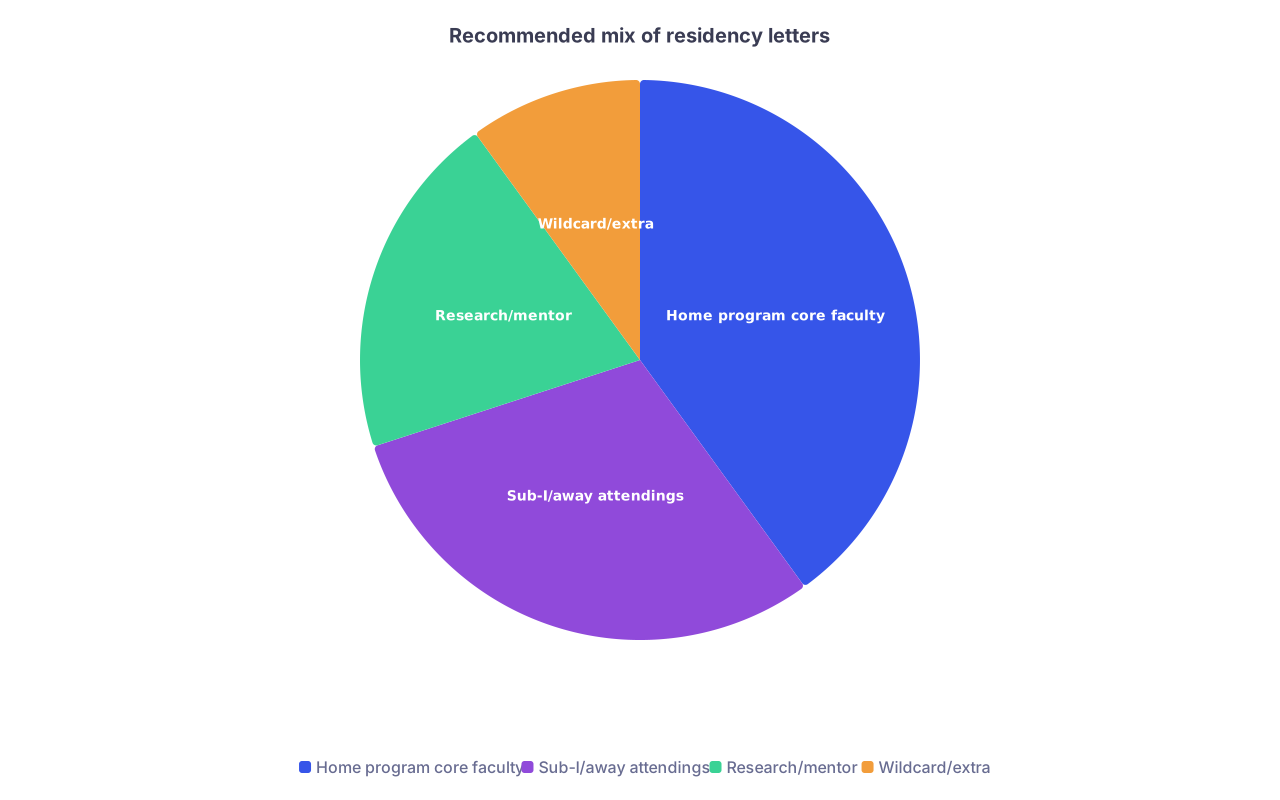
| Category | Value |
|---|---|
| Home program core faculty | 40 |
| Sub-I/away attendings | 30 |
| Research/mentor | 20 |
| Wildcard/extra | 10 |
You want at least:
- 1–2 letters from people who know you very well (home program, longitudinal mentor, research PI who actually saw you think)
- 1 letter tied to your chosen specialty (home or away)
- Optional: 1 additional letter from a sub‑I/away if it’s substantive, not fluff
The key is this: don’t put all your emotional weight on that one sub‑I attending who might not even be the best writer.
A strong, specific letter from a home medicine attending who’s known you for a year beats a vague “pleasant and hardworking” letter from a superstar academic you scrubbed with twice.
So if you’re already panicking about Attending X not remembering you, start shoring up other letters now:
- Email your home clerkship director.
- Talk to the attending who gave you verbal praise.
- Ask your research mentor early.
Think of that questionable sub‑I letter as bonus ammo, not your only weapon.
Step 5: How bad is a “meh” letter really for the match?
Let’s talk worst‑case, since that’s where your brain is living anyway.
What if:
- Attending barely remembers you.
- You still use their letter.
- It’s generic.
Does that alone make you unmatched? No.
Most applications have at least one letter that’s fine but not memorable. Committees don’t auto‑reject people for one bland letter. They look at the overall pattern.
Where you start to get into trouble is:
- All letters are vague.
- No one uses comparative language (top X%).
- No one describes you with concrete examples.
- Nothing in the letters supports the story you tell in your personal statement.
So your goal is not perfection. It’s avoiding a pattern of mediocrity.
If you suspect one letter might be weak, you can compensate:
- Make sure the others are from people who know you well.
- Strengthen your personal statement and experiences section so they’re vivid and specific.
- Crush Step 2 / shelf scores / sub‑I evals to show clinical strength.
Programs are pattern‑recognizers, not single‑data‑point executioners.
A quick reality check on what programs actually care about
| Factor | Relative Weight |
|---|---|
| Clinical performance (MS3/4) | High |
| Step 2 CK score | High |
| Specialty‑specific letters | High |
| School name / prestige | Medium |
| Away rotation letters | Medium |
| Research output | Medium |
They’re not sitting there saying, “Did this one sub‑I attending at Big Name Hospital gush about them?”
They’re asking:
- Does this person seem safe and competent with patients?
- Will they work hard and not melt down at 2 AM?
- Do their mentors trust them enough to recommend them strongly?
- Does their application show consistency?
One attending not remembering you perfectly doesn’t blow that up. You feeling paralyzed and not assembling a solid set of letters because of that fear? That can hurt you.
For next time: how to become unforgettable on a sub‑I
You might still have future sub‑Is or away rotations. Good. You can make this much easier on yourself going forward.
Here’s how people actually get remembered:
- They introduce themselves clearly on Day 1 and say what they’re applying into.
- They take ownership of a reasonable number of patients and follow them obsessively.
- They say things like, “I’d love to get feedback midway through the month” so the attending actually forms opinions.
- At the end, they say directly, “If you feel you know my work well enough, I’d be honored to ask you for a letter.”
And then they do not disappear. They send a thank‑you email with specific callbacks:
“Thank you for letting me take the lead on Mr. H’s new HF diagnosis and for teaching me how you structured that family meeting. That experience really confirmed my interest in cardiology.”
You’re basically stapling your name to a couple of memorable moments in their mind.
That’s how you reduce the “who were you again?” problem next time.
Visualizing the timeline so you don’t miss the window
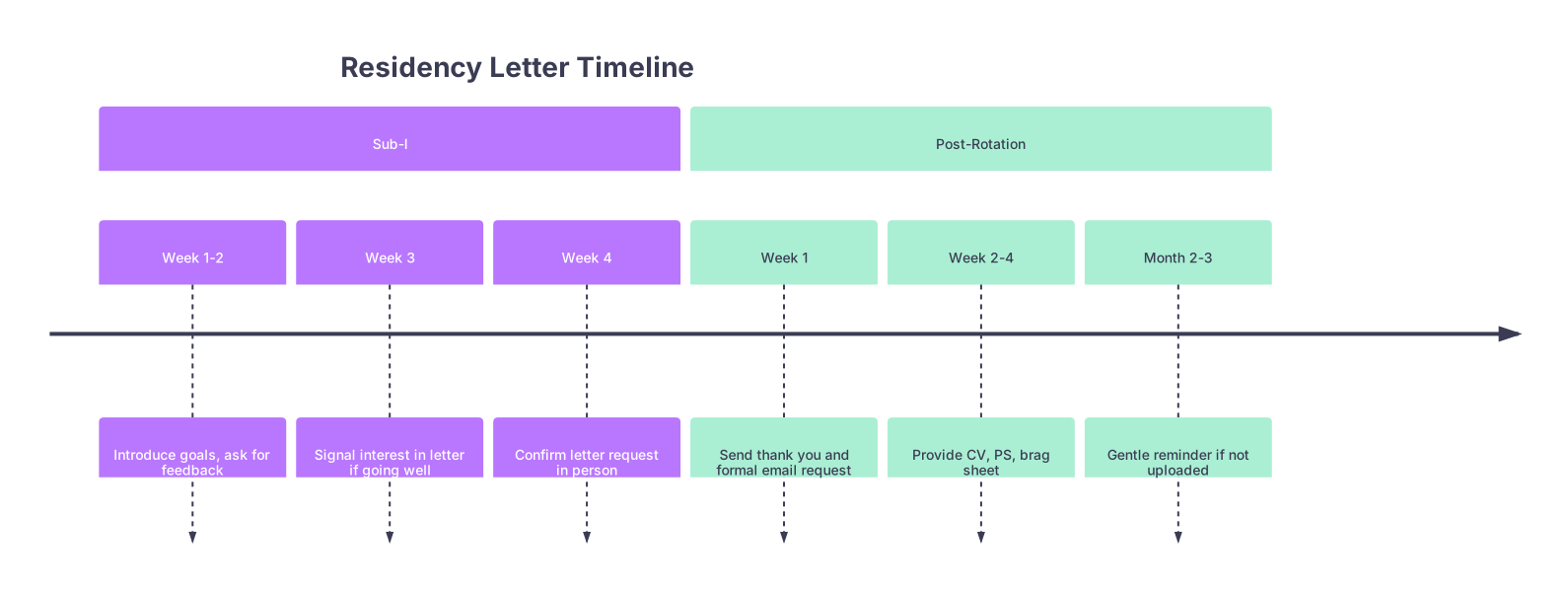
| Period | Event |
|---|---|
| Sub-I - Week 1-2 | Introduce goals, ask for feedback |
| Sub-I - Week 3 | Signal interest in letter if going well |
| Sub-I - Week 4 | Confirm letter request in person |
| Post-Rotation - Week 1 | Send thank you and formal email request |
| Post-Rotation - Week 2-4 | Provide CV, PS, brag sheet |
| Post-Rotation - Month 2-3 | Gentle reminder if not uploaded |
If you’re months out from the rotation, it’s still okay to ask. Just be more detailed in your email because their memory has cooled off.
What to do tonight if you’re spiraling about this
Because I know you. You’re reading this at midnight, refreshing ERAS, wondering if one half‑baked letter is going to kill your chances.
Here’s what you can actually do in the next 24–72 hours:
- Write or revise your email to that attending with enough specifics to jog their memory.
- Decide, based on their reply, whether that letter is “core” or “extra.”
- Make a list of 2–3 other attendings/mentors who know you better and email them now.
- Start a simple spreadsheet of who’s writing what, when you asked, and when you’ll send reminders.
And then, honestly? You let some of this go. There’s a point at which more worrying doesn’t produce more outcome. It just burns whatever’s left of your adrenal glands.

FAQ (because your brain won’t shut up)
1. What if my attending clearly doesn’t remember me—should I still use their letter?
If they openly admit they don’t remember much and you have other options, I’d deprioritize that letter. You can still let them write it—sometimes they reconstruct a decent letter from your materials—but I wouldn’t rely on it as one of your main 2–3 specialty letters unless they explicitly say they can write you a strong one.
2. Is it rude to ask if they can write a “strong” letter?
No. Programs, advisors, and honestly most attendings prefer the clarity. It gives them a graceful out if they can’t. If they say, “I can write you a letter, but I’m not sure how strong it will be,” believe them and thank them, then use someone else as a primary writer.
3. What if I already waived my right to see the letter—how do I know if it’s weak?
You won’t know for sure, and that uncertainty is part of why this is so stressful. That’s why you judge based on process: how well they knew you, how they responded to your request, and whether they engaged with your materials. You protect yourself by having multiple letters from people who clearly know you well, not by trying to read tea leaves about one letter you’ll never see.
4. Does a generic letter from a famous institution help at all?
Marginally, sometimes. The name might catch an eye, but content still wins. A detailed letter from a lesser‑known but engaged attending who supervised you closely often does more for you than a generic two‑paragraph letter from a superstar academic who barely remembers who you are.
5. Am I the only one this is happening to? It feels like everyone else has perfect letters lined up.
No. You’re seeing the Instagram version of everyone else’s application and the raw draft of your own. Behind the scenes, a ton of people have at least one attending who forgot them, replied late, wrote something lukewarm, or never uploaded the letter at all. Most of them still match. Your job isn’t to have a flawless process. It’s to be intentional, build redundancy, and give your letter writers enough to actually remember you when it counts.
Key takeaways:
You’re not doomed because one sub‑I attending may barely remember you. Make their job easy with a detailed email and materials, read their response for signals, and don’t lean entirely on a maybe‑letter when you can strengthen your overall letter set with people who truly know you. The match cares about patterns, not one imperfect data point.