
It’s late. You’re scrolling through your school’s evaluation portal. Again.
OB: Pass.
Surgery: Pass.
Medicine: Pass.
Psych: Pass.
No Honors. No “top 10%” comments. Nothing that screams “this person will be a great resident.”
You start doing the mental math. “Everyone else” in your class seems to be posting about Honors in IM, HP in Surgery, that glowing comment from some famous attending. You’re sitting there wondering if your file is basically trash now. Like, is this the part where you quietly downgrade your specialty dreams and your program list and just hope to match somewhere?
Let me just say the loud part clearly:
You can absolutely still match into a good program with only Passes on core clerkships.
But—and this is the part nobody on Reddit actually explains—you have to be deliberate and a little strategic to make the rest of your app scream, “Look beyond the grade column.”
Let’s walk through what you’re actually up against and what you can still do about it.
What Program Directors Actually See When They Look at Your Clerkship Grades
First thing: the story in your head is way harsher than what’s happening in most PDs’ heads.
You see:
- “All Passes = I’m average = I’m doomed.”
They see:
- “Okay, this school uses H/HP/P.”
- “This student passed all the cores, no failures, no repeats.”
- “Let me look at comments, Step 2, letters, and trends.”
Most programs don’t line up your transcript and reject you just because there’s no Honors column lit up. They care about:
- Red flags (fails, professionalism issues, remediation)
- Clear strengths (great letters, strong Step 2 score, research, leadership)
- Fit for specialty (sub-I performance, narrative comments, MSPE)
| Factor | Typical Weight (Big Picture) |
|---|---|
| Fails/remediation | Very High (red flag) |
| Honors in core clerkships | Moderate |
| Narrative comments/MSPE | High |
| Step 2 CK score | Very High |
| Sub-I/Acting Intern evals | Very High |
If you’re all Passes but:
- No failures
- No professionalism write-ups
- Decent or strong Step 2
- Good letters from your chosen field
…you’re not automatically “bad.” You’re in the pile. Just not pre-labeled as a superstar.
The programs that care a ton about Honors in cores are usually:
- Ultra-top-tier academic programs
- Some super competitive specialties (derm, ortho, plastics, integrated surg, etc.)
If you’re aiming for those with all Passes, I won’t sugarcoat it: you’re fighting uphill. Not impossible, but not the default outcome.
But for “good programs” (solid academics, strong clinical training, name people recognize, not just random community shop you’ve never heard of)? Yes, still absolutely on the table.
The Harsh Truth: What All Passes Do and Don’t Mean
You’re probably catastrophizing, so let’s separate your fears from reality.
All Passes DO:
- Make it harder to stand out on paper if lots of your peers have Honors.
- Raise some low-key questions in very competitive places:
“Underperformer?” “Test issues?” “Late bloomer?” - Push more weight onto Step 2, sub-Is, and letters to prove you’re solid.
All Passes do NOT:
- Automatically block you from competitive but sane programs.
- Mean attendings thought you were bad. (A ton of mid/high comments still land as “Pass” in some grading systems.)
- Define your ceiling forever. I’ve watched people with all Passes get into EM at big academic centers or IM at strong university hospitals because everything else was excellent.
The system is also insane and inconsistent. At some schools:
- 40–50% of the class gets Honors in core rotations. At others:
- 10–15% get Honors, and the rest are Pass, and PDs know this.
That’s why context in your MSPE matters. It’s also why obsessively comparing your grades to that one “Honors in everything” classmate is just self-torture.
The Moves That Actually Help You Recover (or Offset) All Passes
You can’t retroactively turn Passes into Honors. But you have levers left.
1. Sub-Internships: This Is Where You Prove You’re Not “Just Average”
Sub-Is (acting internships) in your chosen field matter more than random 3rd-year grades.
If you’ve got all Passes, you want your sub-Is to say:
- “Functions at or near intern level.”
- “Takes ownership of patients.”
- “Outstanding work ethic, would gladly take as a resident.”
You need at least one (ideally two) rotations where:
- You’re fully switched on no matter how tired you are.
- You’re the reliable one for scut and for thinking through plans.
- You’re early, you stay late, and you’re not a martyr about it.
This is where the “average on paper” student becomes “we really liked them, let’s rank them high.”
2. Step 2 CK: Yes, It’s Annoying, but It’s Your Big Chance
With Step 1 pass/fail, Step 2 is the number that screams, “I know the medicine.”
If you’ve got all Passes and:
- Step 2 is strong (e.g., clearly above the national mean, or competitive for your chosen specialty), it reassures programs that:
- You know your stuff
- The Passes might be more about your school’s grading than your ability
If Step 2 is mediocre too, it doesn’t end you, but now you really need:
- Killer letters
- Strong narrative comments
- A well-framed personal statement that explains your growth
Do not fall into the “I’m doomed anyway” trap and under-study for Step 2. This is one of the few controllable levers left late in med school.
3. Letters of Recommendation: You Need Champions, Not Just “Fine”
Most students with all Passes end up with letters like: “Pleasure to work with. Completed tasks reliably. Would do well in residency.”
That’s… fine. But fine doesn’t fix the “no Honors” story.
You want:
- 1–2 letters that say things like:
- “Top 10–20% of students I’ve worked with.”
- “We would be thrilled to have them as a resident here.”
- “Shows exceptional teamwork and initiative beyond level of training.”
How you get those:
- Stay on services longer when possible (4 weeks > 2 weeks with a letter-writer).
- Tell them directly: “I’m really hoping to match into a strong [specialty] program. My grades don’t fully reflect how much I’ve grown. Would you be comfortable writing me a strong letter?”
- If they hesitate: don’t use them. A lukewarm letter hurts.
Also: if your grades are bland but your comments are good, letter writers can essentially “translate” that for PDs:
“This student got Pass but in our system that still places them above average; they were one of the strongest on the team.”
That narrative matters.
4. Third- and Fourth-Year Narrative Comments: The Hidden Gold
PDs absolutely read the MSPE narrative. Especially when grades are all clustered in “Pass.”
Comments that save you:
- “Students, residents, and staff consistently praised their teamwork and reliability.”
- “Quickly incorporated feedback and showed substantial growth.”
- “Stood out for calmness and organization on busy call days.”
Comments that subtly hurt:
- “Pleasant to work with” and absolutely nothing else.
- “Completed tasks as assigned.”
- “On par with expected level of training.”
You can’t rewrite comments already submitted. But on any rotations you have left, you can:
- Ask for mid-rotation feedback and act on it aggressively.
- Tell residents/attendings: “I really want to grow, please tell me what I can do better—even if it’s blunt.”
- Push for chances to present, call consults, take ownership. Don’t hide.
I’ve literally watched students who were “meh” early 3rd year become “top student on the team” by late 3rd/early 4th year simply because they got hit with tough feedback and decided not to crumble.
Reality Check by Specialty: Where All Passes Hurt More vs Less
Let’s not pretend every specialty is equally forgiving.
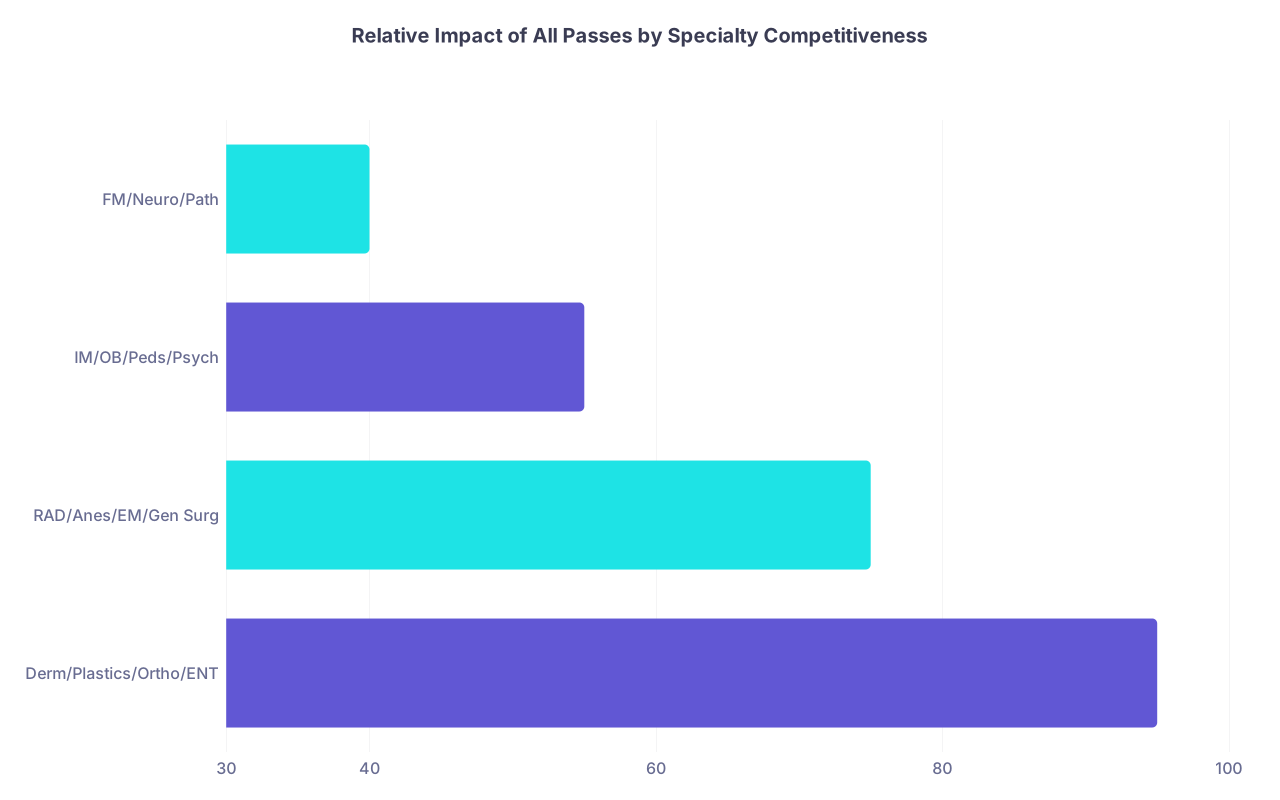
| Category | Value |
|---|---|
| Derm/Plastics/Ortho/ENT | 95 |
| RAD/Anes/EM/Gen Surg | 75 |
| IM/OB/Peds/Psych | 55 |
| FM/Neuro/Path | 40 |
Very rough sense of how much all Passes hurt (0 = don’t care; 100 = huge problem):
90–100: Derm, Plastics, Ortho, ENT, Urology
Here, all Passes really hurt unless you have insane research, Step 2, and connections. You’ll likely need to:- Broaden to more mid-tier or community programs
- Consider a backup specialty
70–80: Anesthesia, Radiology, EM, General Surgery
All Passes are a noticeable weakness, but not fatal:- Strong Step 2 and excellent SLOEs/letters can compensate.
- “Good program” is very realistic; “ultra-top-tier” is harder.
50–60: IM (especially non-elite academic), Peds, OB, Psych
All Passes are just “eh.” They won’t kill you:- You’ll still be competitive for many academic programs with a balanced app.
- The door to “good” is definitely open.
30–40: FM, some Neuro, Path
Much more forgiving. Programs care more about:- Fit
- Reliability
- Letters
- Genuine interest in the field
So the question isn’t just “Can I match into a good program?” It’s:
- “For my specialty and my Step 2 + letters, what does ‘good’ realistically mean?”
How to Talk About All Passes in Your Application (Without Sounding Defensive)
You probably don’t need a whole paragraph in your personal statement about your grades—unless:
- You had a big dip early (family issue, illness, major transition)
- There’s a noticeable upward trend or later growth
If you do address it, it should be:
- Brief
- Honest
- Focused on growth
Example style (don’t copy this word for word, obviously):
During my early clinical rotations, I struggled with balancing efficiency and deeper understanding, and my evaluations were solid but not exceptional. I sought targeted feedback from residents and faculty, and by my sub-internships I was consistently trusted with more responsibility and independent patient care. That experience taught me how to actively seek improvement rather than passively accept “good enough,” and it’s shaped how I show up on every team since.
That says:
- Yes, I see the pattern.
- Here’s what happened.
- Here’s how I grew.
- I’m not blaming the system or my attendings.
Do not:
- Blame “subjective grading” or “biased attendings” in your application.
- Make it sound like you’re bitter about classmates who got Honors.
- Turn your personal statement into a defense brief.
If a PD brings it up on interview day:
- Own it.
- Reiterate what changed.
- Talk about your sub-I performance and growth.
When to Adjust Your Expectations vs When to Hold the Line
There’s a point where “I’m being realistic” and “I’m self-sabotaging” blur.
You should consider adjusting your specialty/program tier targets if:
- All Passes
- Step 2 is below average for your field
- No standout research or extras
- Letters are… fine, not glowing
That doesn’t mean “give up on a good program.” It might mean:
- Fewer dream programs, more realistic and safety programs.
- Considering a slightly less competitive specialty if you’re on the razor’s edge.
You should not automatically downgrade your entire life plan just because:
- You don’t have Honors
- Your classmates do
- A random Reddit thread freaked you out
I’ve seen:
- All-Pass students match EM at strong university programs because their SLOEs were phenomenal.
- “Middling” grade students match IM at big-name hospitals because they crushed Step 2 and sub-Is.
- People with no shiny awards become absolute rockstar residents everyone wants to hire.

| Step | Description |
|---|---|
| Step 1 | All Passes on Cores |
| Step 2 | Boost Step 2 and research |
| Step 3 | Apply broadly including mid tier |
| Step 4 | Focus on sub Is and letters |
| Step 5 | Highlight growth in MSPE and PS |
| Step 6 | Realistic mix of programs |
| Step 7 | Specialty very competitive |
Quick Reality Anchors Before Your Brain Spirals Again
You’re not the only one in this boat. There are a lot of quiet “all Passes” people who don’t post in group chats. They just apply, match, and move on.
Program directors care about:
- Can you do the job?
- Will you show up?
- Are you teachable?
- Are you going to be a problem?
All Passes don’t answer those questions. Everything else in your app does.
You still have time to shape that “everything else.”
FAQ (exactly 5 questions)
1. I have all Passes and one Fail/remediation—am I screwed?
No, but that Fail is now the main thing you have to explain. You need:
- Clear documentation of successful remediation
- Strong later performance (sub-Is, Step 2)
- A simple, honest explanation if asked: what went wrong, what changed, and why it won’t happen again
You’ll want to apply more broadly and maybe lean away from the very top programs, but matching into a solid program is still absolutely possible.
2. My school gives almost everyone Pass—will programs understand that?
Yes, if your MSPE explains the grading distribution clearly. Many PDs know which schools are stingy with Honors. If your school is one of those, the narrative comments and any mention of “top third” or “top quarter” become much more important. It’s not automatic, but you’re not starting at a disadvantage if the context is clear.
3. Should I do away rotations to “prove myself” if I only have Passes?
If your specialty values away rotations (EM, ortho, some surg, certain IM fellow-track programs), then yes, a strong away can really help you stand out. But a mediocre away can hurt. Only do aways if you’re ready to go all-in on preparation, work ethic, and being easy to work with. This is not the “maybe I’ll figure it out while I’m there” phase.
4. Will programs reject me automatically if I don’t have Honors in their specialty’s core rotation?
Some ultra-competitive programs might heavily prefer Honors, but lots of solid programs won’t auto-reject you just for that. If you only got Pass in, say, Medicine, but then you have an excellent IM sub-I with a killer letter, that recent, context-rich data is often more persuasive than a single core grade from a year ago.
5. Is it even worth applying to a “reach” program with all Passes?
Yes—but be selective. Throwing 20 apps at places that clearly want straight Honors and 270+ Step 2 is just burning money. Adding a few reaches that you genuinely like, where you have:
- A connection
- A home rotation history
- Alumni from your school there
…is reasonable. Just don’t build your entire list out of reaches and then act surprised if the interview invites are thin.
Key takeaways to keep you grounded:
- All Passes make life harder, not hopeless. Sub-Is, Step 2, and letters can still move the needle a lot.
- “Good program” is still very reachable for most non-ultra-competitive specialties if the rest of your app is strong and you apply smart.
- You can’t rewrite 3rd year, but you can control how you perform, explain, and advocate for yourself from now until Match.