
Last week I watched a friend open her final clerkship eval on her laptop in the call room. She scrolled, froze, then whispered, “Another High Pass. That’s it. I’m done. No one’s going to rank me.” And I just sat there thinking the exact same thing about my own transcript.
If you’re here, I’m guessing you’re doing that math too: “No honors in medicine… how screwed am I really?” So let’s rip the Band-Aid off and talk about it honestly.
First: How Bad Is “No Honors in Medicine” Actually?
Let me be blunt so we’re working with reality, not vibes.
No honors in your medicine clerkship hurts in some situations. In others? It’s basically background noise.
Here’s the rough hierarchy of how much programs care about core clerkship grades, with medicine usually king of the hill:
| Specialty Type | Med Honors | Surgery Honors | Other Core Honors Importance |
|---|---|---|---|
| Academic IM / Cards | High | Low | Moderate |
| Community IM | Moderate | Low | Low–Moderate |
| Competitive Surgery | Moderate | High | Moderate |
| Primary Care (FM, Peds) | Moderate | Low | Moderate |
| Lifestyle (Derm, Optho) | Low–Moderate | Low–Moderate | Low–Moderate |
That “Med H” line on a transcript does a few things:
- Signals you can handle inpatient medicine intensity
- Often ties directly to who gets nominated for AOA at some schools
- Boosts your application for internal medicine, subspecialties, and sometimes more competitive fields
Now the part that’s making your stomach twist: what if you have no medicine honors? Not one. Just High Pass or Pass.
Here’s the uncomfortable but honest breakdown:
- If you want top-tier academic IM (think MGH, UCSF, Hopkins, Penn):
No medicine honors is a noticeable weakness. Not fatal by itself, but you’ve lost one major “easy signal” they like to see. - If you want solid mid-tier academic or strong community IM:
Annoying, but very survivable. They’ll care more about your overall pattern, Step 2, letters, and your medicine sub-I. - If you’re going into non-IM specialties:
It usually matters only as part of the bigger story: are you generally strong, improving, and reliable, or scattered and struggling?
So it’s not a binary “you’re doomed” situation. It’s: you lost a shiny checkbox. Now you have to show your strengths more intentionally.
How Programs Actually Look at This (Not the Way We Imagine at 2 a.m.)
In our heads, PDs sit with a magnifying glass: “Hmm. High Pass in Medicine. Reject.”
In reality, they’re doing more of a pattern recognition quick scan. Think something like:
- Class ranking or quartile (if your school gives it)
- Step 2 score (now that Step 1 is pass/fail)
- Overall clerkship pattern: mostly HP/H? Some Ps? Any failures?
- Medicine performance + any sub-I evals
- Letters (especially IM letters if you’re applying IM or related specialties)
Most PDs I’ve talked to or heard speak do this kind of internal weighting:
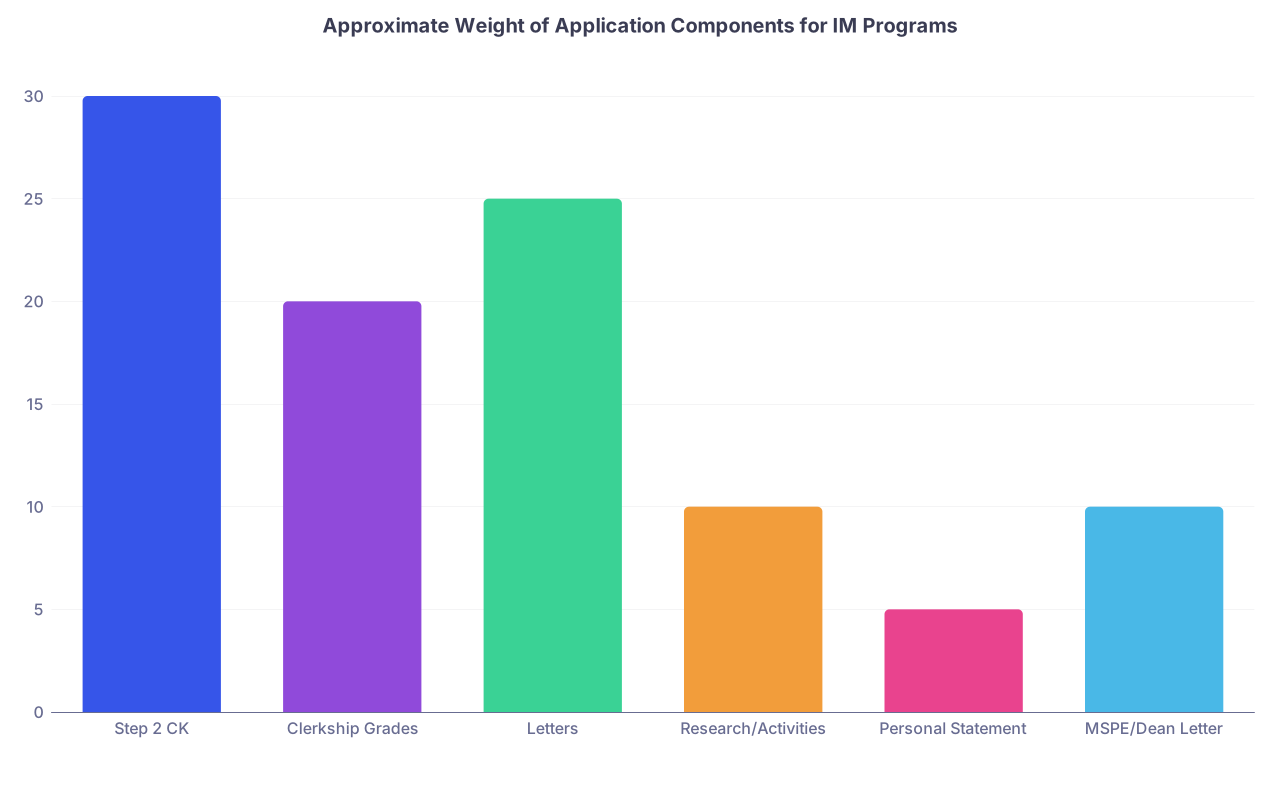
| Category | Value |
|---|---|
| Step 2 CK | 30 |
| Clerkship Grades | 20 |
| Letters | 25 |
| Research/Activities | 10 |
| Personal Statement | 5 |
| MSPE/Dean Letter | 10 |
That “Clerkship Grades” piece? It’s not “medicine honors or bust.” It’s:
- Did you pass everything?
- Do your grades roughly match your narrative?
- Any red flags? (unexplained low Passes, repeated poor feedback, professionalism issues)
- Are you trending upward?
So:
- A transcript of HP in medicine, a couple honors in other cores, strong Step 2, and glowing letters? That reads like “good resident material,” not “problem student.”
- A transcript of all Passes, weak Step 2, mixed comments, and no strong letters? That’s when people start to worry.
The hard truth: no honors in medicine is never the whole story. It’s an ingredient. If the rest of the recipe is solid, this one ingredient doesn’t ruin the dish.
Worst Case Thinking: When “No Med Honors” Really Hurts
Let me indulge the catastrophizing brain for a second and be specific about worst-case scenarios.
Rougher scenario 1: Applying to very competitive IM without Med H
You want:
- Top-tier academic IM
- Research-heavy programs
- Potential cards/hem-onc/GI fellowships down the road
And you have:
- No honors in medicine
- Maybe some honors elsewhere
- Step 2: average or slightly below the programs’ norms
- Research: light or generic
In that combo, yeah, it hurts. Because for those programs, they’re flooded with:
- Medicine honors
- AOA
- Multiple pubs
- Strong name-brand letters
Does it mean you won’t match IM? No. It means you may not match there. You shift from “top tier likely” to “target mid-tier/strong community, reach a few big names.”
I’ve seen people match strong academic IM with no med honors because they had:
- Great sub-I letter in medicine or ICU
- Clear upward trend
- Strong Step 2 (240+ for US MD, a bit higher expectation for DO/IMG)
- Authentic, sharp personal statement that actually said something
So even in the “annoying” scenario, it’s not game over. It’s more like, “your list needs to be realistic now.”
Rougher scenario 2: Pattern of “barely passing” plus no Med H
If your evals say:
- Several Passes in core rotations
- Comments like “needed frequent reminders,” “time management concerns”
- No standout letters
Then no med honors is just one piece of a bigger concern picture. What worries PDs isn’t the absence of an H, it’s the absence of any clear sign of excellence.
That’s when you absolutely need:
- A killer sub-I performance (and a letter that says so)
- Some faculty advocate who can vouch you’ve improved
- Honest explanations in your MSPE or advisor letter if there were specific issues that are now resolved
But that’s a different story than “I got High Pass in medicine and now my brain is screaming that I’m unemployable.”
Things That Can Quietly Offset No Medicine Honors
Here’s where you have more power than your anxiety is admitting.
You can’t change that grade now. But a lot of other things are still very much in play.
1. Do a medicine sub-I and treat it like your personal redemption arc
Sub-internship is where you can basically tell programs: “Look again. I’m better than that original grade.”
If your medicine clerkship was HP and your sub-I eval says:
- “Functioned at intern level”
- “Independent, reliable, excellent follow-through”
- “Top student I’ve worked with this year”
Programs pay attention. A strong sub-I can emotionally “overwrite” a missing H in their minds.
2. Crush Step 2 (relative to your peers and target programs)
I know. Everyone says “just crush Step 2” like that’s easy.
But reality: a strong Step 2 makes people stop squinting at your transcript. It tells them, “Whatever weirdness happened with clerkship grading, this person knows medicine.”
If your med clerkship grade feels like an anchor, your Step 2 score is now your lifeline.
3. Get at least one medicine-heavy letter that actually says something
Letters are brutally underrated in our own anxiety calculus.
You’re thinking, “No med honors = I’m toast.”
They’re thinking, “This letter says you’re reliable, smart, kind to nurses, and teachable. That’s who we want at 2 a.m.”
A generic letter won’t save you. But a specific one might. Stuff like:
- “She made detailed, accurate daily plans and anticipated next steps.”
- “He took ownership of his patients and followed through consistently.”
- “I would be delighted to have her as an intern in our program.”
That kind of language will absolutely soften the blow of not having an H.
Reality Check: Not All Schools Even Give Many Medicine Honors
This part drives me nuts.
Some schools hand out honors like candy. Others give 10–15% per clerkship. Some link honors to NBME shelf cutoffs that are wildly strict. Others use complicated “weighted formula” nonsense that no one fully understands.
Most PDs know this. Because they see your MSPE.
The MSPE usually has some version of: “In this clerkship, X% of students received Honors, Y% High Pass, Z% Pass.”
So they can see:
- If your school gives 40% Honors in medicine and you got HP → that’s more noticeable
- If your school gives 10–15% Honors and you got HP → that’s not nearly as damning
They also see the narrative. I’ve seen students with HP in medicine but MSPE text like:
“One of the strongest students on the team. Excellent clinical reasoning. Performed in the top group of the rotation.”
Grading can be political, subjective, or just structurally restrictive. PDs know. It doesn’t mean they ignore grades, but they’re not as naive as we act like they are when we’re spiraling.
If You’re Not Going Into IM, How Much Should You Care?
This is the part that might actually let you breathe.
If you’re going into:
- Surgery – They care more about surgery honors and surgery letters. Med H is nice, but I’ve seen plenty of matched surgery residents with HP in medicine.
- Peds – They like to see you did fine in medicine, but a strong pediatrics clerkship and letters matter more.
- FM – They want someone reliable, decent clinically, and teachable. Medicine grade matters, but not in an obsessive way.
- Psych, neuro, EM, etc. – Again, medicine grade is a data point, not destiny. A strong performance in their own specialty + good Step 2 + no red flags will carry more weight.
If you’re applying, say, EM with:
- HP med
- Honors in EM
- Great SLOEs
- Decent Step 2
No one is throwing your app into a shredder because you didn’t honor medicine.
How to Talk About It (Without Sounding Defensive or Pathetic)
At some point, an interviewer might glance at your transcript and ask something like, “So how did you find your medicine clerkship?”
You don’t launch into: “Well, I really wanted honors, but my attending was unfair and the eval was late and…”
No. You say something like:
- “Medicine was a huge learning curve for me. I started out slower than I wanted, but by the end of the rotation and especially during my sub-I, I felt much more comfortable managing complex patients. That growth is reflected more in my sub-I and Step 2 than that original grade.”
Or, if it really was just arbitrary:
- “I was proud of how I performed on medicine, even though the final grade was High Pass. I got detailed feedback about [specific skills] and I took that into my sub-I, where I think I really hit the level of responsibility I want as an intern.”
Own the growth. Don’t over-explain. Don’t whine. Show them you’re reflective and moving forward.
When to Actually Worry vs When You’re Just Torturing Yourself
Here’s my blunt line in the sand.
You should genuinely worry (and actively strategize) if:
- You have no medicine honors
- AND weak or average Step 2
- AND no standout letters
- AND you’re aiming only for the most competitive, top-tier programs in a competitive specialty
That combo means: time for a reality-based rank list and maybe a broader application strategy.
You should probably stop doom-scrolling Reddit and breathe if:
- You have HP in medicine or a mix of HP/H across rotations
- You passed everything first try
- You have solid, specific letters
- Your Step 2 is in range for your target programs
- You’re applying to IM, peds, FM, psych, EM, or a decently attainable specialty
That combo gets people matched every single year.
And yes, including people with no med honors.

| Step | Description |
|---|---|
| Step 1 | No Honors in Medicine |
| Step 2 | Broaden Program List |
| Step 3 | Still Very Viable Applicant |
| Step 4 | Strong Step 2? |
| Step 5 | Strong Letters? |
| Step 6 | Other Honors or Strengths? |
Bottom Line: How Much Does “No Honors in Medicine” Really Hurt?
Let me condense all the noise into something you can actually hold onto:
- It’s a ding, not a death sentence. For top academic IM, it hurts. For most other reasonable goals, it’s one factor among many, not the deciding blow.
- Context is everything. Your Step 2, sub-I, letters, and overall pattern matter more than this single missing H. A strong sub-I and a good score can more than compensate.
- You’re not the only one. Every year, plenty of students with no medicine honors match into solid IM, peds, FM, psych, EM, and even competitive programs. PDs know grading is messy.
You don’t have to pretend it doesn’t bother you. But don’t let one line on a transcript rewrite your whole story. You’ve got more control over the rest of the narrative than your anxious brain wants to admit.