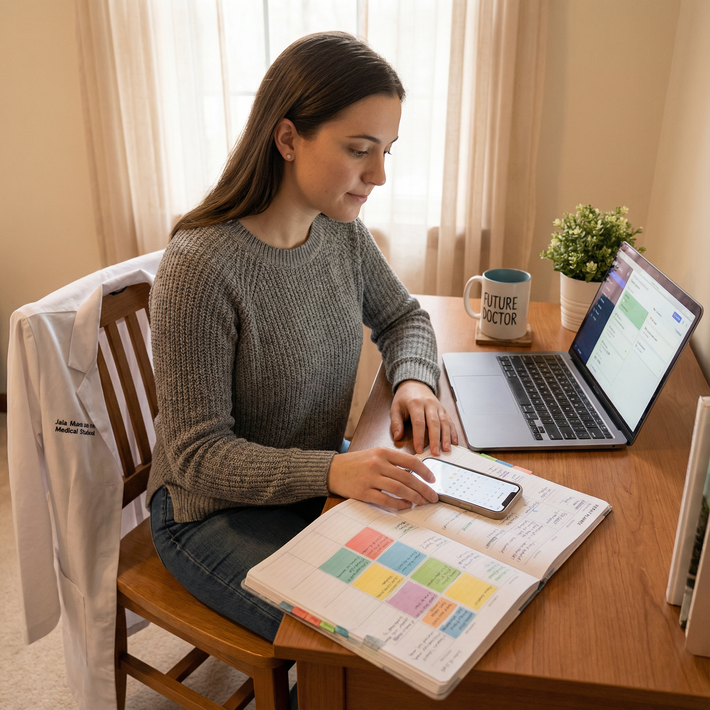
Showing up absurdly early for rounds has become one of medical school's favorite superstitions. Students treat the clock like it is an evaluator. They believe that if they are physically present 30 minutes early, someone important will notice, translate that into "professionalism," and reward them with honors.
That is mostly wrong.
Yes, being late is bad. Obviously. Repeated lateness is a professionalism problem, and professionalism problems sink evaluations fast. But arriving 30 minutes early just to exist in the hallway, hover near the workroom, or stare at Epic does not meaningfully boost your grade. It is not a cheat code. It is not a hidden lever. It is often just dead time wrapped in anxiety.
The real question is more precise: does arriving 30 minutes early correlate with higher clinical evaluations? My answer is blunt. Not by itself. Punctuality is a hygiene factor. It keeps you from losing points. It does not reliably earn you points. Preparedness does.
That distinction matters because morning rounds are part of the hidden curriculum of medical school. Students are not just learning medicine. They are trying to decode rituals. Who stands where. Who speaks first. Whether asking a question looks engaged or clueless. Whether being early looks diligent or awkward. I have watched students burn energy on the optics of medicine while neglecting the substance. Wrong target.
If you want a better grade, stop optimizing for being seen early and start optimizing for being useful early.
This article is for educational purposes only. It is not financial advice, not legal advice, and not tax advice. Figures vary by individual circumstances, so consult a qualified professional before acting.
Introduction: The Clock-Watching Anxiety
Every medical student knows this feeling. You wake up before sunrise, check the time three times in four minutes, and convince yourself that arriving five minutes late will somehow become a permanent stain on your career. It is irrational, but it is universal. The hospital amplifies time anxiety because everything feels consequential. A delayed discharge. A missed lab. A resident who seems annoyed. Suddenly your arrival time feels like a proxy for your character.
That fear feeds a specific hypothesis: maybe if you show up 30 minutes early, you create a buffer and signal commitment. Maybe the attending notices. Maybe the resident mentions it. Maybe it floats into your evaluation as "hardworking," "professional," "goes above and beyond."
That is the myth.
The reality is cleaner and less flattering. Punctuality is expected. Full stop. Nobody gives extra credit for meeting a baseline professional standard. You do not get honors because you occupied a chair near the workroom before sunrise. You get honors because when someone asks, "What happened overnight? What is the sodium today? Why are we continuing this antibiotic?" you answer clearly and correctly. Or, if you do not know, you recover intelligently.
Morning rounds are not a stage play where the best actor wins by arriving first. They are a workflow. A moving chain of chart review, handoff, team huddle, bedside updates, teaching, and decision-making. The hidden curriculum is not "be early at all costs." It is "arrive with enough time to become useful."
That is the real game.
The Myth: The "Proactive" Bias
Let me break down why this myth survives.
People confuse visible effort with valuable effort. That happens everywhere, but medicine is especially vulnerable to it because training is hierarchical and public. If you are the student who arrives very early, looks serious, holds a coffee, and keeps opening the chart, you fit the visual stereotype of diligence. You look like a good student before you have actually done anything.
That is the proactive bias. We assume early arrival equals industriousness.
Medical school also worships the "Good Student" archetype. This person is eager, deferential, never complains, and seems endlessly available. Time becomes part of the costume. The student who is always there first appears more committed than the student who arrives closer to the start time, even if the second student has already reviewed the patient list, checked overnight events, and prepared two smart questions.
This is where the logic falls apart.
Time spent waiting is not the same as time spent learning. And it definitely is not the same as time spent contributing. If you arrive 30 minutes early and spend 25 of those minutes sitting outside the workroom refreshing the chart with no plan, that is not discipline. That is inefficient anxiety. I have seen students do this constantly. They think they are demonstrating professionalism, but what they are actually demonstrating is uncertainty about what useful preparation looks like.
Worse, performative punctuality can backfire.
A student planted in the hallway far too early often gives off one of two signals. Either they are nervous and do not know how to structure their morning, or they are trying a little too hard to be seen trying hard. Neither is impressive. Attendings and residents are usually too busy to be charmed by visible hovering. They want a student who can plug into the workflow, not someone who needs the workflow to notice them.
There is also a subtler issue. Medicine punishes unnecessary friction. If your early presence creates social pressure for the resident to acknowledge you, find you something to do, or alter their own pre-round rhythm, you have made yourself a burden. Quietly. Accidentally. But still a burden.
That is why I call this performative diligence. It looks industrious from a distance, but up close it is empty calories. The hospital is full of people who are busy. The evaluators are not impressed by someone who merely appears busy.
They are impressed by clean presentations, accurate follow-up, situational awareness, and calm execution. Different currency entirely.
The Reality: The Anatomy of Morning Rounds
To understand why 30 minutes early usually does not matter, you need to understand what morning rounds actually are. Students talk about "rounds" like it is one event. It is not. It is usually three different activities wearing the same name tag.
First, the huddle. This may happen in a workroom, hallway corner, or outside a nurses' station. The team aligns on overnight events, urgent problems, discharges, and who needs to be seen first.
Second, the walk-through. This is the movement phase. The team goes room to room, updates plans, clarifies issues, and decides what needs to happen before noon.
Third, bedside teaching. This is the slower moment, when an attending chooses a patient or a problem and starts asking questions. Sometimes excellent. Sometimes painful. Often both.
Now think about that 30-minute pre-round window. What actually happens there?
If you use it to review overnight vitals, new labs, intake and output, consultant notes, and the day's working plan, that time is valuable. If you use it to see your patient briefly and confirm how they feel this morning, even better. That is pre-rounding.
If you use it to stand around because you are afraid not to be there, it is wasted.
This is the distinction students routinely miss: arriving early is not the same as pre-rounding. Presence is not preparation. You can be physically early and mentally absent. You can also arrive 12 to 15 minutes before start time, review exactly what you need, and enter rounds sharp, calm, and useful. Guess which student scores better.
Another reality students ignore: team dynamics are delicate in the morning. Residents are triaging chaos. Interns are checking overnight changes. Seniors are deciding what matters. Attendings may be reviewing charts alone, grabbing coffee, or mentally organizing the day. A medical student who materializes too early without a role can disrupt that rhythm.
Not dramatically. Usually subtly. The resident now feels watched. The attending feels they need to make small talk. Someone asks, "Did you need something?" because your presence implies a request. This is not catastrophic, but it is not additive.
The sweet spot is enough time to prepare, not enough time to loiter.
And yes, there are specialty differences. Surgery often has earlier, faster, more compressed workflows. Internal medicine usually offers more room for independent chart review and floor pre-rounding. But the principle still holds. Use your early time to build situational awareness, not to stage a performance.
The Attendings' Perspective: What They Actually Notice
Students wildly overestimate how much attendings track exact arrival times. Attendings are not running a stopwatch. They are running a service.
What they notice is different. I think of it as competence radar.
They notice whether you know your patient. They notice whether your oral presentation has a logical structure. They notice whether you can identify the active problems rather than reciting trivia from the chart. They notice whether you are teachable, whether you recover when corrected, and whether your presence makes the team smoother or clunkier.
That is the scoreboard.
A student waiting outside for 30 minutes often sends the wrong signal. I have seen attendings interpret that posture not as grit, but as uncertainty. Why are you here this early? What have you done with the time? Do you know what you are supposed to be gathering? If the answer is no, then the extra 30 minutes has become evidence of disorganization.
There is also the anxiety signal. Medicine has a keen eye for anxiety, especially the kind that expresses itself behaviorally. Hovering. Overapologizing. Repeating obvious facts. Showing up excessively early just to stand by the workstation. These behaviors do not say "reliable." They say "I am trying not to mess up and I do not know where to put that energy."
Attendings also care about boundaries and flow more than students realize. If you arrive early and interrupt their quiet review time with premature questions, you are not earning points. You are actively losing them. Badly. The morning before rounds is when many attendings are deciding what they care about, what to teach, and which patients need immediate attention. They do not want to be derailed by a student seeking reassurance through proximity.
Preparedness, though? That gets noticed instantly.
If the attending asks, "Why did the creatinine rise?" and you answer, "It went from 1.1 to 1.6 after diuresis yesterday; urine output was high and blood pressure dipped overnight, so prerenal physiology is likely," that is memorable. If they ask, "What is the plan for discharge?" and you can say, "PT cleared the patient, daughter can pick him up after 3 p.m., and we are waiting on final ID recommendations," that is useful. Useful wins evaluations.
That chart captures the truth better than the hallway folklore does. Punctuality matters. Absolutely. But it mostly prevents damage. Preparedness creates upside.
Being able to answer immediately, synthesize briefly, and identify what matters is worth far more than 10 hours of visible waiting over the course of a rotation. Attendings remember friction and fluency. Not your dramatic relationship with the clock.
The Real Boost: The "Pre-rounding" Protocol

Here is what actually improves your grade: a disciplined pre-rounding routine.
My rule is simple. Arrive about 15 minutes early with a job to do. Not 30 minutes early with nothing to do.
That 15-minute window is enough for a focused student to become dangerous in the best way. You are not trying to reread the entire chart. You are trying to answer the questions that rounds will care about.
Use a tight checklist:
- What happened overnight?
- Any new vitals trend that matters?
- New labs? Especially abnormal ones that change the plan?
- Any new imaging, consultant note, or nursing issue?
- What was yesterday's plan, and did it work?
- What is likely to be discussed today?
- Is there one likely teaching point here?
That last item is underrated. The best students do not just know data. They anticipate what will be educationally relevant. If your patient has decompensated cirrhosis, know why the sodium matters and what precipitates encephalopathy. If your patient has heart failure, know whether the team is prioritizing diuresis, guideline-directed therapy, or discharge readiness. That is how you walk into the huddle looking ready rather than merely present.
The huddle entry matters too. Do not drift in silently like a ghost and do not burst in performing confidence. Aim for professional clarity. You are there, on time, organized, and ready to plug in. If a resident asks, "Anything overnight on your patient?" you should be able to answer in two sentences, not a nervous monologue.
For example:
"Mr. Lewis had no acute overnight events. His oxygen requirement is unchanged, creatinine is stable, and I saw that PT evaluated him yesterday, so I think the main issue today is whether he is ready for discharge with home support."
That is good student behavior. Crisp. Relevant. Forward-looking.
This protocol also improves patient interactions. When you pre-round properly, you are not seeing the patient cold with the team clustered behind you. You already know the broad plan. You can ask a focused question. You can catch mismatches between the chart and reality. Maybe the note says pain is controlled, but the patient says they did not sleep because of severe pain. Maybe the note says tolerating diet, but the patient has been nauseated since 4 a.m. That is real value.
It also reduces errors. Small ones, usually. But small errors matter. The student who checked the morning potassium before rounds may prevent an embarrassing attending question or prompt a needed repletion. The student who notices that a discharge hinges on transportation can save an afternoon delay. These are not glamorous contributions, but they are the texture of strong evaluations.
What does not help? Standing around at 6:30 a.m. pretending you are absorbing medicine by osmosis.
I have seen students arrive very early and then accomplish nothing because they never developed a protocol. They scroll old notes. They recheck stable CBCs. They pace near the resident workstation waiting to be assigned importance. Wrong move. Good students do not wait to feel useful. They prepare to be useful.
So if you want one practical takeaway, it is this: replace vague early arrival with structured pre-rounding. A watch does not earn points. A plan does.
The Cost of Disruption: Why Being Late Is Worse
Let us be equally clear about the other side. Being late is worse than being too early.
Why? Because lateness creates immediate friction. The team pauses. Someone has to update you. The attending notices the missing body and then notices the reappearance. Momentum breaks. On a busy service, especially one juggling admissions and discharges, that ripple effect is real.
The first five minutes of rounds matter disproportionately. They set the tone. A student who is present, organized, and attentive from the start looks professional. A student who rushes in flustered has to dig out of that impression before saying a single medically intelligent thing.
Still, one isolated late arrival will not tank your grade. I have seen students recover just fine. The key is resilience, not dramatics. Walk in. Apologize briefly. Do not deliver a TED Talk about traffic. Ask what you missed. Catch up fast. Then be solid for the rest of the day.
What kills evaluations is the pattern. Repeated lateness says you do not respect the workflow. It tells the team they cannot rely on you. That label sticks far more than students realize.
So no, punctuality does not win honors by itself. But lack of punctuality can absolutely cost you. Baseline expectations are unforgiving that way.
Conclusion: Mastering the Timing

Here is the clean answer. Showing up 30 minutes early on rounds does not boost your grade unless you use that time to pre-round with intention. Punctuality is a baseline requirement. It is not a bonus category. Nobody is handing out honors for hallway waiting.
The Goldilocks zone is simple: arrive early enough to review the patient, labs, and plan, but not so early that you become dead space in the team's morning. For most medical students, that sweet spot is about 15 minutes. Sometimes a little more in a high-volume service. Sometimes a little less on a tightly choreographed team. But the principle stays the same.
Your grade is determined by value. Can you synthesize? Can you anticipate the plan? Can you answer questions without collapsing? Can you recover when you miss? Can the team trust that your patient updates are accurate?
That is the real hidden curriculum.
So stop clock-watching and start chart-watching. That is how you look prepared because you are prepared.
Action steps:
- Find out the actual workflow of your team on day one.
- Aim to arrive about 15 minutes early unless your service clearly requires more.
- Use a pre-round checklist every morning.
- Know overnight events, vitals trends, new labs, and the likely daily plan.
- Enter the huddle with one useful update, not performative enthusiasm.
- If you are late once, apologize briefly and recover fast.
- Build your reputation on reliability and preparation, not on hovering.