
The way most students use UWorld wastes at least half of its value.
You are obsessing over percentages and question counts when the real gold is buried in the explanations.
Let me break this down specifically.
Most people treat UWorld like a quiz app: click an answer, skim why it was right or wrong, move on. That is board-prep for amateurs. Shelf and Step killers use UWorld as a teaching text, where the explanations are the primary curriculum and the questions are just the delivery vehicle.
This is not about “doing more questions.” You probably cannot safely increase volume without burning out or trashing retention. This is about extracting 2–3 times more usable shelf-level pearls per question block, without adding 2–3 times more time.
The Core Mindset: Question vs. Explanation
Most students think the question is the point. It is not. The explanation is.
The question does two things:
- Forces recall under mild stress
- Exposes the gaps in your mental model
The explanation, done properly, does everything else:
- Builds clinical pattern recognition
- Clarifies what exam writers care about
- Provides high-yield “if they give you X, the answer is Y” linkages
- Shows common distractors and how they phrase traps
Your strategy has to reflect that.
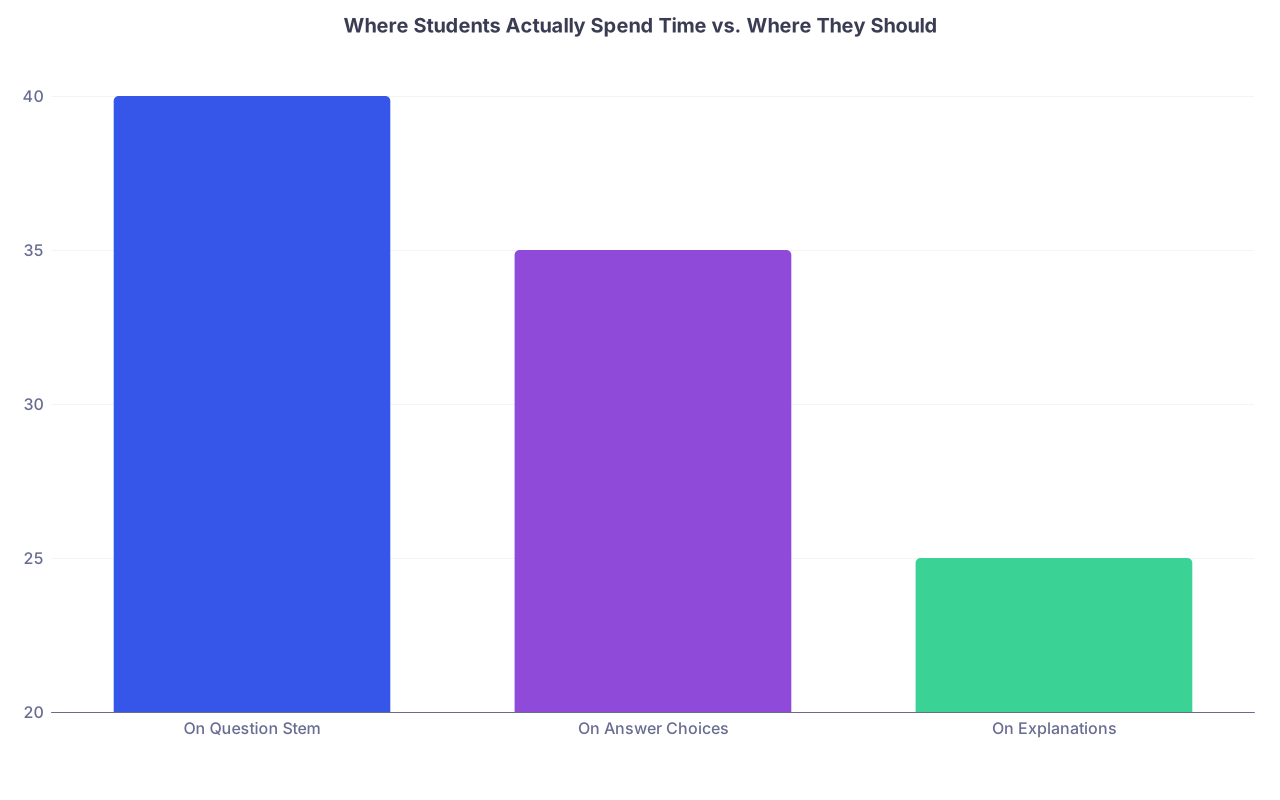
| Category | Value |
|---|---|
| On Question Stem | 40 |
| On Answer Choices | 35 |
| On Explanations | 25 |
If you want shelf-level performance, that last bar needs to be the biggest one.
Target distribution for serious students:
- 20–25%: reading and answering the question
- 10–15%: reviewing answer choices
- 60–70%: mining the explanation for patterns, rules, and anchors
You are not just trying to understand that question. You are trying to extract rules that will answer the next 10 questions on that topic.
Building an Explanation-Mining Workflow
Here is the skeleton:
- Do the block (timed, random, exam-like).
- Triage: which questions deserve deep explanation-mining?
- Extract: turn explanations into reusable, portable “pearls.”
- Connect: plug those pearls into your mental frameworks and external system (Anki, notes, OneNote, Notion, whatever).
Step 1: How You Do the Block Actually Matters
You cannot mine explanations effectively if your blocks are garbage.
- Mode: Timed, random, tutor off for most of prep.
- Environment: library, desk, or call room–like environment. Phone away.
- Goal: approximate shelf conditions. Sustain attention, no pausing every 30 seconds.
When you answer:
You can and should note (mentally or on scratch paper) why you are choosing an answer in 3–7 words. Not full sentences, just the core reasoning:
- “Acute limb pain + sickle cell = salmonella osteo vs Staph”
- “Chronic smoker + hypercalcemia = PTHrP, squamous cell”
- “Third trimester painless bleeding = placenta previa”
Why? Because later, when you read the explanation, you want to compare:
- What you thought → what UWorld expects
That delta is where the pearls live.
Step 2: Triage – Not Every Question Deserves a Deep Dive
Here is where people blow time. They treat every question as equal. UWorld is full of repeats and low-yield edges. You need a triage system.
For each question, assign it to one of three buckets:
Green (Fast Pass)
- You got it right.
- You knew why.
- Your reasoning matched the explanation.
- Content is familiar, already in your deck/notes.
Action:
- Skim explanation in 15–30 seconds.
- Ask: “Any new differentiation pearl or phrasing trick?” If no, next question.
Yellow (Focused Review)
- You got it right but felt shaky.
- You got it wrong but recognized the topic.
- You narrowed to 2–3 options but chose the wrong one.
Action (2–4 minutes):
- Read the explanation only for the correct answer and the distractor you picked.
- Extract: 1–3 pearls that would have forced you to choose correctly.
- Decide if this deserves a card/note.
Red (Deep Dive)
- You had no idea what was going on.
- You guessed randomly.
- You misclassified the entire question (e.g., thought it was nephritic vs nephrotic; thought it was septic shock vs cardiogenic).
- Topic is clearly high-yield and appears often in UWorld (e.g., preeclampsia, DKA management, COPD exacerbation).
Action (4–8+ minutes):
- Read full explanation carefully, including alternative answer explanations.
- Reconstruct the entire concept from the ground up with a tight summary.
- Generate multiple pearls (path, diagnosis, management, contraindications).
- Likely create 2–5 cards/notes from this one question.
If you do nothing else and just implement this triage, your explanation time becomes lethal instead of bloated.

What to Pull From a UWorld Explanation (And What to Ignore)
Let us be specific. Because “just read the explanations” is useless advice.
For each explanation, your job is to extract transferable rules, not copy the text. There are six main categories worth targeting.
1. Trigger Words and Pattern Anchors
These are the phrases that, on exam day, should immediately light up a diagnosis or management pathway in your head.
You look for:
- Age + key symptom pattern
- Time course (acute vs chronic vs peripartum vs postpartum)
- Characteristic labs or imaging findings
- “Buzzless buzzwords” – not classic FA buzzwords, but UWorld’s own way of hinting
Example from peds shelf:
- Question stem: 2-year-old with painless rectal bleeding, normal vitals, no abdominal pain.
- Explanation: “Meckel diverticulum often presents as painless lower GI bleeding in children age <2; technetium-99m pertechnetate scan identifies ectopic gastric mucosa.”
Pearl extraction:
- Age anchor: <2 years, painless lower GI bleed → think Meckel before anything else
- Test-of-choice anchor: technetium-99m pertechnetate scan = Meckel scan = ectopic gastric mucosa detection
You do not write: “Meckel diverticulum is a remnant of the vitelline duct…” Save the embryology for elsewhere. The shelf uses the pattern, not the textbook paragraph.
2. “If They Give You X, You Must Choose Y” Rules
These are direct mapping rules. The highest-yield material lives here.
Examples:
- “Patient with NSTEMI undergoing PCI who is aspirin-allergic → use clopidogrel.”
- “Symptomatic pregnant patient at 32 weeks with placenta previa and active bleeding → C-section, no digital cervical exam.”
- “Young woman with first unprovoked seizure and normal exam → get MRI brain + EEG, no immediate long-term AED unless criteria met.”
When UWorld explicitly states a rule in this style, capture it. You want dozens of these per system. That is how you crush management questions where every option sounds plausible.
3. Common Distractor Differentiation
Shelf writers love to set up two lookalike diagnoses and see if you know the one discriminating feature. UWorld explanations often lay this out clearly—if you are paying attention.
You look for phrases like:
- “Unlike [distractor], this condition typically…”
- “This is not [other condition] because…”
- “Key differentiator is…”
Example from psychiatry:
- Explanation for borderline personality disorder: “Unlike bipolar disorder, borderline personality disorder has mood shifts that are triggered by interpersonal stressors and last hours to days (not weeks), with chronic pattern of unstable relationships and self-image.”
You convert this to:
- Mood changes lasting hours–days + fear of abandonment + chronic relational chaos → BPD
- Mood episodes lasting weeks with clear euthymic intervals → think bipolar
Then you do the same for, say, BPD vs histrionic vs narcissistic. Stack those differences somewhere you will see them again.
4. Exam-Loved Numbers and Thresholds
UWorld is excellent at hinting which numerical cutoffs matter on exams, as opposed to what your attending casually mentions on rounds.
Whenever you see a specific number paired with a decision, flag it.
Examples:
- “Platelets <50,000 → avoid LMWH before surgery; consider platelet transfusion if invasive procedure planned.”
- “Persistent BP ≥160/110 for severe preeclampsia; treat with IV labetalol, hydralazine, or oral nifedipine.”
- “ASCUS cytology, age 25+, HPV negative → repeat co-testing in 3 years.”
Collect these. Do not overdo random numbers, but the decision-making cutoffs are tested relentlessly.
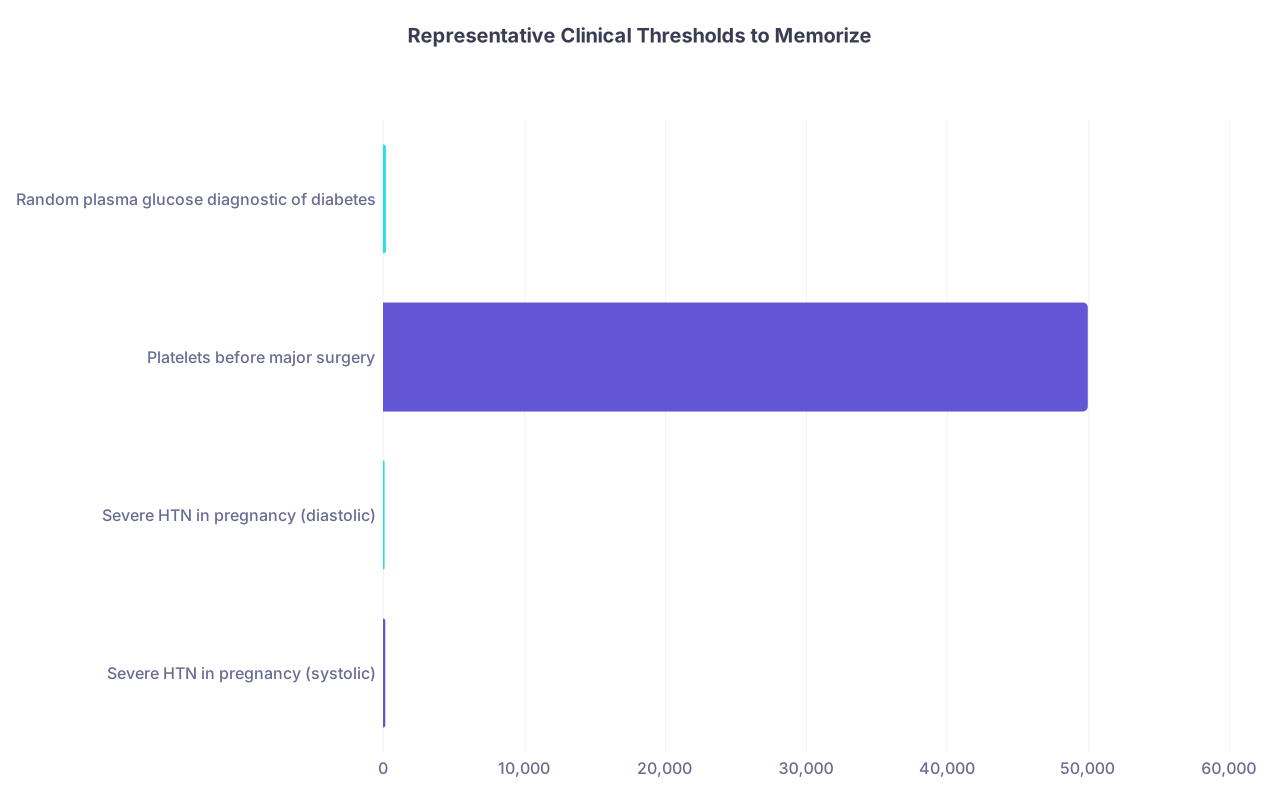
| Category | Value |
|---|---|
| Severe HTN in pregnancy (systolic) | 160 |
| Severe HTN in pregnancy (diastolic) | 110 |
| Platelets before major surgery | 50000 |
| Random plasma glucose diagnostic of diabetes | 200 |
You are not trying to flash cards on every lab range. Just the ones that flip a management choice.
5. Stepwise Management Algorithms
This is where shelves really separate people. Many UWorld explanations give a reasonably clean version of the algorithm buried across 5 pages of a guideline.
You want:
- First-line test
- First-line treatment
- Next step if that fails or contraindicated
- What not to do (classic exam trap)
Example from IM shelf (COPD exacerbation):
UWorld explanation might say:
- Initial treatment: short-acting bronchodilators + systemic steroids + oxygen titrated to 88–92%.
- Add antibiotics if 2 of 3 cardinal symptoms: dyspnea, sputum volume, sputum purulence.
- Noninvasive positive pressure ventilation if hypercapnic respiratory failure with alert mental status.
- Intubation if NPPV fails or patient deteriorates.
You abstract this into a tight ladder in your own words. Possibly as a mini algorithmic note or a 3–4 card set, not a paragraph.
6. Phrasing and Question-Writing “Tells”
This is more advanced, but if you want to play at the top of the curve, you start noticing how UWorld phrases specific ideas.
For instance:
- “Patient appears comfortable, no acute distress” in a GI bleed question → probably a slow bleed, think outpatient colonoscopy vs emergent intervention.
- “Nontender lymphadenopathy, night sweats, weight loss” → do not overthink, this is lymphoma workup.
- “Patient has no prior medical records available” in a chronic condition scenario → they are forcing you to treat as new diagnosis, not rely on unknown history.
These are soft signals, but UWorld uses them consistently. Pay attention, and you start reading between the lines of shelf questions instead of being jerked around by each paragraph.
How to Turn Explanations Into Retainable Pearls
Reading a beautiful explanation and “feeling like you get it” is a trap. You will forget 80% of it in 48 hours unless you convert it into something your brain or your system will see again.
Two main tools here: structured notes and spaced repetition.
Strategy 1: High-Yield, Low-Volume Notes
You are not writing a second textbook. You are building a personal exam manual.
Principles:
- Use headings by system + topic (e.g., IM → Cardio → ACS, Peds → ID → Meningitis).
- Under each topic, collect UWorld-derived rules and contrasts.
- Write in short, exam-focused lines, not prose.
Example: IM → Nephrology → Nephritic vs Nephrotic
- Nephritic: HTN, hematuria (RBC casts), mild proteinuria, low complement in PSGN, rapid rise in Cr.
- Nephrotic: heavy protein >3.5 g/day, edema, hyperlipidemia, fatty casts.
- If kid with hematuria 2–3 weeks post strep throat + low C3 → PSGN → treat supportively.
- If kid with hematuria and hearing loss + family history → Alport → mutation in type IV collagen.
You then plug shelf-style UWorld distinctions under these headers as you encounter them. This way, every time you study nephritic/nephrotic from a book, you cross-reference with what questions have actually been testing.

Strategy 2: Smart Anki From Explanations (Not From Questions)
If you are using Anki, you should not be blindly “cloze’ing” UWorld question stems. That is lazy and creates bloated, low-yield decks.
Instead, you mine explanation-derived rules into tight, 1:1 cards.
Good card examples from UWorld explanations:
Q: Child <2 years with painless rectal bleeding – best diagnostic test?
A: Technetium-99m pertechnetate scan (Meckel scan) for ectopic gastric mucosa.Q: Key clinical feature that differentiates bipolar disorder from borderline personality disorder regarding mood episodes?
A: Bipolar episodes last weeks with clear symptom-free intervals; BPD mood shifts occur over hours–days and are triggered by interpersonal stressors.Q: Initial pharmacologic treatment for severe range BP (≥160/110) in pregnancy?
A: IV labetalol, IV hydralazine, or oral nifedipine.
Bad cards:
- Huge cloze deletions of entire sentences from UWorld explanation.
- “What is Meckel diverticulum?” (Too broad, not task-oriented.)
- 8-fact cards (you forget one, card is “wrong,” and you stop doing them).
Rule: if you cannot review the card in 5–10 seconds, it is probably too big.
Block Review: Putting It All Together in Real Time
Let me walk you through a 40-question block review done properly.
You finish a 40-question IM block. Score: 60%. You feel miserable. Fine.
Now the work starts.
Pass 1: Quick Outcome Scan (5–7 minutes)
You run through all 40 questions with just the following focus:
- Mark: Green / Yellow / Red
- Brief note if needed: “shock type confusion,” “diabetes screen recs,” “hep B serology mix-up”
Do not read full explanations yet. You are triaging.
Let us say you end up with:
- 10 Green
- 18 Yellow
- 12 Red
Pass 2: Green – Minimal Time (10–15 minutes total)
For each Green question:
- Skim the explanation in under 30 seconds.
- Ask: any new “X → Y” rule, threshold, or distractor comparison I did not already know?
- If yes, note it under the relevant topic or add one card. If no, next.
You are done with Greens fast. Good.
Pass 3: Yellow – Focus on Mis-calibration (30–45 minutes)
This is where you fix shaky foundations.
For each Yellow:
- Read the explanation for the correct answer and the distractor you chose.
- Identify the one discriminating feature you missed or mis-weighted.
- Formulate it in question-answer format.
Example:
You got a question on heart failure treatment correct (chose ACE inhibitor), but were between ACE and ARB.
Explanation: “ACE inhibitors are first-line for systolic heart failure unless the patient has a history of ACE-induced cough or angioedema, in which case ARBs are used.”
Your pearl:
- For HFrEF, choose ACE inhibitor first-line unless ACE-intolerant (cough, angioedema) → then ARB.
One Anki. Done.
Do not rewrite the whole HF guideline. That is elsewhere.
Pass 4: Red – Deep Concepts (45–75 minutes)
Now the ugly 12.
Here you slow down. For each Red question:
- Read the explanation fully, including alternative answer explanations.
- Identify why you got it wrong:
- Did not know the disease at all?
- Knew disease but misapplied management?
- Misread key detail in stem?
Then you:
- Write a 2–4 line summary of the entire concept in your words.
- Extract 2–5 discrete pearls (pattern, test, treatment, red flags).
- Add them to:
- Your system-organized notes, and/or
- 2–5 new cards
Example, OB question on shoulder dystocia management:
Stem: Delivery complicated by fetal head delivering then retracting (“turtle sign”). You guessed “forceps-assisted delivery.” Wrong.
Explanation describes McRoberts maneuver, suprapubic pressure, etc.
Your output:
- Shoulder dystocia sign: fetal head retracts (“turtle sign”) after delivery of head.
- First-line maneuvers: McRoberts (hyperflex maternal hips) + suprapubic pressure.
- Do NOT use fundal pressure (worsens impaction).
- Last-resort: Zavanelli (cephalic replacement) + C-section.
You build 3–4 cards from this and plug the management ladder into an OB note.
Now next time you see the word “turtle sign,” your hand will move to McRoberts + suprapubic pressure without drama.
Making It Shelf-Specific (Not Just Step-Style)
The article title says “shelf-level.” That matters. UWorld is written mostly for Step 2 CK level, which overlaps heavily with shelves but is not identical.
Here is how you tune your explanation-mining to shelves.
Prioritize Core Shelf Syndromes
Each shelf has a list of “they will absolutely ask this multiple times.” You should be especially aggressive mining explanations on those.
For example:
- IM: ACS, CHF, COPD/asthma exacerbation, PE, DKA/HHS, stroke/TIA, cirrhosis complications, AKI, anemia types.
- Peds: Neonatal jaundice, congenital heart disease basics, vaccine schedules, common infections, dehydration, FTT, abuse.
- Surgery: Pre-op risk assessment, post-op fever causes, SBO vs ileus, trauma ABCs, acute abdomen, vascular catastrophes.
- OB/GYN: Hypertensive disorders of pregnancy, bleeding in pregnancy, normal vs abnormal labor patterns, contraceptive choices, ectopic pregnancy, ovarian torsion.
When a UWorld explanation touches any of these, default to Yellow or Red. Do not blow them off as “oh, just one miss.”
Match Rotation Realities
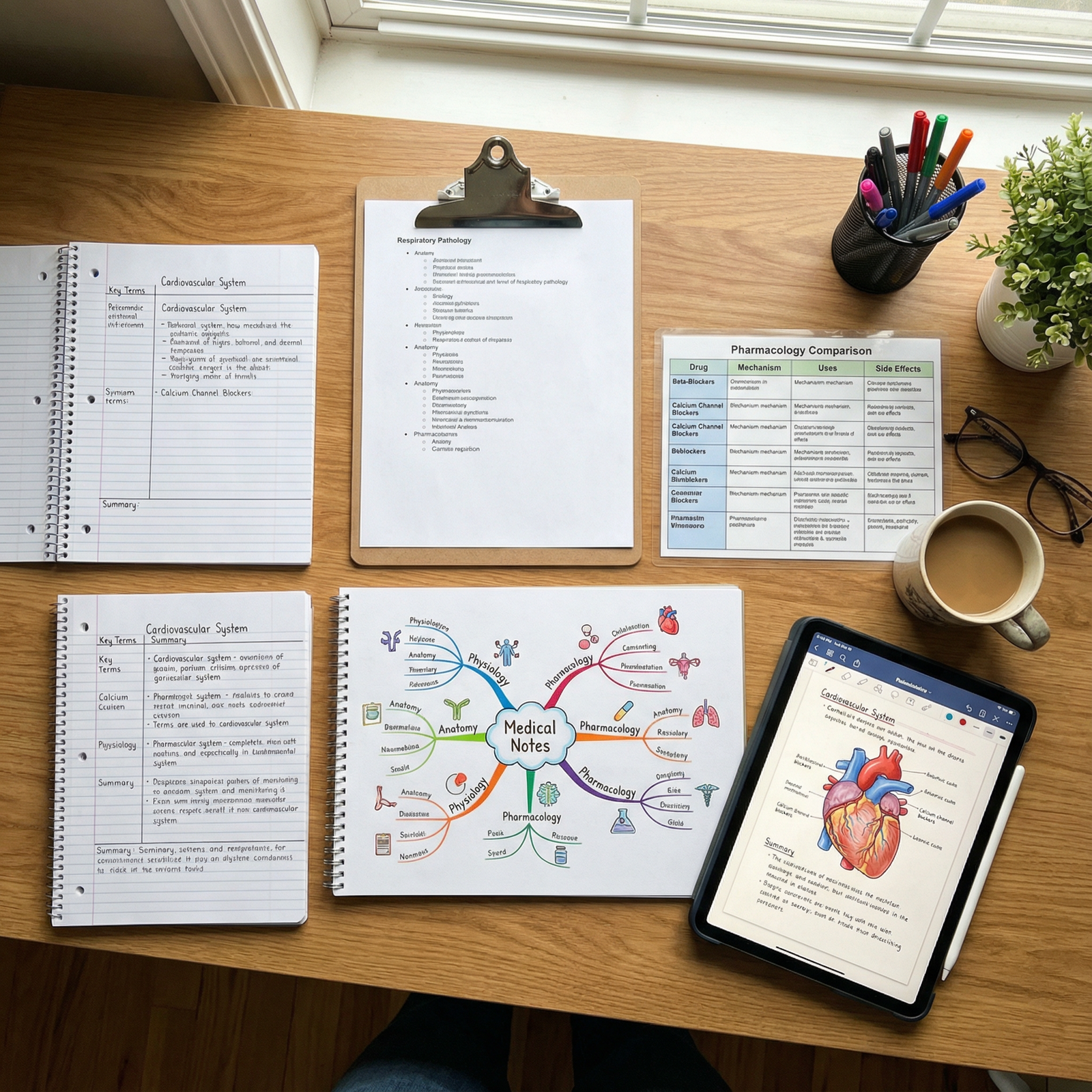
You have limited time per day on rotations. You are tired. You are paged midway through blocks.
You need a realistic block + explanation schedule that fits a surgery or IM month.
| Rotation | Questions/Day | Review Time | Focus |
|---|---|---|---|
| IM | 20–40 | 60–90 min | All three buckets, full mining |
| Surgery | 10–20 | 45–60 min | Heavy triage, prioritize Red/Yellow |
| Peds | 20–30 | 60–75 min | Algorithm-heavy topics, thresholds |
| OB/GYN | 20–30 | 60–75 min | Management ladders, contraindications |
On brutal weeks (call every 3 nights, for example), you might shift to:
- Smaller blocks (10–15 questions)
- Ruthless triage: mostly Yellow/Red mining, Greens almost ignored
- Weekend catch-up with a longer explanation session
Consistency beats heroic 4-hour review sessions you cannot sustain.

| Step | Description |
|---|---|
| Step 1 | Start of Week |
| Step 2 | Daily Small Blocks 10-20 Qs |
| Step 3 | Triage G/Y/R After Each Block |
| Step 4 | Weekday: Quick Yellow & Red Review |
| Step 5 | Flag Tough Topics |
| Step 6 | Weekend: Deep Dive 2-3 Topics |
| Step 7 | Update Notes & Anki |
Clinical Integration: Linking Patients to Explanations
One last advanced layer that serious students use.
When you see a patient that maps to a UWorld pattern, you should be mentally rehearsing the explanation.
Example:
- You admit a 56-year-old with classic NSTEMI. You have already seen 8 UWorld questions on NSTEMI. On rounds, as the attending talks about DAPT, heparin, beta-blockers, you recall the exact UWorld phrasing for initial management, contraindications to beta-blockers (acute decompensated HF, bradycardia), and indications for urgent PCI.
Then, later that day:
- You deliberately search and redo 1–2 UWorld questions on NSTEMI that you previously tagged Red/Yellow.
- You reread your explanation-derived notes or cards on that topic.
You have now tied:
- Concrete patient
- Theoretical explanation
- Your retrieval practice
That is how you make those pearls stick long term, not just for exam day.

What Not To Do With UWorld Explanations
Quick list of mistakes I see constantly:
- Copy-pasting entire explanations into notes. You will never read them again.
- Making 15 cards from every question. That becomes unreviewable within 2 weeks.
- Treating all wrong questions as equal. Some are pure trivia. Some are core algorithms.
- Ignoring wrong reasoning on questions you got right. Those are accidents waiting to happen.
- Reading explanations passively like a story. You must convert them into decisions, contrasts, or rules.
If your “review” feels strangely pleasant and soothing, you are probably doing it wrong. Proper explanation-mining is a bit uncomfortable. You are confronting exactly why you were wrong and committing to a clearer rule.
Final Compression: How to Know You Are Doing This Right
A few signs you are actually mining explanations at a high level:
- When you read new questions, you hear UWorld-style rules in your head.
- On shelves, you recognize management ladders almost verbatim from your notes.
- Your Anki or notes contain short, punchy, exam-focused pearls, not paragraphs.
- Your percentage might not jump immediately, but your confidence on management and diagnosis questions sharply improves over 2–3 weeks.
And the big one: when you get a question wrong, you no longer just shrug and move on. You feel an almost automatic urge to “extract the rule” before you close UWorld.
That reflex is what separates people who “finished the QBank” from the ones who actually learned from it.
Key points to walk away with:
- The explanation is the curriculum; the question is just the hook. Use triage (Green/Yellow/Red) and spend most of your time on Yellow/Red with explicit rule extraction.
- Convert explanations into tight, reusable pearls: trigger patterns, X→Y decisions, differentiators, thresholds, and management ladders—then encode them in lean notes and cards.
- Keep it shelf-specific and rotation-compatible: fewer questions if needed, but ruthless, structured mining of each explanation you do touch.