
The way most MS3s study for shelf exams is fundamentally wrong. Not slightly off. Wrong enough to tank scores that should have been solid.
I have watched strong students miss honors, barely pass, or fail shelves they were absolutely capable of crushing. Not because they were lazy. Because they made predictable, avoidable study errors specific to third year.
Let me be blunt: MS3 is a trap year. The rules change, the feedback loop disappears, and people cling to pre-clinical habits that stop working. If you keep studying like it is Step 1 season, you are volunteering to suffer.
This is the guide I wish every MS3 got on day one of clerkships: what not to do if you care about your shelf scores.
Error #1: Treating The Shelf Like a Side Quest
The biggest lie you will hear on day one of rotations: “Focus on the wards, the shelf will take care of itself.”
It will not. I have seen students trust that advice, grind 70–80 hour weeks trying to impress attendings, then get blindsided by a 30–40% of the exam on topics they never saw on their service.
Here is the mistake: assuming that being “good clinically” on your specific team equals being prepared for a broad, standardized exam.
You are on GI service? Great. The IM shelf still expects you to know CHF, COPD, sepsis management, anemia workup, vague outpatient stuff you barely see. OB triage all day? The OB shelf still wants prenatal care, endocrine in pregnancy, gynecologic cancers, contraception algorithms. The exam is not about your rotation’s niche.
Red flags you are making this error:
- You rationalize skipping questions: “I learned so much on rounds today, I am too tired.”
- You say, “My attendings say I am doing great, I should be fine on the shelf.”
- You study only what you saw that day instead of following a full content plan.
Do not confuse being useful on the team with being ready for a national exam.
What to do instead:
- From week 1, block non-negotiable test time: even just 20–30 questions per day.
- Follow a shelf-oriented resource path (UWorld + one primary text, not just UpToDate rabbit holes).
- Ask yourself weekly: “If the shelf were tomorrow, which topics would absolutely destroy me?” Then fix those, not just what patients you saw.
Being a great team player will help your evals. It will not rescue a weak shelf score.
Error #2: “Wasting” the First Half of the Rotation
The most expensive mistake: coasting the first 3–4 weeks then cramming like a pre-clinical exam at the end.
I have seen this exact pattern: Week 1–2: “I’m just trying to get used to the hospital.” Week 3–4: “I’ll start real studying after this weekend shift mess.” Week 5–6: “Oh. The shelf is in 10 days. Time for 8-hour study days after 12-hour shifts.”
That last-minute scramble works for block exams where the curve is gentle and the questions are predictable. Shelves punish that approach. The question style, the length, and the integration of knowledge require spaced exposure and lots of reps. You cannot brute-force that in a week.
Here is what is quietly killing you: you are not just short on “content hours.” You are short on:
- Pattern recognition for NBME-style questions
- Stamina for 100+ questions in one sitting
- Time to circle back and fix your weak spots
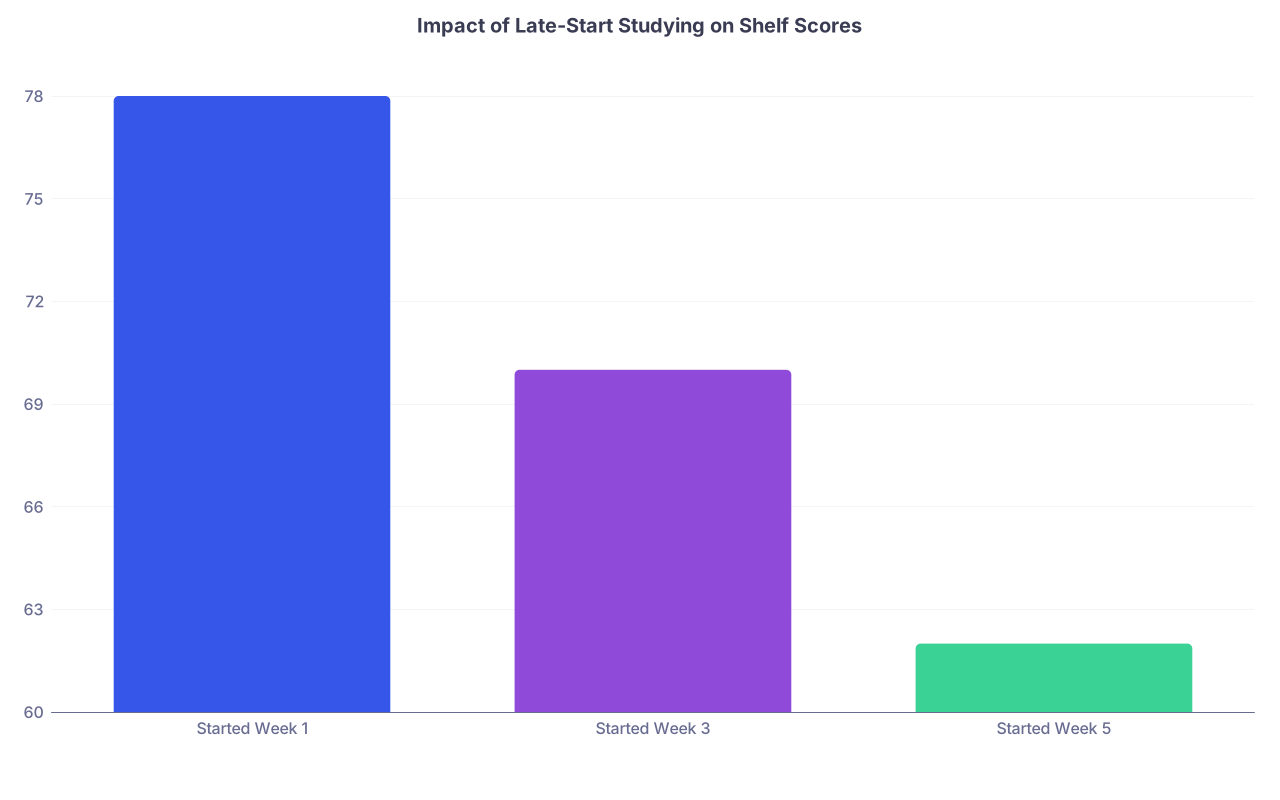
| Category | Value |
|---|---|
| Started Week 1 | 78 |
| Started Week 3 | 70 |
| Started Week 5 | 62 |
Those numbers are not pulled from a single paper, but they match what I have seen personally: starting real prep late costs you roughly a grade tier.
Avoid this by front-loading:
- Week 1–2: Low volume, but daily. 10–20 questions + short review. No zero days.
- Weeks 3–4: Ramp to 20–40 questions per day. One pass through your core text.
- Final 1–2 weeks: Focus on mixed blocks, NBMEs, and reviewing your wrongs. Not starting from scratch.
If you are thinking, “I just want to survive this rotation first,” understand: survival without structure now is what creates panic later.
Error #3: Passive Reading Without Question-Based Learning
If you are “studying” with 90% reading and 10% questions, you are preparing to be surprised on test day.
I have watched students proudly say, “I read all of Case Files, most of BRS, and half of [insert big textbook]” and then score below the national mean. Meanwhile, the student who did UWorld + one lean book walks out feeling fine.
The shelf is not a recall exam. It is a decision-making exam. That means:
- The test cares more about what you do with information than whether you recognize the sentence from a book.
- You need to recognize disease presentations in messy, half-described vignettes.
- You must practice test pacing, triage, and the art of giving up and guessing strategically.
You do not get those skills from passively reading while half-distracted in the workroom.
Common passive-study traps:
- “I’ll just read the whole clerkship book first, then start questions.” (You won’t.)
- Highlighting entire paragraphs in blue and yellow as if that transforms understanding.
- Reading UpToDate exhaustively on each patient and convincing yourself this is “shelf prep.”
Reading has a role, but only if it is tethered to active practice:
- Use reading to clarify what you repeatedly miss in questions.
- Read short, high-yield sections after a block of questions, not before.
- Summarize in your own words. Out loud. Even just a sentence or two per topic.
If at the end of the day you did 0 questions but “read a ton,” that is a red flag, not a flex.
Error #4: Focusing Only On What You See On Your Service
Clinical exposure is biased. The exam is not.
On a surgery rotation, you might see 10 cholecystitis cases. Guess how many questions you get on the shelf about outpatient management of chronic venous insufficiency or post-op pulmonary complications you barely discussed on rounds? More than one. Enough to matter.
On peds, maybe your service is obsessed with bronchiolitis and asthma. The shelf will still hammer you on growth charts, immunization schedules, neonatal jaundice management, genetic syndromes, and weird metabolic diseases.
The dangerous thought: “If it is important, I will definitely see it.” No. Some high-yield topics are rare in your particular hospital, but show up constantly on the exam.
I still remember a student on OB who told me, “We don’t really do much outpatient prenatal care here, it’s all L&D.” She then got crushed on questions about prenatal screening, chronic disease in pregnancy, and routine visit schedules. None of that was foreign to the exam writers.
How to avoid this:
- Use a structured outline or book that covers the full tested blueprint (e.g., UWorld topic list, Amboss, a proper shelf book).
- After clinic/rounds, explicitly ask yourself: “What did I not see today that will be on the exam?” Then study that.
- Do mixed-topic question blocks instead of only organ- or chief-complaint-based sets. Force yourself to see the stuff the rotation is ignoring.
Your lived clinical experience is a sample. The exam is the population. Study for the population.
Error #5: Using Too Many Resources (The Classic MS3 Overkill Move)
If your “plan” looks like this: UWorld + Amboss + Anki + OnlineMedEd videos + Case Files + PreTest + random PDFs from upperclassmen, you do not have a plan. You have chaos.
I have watched students drown themselves with:
- 4+ question banks they never finish
- 3 different book series opened to the same disease to “cover every angle”
- Playlists of videos at 2x speed they do not remember the next day
The harder the rotation, the more anxious students get, and the more they hoard resources. It feels productive. It is not. It fragments your time, dilutes repetition, and prevents mastery of any single backbone.
Here is the hard truth: you will not finish everything. So stop pretending you will.
A sustainable, high-yield resource stack usually looks like:
- 1 primary question bank (UWorld or Amboss)
- 1 concise text or video series for conceptual gaps (e.g., Case Files, OnlineMedEd, or a small review book)
- 1 source of practice NBMEs/CLIPP cases/etc. if available
That is it. Everything else is optional and usually unnecessary.
| Plan Type | Question Bank | Text/Video | Extra Resources Count |
|---|---|---|---|
| Lean, Effective | 1 | 1 | 0–1 |
| Typical MS3 | 2 | 2 | 2–3 |
| Overloaded | 3+ | 3+ | 4+ |
If you cannot clearly answer “What is my primary resource for this clerkship?” you are likely in the overloaded zone.
Pick a spine. Commit to finishing it. Use other things only as needed, not as a default.
Error #6: Ignoring Timing and Stamina Until It Is Too Late
Every year, I see the same disaster: smart student, knows the content, does fine on short untimed blocks… then gets wrecked on exam day because they simply cannot move fast enough.
They never practiced:
- 90–120 questions in one sitting
- Pacing decisions (when to mark and move, when to guess and go)
- Maintaining focus when tired, hungry, or frustrated
Shelves are long. The cognitive fatigue is real. You will be doing them at the tail end of a brutal rotation, not fresh after a rest week like some idealized schedule on Reddit.
Common timing mistakes:
- Always doing 10–15 question blocks “because I learn better that way”
- Leaving the only full-length practice exam for 1–2 days before the real shelf
- Reviewing each question as you go instead of at the end, which destroys pacing sense
Fix this early:
- Once or twice a week, do a larger block (40–50 questions) timed.
- At least 1–2 weeks out, start simulating closer to full exam length.
- Review timing performance, not just correctness. If you are rushing the last 10 questions every time, that is a warning.
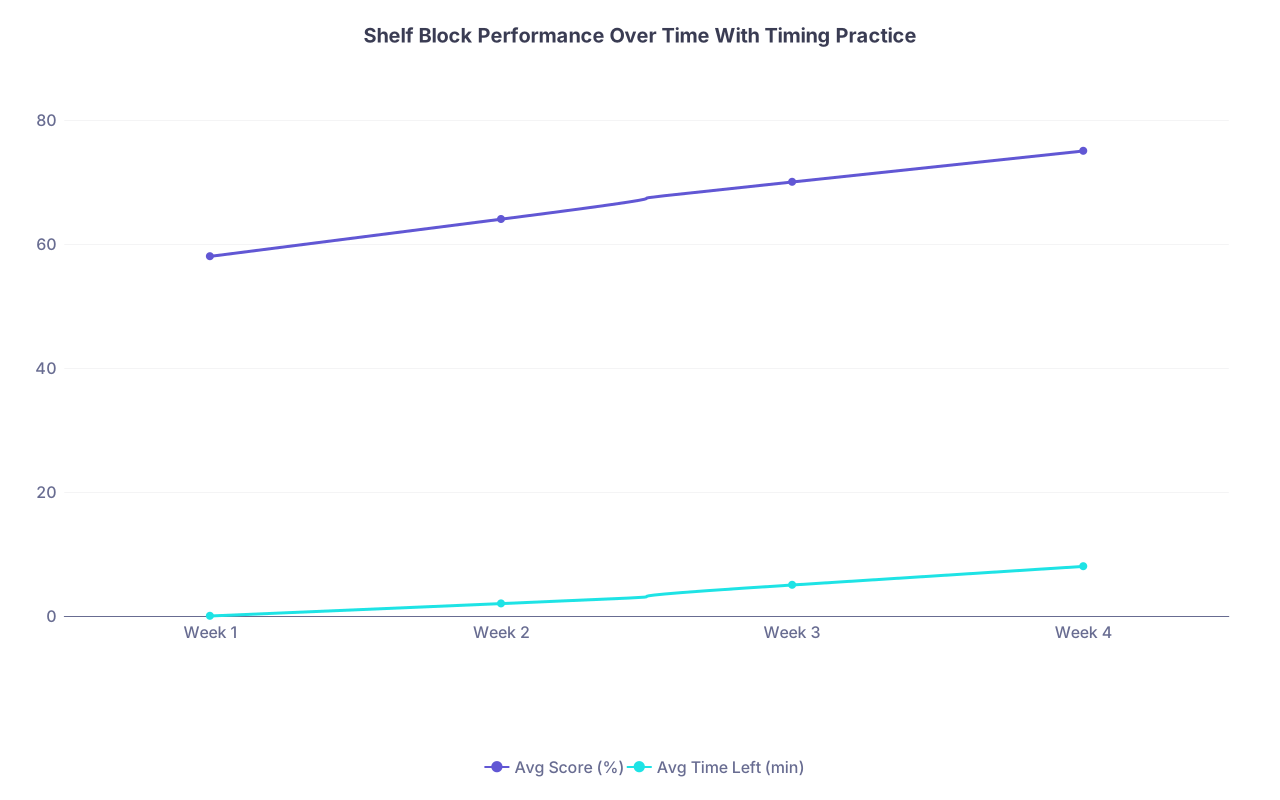
| Category | Avg Score (%) | Avg Time Left (min) |
|---|---|---|
| Week 1 | 58 | 0 |
| Week 2 | 64 | 2 |
| Week 3 | 70 | 5 |
| Week 4 | 75 | 8 |
The students who respect stamina as a skill tend to be much calmer walking into the exam. Not because they know everything. Because they have already lived through something very similar at least once.
Error #7: Not Doing Post-Call / Post-Shift Triage on Your Energy
Third year is constant negotiation with exhaustion. You cannot just “add study” on top of 12-hour days indefinitely. Something breaks. Usually sleep or sanity.
The subtle mistake: you treat every day as if you are supposed to perform at 100%—on the wards and in studying. So when you predictably fail at that, you do nothing. “What’s the point if I can’t do the full block?”
I have seen people waste entire rotations with this all-or-nothing thinking. “I didn’t have energy to do 40 questions… so I just scrolled my phone.”
You need a backup plan for low-energy days.
After a rough call or a brutal trauma shift:
- Maybe you cannot do 40 questions. Fine. Do 10. Or even 5. But do them deliberately.
- Maybe you cannot read a whole chapter. Fine. Skim the summary boxes or high-yield tables.
- Maybe you are fried. Fine. Watch one targeted video on a topic you missed recently.
That “something is better than nothing” cliché? On rotations, it is not cliché. It is survival strategy.
You should have:
- A “full energy” plan (timed block + review)
- A “medium energy” plan (shorter block + flashcards or concise reading)
- A “low energy” plan (5–10 questions or one short video, then sleep)
Write those down once. Do not improvise at 10 p.m. when your brain is mush. That is when bad decisions (and zero study) happen.
Error #8: Failing to Post-Mortem Your Missed Questions
If you are doing questions and still bombing shelves, this is usually the issue: you are blasting through questions, tracking percent correct, and barely learning from your mistakes.
Typical weak review pattern:
- Check answer
- Read short explanation
- Think “Oh, right, I knew that.”
- Move on
You did not know it. If you did, you would have gotten it right. Your brain is lying to you to protect your ego.
What effective review actually looks like:
- For missed questions, you write down: What did I think the diagnosis/next step was? What was the exact reasoning error?
- You categorize your errors: knowledge gap, misread question, poor test-taking strategy, or conceptual misunderstanding.
- You focus your reading on the concept behind the miss, not just the fact.
Even a 5–10 second “Why did I miss this?” reflection matters. It forces you to break the “mindless roulette of questions” loop.

| Step | Description |
|---|---|
| Step 1 | Finish Question Block |
| Step 2 | Check Answers |
| Step 3 | Skim Explanation |
| Step 4 | Identify Error Type |
| Step 5 | Knowledge Gap |
| Step 6 | Misread Question |
| Step 7 | Strategy Error |
| Step 8 | Targeted Reading/Note |
| Step 9 | Practice Slower Reading |
| Step 10 | Adjust Test Strategy |
| Step 11 | Correct or Wrong? |
If you are not improving after hundreds of questions, stop adding more volume. Fix your review.
Error #9: Ignoring How Each Shelf Fits Into Step 2 Preparation
Here is the long game people forget: shelves are not isolated hurdles. They are Step 2 CK rehearsal.
Students make a dangerous mental separation:
- “Shelves are just to pass the rotation.”
- “I’ll deal with Step 2 later.”
Then fourth year hits, Step 2 is three months away, and they realize they never built durable systems for retention. They crammed and flushed each rotation. Now they are relearning everything from scratch. Under a higher-stakes timeline.
You tank shelves when you treat them as disposable instead of cumulative.
Way to avoid this:
- Use consistent note-taking across rotations (same notebook, same digital system, same tags).
- Mark questions/concepts as “Step 2 important” and revisit them across rotations.
- Recognize recurring patterns: chest pain workup, sepsis management, electrolyte disorders, OB emergencies, etc.

The ugly truth: if you habitually cut corners preparing for shelves, you are rehearsing how to underperform on Step 2.
Error #10: Letting Shame and Comparison Paralyze You
This one is quieter but brutal: the mental game.
You see classmates posting “just finished all of UWorld IM on this rotation!” while you are still at 40%. Someone says they did 3 NBMEs and scored 80+ on all of them. You just barely passed your first practice exam.
Common reaction: you shut down. Instead of adjusting your plan, you numb out. Procrastinate. Pretend the exam is not coming.
Here is the mistake: using other people’s progress as a reason to give up, instead of a data point to adjust from.
I have seen students come back from awful practice scores. The ones who succeed do not say, “I suck at this.” They say, “OK. What specifically is killing me, and what is the smallest change that would help?”
If you are behind:
- Stop fantasy-planning (“I’ll do 200 questions a day”). Do the math on what you can actually finish.
- Ruthlessly prioritize: high-yield topics, your weakest systems, and practice exams.
- Cut the fluff resources. You do not have time for pretty but low-yield extras.
And for the love of sanity, stop asking every classmate about their question counts and NBME scores. That rarely helps. Usually just spikes cortisol.
Error #11: Not Protecting Sleep the Week Before the Shelf
You can abuse your sleep early in the rotation and get away with it. For a while. But if you push into shelf week running on 4–5 hours of broken sleep per night, you are handicapping yourself before you even start the exam.
The false belief: “I’ll just grind more these last few days, then crash after the exam.” Unfortunately, your brain does not instantly bounce back from chronic sleep debt. Especially not in decision-heavy tasks like a shelf.
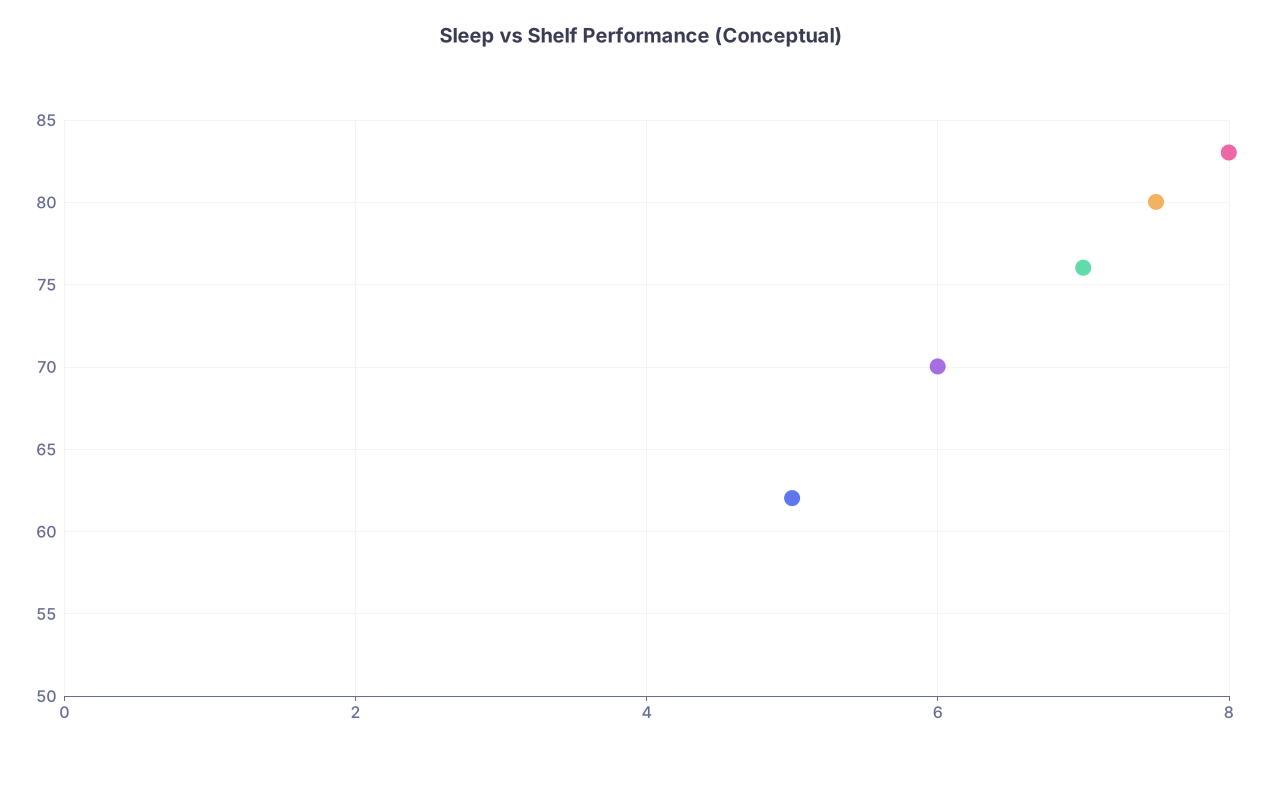
| Category | Value |
|---|---|
| Student A | 5,62 |
| Student B | 6,70 |
| Student C | 7,76 |
| Student D | 7.5,80 |
| Student E | 8,83 |
Rough correlation: more consistent, decent sleep in the final week → better performance, even with slightly less content crammed.
Your guardrails for shelf week:
- No drastic new resource additions or last-minute overhauls.
- Cut question volume a bit the last 1–2 days in favor of sleep and light review.
- Protect at least one full night of real sleep right before test day.
If you are debating between one more 40-question block at midnight and an extra hour of solid sleep 48 hours before the shelf, choose the sleep. Every time.
The Core Mistakes, In Short
If you remember nothing else, remember this:
Do not treat shelves as an afterthought to clinical work. The exam covers more than your rotation ever will, and it demands deliberate, early, question-based preparation.
Do not drown yourself in resources or delay serious studying to the last couple of weeks. Pick a lean stack, start small in week one, and build consistency instead of chaos.
Do not ignore stamina, timing, and review quality. Content alone will not save you if you cannot finish the test, learn from your mistakes, or think clearly because you have destroyed your sleep.
You do not need to be perfect to avoid tanking your shelf scores. You just need to stop making the same predictable errors everyone else walks into blind.