

The hidden curriculum in medical school punishes accents and slow English. You’re not imagining it.
If English is not your first language, pimping and oral presentations can feel less like “learning opportunities” and more like public execution. You know the answer in your head. It just refuses to squeeze itself into the exact English sentence you need, at the speed attendings expect.
Let’s fix that.
This is not about “improving your English in general.” That’s a 10‑year project. You need tactics you can use on rounds tomorrow morning. I’m going to walk you through exactly what to say, what to practice, and how to protect yourself from being unfairly labeled “slow,” “quiet,” or “unprepared” when the real problem is language processing speed under pressure.
1. Understand the Game You’re Actually Playing
Pimping and presentations are not language tests. They’re perception tests.
On the wards, attendings and residents are subconsciously grading you on three things:
- Do you know stuff?
- Are you prepared?
- Are you safe and reliable?
Language issues can trick them into answering “no” to all three, even when the real answer is “yes.” That’s the trap.
So your job is not “speak perfect English.” Your job is: make it blindingly obvious that you are:
- Prepared
- Thoughtful
- Safe
even if your grammar is broken and your accent is heavy.
Here’s how that misperception usually plays out:
You pause for 3–4 seconds to find the right word.
The attending reads it as “doesn’t know the answer.”You misinterpret a complex question.
They think “weak knowledge base.”You give a long, slightly disorganized answer because you’re translating in your head.
They think “can’t prioritize information,” “not ready for internship.”
So we’ll attack this from three angles:
- Phrasing that buys you time without looking lost
- Rigid structures for presentations so you don’t improvise English under stress
- Lightweight preparation routines that specifically help non-native speakers
2. Surviving Pimping: Scripts, Not Heroics
You will not suddenly become fast, idiomatic, and witty under pressure. Stop trying.
Instead, build a small toolkit of memorized phrases you can use in 90% of pimping situations. Think of them as macros that handle language so your brain can focus on content.
When You Need 3 Extra Seconds
Silence looks like “clueless.” You need noise that buys time and signals thinking, not panic.
Memorize 2–3 of these and use them constantly:
- “Let me think it through out loud.”
- “I’m not completely sure, but my first thought is…”
- “If I reason from the pathophysiology…”
Those opening phrases do three things:
- Turn an interrogation into a thought-process conversation
- Show you’re engaging, not freezing
- Give you a second to translate in your head
Example:
Attending: “Why do cirrhotics get thrombocytopenia?”
You: “Let me think it through out loud. In cirrhosis, the spleen is often enlarged, so there’s more platelet sequestration, and also there’s less thrombopoietin production in the liver.”
You’ve bought yourself 3 seconds and looked thoughtful instead of “slow.”
When You Don’t Understand the Question
This is deadly for non-native speakers. Many students pretend they understood and then answer something slightly off. That looks worse than “I need clarification.”
Use clear, confident clarification lines. Not timid ones.
Say:
- “Can I clarify what you mean by…?”
- “Just to make sure I’m answering the right question: are you asking about [diagnosis / management / mechanism]?”
- “Do you mean in the acute setting or long-term management?”
Avoid:
- “Sorry?”
- “Can you repeat?” (alone; it sounds like you just didn’t listen)
Attach clarification to specific content:
Attending: “What’s the next best step?”
You: “Do you mean the next diagnostic step, or the next treatment step?”
That shows you’re organized, not confused.
When You Genuinely Don’t Know
Everyone gets pimped beyond their knowledge. Native speakers just sound more confident while guessing.
As a non-native speaker, you must avoid sounding like you don’t care or didn’t prepare. Use a formula:
- Admit the limit
- Offer your best guess with reasoning
- Say what you’ll do next
Example:
“I’m not sure of the exact answer, but I’ll take a guess. I think the first-line treatment is [X] because [brief reason]. I’ll look this up after rounds and add it to my note.”
That sentence does a lot of work: humility, effort, safety.
When They Rapid-Fire You
Some attendings machine-gun questions just to see you sweat. You will not magically match their speed.
Your goal here is: hold your ground and keep your dignity.
Practical approach:
- Answer in short, bullet-style sentences, not long explanations
- Use your stock openers to slow the pace
- If they cut you off, do not chase them; reset on the next question
Example pattern:
Attending: “Causes of chest pain?”
You: “Cardiac, pulmonary, GI, musculoskeletal. For cardiac: ACS, pericarditis, aortic dissection…”
Short phrases. No storytelling. Your English processing load drops dramatically.
3. Presentations: Use Rigid Templates So You’re Not Inventing English
Presenting patients is scriptable. Yet most students wing the language every single time. That’s a disaster if you’re translating in your head.
You want fixed skeletons for:
- New patient H&P
- Daily SOAP note style progress note
- One‑liner on rounds
Then you just plug in data.
One-Liners That Always Sound Organized
Build a generic template and reuse it:
“[Age]-year-old [sex] with history of [top 2–3 problems] presenting with [main complaint] for [duration], now on hospital day [#] for [main working diagnosis / issue].”
Examples:
“65-year-old man with history of hypertension and CAD presenting with three days of progressive shortness of breath, now on hospital day two for acute decompensated heart failure.”
Memorize that English exactly. Do not customize the grammar every time. You don’t need creativity here.
H&P Presentation Template
Use the same segment order, same transitions, every time. For example (adapt, but keep it fixed for yourself):
- One-liner
- Chief complaint
- History of present illness
- Relevant past medical/surgical history
- Medications/allergies
- Pertinent social/family history
- Review of systems (only key positives/negatives)
- Physical exam
- Labs/imaging
- Assessment and plan by problem
Now fix the transitions:
- “The chief complaint is…”
- “In terms of history of present illness…”
- “Relevant past medical history includes…”
- “On physical exam today…”
- “Key labs and imaging include…”
- “Overall, my assessment is that…”
- “My plan is as follows…”
You should say these transition phrases in your sleep. The only English that changes is the content, not the structure.
That way, when your brain is busy translating “bilateral rales at the lung bases,” it’s not also trying to invent the sentence structure.
Daily SOAP-Style Presentation Template
For follow-ups:
S: “Overnight, the patient [had / did not have] any acute events. This morning, they report…”
O: “Vital signs are stable/abnormal with [specifics]. On exam…”
A: “My assessment is that the primary issue is…”
P: “For this, I plan to…”
Again, templates. Not poetry.
4. Targeted Practice for Non-Native Speakers (30–45 Min/Day)
You don’t need five hours of “improving your English.” You need high-yield, ward-specific English.
Here’s a realistic daily routine you can actually maintain on rotations.
A. Shadow-Transcript Rounds (10–15 Minutes)
Take one patient you’ll present tomorrow.
- Record yourself on your phone presenting them using your template. No notes.
- Play it back and write down exactly what you said. Don’t fix it yet.
- Now rewrite that presentation into cleaner, shorter English.
- Record again, using the improved version.
You’re training three things at once: content, structure, and the exact English you’ll need in the morning. This is way more efficient than generic conversation practice.
B. Pimping Flashcards: But For Phrases (10 Minutes)
You probably already have Anki or some question bank. Add front: question, back: answer in one or two spoken sentences.
Front: “Mechanism of ACE inhibitors?”
Back: “They block the conversion of angiotensin I to angiotensin II, leading to vasodilation and decreased aldosterone, which lowers blood pressure and reduces afterload.”
Then actually say the answer out loud as you review. Not in your head. Your tongue needs reps, not just your brain.
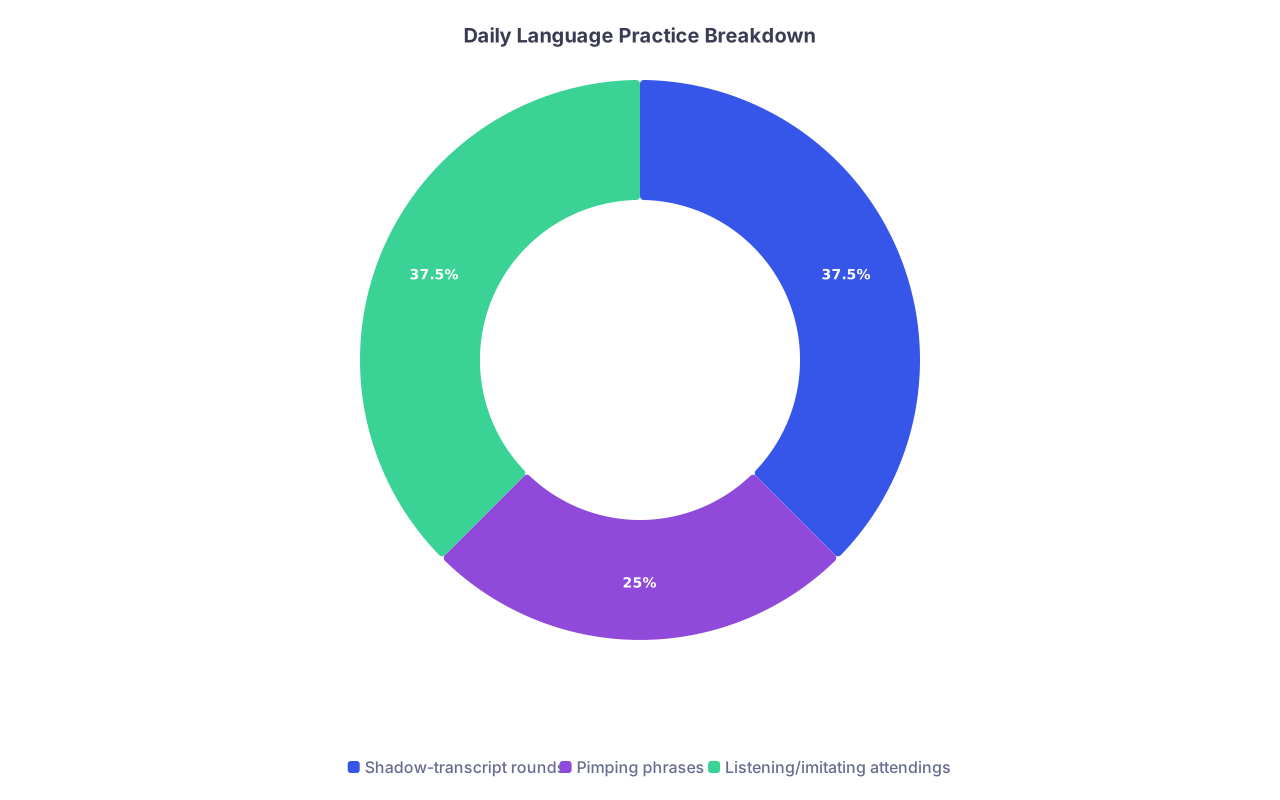
| Category | Value |
|---|---|
| Shadow-transcript rounds | 15 |
| Pimping phrases | 10 |
| Listening/imitating attendings | 15 |
C. Listen and Copy Attendings (10–15 Minutes)
On rounds, pick one attending or senior who explains things clearly.
Write down 1–2 phrases they use exactly as they say them:
- “From a hemodynamic standpoint…”
- “Given this constellation of findings…”
- “At this point, my primary concern is…”
Later that day, stand in your room and practice saying those lines with your own content.
You’re stealing fluent scaffolding and dropping your ideas into it. This is how you sound “native” much quicker than by memorizing random vocabulary.
5. Dealing With Accent and Bias (Without Losing Your Mind)
Some people will assume you know less because your English is slower or accented. That’s their problem—but you live with the consequences. So you need strategy, not just pride.
Name the Language Issue Up Front (Tactically)
Sometimes it helps to proactively frame your English so people interpret your pauses correctly.
On day 1 with a new team, you can say something short and neutral:
“I’m fluent in English, but it’s not my first language, so I sometimes take an extra second to find the right word. If anything I say is unclear, please let me know and I’ll rephrase.”
That tells them: “Pause ≠ confusion.” You’ve changed what they see.
Use the Chart and Notes as Proof of Competence
Many non-native speakers are much better in writing than speech. Use that.
Make your:
- Notes precise and well-organized
- Assessment and plan thoughtful
- Problem lists clean
Residents often say behind closed doors: “Her presentations are rough, but her notes are excellent. She’s solid.” That matters on evaluations.
When Someone Is Rude or Dismissive
Yes, it happens. “Do you even understand what I’m asking?” “You need to speak clearer.” I’ve heard it on rounds more than once.
Three practical options, depending on the power dynamic:
In the moment, with a resident or fellow:
“I do understand, but I’m slower to answer in English. I’ll try to be more concise.”
Calm, direct. You’re not apologizing for existing; you’re signaling awareness and effort.After rounds, one-on-one with a resident you trust:
“Sometimes on rounds I feel my English makes me look unprepared, even when I study a lot. If you notice specific things I can improve, I’d appreciate concrete feedback.”
This often converts them into an ally.If it’s persistent and abusive:
Document dates and comments. Talk to your clerkship director or student affairs. Say:
“I’m comfortable with constructive feedback, but I’m concerned that my language background is being treated as a lack of effort or intelligence. Here’s what was said…”
Don’t suffer in silence out of shame. This is not “toughening you up.” It’s bias.
6. Exam-Oriented Speaking: OSCEs and Case Discussions
Spoken English also hits you in OSCEs, case-based small groups, and oral exams. Same principles, different setting.
OSCE: Keep It Simple, Safe, and Structured
Standardized patients and examiners don’t care about your elegance. They care about:
- Safety
- Empathy
- Organization
Use simple patterns:
Introduce:
“Hello, my name is [Name]. I’m a medical student. How would you like me to address you?”
Ask permission:
“Is it okay if I ask you some questions and then examine you?”
Signpost:
“First, I’ll ask about your symptoms. Then I’ll examine you. At the end, I’ll explain what I think is going on.”
Summarize:
“Let me summarize to be sure I understood: you’ve had [X] for [Y time], it’s worse with [Z], and you’re most worried about…”
These are lines you can memorize once and reuse in every OSCE station.
Small-Group Discussions
You don’t need to be the most talkative. You do need to avoid looking disengaged.
Use entry phrases to jump in briefly:
- “I agree with [Name]. I’d add that…”
- “I have a question about the differential. Could we also consider…”
- “From my understanding, the key issue here is…”
Aim for 2–3 short contributions per session. Quality over quantity. And if you need time to form a sentence, jot keywords on your paper first; then talk.
7. Concrete Micro-Scripts You Can Steal
Here’s a small toolbox you can start using tomorrow. Edit them to your own voice, but keep the structure.
Buy-Time Script During Pimping
“Let me think that through out loud. If I start from the pathophysiology, in [disease], we see…”
Clarify-Question Script
“Just to be sure I answer what you’re asking: are you referring to the initial management in the ED, or the long-term outpatient plan?”
“I Don’t Know” Script
“I’m not certain of the exact guideline recommendation, but my guess would be [X] because [Y]. I’ll look this up after rounds and update my note.”
Patient Presentation Opening
“This is a 54-year-old woman with a history of type 2 diabetes and hypertension, presenting with two days of chest pain, now on hospital day three for NSTEMI.”
Plan Transition
“For my assessment and plan, I’ll go problem by problem.”
Then:
“Problem one: NSTEMI. She’s hemodynamically stable, troponins are downtrending, so I plan to…”
Memorize the bones. Let the content change.
8. Protect Your Energy and Confidence
Constantly translating and performing in a second language is exhausting. You’re not dramatic; it really is more work for your brain.

If you don’t manage that, everything else falls apart.
Practical things that help:
- Sleep is performance-enhancing for language. If you cut sleep below survival levels, your English fluency drops first, even if your raw knowledge is there. Protect your 5–6 core hours like they’re a drug.
- Batch your speaking practice. Ten minutes of intense out-loud practice is more useful than mumbling all day.
- Have at least one friend who gets it. Another non-native speaker or someone supportive you can text “Today’s rounds were brutal, I blanked on the simplest word” without shame.
- Separate language shame from knowledge. When you feel bad after rounds, ask yourself: “Did I not know it, or did I know it but couldn’t say it quickly?” Those are different problems. Solve the right one.
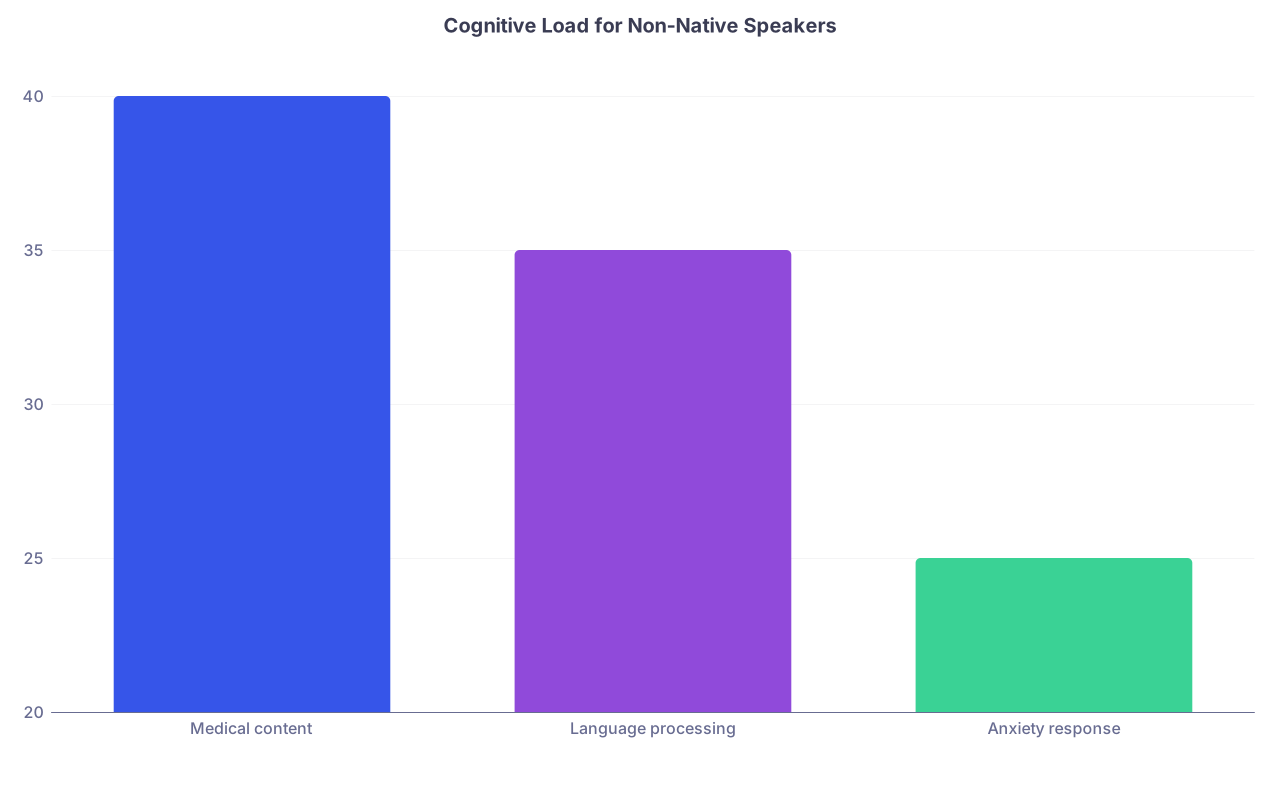
| Category | Value |
|---|---|
| Medical content | 40 |
| Language processing | 35 |
| Anxiety response | 25 |
You’re juggling more than your native-English classmates. Fact, not excuse. You just have to be more deliberate.
9. Long Game: What Actually Improves Over 6–12 Months
You will not notice your own improvement day to day. But it adds up.
Realistic trajectory I’ve seen in non-native students who use the kind of tactics above:
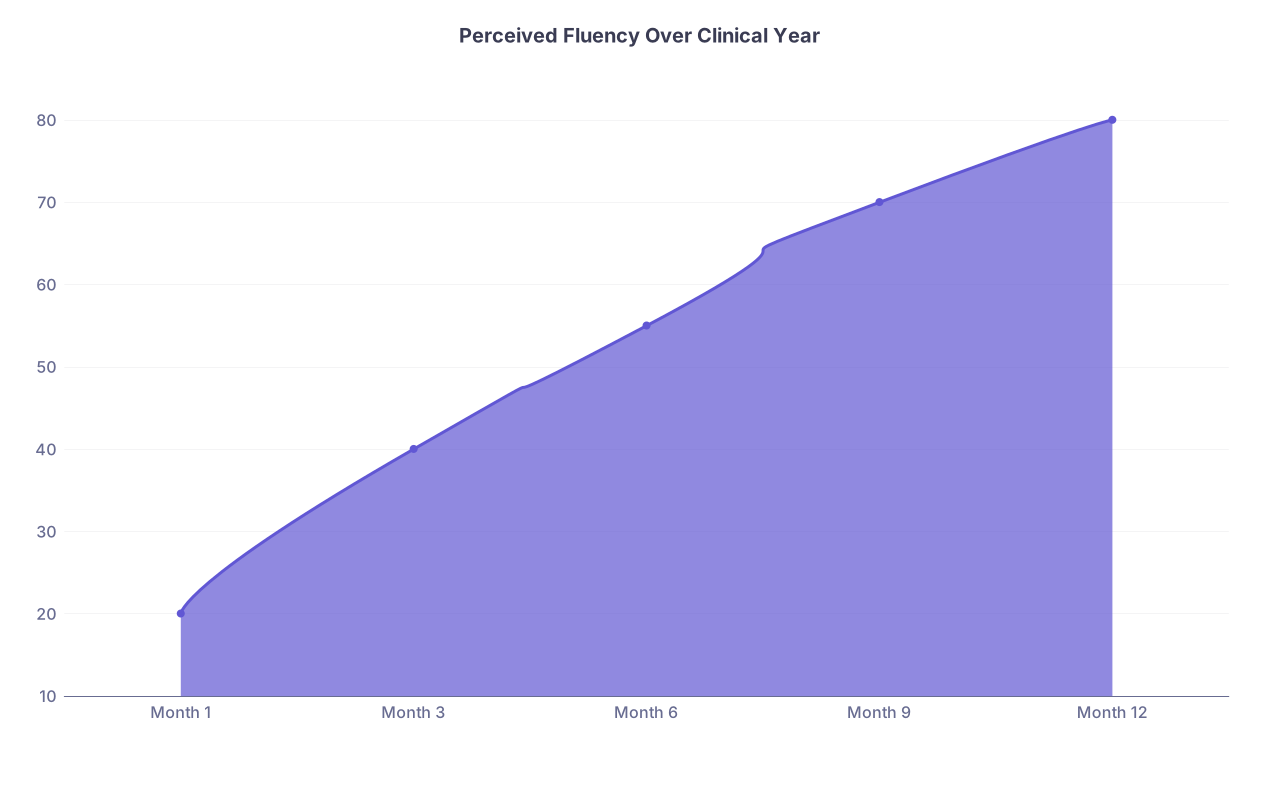
| Category | Value |
|---|---|
| Month 1 | 20 |
| Month 3 | 40 |
| Month 6 | 55 |
| Month 9 | 70 |
| Month 12 | 80 |
What changes:
- Month 1–2: You’re memorizing templates. Everything feels forced.
- Month 3–4: Presentations start to feel “automatic.” You still struggle with unexpected pimping.
- Month 6–9: You catch yourself answering before fully translating. English comes more “directly” from your medical thought.
- Month 12: People start saying, “You’ve improved so much this year,” and you realize rounds no longer terrify you every day.
The key is consistency on small, specific habits. Not vague “I should practice more.”
10. What You Should Do Tonight
Not tomorrow. Tonight. One small, surgical move.
Pick one patient you’ll present tomorrow. Then:
- Write out a full spoken presentation using the templates above. Transitions included.
- Stand up, record yourself presenting it once.
- Listen, tighten any sentences that feel clumsy.
- Record a second, improved version.
- Save that recording and listen to it once while you get ready in the morning.
That’s it. One patient. One night.
You’ll walk onto rounds with at least one moment where your English and your knowledge line up cleanly. You feel that tiny bit of control. Then you repeat it the next day.
Open your notes app right now and type: “Template for my one-liner:” and fill in a generic version. That’s your first brick.


