If You’re Assigned a Toxic Team: Boundary-Setting and Documentation
What do you actually do when you realize on Day 2 of a rotation, “Oh. This team is bad. And I’m stuck with them for six weeks”?
Not theoretically. Practically. As in: who do you email, what do you write down, how do you protect your evaluation and your sanity without blowing yourself up politically.
Let’s walk through it like we’re standing in the call room between consults and you’re asking, “Okay, what now?”
Step 1: Name What’s Actually Happening (Not Just “It Feels Toxic”)
“Toxic” gets thrown around so much it stops being useful. You need to translate “this feels awful” into specific behaviors. That’s how you protect yourself and set boundaries.
You’re looking for patterns like:
- Public humiliation or yelling
- Threats about grades or future careers
- Retaliation for asking questions or leaving on time
- Being forced to do non-educational scut as punishment
- Sexist, racist, homophobic, or other discriminatory comments
- Deliberate sabotage (not letting you see patients, then calling you unprepared)
That’s different from:
- A brusque attending who is impatient but fair
- High expectations and fast-paced rounds
- A resident who’s burned out but not targeting you
You handle those very differently.
Here’s the litmus test I’ve used with students:
If someone recorded a video of the interaction and played it at a professionalism committee meeting, would most faculty wince and say “That’s not okay”?
If yes, you’re not being “too sensitive.” You’re in a genuinely problematic environment.
Start a simple note in your phone or on paper (more on how to document safely later). For now, just basic facts, no essays:
- Date
- Time/approx
- Who was present
- What was said/done (one or two sentences, neutral language)
You’re creating a log, not a diary.
Step 2: Decide Your Short-Term Goal (Survive? Fight? Transfer?)
Not every situation calls for the same level of pushback. Before you act, be honest about what you want from this rotation.
For example:
- “I just need to pass and not tank my mental health.”
- “I want to do this specialty; I need at least Honors or high pass.”
- “This is so bad I think it’s dangerous or abusive; I’m willing to escalate.”
That goal will shape your approach.
If you want to:
- Survive with minimal conflict → prioritise boundaries + documentation + quiet support
- Protect your grade in that specialty → calculated professionalism + strategic allies + careful communication
- Address real harm or danger → early escalation to course director / student affairs with specific documentation
You can change your goal mid-rotation. But decide something now so you’re not reacting emotionally every day.
Step 3: Quietly Map the Power Structure
You cannot handle a toxic team if you don’t understand who actually matters.
On a typical ward team:
- Attending
- Senior resident
- Intern(s)
- You (and maybe other students)
But behind that there’s:
- Clerkship director
- Site director
- Course coordinator or admin
- Office of student affairs / dean of students
You need to know:
- Who writes your evaluation
- Who has a reputation for being fair
- Who has a reputation for sweeping things under the rug
Ask upperclassmen. They’ll tell you the truth faster than any official orientation.
Simple, low-drama question to a trusted MS4 or recent grad:
“Hey, I’m on [Service] with [Attending/Resident]. Anything I should know about how they evaluate students or how to work best with them?”
If three people say “Document everything,” believe them.
Step 4: Set Baseline Boundaries Early (Without Sounding Like You’re Complaining)
On a bad team, you want to set “normal professional” expectations as early as possible so you can reference them later.
That’s different from marching in with demands.
Two places you can do this naturally:
- First or second day check-in with your senior resident
- Post-call / end-of-day quick conversations
Example script with your senior:
“I really want to be helpful and learn as much as I can. I also want to make sure I’m doing things safely and within the student role. Could we clarify expectations about staying late, cross-cover tasks, and when it’s appropriate for me to sign out?”
You’re not saying, “I refuse to stay late.”
You’re forcing them to articulate what they expect. Out loud.
If they say something outrageous (“Students stay until midnight if the work’s not done”), you log that. And you’ll use that later if needed.
Core boundaries you quietly protect:
- You do not perform tasks outside your scope unsupervised (no writing independent orders, no calling families with serious updates alone, no procedures without supervision).
- You’re not staying excessively late regularly doing pure scut that’s not educational (documenting this pattern matters).
- You’re not tolerating discriminatory or harassing comments. That’s a line, not a preference.
Step 5: Start Professional-Grade Documentation (This Is Your Shield)
Most students either document nothing or write emotional essays. Both are useless in a dispute.
You want short, factual, boring notes. Boring wins.
Use this structure:
Date – Time – Location – People – What happened – Impact (if relevant)
Example:
1/9 – ~7:30 am – team room – Attending Dr. X, Senior Dr. Y, Intern Dr. Z, 2 other students
Dr. X said: “You’re useless; did your school lower standards to let you in?” after I didn’t know the specific dose of a medication. Said this in front of team and nurses. Later that day, I avoided asking questions on rounds due to fear of similar comments.
Another:
1/12 – 5:45 pm – hallway outside OR
Senior Dr. Y instructed me to “just sign those orders, nobody’s going to check; we don’t have time,” referring to discharge orders in the EMR under my name. I expressed discomfort and asked if they could review before signing. They rolled eyes and said, “Fine, I’ll do it,” but continued to complain to intern about me being “too cautious.”
Keep this somewhere:
- Not on a shared device
- Not in your school email
- Preferably on your personal device or in a private cloud document
Assume anything in hospital systems is discoverable and not private.
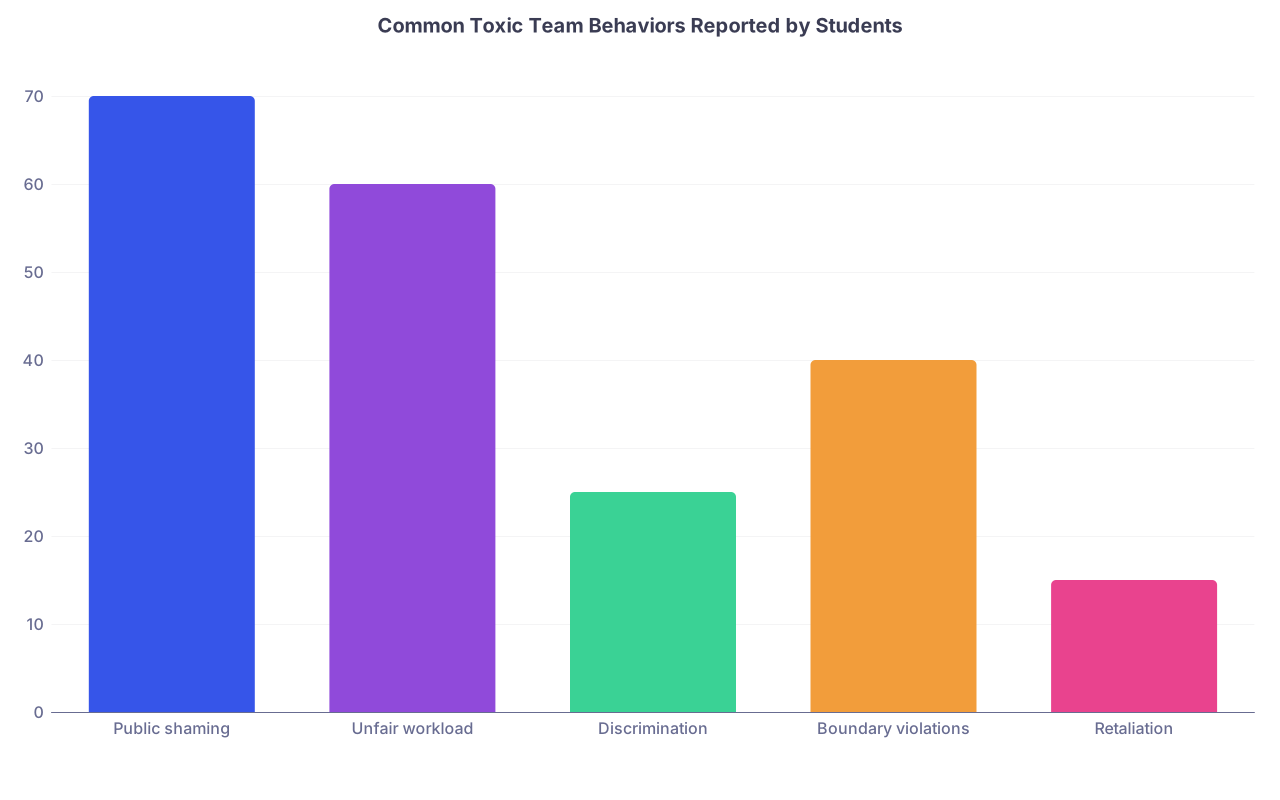
| Category | Value |
|---|---|
| Public shaming | 70 |
| Unfair workload | 60 |
| Discrimination | 25 |
| Boundary violations | 40 |
| Retaliation | 15 |
Why this level of detail matters:
- If you talk to the clerkship director, you won’t sound vague or dramatic.
- If grades get weird, you have a pattern to point to.
- If this escalates to professionalism or Title IX, they take you more seriously when you’re specific.
Step 6: Protect Your Grade Without Selling Your Soul
Here’s the ugly truth: even when a team is toxic, they still control your evaluation. You need to play the game smartly.
Minimum strategy:
Show up early. Be prepared. Be unfailingly polite. Don’t give them easy ammunition.
That doesn’t mean becoming a doormat. It means:
- Pre-round appropriately, even if no one thanks you.
- Have your one-liners and plans ready.
- Ask focused, non-defensive questions: “Can I clarify why we chose X over Y?” instead of “Why did you yell at me in front of the patient?”
If feedback is weaponized against you, respond like this:
Attending: “You’re always unprepared. Maybe this isn’t for you.”
You:
“I’m really committed to improving. Could you give me one or two specific things I should focus on for the rest of the week so I can better meet expectations?”
Then you write down what they say. Send an email to yourself:
“Per discussion with Dr. X on 1/15, goals: 1) be ready with A/P on my patients without notes, 2) read ahead on common diagnoses (CHF, COPD).”
If later they claim you “never responded to feedback,” you have receipts that you asked for it and acted.
Step 7: Address Crossing-the-Line Behavior in Real Time (When Safe)
There are moments you should not let pass quietly. But you need scripts that don’t blow things up.
For lower-level issues (sarcasm, snapping, dismissive comments):
“I hear you. I’m trying to get better at that. If you’re open to it, I’d appreciate specific feedback on what I can change.”
You’re not arguing. You’re redirecting to behavior, not character.
For clearly inappropriate comments (slurs, sexual remarks, targeted harassment), you have three options, depending on your safety and power dynamics:
- Call it out gently but clearly in the moment
- Address privately later
- Skip to documentation + reporting
Example in the moment (if you feel safe enough):
“I’m uncomfortable with that comment.”
(Then silence. Let them sit with it.)
Or privately later:
“Dr. X, about what was said earlier — the comment about [specific phrase]. That felt personal and inappropriate. I want to make sure we can keep this professional.”
You will not always win these. Some people double down. That’s why your documentation and allies matter.
Step 8: Loop in Allies Before You Escalate
You rarely want your first step to be an official complaint, unless there’s obvious discrimination, harassment, or patient safety danger.
Start smaller:
- Trusted resident on another team
- Another student who’s rotated with this team before
- A faculty mentor not involved in this rotation
- The clerkship coordinator (logistics and process questions)
What you say:
“I’m struggling a bit on my current team and I’m not sure how much is just a tough rotation versus something that should be addressed. Can I run a few specific situations by you and get your take?”
Then present 2–3 factual episodes from your log. Ask:
“If you were in my position, what would you do?”
“Is this within the range of ‘normal harshness’ for this service, or is it beyond?”
A good ally will:
- Help you calibrate your reaction
- Tell you if this team has a history
- Help you phrase things if you do escalate
- Sometimes intervene quietly (“Hey, go easy on the students; they’re saying morale is rough.”)
Step 9: Decide When to Escalate — And How Hard
There are three levels of escalation:
- Soft escalation: direct-ish but local
- Formal-but-quiet escalation: through clerkship leadership
- Full formal escalation: student affairs, professionalism committees, Title IX, etc.
Level 1: Soft Escalation
This might be a conversation with the attending or senior like:
“I’m having a hard time understanding how I’m doing on this rotation. Some of the feedback has felt personal rather than about my performance. I really want to meet expectations — could we clarify what those are and how I can get there?”
This sometimes snaps attendings into “teacher mode” instead of “frustrated clinician mode.”
If the attending themselves is the problem, skip this and go to Level 2.
Level 2: Formal-but-Quiet Escalation
This is talking to:
- Clerkship director
- Site director
- Course director
You send an email asking for a brief meeting. In that meeting, you stay calm and concrete.
Structure it like this:
Start with your goal:
“My main goal is to complete this rotation successfully and get a fair evaluation. I also want to flag some concerning team dynamics.”
Describe patterns, not one-off annoyances:
“There’s been frequent public shaming, including comments like [example]. This has happened approximately X times per week.”
Focus on impact:
“I’m now hesitant to ask questions or present plans, and I’m worried this is affecting both my learning and how I’m being perceived.”
State what you’re asking for:
- Monitoring of the team
- Mid-rotation feedback from a neutral attending
- Possibility of switching teams (rare, but sometimes possible)
- Assurance that raising this concern won’t tank your grade
Then follow up with a brief email summarizing the meeting. More documentation.
Level 3: Full Formal Escalation
You go here when:
- There is discrimination or harassment
- There are serious boundary violations (e.g., physical, sexual, or clear danger)
- Patient safety is compromised and ignored
- You’ve tried lower routes and nothing changed
This typically means:
- Office of student affairs
- Title IX office (for sex/gender/sexual orientation issues, harassment)
- Diversity/equity office (for race/ethnicity-based issues)
- Institutional professionalism system
At this point, you use your log directly. You don’t sugarcoat, but you also don’t exaggerate. Overstating damages your credibility.

| Step | Description |
|---|---|
| Step 1 | Notice toxic behavior |
| Step 2 | Go to Student Affairs/Title IX |
| Step 3 | Document incidents |
| Step 4 | Maintain boundaries |
| Step 5 | Consult trusted mentor |
| Step 6 | Meet Clerkship Director |
| Step 7 | Safety or discrimination? |
| Step 8 | Pattern persists? |
| Step 9 | Mentor concerned? |
| Step 10 | Improvement? |
Step 10: Take Care of Your Head (So You Don’t Internalize Their Garbage)
Toxic teams mess with your sense of competence. I’ve watched excellent students start saying, “Maybe I really am dumb,” after two brutal weeks with a malignant resident.
You need external calibration.
Do at least one of these each week:
- Run a case by a different attending or resident and ask, “Does this level of thinking seem appropriate for where I’m at?”
- Check in with a classmate on a different rotation and compare experiences.
- Talk to a mentor who’s seen you perform before and ask, “Am I missing something? Or does this sound like a bad environment?”
Most of the time, the answer is: you’re fine; the team is broken.
Also, don’t underestimate simple concrete actions:
- Sleep as much as the rotation allows. Toxicity hits 10x harder when you’re sleep-deprived.
- Keep at least one non-medicine thing in your week (30 minutes of exercise, a show, a walk with a friend).
- Give yourself permission not to “fix” the system. You’re allowed to just survive a bad month.
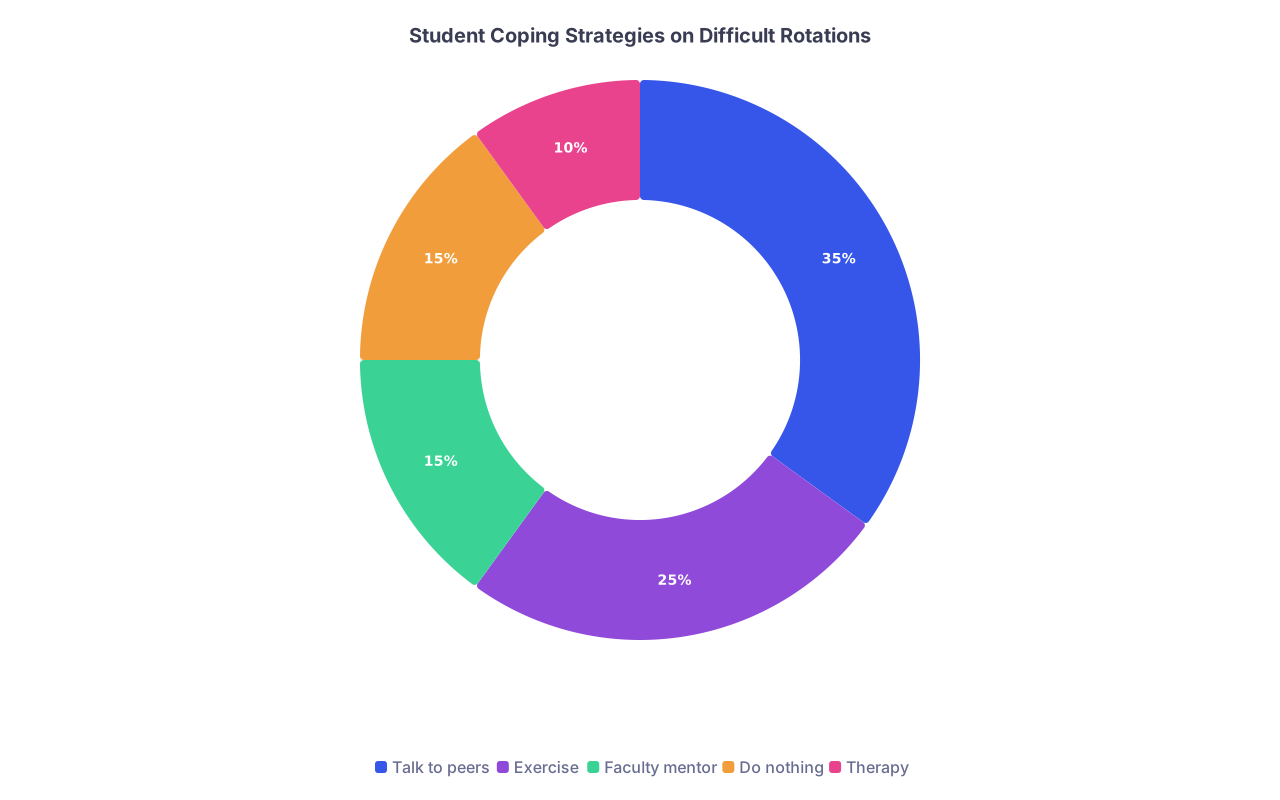
| Category | Value |
|---|---|
| Talk to peers | 35 |
| Exercise | 25 |
| Faculty mentor | 15 |
| Do nothing | 15 |
| Therapy | 10 |
When You’re Near the End of the Rotation
Last 1–2 weeks, you make two moves:
- Get explicit feedback
- Clean up the paper trail
Ask your attending or senior:
“As we’re nearing the end of the rotation, could you share how I’m doing and what you’ll likely highlight in your evaluation?”
If they say concerning things that don’t match your performance, you write down the conversation. If they threaten your grade inappropriately, that goes straight into your log and likely to the clerkship director if the final eval looks off.
For your documentation:
- Make sure your log is backed up somewhere safe.
- If you had meetings with leadership, keep those follow-up emails.
- If you decide to file anything formal later, you’ll have everything ready.
Sometimes the rotation ends, the eval is fine, and you decide you’re done. That’s okay. You don’t have to burn yourself out fighting every bad actor.
But if there’s a pattern with this team, your documentation plus others’ complaints eventually builds a case. Institutions move slowly, but patterns accumulate.

Quick Reference: Documentation vs. “Just Venting”
| Aspect | Effective Documentation | Just Venting Notes |
|---|---|---|
| Tone | Neutral, factual | Emotional, subjective |
| Length | 2–5 lines per event | Paragraphs or pages |
| Content focus | Who/what/when/where | How you felt mainly |
| Usefulness later | High | Low |
| Storage | Private, secure | Random, scattered |
If your notes look like the right-hand column, they’re for your therapist, not your dean. Convert them to the left-hand style before using them.