Residents are grading you long before an attending ever opens your evaluation form.
Let me be more blunt: by the end of day 2 of a rotation, most residents on your team could rank every medical student from “would fight to work with again” to “please never assign to me.” That ranking is not random. It follows a very consistent, very real unwritten rubric that no one bothers to explain to you.
I will.
Not the sugar‑coated “be professional, be enthusiastic” nonsense you hear in orientations. The actual criteria residents use at 10:30 p.m. writing notes, re-ordering labs you forgot, and deciding how generous to be on your eval.
You’re not being judged on how smart you are. You are being judged on how much work you create or remove for the resident and whether they’d trust you with a real patient at 2 a.m.
Let me walk you through how this really works.
The Hidden Scorecard Residents Use
There’s no official form taped to the workroom wall, but there may as well be. The categories are the same across medicine, surgery, peds, psych, you name it.
Behind closed doors, residents mentally score you on five things:
- Reliability
- Situational awareness
- Data handling (notes, presentations, follow‑through)
- Initiative without chaos
- How you affect team morale
Residents are not sitting there with a spreadsheet, but they are constantly updating a mental file on you. The story they tell about you at the end of the rotation—on your eval, to the attending, to future chiefs—is built off that file.
Let’s break down each dimension exactly how residents actually think about it.
Reliability: The First Filter You Either Pass or Fail
If you fail here, nothing else saves you. I’ve watched brilliant students get average evaluations because nobody trusted them to do what they said they’d do.
What “reliable” really means on rounds
It’s not about perfection. It’s about this:
- You say you’ll do something → it gets done
- If you can’t do it → you say so early
- You don’t vanish
That’s it. But watch how fast residents pick up on this.
They’re tracking:
- Do you show up on time, every time, without drama? Not 2 minutes after sign‑out, not “sorry parking was crazy,” just there.
- When the intern asks you to check a post‑op CBC and follow up the result—did you actually check it, and did you tell someone the result?
- If you’re told “get collateral from the daughter” or “follow up this outside record,” do we have an answer the next day or another vague “I couldn’t find it” with no effort?
The mental categories are brutally simple:
| Category | What Residents Say |
|---|---|
| Rock solid | "If they say it's done, it's done." |
| Mostly reliable | "Pretty good, needs some oversight." |
| Shaky | "Double-check everything." |
| Liability | "Don't give them anything important." |
You want to be in “rock solid” by week 2. That alone gets you honors at many places, because residents advocate hardest for students who make their lives easier and their patients safer.
Two behaviors that kill your reliability score
Silent failure
You’re asked to call a consultant. You try once, they don’t answer, you give up and never mention it. The resident finds out at 3 p.m. when the attending asks, “What did cardiology say?”You just earned: “I have to babysit this student.”
Chronic mild lateness or flakiness
You’re the student who’s always 2–3 minutes late to pre‑rounds, always “just finishing reading one more note,” always missing when something needs to be done. Tiny things add up fast.
Residents rarely confront you about this. They just quietly drop you a full letter grade on “professionalism” and “dependability.”
Situational Awareness: The Difference Between “Star” and “Fine”
This is the trait attendings label as “maturity beyond level” while residents translate it as “they just get it.”
Situational awareness is your ability to read the room, the patient, and the workflow without having to be spoon‑fed.
What residents are actually watching
- Do you see when the team is behind and cut your questions?
- Do you step in to help with scut when the intern is drowning in pages?
- Do you shut up when an attending is pissed off about an unsafe discharge and it’s not your moment to chime in?
The best students I’ve seen do things like:
- Grab the accu‑check machine when they see the nurse about to check your patient’s glucose, so you’re at bedside and can examine while you’re there.
- Print/distribute lists for rounds without being asked.
- Pull up imaging and labs before the team reaches the room.
Bad situational awareness looks like:
- Asking long pathophys questions while transport is waiting to take a patient to the OR.
- Presenting a 7‑minute monologue on chronic issues when the attending clearly wants only acute updates.
- Standing at the back of the group on rounds, not looking at the patient, staring at Epic.
Residents clock this fast. They start saying things like, “They’re not bad, but they just slow everything down,” which is code for: no honors.
Data Handling: Notes, Presentations, and Follow‑Through
This is the part students think is the whole job. It’s not. But it’s the most visible, so residents do score it hard.
Presentations: What residents secretly count
Attendings are listening for medical reasoning. Residents are listening to something else first: can they trust you as a data source?
They’re checking:
- Are your vitals, labs, and meds correct?
- Do you know what’s new and what’s old?
- Do you clearly separate “this is fact” versus “this is my impression”?
A student who routinely misstates labs, misses hypotension, or forgets that the patient is on heparin gets quietly tagged as “unsafe.” Once that label sticks, you don’t lose it.
Then there’s structure. Residents prefer short, clean, predictable presentations. You know the best feedback I’ve heard from a resident to an attending?
“She’s money. Everything is right, the story is clean, and she knows the plan.”
Not “she knows 500 zebras.” Money. Meaning: reliable data, logically presented, no drama.
Notes: What they really care about
On most rotations, nobody expects your notes to be perfect. But residents notice:
- Do you get them in on time?
- Do they match the story you told on rounds?
- Do they copy-paste entire novels with outdated info?
- Do you actually update the assessment/plan or just move words around?
The worst thing you can do: copy a resident’s note from three days ago, change the date, and leave in wrong facts. That’s how I watched one student go from “solid B+” to “barely pass” on a busy medicine service. The resident had to re-write multiple notes after the attending caught obvious contradictions.
You don’t have to write like an intern yet. You do have to be accurate and not create more work. That’s the bar.
Initiative Without Chaos: Where Most Students Overplay Their Hand
This is the category where gunner energy kills people.
Residents reward initiative when it saves them time, improves patient care, or shows ownership. They punish it when it creates fires they have to put out.
Good initiative (residents love this)
- You checked renal dosing on a new antibiotic and quietly suggest, “Should we adjust for CrCl of 28?”
- Before rounds, you call the nurse: “Any overnight events for Mr. X? Any pain issues?” Now your presentation is sharper.
- You notice a trend in the labs, look it up, and then ask a focused question: “I saw her platelets have been trending down since starting heparin—how do we think about HIT here?”
This says: I care. I am engaged. I’m thinking, but I’m not freelancing orders.
Bad initiative (residents quietly hate this)
- You suggest big plan changes in front of the attending that the team hasn’t discussed (“What about discharging him today? He looks good.”)
- You call consultants or order labs/imaging without talking to the resident first.
- You correct someone (nurse, intern, or attending) in front of the patient to show you’re right.
This is how a resident describes that student later: “Smart but no insight. I wouldn’t want them on my team again.”
How You Affect Morale: The Soft Factor That Isn’t Soft
This is the part no one admits in faculty meetings but dominates resident conversations.
After you leave the rotation, nobody remembers your exact HPI structure. They remember how it felt to have you on the team. Did it get lighter or heavier when you walked onto the floor?
Behaviors that boost your “I’d take them as an intern” score
- You don’t complain about hours, pages, or “busywork” in front of residents. We know the system is broken. We just don’t have energy to manage your existential crisis too.
- You look for ways to help: printing lists, offering to call pharmacy, checking on discharge paperwork.
- You treat nurses, techs, housekeeping with the same respect as the attending. Residents watch that like hawks.
- You stay engaged even on post‑call days when everyone’s exhausted. No slump into your phone for two hours straight.
Flip side:
- You sigh, roll your eyes, or make faces when new admissions come in.
- You pack up conspicuously before everyone else, especially if work is still clearly happening.
- You openly angle for letters, specialties, or research in a way that feels transactional. Residents can smell it.
Are residents petty sometimes? Sure. They’re human and sleep‑deprived. That’s exactly why you should assume your “vibe” on the team is being graded just as much as your differential for hyponatremia.
The Quiet Ranking: How Residents Actually Talk About You
Evaluations are one thing. The real ranking happens in conversations you never hear.
Two settings matter:
- The end‑of‑rotation “anyone have thoughts on the students?” attending chat
- The behind‑the‑scenes resident gossip that decides who gets strong letters, who gets interviews, and who gets quietly blacklisted
What those conversations really sound like
You imagine residents saying: “They were a great team player and showed solid fund of knowledge.”
Here’s what they actually say, in call rooms and workrooms:
- “She was clutch. I’d work with her any day.”
- “Honestly, invisible. Didn’t hurt us. Didn’t help us.”
- “Nice enough, but I had to recheck everything.”
- “Smart but exhausting. Always one more question, always something.”
- “I trusted him as much as some of the interns. He’ll be fine.”
That last sentence is gold. When a resident says “I trusted them like an intern,” your eval will be glowing, and if you’re applying to that specialty, they’ll remember you when applications come around.
Now look at how these subjective phrases map to their mental ranking.
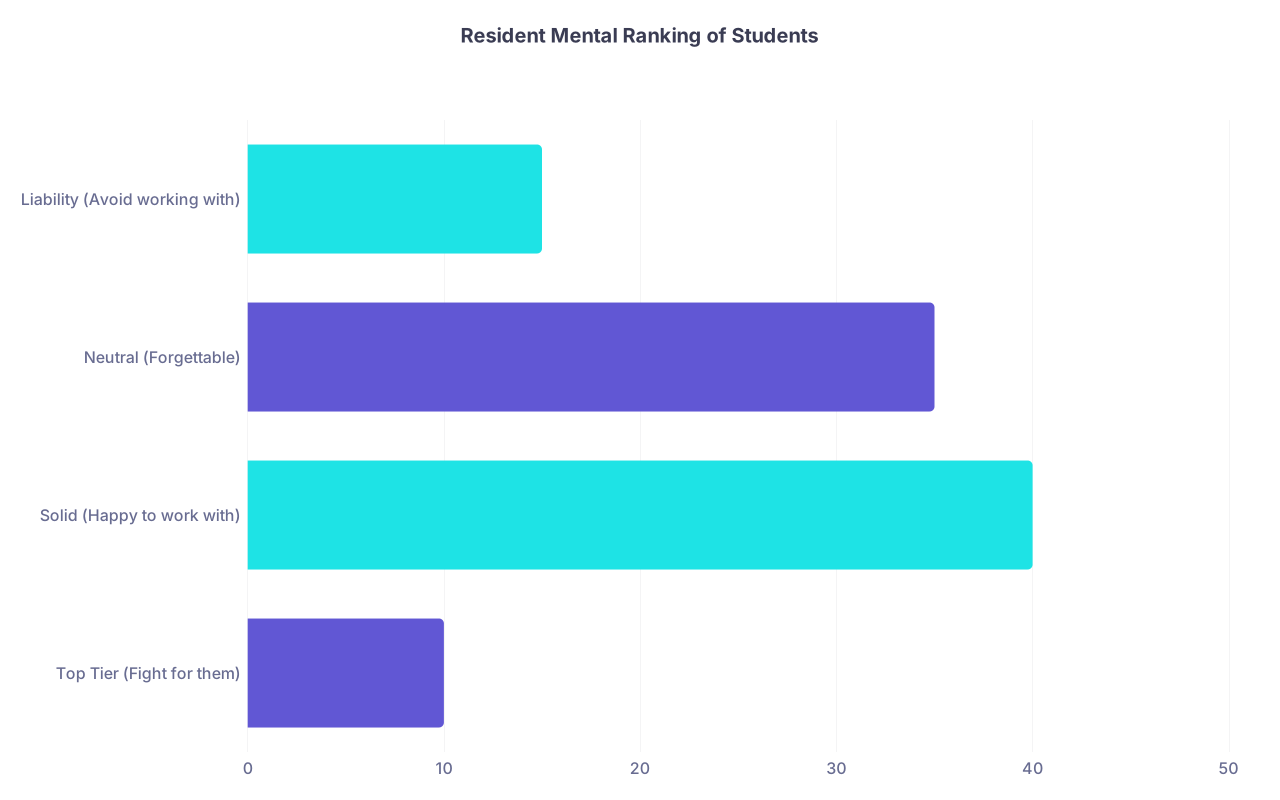
| Category | Value |
|---|---|
| Top Tier (Fight for them) | 10 |
| Solid (Happy to work with) | 40 |
| Neutral (Forgettable) | 35 |
| Liability (Avoid working with) | 15 |
No, that’s not from a published paper. That’s roughly what I’ve seen over years of listening to residents talk. Maybe 10% are stellar, 40% are good, most are forgettable, and 10–15% are the ones we quietly warn each other about.
How This Translates Into Your Grades and Letters
Here’s the part students misunderstand: the written evaluation form is just a vessel. The residents pour their story about you into whatever vague boxes the school uses.
If your school uses “Meets, Exceeds, Outstanding,” this is roughly how residents think:
- Outstanding / Honors: “Would absolutely take them as an intern. Low maintenance, high reliability, makes team better.”
- Exceeds / High Pass: “Good student, would happily work with again. Some rough edges, but overall positive.”
- Meets / Pass: “Fine. Did their job. I don’t remember much else.”
- Below: “Created extra work, made mistakes without insight, or clear professionalism issues.”
Your clerkship director might look at checkboxes, but the comment section and resident reputation carry more weight than you think—especially for letters.
Residents remember the top 5–10% of students for years. When they become fellows, attendings, or chiefs, those are the names they bring up for positions, research, and calls like, “Hey, what do you think of this applicant?”
That’s the real ranking system.
Concrete Behaviors That Lift You in the Unwritten Rubric
Since you like specifics, here’s what students who end up in the top tier tend to do differently.
They:
- Pre‑round efficiently, not performatively. They get key vitals, labs, overnight events, then see the patient. No 45‑minute pre‑rounding on one stable patient.
- Present concise, updated, structured stories. Same order every time. Residents can almost write the note while listening.
- Own one or two patients deeply. Know the family, social situation, consultant opinions, and upcoming steps better than anyone.
- Ask questions at the right time. When walking between rooms, after rounds, or when work is caught up. Not while the intern is drowning in pages.
- Fix their mistakes once. You tell them, “Don’t forget I/Os.” You never have to say it again.
- Read with a purpose. You see your patient with pancreatitis → you go home and read specifically about severity scores and fluid management, then bring 1–2 sharp points back the next day. Not just “I read UpToDate.”
Compare that with the middle-of-the-road student:
- Pre‑rounds but misses subtle things (new O2 requirement, decreased urine output).
- Presentations are long on history, short on today’s problems.
- Reads, but you can’t see it in what they say or do.
- Doesn’t make big mistakes, but doesn’t carry real responsibility either.
And the bottom tier:
- Unreliable on follow‑through. Data frequently wrong.
- Needs constant reminding for the same tasks.
- Poor awareness of how their behavior affects the team.
- Often “too busy” to help with simple things: tracking down a blood culture, grabbing a consent form, walking a patient.
This is the quiet spectrum you’re being placed on.
A Simple Mental Model: “Would I Hand Them My Pager?”
This is the question residents are subconsciously answering the entire rotation:
“If I had to hand this student my pager for 30 minutes and step away, how nervous would I be?”
- Not nervous at all → Honors
- Mildly nervous but overall okay → High Pass
- Nervous, would triple check everything after → Pass
- Refuse to do it → Below expectations / serious concerns
Improve that answer, and everything else follows.
Here’s a rough trajectory of how residents’ trust in a strong student grows over a 4‑week rotation:
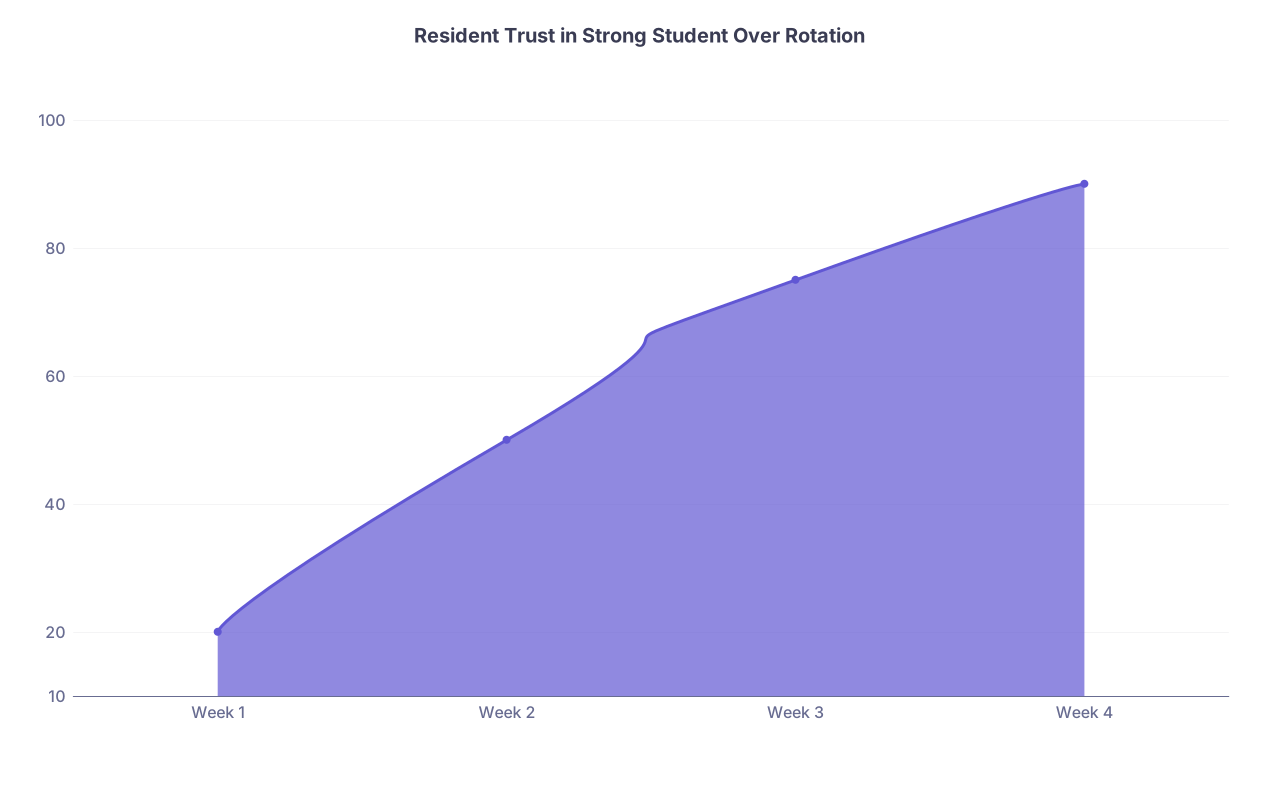
| Category | Value |
|---|---|
| Week 1 | 20 |
| Week 2 | 50 |
| Week 3 | 75 |
| Week 4 | 90 |
You want that slope steep and high. You get there with consistent reliability and gradual, visible growth.
Final Word: You’re Being Graded on How Safe and Useful You Are
Strip away the mystique and this unwritten rubric is simple:
Residents are overworked, under‑slept, and responsible for patients who can actually die. They judge you on two basic questions:
- Are you safe?
- Do you make my job and my patients’ lives better or worse?
Everything else—how many pathophys facts you know, how articulate your SOAP note is, how passionate you say you are about the specialty—is secondary.
If you act like the kind of intern you’d want covering your own family member, residents will rank you higher. Quietly. Consistently. And that ranking will follow you longer than you think.
You’ve now seen the hidden scorecard. Next in your journey is learning how to signal this competence early—by day 1 or 2 of a rotation—so you’re slotted into the “top student” category before anyone knows your name. But that’s a story for another day.