
Last year a student finished a month on a busy medicine service, certain she’d crushed it. Honors in everything so far. Glowing comments from interns. Then she saw her evaluation from the chief: “Hard‑working but not someone I’d trust with a sick patient without close oversight.” That line followed her into every letter discussion meeting.
Let me tell you what actually happened in the background. She thought the attendings were the ones who “really” mattered. The chiefs, in her mind, were just glorified schedulers. The chiefs, meanwhile, were the ones writing the rank lists, filtering who got interviews for the home program, and quietly labeling students as “top 5,” “solid middle,” or “do not bring back.”
You want to know what chief residents really remember about you on rotations? This is the unsanitized version.
First truth: The chiefs are keeping a mental short list
Here’s the part students do not fully grasp: chiefs are constantly sorting you into buckets. Not formally. Not in a spreadsheet. In quiet hallway conversations, post‑call debriefs, and those “any stand‑out students this month?” emails from PDs.
The buckets are usually some version of:
- “I’d recruit this person tomorrow”
- “Good, safe, would not fight for them”
- “Red‑flag, would block this person”
And no, they don’t base that on how much you know about IL‑2 signaling or whether you correctly differentiated prerenal vs intrinsic every time. They’re watching something else entirely.
Most chiefs can recall almost nothing about your actual answers on rounds three months later. But they will remember, with uncomfortable clarity:
- The one time you didn’t come find them when a patient got hypotensive
- The way you treated the night nurse on your 2 a.m. cross‑cover call
- That you vanished at 4 p.m. every day the attending left, without asking what still needed to be done
Program directors ask us a simple question at ranking meetings: “Would you want this person covering nights with you?” Everything you do on rotation ends up serving that question.
What sticks in a chief’s mind after you’re gone
I’ve sat in rooms where a PD opens the ERAS file, everyone stares at a Step score, and then someone says, “Anyone know this applicant?” Then we, the chiefs and senior residents, start talking.
Nobody says, “On October 14, she quoted the ACC heart failure guidelines verbatim.” That’s not what sticks.
1. Your reliability under pressure
Let’s start with the thing that matters more than your “work ethic” buzzword: are you reliable when things get real.
Specifics chiefs remember:
- The 3 a.m. rapid response where you actually showed up
- The day your intern got buried and you quietly picked up three discharges and did them well
- The night the ED was dumping admissions and you didn’t whine, you just asked, “What can I take off your plate?”
We remember who disappeared when things got hard. We remember who was “great” on slow days but suddenly had “pre‑existing conflicts” or “study time” when the service exploded.
A student once had an average fund of knowledge, nothing special. But on a brutal ICU call, she stayed late, helped us chase labs, called families with us, never complained. When her ERAS came up for our program, one of the chiefs said, “She’s a worker. I want her on my team.” That was it. She got an interview when other higher‑scoring students did not.
You think it’s about your chalk talk. The chief is remembering whether you came through when they were drowning.
2. How you respond the second time you get corrected
Everyone can fake humility once.
We correct you on a note: “Don’t copy forward this inaccurate problem list.” You apologize, fix it, nod vigorously. Good. That’s not what we remember. We watch what you do the next time.
A pattern we talk about a lot in chief offices:
- Student who gets feedback, improves, and never makes the same mistake twice
- Student who nods, apologizes, and then repeats the same behavior all month
You’d be shocked how many students fall into the second category.
A surgery chief I know still talks about a student who kept putting “stable” in every progress note for a postop patient that was quietly decompensating. Got called out on it. Next day? Same wording. The comment that ended up in the dean’s letter draft was brutal: “Does not adjust behavior in response to direct safety‑related feedback.”
You think it’s “just a note.” Chiefs are thinking: “How will this person handle critical feedback in residency? Are they trainable or dangerous?”
3. Whether you make life easier or harder for the team
Here’s the dirty secret: most of us don’t care if you can recite obscure trial acronyms. We care whether the room gets lighter or heavier when you walk onto the unit.
Chiefs remember:
- The student who pre‑rounded on the whole team’s patients, not just “their” two
- The one who checked on a patient’s transport, lab draws, or family updates without being asked
- The student who constantly said, “That’s not my patient,” or “Is that really my role?”
Interns talk to chiefs. A lot. They tell us who actually helped and who was dead weight with a good Anki streak.
I’ve seen chiefs override stellar attendings’ comments because the intern came to them and said, “Look, the attending liked them, but they were useless after rounds. Never helped with notes, never followed up studies, always on their phone ‘reading.’”
There’s a phrase you never want to be associated with in a chief’s mind: “High maintenance.” Once that label hits you, it sticks.
4. How you talk about nursing, ancillary staff, and other services
You can be the most brilliant student on the floor. If you’re dismissive to nurses, you’re finished.
Chiefs remember exact phrases. I’ve sat in evaluation meetings where someone quotes a student word for word, months later:
- “The nurse is being dramatic again.”
- “I don’t really think PT knows what they’re talking about for this patient.”
- “Why is respiratory therapy so slow?”
We also remember the inverse:
- The student who brought coffee to the night nurse who’d been triple‑assigned
- The one who said, “Let me go talk to RT directly and see what they’re recommending”
You might think chiefs are too busy to notice these micro‑interactions. We’re not. During sign‑out, nursing will casually say things like, “That student was great,” or “Please don’t assign that student to my patients again.” You won’t hear that. We do.
And then, when the PD asks us for “any red flags?” that’s exactly what we bring up.
5. Whether you get the story on your patients
A secret from morning report and eval meetings: we don’t just remember who knew the lab values. We remember who knew the human being attached to those numbers.
There’s a subtle but big difference between:
“Mr. Jones is a 64‑year‑old with CHF exacerbation, here with increased shortness of breath, orthopnea, and PND…”
and
“Mr. Jones is a retired bus driver who’s been admitted six times this year because he can’t afford his meds. He sleeps sitting up in a recliner and his wife’s overwhelmed.”
The second student? That’s the one we remember.
Chiefs are thinking: who will talk to families at 11 p.m. when nobody else has the energy? Who will catch the social determinants that are going to bounce this patient right back into our ED? Who actually sits on the bed and talks like a human?
I’ve watched a PD change their tone on an applicant when a chief said, “I still remember how she talked to that patient with end‑stage COPD. She got him to sign DNR when nobody else could, because she actually listened.”
We do not forget that.

What doesn't matter as much as you think
Let me puncture some myths quickly, the ones that make students anxious about the wrong things.
1. We don’t care if you don’t know every answer on rounds
You will not be remembered for missing the third‑line therapy for some rare autoimmune disease.
What sticks is how you respond to not knowing:
- Do you make something up and bluff? Chiefs hate this. It’s unsafe.
- Do you flatly say, “I don’t know,” with no follow‑up? Also weak.
- Or do you say, “I’m not sure. My guess would be X because of Y. I’ll look it up and get back to you this afternoon.”
That last one? Safe. Teachable. That’s how residents think. That’s who we want to work with.
A student who guesses convincingly and is wrong is far more dangerous in our minds than a student who says, “I’m not comfortable making this call yet.”
2. The exact number of hours you stay late is not the point
Staying until midnight every night does not impress anyone anymore. That game is over. Chiefs see through it.
What we actually notice:
- Do you stay until the work is done?
- If you need to leave, do you tell the team what you have done and what’s not done?
- Do you leave at the first legal minute even when the team is clearly still buried?
We remember the student who, on a brutal call day, said at 4:30 p.m., “I can stay until 6; what would be truly helpful for me to finish before I go?” That’s a resident brain.
We also remember the one who disappeared at 4:01 every day, regardless of whether the team was in crisis, because “the student schedule says we’re done at 4.”
You are not competing on martyrdom hours. You are being evaluated on judgment.
What chiefs actually write on your evaluation
Here’s the part you never see clearly: the difference between generic fluff and the kind of comments that move the needle for PDs.
Attendings often write “Excellent medical knowledge. Hard‑working. Pleasure to work with.” Everyone gets some version of that.
Chiefs and senior residents, when they care enough, will write specifics. Those specifics are what PDs read aloud in meetings.
The things that echo:
- “I would trust this student with my sickest patients as an intern.”
- “Top 5 students I’ve worked with in the last two years. Calm under pressure.”
- “Nice on the surface, but disappeared whenever the workload increased. Would not want on nights.”
- “Needed repeated redirection about documentation and never fully improved. Concerning for safety.”
Those phrases? They become your unofficial reputation in that department. And yes, they get paraphrased into letters, SLOEs, and whispered side comments.
If you want to understand what chiefs really remember, look at what we bother to write down when we’re exhausted and have 20 evals to fill out. Anything we still care enough to type is what stuck.
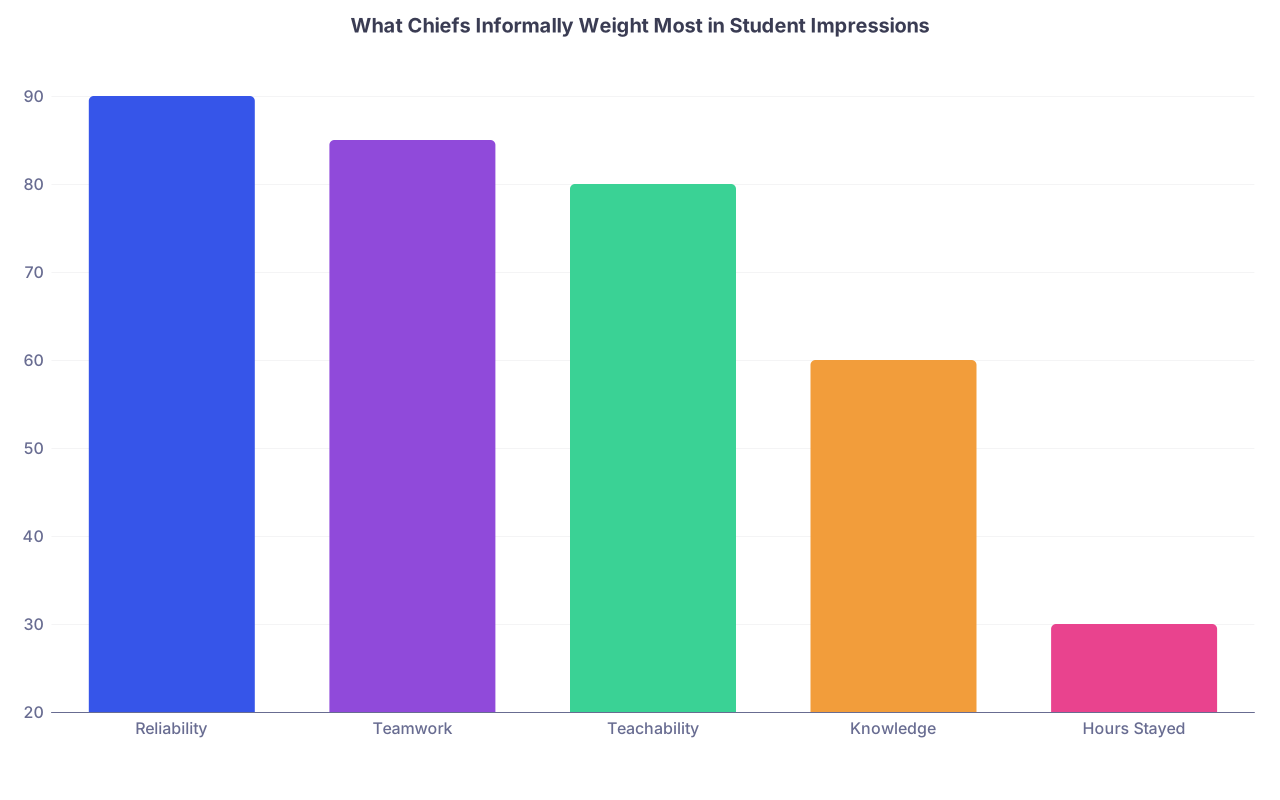
| Category | Value |
|---|---|
| Reliability | 90 |
| Teamwork | 85 |
| Teachability | 80 |
| Knowledge | 60 |
| Hours Stayed | 30 |
The behind‑closed‑doors conversations about you
Let me walk you into a real scenario. Composite, but accurate.
It’s late fall. Interview season. The PD pulls up the list of home students who applied to the program.
“Alright, any thoughts on Patel?”
Chief #1: “Oh yeah. She was on my wards team. Super solid. She picked up extra patients without being asked. I’d put my name on her.”
Chief #2: “Agree. I remember she stayed with a dying patient’s family for hours when the intern got pulled away. She’s the real deal.”
Result: gets an interview, PD already biased in her favor before she walks in.
Next student.
“What about Gonzalez?”
Silence, then:
Chief #3: “Honestly, I barely remember him. Wasn’t bad. Wasn’t great. Just… there.”
Chief #1: “I remember the intern saying he disappeared after rounds mostly. But no major issues.”
Result: might get an interview, but no one is fighting for him. On the rank list, he’ll sink below anyone with a champion.
Next student.
“And Smith?”
Chief #2: “The one who argued with nursing about every order and rolled his eyes in sign‑out?”
Chief #1: “Yeah. Brilliant, but exhausting. I’d pass. Too much work.”
Result: maybe no interview. Or if he does get one, he’s walking in with a silent handicap.
You do not hear these conversations. But this is how it really goes down.
How to make sure you’re remembered for the right things
Let’s be blunt. You cannot control whether an attending likes your “style” or whether you happen to be on a service with 20 admissions a day versus 2. But you have more control than you think over what the chiefs remember.
A few moves that reliably stick in chiefs’ minds:
Early in the rotation, ask your senior or chief:
“What does a truly outstanding student look like on this service to you? Not in the handbook version, but in reality.”
Then actually do that.When something goes wrong—your patient crashes, you missed a lab, you were late—own it first.
“I should have caught that earlier. Here’s what I’m going to do differently from now on.” Chiefs remember that kind of accountability.Protect your credibility like it’s oxygen.
Don’t lie about seeing a patient you did not see. Don’t say, “I checked that,” when you did not. Once a chief catches you in one lie, you’re done. The label becomes “untrustworthy,” and that’s lethal in our world.Aim to be the student everyone requests, not just the attending’s pet.
If the interns, nurses, and night float all say, “Send her back anytime,” you’ve already won.
You don’t need to be the smartest person in the room to end up on our “top 5” list. You just need to make it brutally easy for us to answer yes when someone asks, “Would you want them on your team at 2 a.m. with three admits and a crashing patient?”
FAQ (exactly three questions)
1. If I had a bad day or snapped once, is my reputation ruined with the chiefs?
No. Everyone has a bad day. What destroys you is a pattern. If you lost your cool or were short with someone, you can partially repair it by behaving differently consistently afterward—and sometimes by directly apologizing to the person involved. Chiefs respect people who show insight and change; we distrust people who pretend nothing happened and keep doing the same thing.
2. Do chiefs actually influence grades and not just residency decisions?
Yes, especially on core clerkships. On many services, the chief runs the grading meetings, synthesizes feedback from residents, and presents it to the clerkship director. Even if they do not formally set the grade, their narrative summary drives whether you’re seen as “honors‑level” or “meets expectations.” Later, those same impressions feed into who gets strong home letters and who gets a neutral, generic one.
3. I’m introverted and not naturally talkative—will I be forgotten or penalized?
Quiet is not a problem. Invisible is. Chiefs do not need you to be the loudest voice; we need to see your work. If you’re introverted, make your reliability obvious: clear updates, written sign‑outs, offering help directly. When you do something extra—staying late to finish notes, spending time with a family—tell your intern or senior what you handled. That is not bragging; it is making your contribution visible so you’re remembered for what you actually did.
Key points to walk away with: chiefs remember how safe, reliable, and coachable you were—not how many esoteric facts you knew. They remember how you treated the weakest people in the system, especially on bad days. And when your name comes up months later, the only real question they’re answering is: Would I want you next to me on the worst night of the year?