

The loudest medical student on rounds is not the most impressive—just the most noticeable.
If you’re an introvert, that distinction can save your sanity.
You do not have to become the loud, joke-cracking, always-answering person to stand out. In fact, when introverts try to fake that persona, it usually backfires: you look shaky, you overtalk, you get flustered when cold-called, and the team just senses something is off.
You can be quiet and still be the student everyone remembers as “sharp, reliable, and on top of things.”
Let’s walk through what that actually looks like on a real team, on real rounds, when you’re tired, scared of looking stupid, and surrounded by people who seem much more comfortable talking.
Step One: Redefine What “Standing Out” Actually Means on Rounds
You’re probably using the wrong scoreboard.
Most students think “standing out” = talking a lot. Answering every question. Volunteering constantly. That’s an undergrad seminar mindset, not a clinical one.
On rounds, attendings and residents are subconsciously tracking different things:

They care about:
- Can I trust this student with real responsibilities?
- Do they prepare?
- Do they follow through?
- Do they help the team, or drain it?
You can hit all of those without ever becoming “the talker.”
Think of it this way: loud students are noticeable. Dependable students are memorable. People write strong evaluations for memorable.
So for you, the goal is not “talk more.” It’s “make my quiet presence impossible to ignore because I make everyone’s life easier and my patients’ care better.”
We’ll break that into four areas where introverts can quietly dominate:
- Preparation and pre-rounds
- Strategically chosen moments to speak
- Silent but visible reliability during rounds
- One-on-one micro-interactions outside of rounds
Step Two: Use Preparation as Your Superpower (Pre-Rounds)
Quiet students often underestimate how much damage—or good—they can do before rounds even start.
Introverts usually excel at solo work, pattern recognition, and deep focus. Pre-rounding is literally built for you.
The 30–45 Minute Pre-Round Routine
Here’s a simple system that will make you look “on it” without saying a word.

| Step | Description |
|---|---|
| Step 1 | Arrive 30-45 min early |
| Step 2 | Check overnight events |
| Step 3 | Review vitals & I/Os |
| Step 4 | Check new labs & imaging |
| Step 5 | See patient briefly |
| Step 6 | Update your one-liner & plan |
Concrete steps:
Arrive 30–45 minutes before your intern starts. Not 5 minutes before rounds.
On each of “your” patients:
- Skim overnight notes and nurse messages.
- Look at vitals trend (not just “fever vs no fever”—look at direction).
- Look at new labs and imaging. Identify: better, worse, unchanged.
- Visit the patient. Ask 2–3 targeted questions related to their active issues (pain, breathing, nausea, output, whatever is relevant).
Write a tiny, structured note to yourself:
- One-liner updated (“72M with CHF, here with volume overload, now day 3 diuresis…”).
- 3–5 bullet “Assessment/Plan” in your notebook or device.
You do not have to be the fastest. You just need to have a coherent picture of your patient.
How This Helps You Stand Out Quietly
When the team gets to your patient and the resident says, “Anything new overnight?” you can speak one short sentence:
“His shortness of breath is better, still some orthopnea, net negative 1.5L, creatinine is stable.”
That line screams: I pre-rounded, I looked at vitals, I checked I/Os, I saw the patient, I made sense of it.
You didn’t perform. You just did the work.
Do that consistently, and you’re already in the top half of the team.
Step Three: Pick Your Spots to Speak—Don’t Fight for Air
On rounds, extroverts love open airspace. They jump into every silence. That doesn’t have to be you.
Your goal: speak less often, but with content that actually moves patient care or shows clear preparation.
Three High-Impact Moments for Introverts to Talk
You don’t need to talk 20 times. You need to talk 5 times with substance.
Here are the highest-yield moments:
The One-Liner / Case Presentation
This is your biggest “on stage” time.
Script it. Literally. Write the exact first sentence and the structure in your pocket.Structure that works:
- Name, age, 1 line of relevant history.
- Why they’re here.
- 1–2 key overnight changes.
- 3–5 bullet plan by problem.
Practice out loud walking to the hospital. You’ll sound much more confident without forcing a personality change.
The “I-noticed-this” Moment
Residents love when students catch things they missed.Example lines:
- “I noticed his platelets dropped from 230 to 140 since admission; I wasn’t sure if that’s from heparin or dilutional?”
- “Her sodium’s been trending down over three days; I wondered if we should adjust fluids?”
Notice the phrasing: you’re not grandstanding. You’re flagging concern and inviting teaching.
The Legitimate, Focused Question
Bad students spray questions they could Google.
Strong introverts ask 1–2 narrow, well-timed questions per day, usually after rounds or between patients.Examples:
- “For this COPD patient, how do you decide between BiPAP vs intubation when they first come in?”
- “We’re starting this new chemo—what side effect should I be especially watching for on the floor?”
Ask after the team finishes the core decisions, not mid-chaos. Respect the flow.
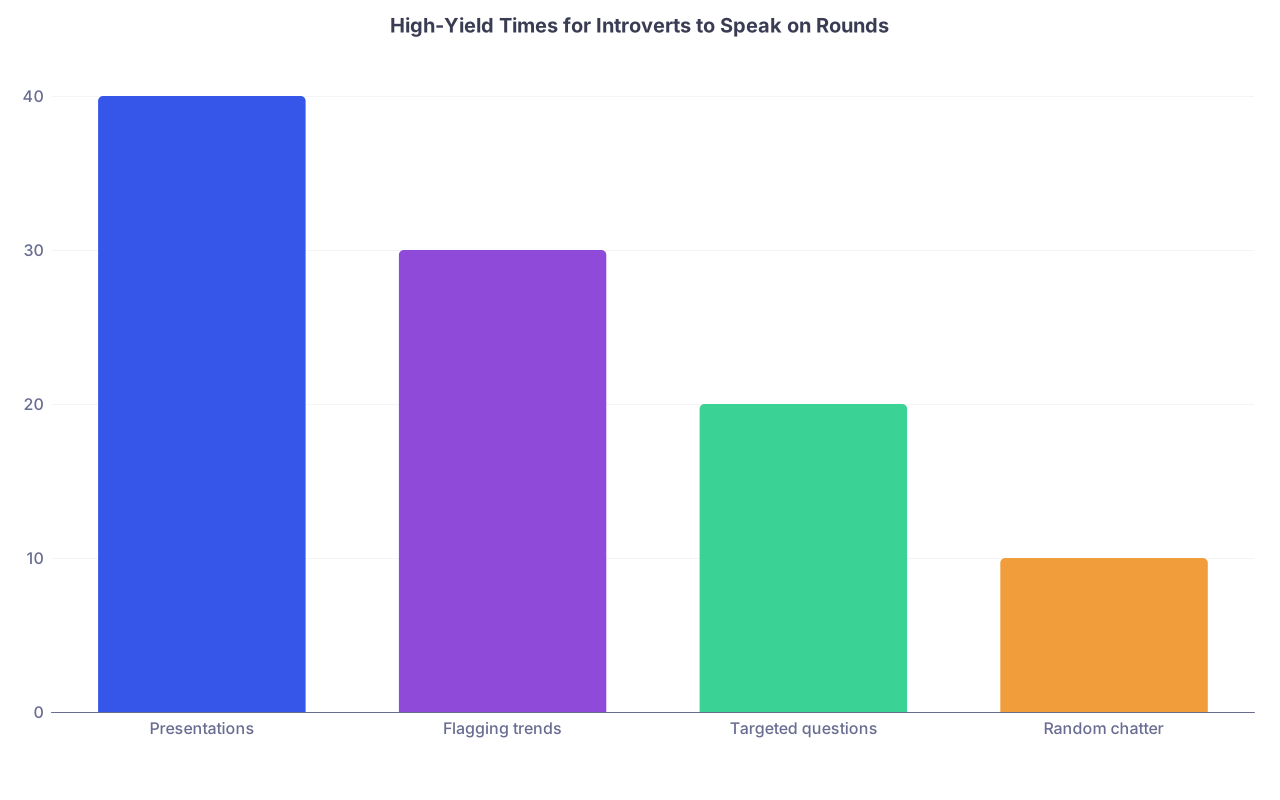
| Category | Value |
|---|---|
| Presentations | 40 |
| Flagging trends | 30 |
| Targeted questions | 20 |
| Random chatter | 10 |
(Think of this as “relative impact,” not exact percentages. Presentations, flags, and smart questions get remembered. Chatter doesn’t.)
Step Four: Let Your Reliability Speak Louder Than Your Volume
There’s a moment after rounds when the attending and senior resident are talking about you. You’re not in the room. You have zero control in that moment.
Except you do. You control what they have to work with.
What they remember are patterns:
- “She always has her patients prepped.”
- “He follows up on everything I ask.”
- “If I give her a task, I do not have to think about it again.”
That is where introverts can quietly destroy the curve.
The Task Rule: 100% Follow-Through, 0% Drama
Any time someone asks you to do something—note, call, consent, set up family meeting—mentally do this:
- Write it down immediately. Not later. Right then.
- Repeat it back in 1 sentence: “So, call nephrology and ask about starting diuresis again?”
- Before leaving the room, decide: “When am I doing this?” Today, not vaguely “later.”
Then, after you actually do it, close the loop:
- “I called nephrology; they recommend holding diuresis and repeating BMP at 3pm.”
- “I updated the family at bedside; they understand the plan for colonoscopy tomorrow.”
Short. Clear. No dramatics about how hard it was. Just: done.
Residents build trust on this. And once they trust you, they teach you more, give you more responsibility, and your eval goes up—even if you weren’t the noisiest person on rounds.
Step Five: Use One-on-One Moments, Not Group Performances
Introverts typically do much better in small interactions. You can absolutely use that.
You don’t need to impress an audience. You just need the attending and residents to see who you are when the spotlight is off.
Places to Lean into as an Introvert
- Walking between patients
- In the workroom when everyone is charting
- Waiting for the elevator after rounds
- Before or after a procedure with a resident
This is when you can ask:
- “Can I run my assessment and plan by you to see if I’m on the right track?”
- “How would you have framed that presentation differently?”
- “I’m trying to get better at interpreting ABGs. Do you have a favorite way to think about them?”
You’ll often get more honest teaching and feedback here than in front of the whole team.
Step Six: Learn a Quiet Presentation Style That Works for You
Let’s deal with the part you probably dread the most: opening your mouth in front of everyone.
You don’t need to sound like a podcast host. You do need to sound organized and not terrified.
A Simple Script for Presenting Without Sounding Robotic
Pick one consistent structure and use it every time. Something like:
- One-liner: “Mr. X is a 65-year-old man with history of COPD and HTN, admitted three days ago for COPD exacerbation.”
- Interval: “Overnight, no acute events. His work of breathing has improved; he’s now on 2L nasal cannula from 4L.”
- Systems (only relevant ones):
- Respiratory: “Still has some wheezing, no accessory muscle use, SpO2 94% on 2L.”
- Infectious: “Afebrile, WBC down from 14 to 11.”
- Labs/imaging highlights.
- Assessment/Plan by problem:
- “# COPD exacerbation – continue steroids day 3/5, wean oxygen as tolerated, duonebs q4h.
Question: if he remains stable today, could we aim for discharge tomorrow with close follow-up?”
- “# COPD exacerbation – continue steroids day 3/5, wean oxygen as tolerated, duonebs q4h.
Notice the final move: you end with a reasonable question or disposition thought, not a mumble. That gives the attending a hook to teach from and shows you’re thinking.
You don’t need to be loud. You just need to be structured.
Step Seven: Protect Your Energy So You Don’t Completely Burn Out
Rounds are exhausting for introverts not because of the medicine, but because you’re “on” for hours around people.
If you don’t manage that, you’ll go home fried, and your performance will slide no matter how smart you are.
Three Simple Energy Rules for Introverts on Rotations
Have a decompression ritual after rounds
Ten minutes. Alone. No phone if possible.
Walk a quiet stairwell. Sit in your car. Find a bench outside. Let your brain drop out of “performance mode” before you dive into afternoon notes or studying.Use micro-breaks
If the team is chatting about fantasy football and you’re socially drained, it is fine to quietly step out and “check on lab results” or “review my patient’s meds.” The point is not to isolate yourself all day, but to accept that you will need short, intentional resets.Do not schedule high-social stuff every single night
If you’re on a demanding rotation (medicine, surgery, pediatrics wards), give yourself permission to say no to some post-rotation group hangouts. You’ll perform better if you’re not constantly overdrawn.
Step Eight: Handle Being Put on the Spot Without Panicking
You will be cold-called. You will be asked questions you don’t know.
Extroverts bluff or talk in circles. You don’t have to.
Here’s a calm, composed pattern you can use every time:
If you partially know it, show your reasoning.
“I’m not completely sure, but I think the next step would be to check X because Y.”If you have no idea, say this instead of rambling:
“I’m not sure. I’d like to read about this after rounds and get back to you.”
Then actually read about it. And the next day or later that afternoon, close the loop:
- “You asked earlier about indications for noninvasive ventilation—what I found was…”
That move—circling back—is wildly underused. It makes you look prepared, humble, and serious. Perfect fit for introverts.
Step Nine: Turn Your “Quiet Strengths” into Visible Strengths
You have built-in advantages as an introvert if you lean into them instead of fighting them.
| Natural Introvert Trait | How to Make It Visible on Rounds |
|---|---|
| Deep listening | Catch subtle overnight issues, summarize patient concerns clearly |
| Thoughtful processing | Ask 1–2 sharp, well-framed questions a day |
| Preference for 1:1 | Seek brief feedback from residents between patients |
| Detail orientation | Always know vitals/labs trends cold for your patients |
| Calm demeanor | Be steady during codes, rapid responses, or stressful family meetings |
None of that involves becoming loud. It just involves bringing what you already do well into the light in small, concrete ways.
Step Ten: When You’re Being Misread as “Disengaged”
This happens a lot. Quiet student = “doesn’t care” in some people’s heads. You can’t control every perception, but you can preempt some of it.
If you get even a whiff of this (a comment like “You’re really quiet” from a resident, or “You should speak up more”):
Acknowledge it directly in a brief, non-dramatic way:
- “I know I’m on the quieter side in groups.”
Add the frame:
- “I’m always engaged, but I tend to process a lot internally first.”
Ask for a specific adjustment or feedback:
- “I’d appreciate if you could let me know if there are particular parts of rounds where you’d like me to contribute more.”
You’re not apologizing for being introverted. You’re signaling self-awareness and a willingness to adapt, which most evaluators respect.
What To Do Today
Do not try to fix everything at once. Pick one concrete move and test it tomorrow.
Here’s your assignment:
Tonight, write out a full, structured presentation for one of your patients—one-liner, interval events, key vitals/labs, and 3–5 point assessment/plan. Practice saying it out loud twice.
Tomorrow on rounds, use that script exactly once. Do not worry about talking more. Just deliver that one presentation clearly.
Then notice what happens: the nods, the “Nice job,” or the way your resident starts asking you more questions. That’s your proof that you can stand out on rounds without faking a personality you do not have.


