

Some students get called on first because faculty have already decided they are “safe” before rounds even start.
That is the part no one tells you. By the time the attending asks, “So, who wants to present this patient?” or “What’s the differential here?”, the choice often isn’t random. It’s the final step in a judgment that’s been forming since the minute you walked onto the floor.
Let me walk you through how this really works, from the perspective of attendings and residents who teach every day—and how you can quietly put yourself in that “call on first” category without becoming the annoying gunner everyone hates.
The Myth of Random Cold Calling
Most students think being called on is either:
- Pure random chance
- Punishment for looking away or avoiding eye contact
- A reward for raising your hand or standing at the front
Those matter a little. But they are surface-level.
Behind the scenes, faculty and residents are constantly running a silent calculation:
“How much time do I have?”
“Who do I need to assess today?”
“Who can I call on without this becoming a disaster?”
“Who actually wants to engage?”
The decision to call on you first, repeatedly, is usually based on four things:
- Your perceived safety (you won’t crash and burn brutally)
- Your reliability (you show up, you read, you try)
- Your vibe (you’re not combative, you’re teachable)
- Your visibility (you’ve made it easy to remember you exist)
The students who get called on first over and over are the ones who quietly win those four categories—not always the ones with the highest test scores.
How Attendings Actually Sort You on Day 1
I’ve watched this play out hundreds of times on medicine and surgery services. The attending meets the team on Monday and, by the end of that team huddle, has already built a mental tier list of learners.
They will not tell you this explicitly, but it’s real.

| Category | Value |
|---|---|
| Perceived effort & reliability | 35 |
| Professionalism & attitude | 30 |
| Knowledge signals | 25 |
| Random factors | 10 |
Here’s what that looks like in practice.
The attending walks onto the unit. You’re standing there with the team:
- One student is at the front, introduces themselves clearly, shakes hands, makes eye contact. Knows the service. “Hi Dr. Patel, I’m Alex, MS3—on my first week of medicine. I’m following Ms. Jones in room 12 and Mr. Ramirez in room 8.”
- One student is half a step behind, head slightly down, mumbles their name, doesn’t mention a patient.
- One is still stuffing their phone into their pocket, white coat half-open, holding a Starbucks cup.
In 30 seconds, the attending has slotted you mentally:
- “Leader / likely engaged”
- “Middle of the pack”
- “High risk of being unprepared, may be trouble”
The first group gets called on early and often, because attendings think: “I can teach through this person. They’ll keep the flow going.” The third group gets called on when the attending feels like performing a public service announcement on “reading more” or “owning your patient.”
You want to be in that first group. Not performatively. Predictably.
The Real Teaching Agenda: Why They Need a “Go-To” Student
Here’s the part most students never see: attendings have their own agenda on rounds, and it’s rarely “test everyone equally.”
They’re trying to:
- Hit required teaching points
- Finish notes and orders
- See enough patients to not get behind
- Satisfy eval requirements for you and the residents
- Not look incompetent in front of patients, staff, or their colleagues
So they need at least one student they can reliably teach through without it turning into a 10-minute rescue mission. That becomes the student they call on first.
If you’ve ever wondered why:
- The same person always gets the “interesting” questions
- The same person presents the sickest patients
- The same person is always asked, “What do you want to do next for this patient?”
…it’s because the attending has chosen a “teaching anchor.”
They’re not consciously trying to play favorites. They’re trying to survive rounds and deliver some education without chaos.
If you want to be called on first, you’re really asking: “How do I become the anchor?”
Let’s break down how that choice gets made.
The Eight Signals Attendings Use (Often Unconsciously)
Here is the stuff that actually shapes who gets called on. Very little of it shows up in any official handbook.
1. Your First 3 Sentences on Day 1
I’m not exaggerating. Those first three sentences signal everything:
- Do you speak clearly?
- Do you know which service you’re on?
- Do you already know one patient’s name and room?
A student who says:
“Hi, I’m Sam, MS3 on my first week of surgery. I’m following Mr. Lewis in 413 and Ms. Park in 416. I pre-rounded on them this morning.”
will get called on sooner than the student who says:
“Hey, I’m Sam. Uh, third-year. On this rotation. Yeah.”
One sounds like a junior colleague. The other sounds like extra weight.
You don’t need to be slick. Just specific, present, and oriented.
2. Where You Stand—and How Present You Look
Yes, physical position matters. Every attending I know does this.
The student who consistently:
- Stands near the front, slightly to the side, not blocking the resident or patient
- Has a small notebook or folded paper ready
- Looks at the patient when they’re being discussed
- Puts their phone away without being asked
…is read as “engaged, prepared, safe to call on.”
The student:
- Half-hidden behind the intern
- Staring at the computer during bedside teaching
- Whispering to another student while the plan is discussed
…gets mentally flagged as “not worth the time right now.”
No one announces this. But I’ve heard attendings later in the workroom say things like, “Yeah, I didn’t ask her much—she looked like she didn’t want to be there.”
If you look like you’re there to participate, they’ll feel much more comfortable starting with you.
3. How You Handle the First Question
The first time they cold call you is a test. Not of your knowledge. Of your response pattern.
They’re asking:
- Do you crumble or think through it?
- Do you handle not knowing with composure or meltdown?
- Do you ramble, or can you be concise?
- Are you defensive, or coachable?
If you respond with something like:
“I’m not 100% sure, but I was thinking along the lines of X because of Y and Z. I’m missing how A fits in though.”
That’s gold. You showed thinking, humility, and a handle on the data. You’ve now signaled: “You can safely call on me. I won’t freeze and make this awkward for everyone.”
If you respond with:
“Uh… I don’t know… I didn’t read that yet… sorry…”
…three times in a row, you’ve answered a different question: “Should I build my teaching rounds around this person?” Answer: no.
They’ll still ask you things. But not first. Not for the “interesting” cases. Not for the higher-order thinking.
4. Your Pre-rounding and Presentations
There’s a brutal truth here: the students who do solid, consistent pre-rounding and presentations become the default “first called” students.
Why? Because they make the attending’s life easier.
If your SOAP note or oral presentation is:
- Structured
- Complete but not bloated
- Contains your own assessment and plan, even if rough
…you’ve essentially raised your hand to be used as a teaching platform. Attendings see: “I can refine this. I can push them a bit. They did the work.”
If your presentations are:
- Just a list of vitals and labs
- Missing your own thinking
- Needing the resident to constantly correct basic stuff
The attending mentally shifts: they’ll still call on you, but much later, once they’ve hit the key points with someone more prepared.
I’ve heard attendings say, “I’m going to start with Maya for the first few patients—she’s got a good structure and it’ll help everyone else hear how I tweak things.”
That is exactly the “called on first” energy.
5. Your Willingness to Commit to an Answer
There’s something attendings hate: students who endlessly hedge and never commit.
You know the type of exchange:
Attending: “What do you think the most likely diagnosis is?”
Student: “Well, it could be X, maybe Y, also possibly Z, I’m not sure.”
Attending: “OK, what’s your best guess?”
Student: “I mean, it could be any of them…”
This makes it very hard to teach. They can’t see your actual thinking. It feels like trying to grab smoke.
Compare that to:
“My leading diagnosis is X because of A, B, and C. I’m less convinced about Y because we’re missing D, but I’d still keep it on the list given E.”
That student will get called on first again and again. Why? Because they commit. Even when wrong, you can work with it. And that’s what attendings want.
6. Whether You Telegraphed That You Want to Learn
Quiet secret: many attendings call on the students who have directly or indirectly told them, “I want you to push me.”
That can sound like:
- “If you see opportunities where I can read more or think deeper, I’d actually appreciate the feedback.”
- “I’m trying to get better at my presentations; feel free to be tough on me.”
- “This is a stretch area for me—if there are questions you like to ask students on this topic, I’d love to try them.”
You do not need to say this in some dramatic, kiss-up way. Just once, early in the week, usually when walking between patients or at the end of rounds.
What happens then? The attending thinks: “OK, permission granted. This student wants more engagement.” When they scan the group to decide who to ask, your name floats to the top.
7. Feedback Loops from Residents
Never forget this: most attendings are heavily influenced by what the senior resident says about you when you are not in the room.
If the resident says in the workroom:
- “Yeah, Jess reads a lot, asks good questions, and her notes are solid.”
or - “Alex is dependable; I’d trust them with a new admit.”
You’re getting called on first. Because the attending now sees you as low-risk, high-yield.
If the resident says:
- “Honestly, I don’t know what Chris is doing most of the time.”
- “They’re quiet and don’t really volunteer for anything.”
You just slid down the internal priority list.
So your daily behavior with residents feeds directly into whether attendings choose you as their default student to engage on rounds.
8. Your Attitude During Stressful Moments
Watch what happens the first time a code is called, a patient crashes, or the day goes sideways and everyone is behind.
In those moments, attendings are scanning for who makes the situation better versus worse.
Students who:
- Step aside when space is needed
- Offer small, specific help: “Can I print the list? Can I grab the chart?”
- Stay calm, stay professional
…get remembered as “good in chaos.” Later, when things settle and the attending wants to actually teach again, you’re the one they lean on.
The student who looks visibly annoyed rounds are taking too long, keeps saying they need to leave early, or throws in little sighs and eye rolls? That student gets frozen out of opportunities. Including questions.
Not officially. Not on paper. But in day-to-day reality? Absolutely.
How to Make Yourself the Student Who Gets Called On First (Without Being a Gunner)
There is a way to do this that doesn’t turn you into the caricature everyone hates.
Step 1: Set the Tone in the First 48 Hours
Introduce yourself clearly. Early. With specifics.
“Hi Dr. Chen, I’m Priya, MS2 on my first week of inpatient peds. I’m following rooms 12 and 18. I’m mostly trying to improve my assessment and plan writing this month.”
You’ve done three things:
- Shown orientation and ownership
- Revealed your level
- Given them a teaching target (A/P)
They now have a reason to call on you when assessment and plan questions come up. They’ll think, “This is what she wanted to work on anyway.”
Step 2: Always Have a Thought, Even If It’s Rough
Never answer with just “I don’t know.”
You can say:
- “I’m not sure, but I thought X because of Y.”
- “I narrowed it to A vs B. I leaned B because of…”
- “I looked this up last night; I might be mixing details, but my understanding was…”
This tells the attending: “I tried. I think. I’m willing to be wrong.” That’s exactly who they want to engage early.
Step 3: Own One Thing Per Patient
You don’t need to be a genius. You need to own something.
It can be:
- The latest imaging findings
- The antibiotic dosing and reasoning
- The risk factors and guideline-based management
- The discharge barriers and social context
If, every time that patient is discussed, you’re the one who reliably has that detail at your fingertips, you become “the safe person to ask first.”
Residents and attendings remember reliability more than brilliance.
Step 4: Be Explicit Once: “Feel Free to Call On Me”
Once. Not five times. Not every day.
At some point early in the rotation, say something like:
“I actually appreciate being asked questions on rounds—it helps me stay focused. So if you’re ever deciding who to ask, I’m always OK being in the mix.”
Most attendings will mentally note: “This one doesn’t mind the spotlight.” Guess who gets picked first when they need someone to answer in front of a patient?
Step 5: Recover Well When You Bomb
Because you will bomb a question spectacularly at some point. Everyone does.
The students who never get called on again after that are the ones who:
- Shut down
- Get defensive
- Make excuses
The ones who keep getting called on say something like:
“I clearly need to review that. I’ll read up on it tonight and circle back tomorrow if you’re OK with that.”
And the next day, they actually bring it up:
“Dr. Lopez, yesterday you asked about indications for non-invasive ventilation. I looked it up last night—mind if I run through what I found really quickly?”
That is the kind of behavior that makes attendings think: “Yes. This is my person. I’ll start with them.”
The Quiet Politics: Who Doesn’t Get Called On First (And Why)
You also need to understand the negative side, because you’ve seen it: the student who basically disappears for a whole rotation.
Here’s what usually lands you there:
- Inconsistent presence – coming late, leaving early, frequently “missing” when something is happening
- Chronic over-apologizing with no change – “Sorry, I didn’t get to that” on repeat
- Snarky comments about the rotation, the specialty, or how “none of this matters for my future”
- Obvious disengagement – scrolling, leaning on the wall, checking watches every 3 minutes
Once an attending or resident pegs you as someone who’s just trying to slide through, they may still call on you sometimes out of duty. But they will not build their teaching around you. You will not be their first choice.
And that matters. Because being called on first is not just about ego. It shapes:
- The complexity of questions you get
- The richness of feedback you receive
- How strongly they remember you when they fill out your eval
You’re not trying to accumulate “called on” points. You’re trying to accumulate impressions: “engaged, teachable, reliable.”
Those impressions are what show up in narrative evals like:
“One of the strongest students I’ve worked with this year; consistently prepared and actively engaged in learning.”
Guess who got called on first most of that month.

| Step | Description |
|---|---|
| Step 1 | First 48 hours |
| Step 2 | Low-risk teaching anchor |
| Step 3 | Occasional cold call |
| Step 4 | Called on first regularly |
| Step 5 | Used selectively |
| Step 6 | Resident feedback |
| Step 7 | Mostly ignored on rounds |
| Step 8 | Engaged & Prepared? |
| Step 9 | Handles questions well? |
What This Looks Like Over a Whole Rotation
Let me paint you a real example from an internal medicine month.
Three students: A, B, C.
Student A
Introduces themselves clearly, has a notebook, follows two patients in depth. Presentations are rough but structured. Always has at least one thought. Recovers well from wrong answers and circles back the next day with what they read.Student B
Quiet, polite, stands in the back. Presentations are mostly vitals and lab lists. Often answers “I don’t know” without further thought. Rarely volunteers. Shows up on time, but never takes ownership.Student C
Very smart on paper. Occasionally flexes obscure facts. But frequently late, disappears to “study for Step,” visibly annoyed when things run long. Residents don’t trust them with tasks.
By week 3:
- Attendings and residents are starting with Student A for most teaching questions.
- Student B gets occasional softballs.
- Student C gets called on mostly when someone is irritated or trying to make a point.
At the end of the month:
- Student A’s eval: “Always prepared, eager to engage, took feedback well. One of the most reliable students this block.”
- Student B’s eval: “Quiet but pleasant, would benefit from more active engagement.”
- Student C’s eval: “High potential, but inconsistent professionalism and engagement were concerning.”
This pattern plays out in every discipline: surgery, OB, peds, psych, ED. The details change, the core doesn’t.
| Behavior Type | Likely Result on Rounds |
|---|---|
| Clear intros + ownership | Higher chance of being called on first |
| Always has a thought | Seen as safe teaching anchor |
| Follows through on feedback | More complex questions, more trust |
| Consistently late/disengaged | Rarely called on, limited teaching |
| Defensive when wrong | Attending avoids using you as anchor |
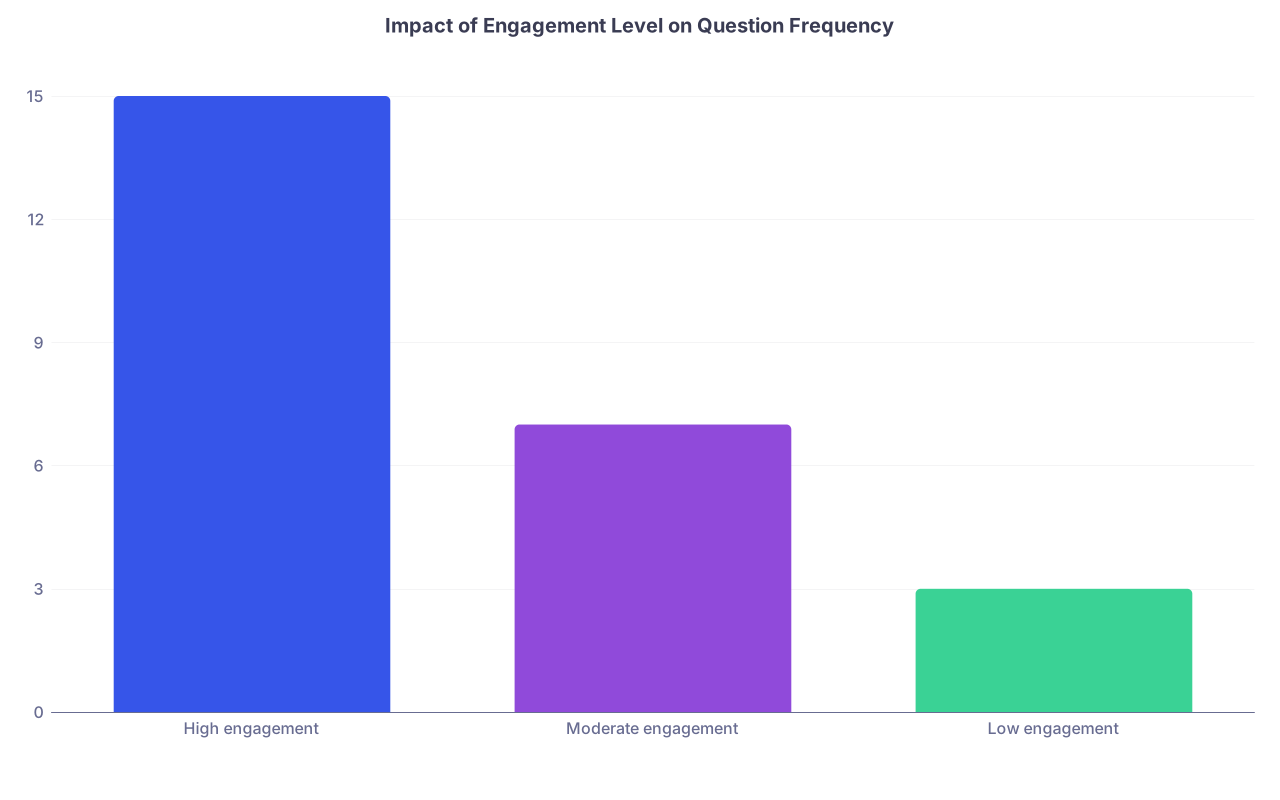
| Category | Value |
|---|---|
| High engagement | 15 |
| Moderate engagement | 7 |
| Low engagement | 3 |
(Approximate average number of directed teaching questions per half-day of rounds, based on informal faculty observations across multiple clerkships.)

FAQs
1. I hate being put on the spot. Do I have to be the one who gets called on first?
No, you don’t. But you do need to show some visible engagement if you want solid evaluations and decent teaching. You can still be lower-key and do fine. Just don’t disappear. Aim for: answer a few questions clearly, own your patients, and show that you’re thinking—even if you’re not chasing the spotlight.
2. What if I get anxious and blank when called on?
Then your job is to build a default response pattern. Something like: “I’m blanking on the name, but I remember that the mechanism was…” or “I’m not sure on the exact number, but I know the trend is…” That way you’re still showing thinking instead of silence. Also, tell a resident you trust; good residents will help feed you small wins early so your confidence builds.
3. Is it better to volunteer answers or wait to be called on?
Controlled volunteering is powerful. If you occasionally say, “Can I take a stab at that?” you signal engagement without hijacking rounds. Don’t answer every question directed at others. Do speak up when there’s a pause and no one’s answering, or when you have something clearly relevant and concise. That behavior makes attendings more likely to start with you next time.
4. How do I recover if I made a bad impression early in the rotation?
You fix it in 3–4 consistent days. Start showing up early, own your patients, tighten your presentations, and follow up on missed questions. Then, very simply, you can say to the attending, “I felt like I had a slow start, but I’m working on being more prepared and engaged this week.” That self-awareness plus visible change is usually enough to get you reclassified in their mind.
5. Do attendings really remember who was engaged when they write evals weeks later?
Yes, in a pattern-based way. They may not remember your exact words, but they remember: “She was the one I could always count on to have read,” or “He disappeared whenever things got busy.” Being the student who gets called on first, repeatedly, cements you as “memorable and engaged,” which is exactly what you want showing up in narrative comments and future letters.
Key Takeaways
- Being called on first is rarely random; it’s a reflection of how safe, engaged, and reliable you appear to your team.
- You do not need to be the smartest—just consistently prepared, willing to think out loud, and able to recover well when you’re wrong.
- Small, early behaviors—how you introduce yourself, where you stand, how you react to the first few questions—set the tone for your entire rotation.


