
The way most students “pre-round” is broken and wastes time.
You do not need 60–90 minutes of chaotic chart-diving and half-baked exams to look prepared on rounds. You need a tight, repeatable 30‑minute routine that you can scale up or down based on census and complexity.
I am going to give you that routine. Step by step. With timing. With priorities. With built-in shortcuts for crazy days.
The Core Idea: Same Script, Different Patient
Stop reinventing the wheel for every patient and every service.
You want:
- One fixed time budget: ~30 minutes before rounds
- One fixed order of operations for each patient
- One fixed format for your pre-round note and oral presentation
You then scale by:
- Adjusting depth, not changing the structure
- Dropping low-yield tasks first when time is tight, not the whole routine
This is how residents function when they have 15–20 patients. You are just doing the student version.
The 30-Minute Pre-Round Template (Per Patient and Per Team)
Here is the high-yield breakdown for a typical day on wards as a medical student with 4–6 patients.
You have two clocks:
- Global clock: 30 minutes total pre-round time
- Per-patient clock: about 4–5 minutes each, on average
Think in passes:
- Pass 1: Chart and overnight events
- Pass 2: Bedside exam (if required on your service)
- Pass 3: Final update and organize your list
We will start with the per-patient sequence, then plug it into a 30-minute block.
Per-Patient Micro-Routine (4–5 Minutes Each)
Use this in the exact same order for every patient. Do not improvise. Do not “browse the chart.”
Step 1: Snapshot the Overnight Course (60–90 seconds)
Goal: Can you answer the attending’s first 2 questions:
- “Any events overnight?”
- “How was the blood pressure / oxygen / pain control?”
Open:
- Latest nursing note
- Overnight cross-cover note (if your hospital uses them)
- PRN medication administration record
Scan for:
- Rapid response / code / significant page events
- New complaints: chest pain, SOB, confusion, falls, agitation
- PRN use: opioids, antihypertensives, anxiolytics, antiemetics
You are not reading word by word. You are hunting specifically for:
- What changed
- What required action
Write 1–2 bullets on your list:
- “No acute events. 2x PRN oxy 5 mg usage, pain improved.”
- “Episode of hypotension 88/54 at 0300 – IVF bolus 500 mL, SBP now >110.”
That is it. Move on.
Step 2: Check Vital Trends and I/Os (60–90 seconds)
Do not get sucked into the full vitals timeline. Look at:
- Last 24 hours of vitals (table view if available)
- Oxygen delivery and changes (RA → 2L NC → 4L NC, etc.)
- I/Os summary for 24 hours (net positive/negative)
You care about:
- Fever spikes
- Sustained tachycardia or hypotension
- New or increasing O2 requirement
- Big fluid swings (e.g., +3L in HF patient, -2L in AKI patient)
One or two bullets:
- “Tmax 38.2 at 0100, defervesced w/ Tylenol; HR 90–110; BP stable.”
- “Net -1.2L, on IV Lasix 40 BID. Weight down 1.1 kg.”
If something looks off (e.g., new tachycardia, BP dropping), star it to revisit on your assessment.
Step 3: Labs and Key Diagnostics (60–90 seconds)
Labs:
- Focus on new labs from last 24 hours
- Glance at:
- CBC
- BMP (or CMP)
- Relevant trend (troponin, LFTs, INR, lactate, CRP, etc. depending on problem)
- Compare to yesterday’s numbers quickly:
- Up, down, or same? Does it fit the story?
Diagnostics:
- Any new imaging: CT, MRI, US, CXR, echo
- Any new micro: blood cultures, sputum culture, urine culture, etc.
You are not reading a whole CT chest paragraph out loud during rounds. You are extracting:
- Impression line
- Clinically relevant details
Bullets like:
- “WBC 15 → 12.2. Hgb stable 8.9. Cr 1.6 → 1.8.”
- “BCx from 1/2 bottles now growing MSSA – speciation pending.”
- “Today’s portable CXR: improving RLL infiltrate, no effusion.”
If the lab section is long, underline or bold the one number that changes management today.
Step 4: Quick Med and Order Check (30–45 seconds)
Most students either skip this or drown in it. You are doing a fast safety and sanity check.
You care about:
- New antibiotics or major med changes overnight
- New drips (pressors, insulin, etc.)
- Discontinued meds that matter (e.g., stopped home beta-blocker)
- Key orders impacting disposition: NPO, DVT prophylaxis, PT/OT, telemetry, code status
Examples:
- “Started on vancomycin overnight for concern for MRSA coverage.”
- “Heparin drip started for new AF with RVR.”
- “NPO after midnight for possible ERCP – confirm if still planned.”
You do not need to recite full MARs. Focus on changes and big-ticket items.
Step 5: Mental Assessment and Plan Sketch (45–60 seconds)
Before you see the patient, frame your assessment while your data is fresh.
Answer internally:
- Is the main problem improving, stable, or worse?
- Do today’s data and overnight events change:
- Level of care?
- Antibiotics?
- Fluids/diuresis?
- Need for procedures or imaging?
Write a mini-plan skeleton:
- “Sepsis 2/2 PNA – improving, narrowing abx if cultures finalize.”
- “HF exacerbation – still volume overloaded, continue diuresis, monitor Cr.”
- “AKI on CKD – Cr slightly up, review meds, check bladder scan, may need renal input.”
Do not write an essay here. Just orient your brain so your bedside exam is targeted.
Bedside Exam: How Much and How Fast
On many services, as a student you are still expected to:
- See each patient
- Do a focused exam
- Confirm subjective status (“How are you feeling today?”)
You do not have time for 10–15 minute comprehensive exams on every patient every day. That is fantasy.
Think:
- Focused exam tied to active problems, completed in 2–3 minutes per patient.
Script for a 2-Minute Bedside Encounter
- Knock, sanitize, quick intro:
- “Good morning, it is [Name], the medical student on your team.”
- One-line context:
- “I just wanted to check on you before the team comes by.”
- 2–3 targeted questions:
- “How is your breathing compared to yesterday?”
- “Any chest pain, lightheadedness, or new pain?”
- “Any nausea, vomiting, or trouble eating?”
- Focused exam that fits the case:
- CHF: JVD, lungs, heart, edema, weight (if available)
- COPD/PNA: respiratory effort, O2 needs, auscultation
- Abd pain: inspect, auscultate, light palpation, rebound/guarding if relevant
- Neuro: mental status, focal deficits, strength if relevant
- One closing line:
- “I will share this with the team when we round in a bit. Anything you want me to pass along?”
Write down 2–3 exam bullets and any new symptom reports.
On some rotations (e.g., surgery), you may skip full daily exams on very stable post-ops after checking with your resident. Always follow service culture and resident guidance.
Putting It Together: The 30-Minute Block
Assume:
- You have 5 patients
- Expectation: see them, know overnight events, be ready to present
Here is a realistic 30-minute template.

| Step | Description |
|---|---|
| Step 1 | Start Pre-Rounds |
| Step 2 | 5-min Global Chart Scan |
| Step 3 | 15-min Patient Loop: Chart + Bedside |
| Step 4 | 5-min Final Review & To-Do List |
| Step 5 | Prep First 1-2 Presentations |
Minute 0–5: Global Scan and Prioritization
Before deep diving into any one patient:
Look at your patient list:
- Who is sickest? (ICU, step-down, on pressors, higher O2)
- Who has new significant labs/imaging?
- Who is at a decision point today? (discharge, procedure, transfer)
Reorder your mental plan and physical route:
- Sickest / most complex patients first
- Likely discharges or stable routine follow-ups later
Quick global vitals glance:
- Any red flags you should deal with right away?
- If yes, prioritize that patient first and skim chart before bedside.
This initial 5 minutes prevents you from wasting time doing a perfect workup on a stable patient while your unstable one decompensates.
Minute 5–20: Patient Loop – Chart + Bedside (3–4 Patients)
For each of your priority 3–4 patients:
- 2–3 minutes of chart work (Steps 1–5 above)
- 2–3 minutes at bedside
That is roughly:
- 4–6 minutes per patient
- 3 patients in ~15 minutes
If you have:
- 4 patients: 4 x ~5 minutes = 20 minutes
- 6 patients: you must tighten the chart review to 2 minutes and bedside to ~2 minutes for stable patients
Minute 20–25: Last Patient(s) + Quick Catch-Up
Use this time for:
- Last 1–2 stable patients (who may not need a full exam if not required and exam unchanged)
- Shortened routine:
- If truly stable and seen thoroughly yesterday, you might:
- Check overnight events, vitals, labs
- Do a briefer symptom check instead of head-to-toe exam
- Confirm with senior if that approach is acceptable
- If truly stable and seen thoroughly yesterday, you might:
Minute 25–30: Final Review and Presentation Prep
Last 5 minutes are not optional. This is where you convert data into a coherent story.
Tasks:
Clean up your list:
- Overnight events as 1 line per patient
- Vitals labeled “stable/improved/worse” with 1–2 numbers
- Labs: only key changes
- Plan bullets clearly structured by problem
Prep the first 1–2 patients you will present:
- Run through your oral presentation in your head:
- “Mr. Smith is a 67-year-old man on hospital day 3 for… Overnight… Vitals… Labs… Assessment/Plan…”
- Make sure you can answer:
- “Are they better or worse?”
- “What is the barrier to discharge?”
- “What are we doing differently today than yesterday?”
- Run through your oral presentation in your head:
If you must sacrifice something due to time, you never sacrifice:
- Knowing overnight events
- Knowing key vitals/labs
- Having a clear A/P structure ready
You sacrifice:
- Over-detailed exam repetition on an unchanged stable patient
- Deep-dive literature searches before rounds
- Formatting perfection in your written note
How to Scale This When the Service Explodes
Some days will be smooth. Others will be “12 new admits, 3 transfers, attending in a terrible mood.”
Your routine must be elastic.
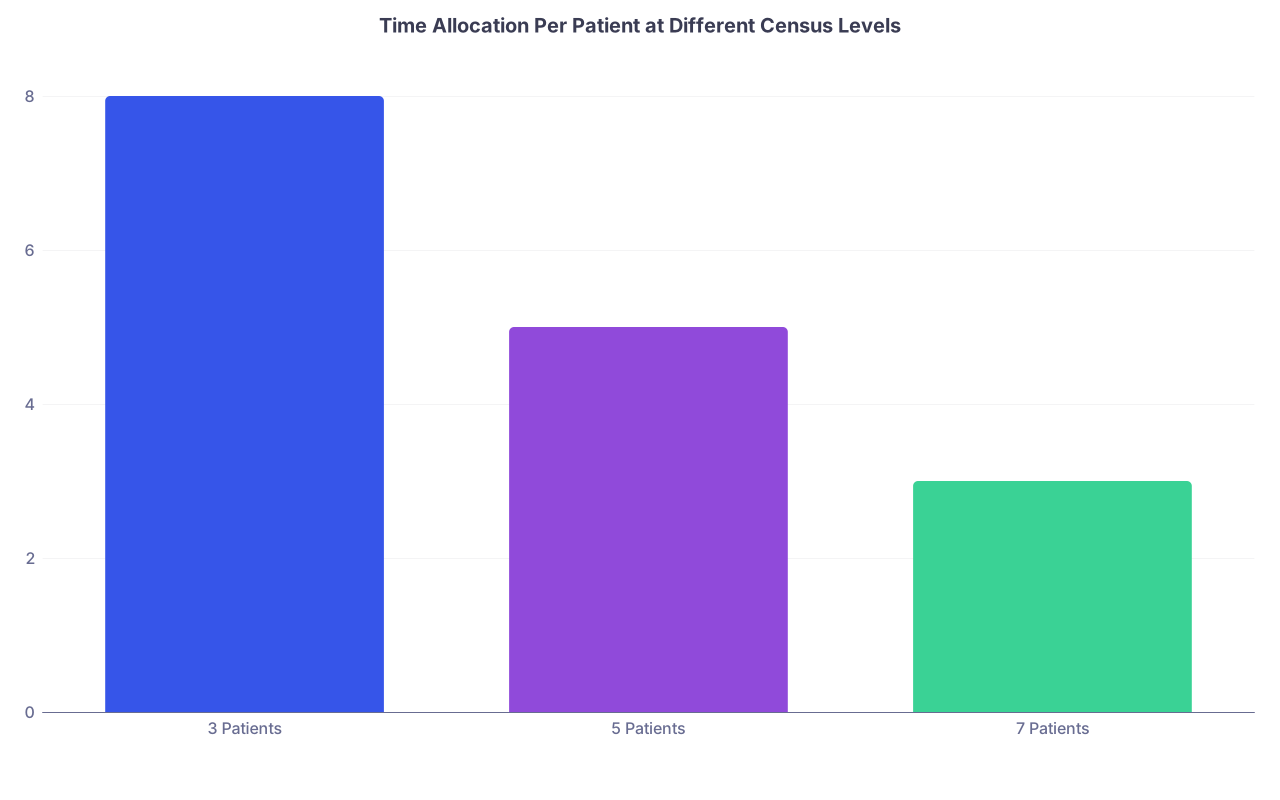
| Category | Value |
|---|---|
| 3 Patients | 8 |
| 5 Patients | 5 |
| 7 Patients | 3 |
Interpretation: As census increases, you shrink depth per patient, not structure.
Low Census (2–3 Patients)
You can:
- Spend 8–10 minutes per patient
- Do more complete systems exams
- Read more of imaging reports, micro details
- Add brief literature checks for complex issues
Use this time to:
- Practice full oral presentations
- Refine differential diagnoses
- Ask residents for feedback on your pre-round content
Moderate Census (4–6 Patients)
This is the sweet spot for the 30-minute template:
- 4–6 minutes per patient
- Focused chart and focused exam
- Tight A/P, minimal fluff
You should comfortably hit:
- All patients seen
- All data up to date
- 1–2 strong presentations ready
High Census (7+ Patients as a Student)
This is where students either:
- Panic and try to be a mini-PGY-3
- Or adapt and compress smartly
Your move:
- Identify 1–2 “high-intensity” patients:
- Unstable, new, or complex
- You will do nearly full routine on them
- For the rest:
- Shorten bedside exam if unchanged
- Focus on new symptoms and key exam elements only
- Lasering in on:
- Overnight events
- Vitals / O2 changes
- Labs relevant to their problem
- One-sentence plan updates
For example:
- ICU patient on pressors: 8–10 focused minutes
- New admission with sepsis: 8–10 minutes
- Stable CHF improving, stable COPD day 5, post-op day 3 routine: 2–3 minutes each
Total still comfortably fits into ~30–40 minutes before rounds.
A Simple Pre-Round Checklist You Can Print
Here is a one-look checklist you can tape to your workstation as training wheels.
| Step | Task Focus | Time Target |
|---|---|---|
| 1 | Overnight events + PRNs | 60–90 sec |
| 2 | Vitals trend + O2 + I/Os | 60–90 sec |
| 3 | Labs + new imaging/micro | 60–90 sec |
| 4 | Med / order changes | 30–45 sec |
| 5 | Mini A/P skeleton | 45–60 sec |
Run this in order, every time, for every patient. It will become muscle memory.
How to Not Drown in the EHR
A huge part of wasted pre-round time is wrestling with the chart. You click blindly, read too much, and then realize you still do not have the narrative.
Fix that with pre-built views and templates.
Build or Borrow EHR Views
Ask interns:
- “What vitals and labs view do you actually use for pre-rounding?”
- “How do you pull up all yesterday vs today labs in one screen?”
Create:
- A “Pre-round vitals” tab:
- 24-hour vitals, O2, pain scores, maybe weight
- A “Daily labs” tab:
- Only CBC, BMP, plus 2–3 problem-specific labs
- A “Med changes” quick filter if your system has it
You want one-click access to each cluster of info. If you are clicking more than 3–4 times per section, you are wasting time.
Create a Note Template That Mirrors Rounds
Your progress note should mirror how you speak on rounds:
- Subjective: 2–3 bullets (symptoms, overnight complaints)
- Objective:
- Vitals: summary + key highs/lows
- I/Os
- Exam: problem-focused
- Labs/Imaging: only changes
- Assessment/Plan: by problem
Copy your oral structure into a “smart phrase” / template in the EHR. Then:
- Fill it as you pre-round
- Use it as your crib sheet when presenting
Stop writing paragraphs you never say out loud.

What To Say On Rounds (And What To Leave Out)
You pre-rounded well. Now do not wreck it with a cluttered presentation.
Your attending wants:
- Clear overnight summary
- Quick “are they better or worse?”
- Key data that support your assessment
- A plan that actually changes something today
6-Sentence Skeleton for a Stable Patient
- One-liner: “Mr. X is a [age]-year-old [relevant comorbidities] on hospital day [X] for [primary issue].”
- Overnight: “Overnight, [no acute events / had X event], [brief management].”
- Subjective: “Today he reports [X], denies [big scary Y/Z].”
- Objective: “Vitals [stable/improved/worse] – Tmax, SBP range, O2; exam [short description].”
- Data: “Labs show [1–2 key changes]; imaging [if new and relevant].”
- Assessment/Plan: “Overall [improving/stable/worse]. We will [1–3 plan bullets tied to problems].”
Do not:
- Read the entire CT report
- List every medication dose
- Recite the entire BMP if only Cr and K matter today
Do:
- Tie data to actions:
- “Cr increased from 1.6 to 1.9, so we will hold lisinopril and recheck BMP this afternoon.”
- “Net negative 1.5 L and improved dyspnea, so we will continue IV Lasix today, consider transition to PO tomorrow.”
Service-Specific Tweaks (Medicine vs Surgery vs ICU)
The 30-minute structure is the same. The content emphasis changes.
Medicine
Priority:
- Vitals trends
- Symptom trajectory
- Labs and micro
- Fluids and meds
- Disposition planning
Exam:
- Focus on cardiorespiratory, volume status, and problem-specific systems
- Mildly more thorough on new or changing issues
Surgery
Priority:
- Pain, PO intake, bowel function, ambulation
- Post-op vitals (fever, tachycardia, hypotension)
- Wound / drains / outputs
- Labs: Hgb, WBC, electrolytes
Exam:
- Incision and wounds
- Abdomen if relevant (distension, tenderness, bowel sounds)
- Extremities for DVT concerns if symptomatic
Rounds are faster and more “yes/no” oriented. Your pre-rounding supports crisp answers:
- “Passing gas?”
- “Tolerating diet?”
- “Ambulating?”
ICU
Pre-rounding becomes heavier:
- You may need more than 30 minutes for multiple complex patients
- Still use the same structure, but:
- More time on vent settings, hemodynamics, drips
- More frequent labs and imaging review
Your best move as a student:
- Take fewer patients in ICU and do them well
- Explicitly ask your resident: “Given the time, what do you want me to prioritize for pre-rounds?”
Example: A Realistic 30-Minute Morning With 5 Patients
Let me show you what this actually looks like minute by minute.
Patients:
- New admission: 72-year-old with sepsis from UTI, borderline BP
- CHF exacerbation, day 3, still volume overloaded
- COPD, improving, weaning O2
- Stable diabetic with foot ulcer on IV antibiotics
- Ready-for-discharge cellulitis patient
06:00–06:05 – Global Scan
- Flag #1 (sepsis) and #2 (CHF) as top priority
- Glance at vitals columns:
- #1: BP soft overnight, still on IV fluids
- #2: Net -0.8 L, still edematous
- Note #5 looks rock stable; mentally set them last
06:05–06:12 – Patient 1 (New Sepsis)
- Chart: overnight events, vitals, labs, cultures, antibiotics – 4–5 minutes
- Bedside: focused ROS and quick exam – 2–3 minutes
- Jot down clear A/P: fluid status, pressor risk, antibiotic plan, source control thoughts
06:12–06:18 – Patient 2 (CHF)
- Chart: vitals trend, weight, I/Os, BMP – 3 minutes
- Bedside: dyspnea, JVP, lungs, edema – 3 minutes
06:18–06:23 – Patients 3 and 4 (Moderate Complexity)
- Each:
- 2 minutes chart
- 2 minutes quick bedside
- You are mostly confirming improvement or stability
06:23–06:27 – Patient 5 (Discharge-Ready)
- Chart: quick check vitals, labs, med reconciliation, discharge orders status – 2–3 minutes
- Brief bedside “any new concerns?” and wound check – 1–2 minutes
06:27–06:30 – Final Cleanup
- Update list with overnight events and key labs
- Mentally rehearse presentations for #1 and #2
- Clarify one question to ask your resident (e.g., “If his BP stays 90s systolic, do we switch antibiotics or add pressors?”)
You walk into rounds:
- On time
- Calm
- Actually knowing your patients
That is what this system buys you.
FAQ (Exactly 4 Questions)
1. What if my resident wants me to pre-round earlier and spend more than 30 minutes?
You follow the team’s expectations first. However, you still use the same 30-minute core within that longer time. Extra time can be spent on:
- Deeper exams
- Reading imaging in more detail
- Brief literature checks
- Asking for feedback on your notes and presentations
But you keep the scalable structure. That way on days when you have less time, you are not lost.
2. How do I pre-round efficiently when the EHR is painfully slow or unfamiliar?
You front-load learning the EHR in the first 1–2 days:
- Ask an intern to literally sit next to you for 5 minutes and walk through how they pre-round in that specific system.
- Create quick links/favorites for labs, vitals, and MAR views.
- Avoid opening full narrative notes during pre-rounding unless you must.
The longest part of pre-rounding for new students is usually EHR wandering, not clinical reasoning. Kill the wandering.
3. Is it acceptable to skip seeing a stable patient in person before rounds?
You always clarify this with your senior. On some medicine services, very stable long-stay patients may not require a full daily exam from the student if:
- They are unchanged
- They were seen thoroughly yesterday
- Nursing has no new concerns
Even then, you still review overnight events, vitals, and labs. You never skip the data. Skipping the bedside exam on very stable patients is a team decision, not your solo choice.
4. How can I practice and internalize this routine before my rotation starts?
Use mock cases:
- Take 2–3 sample patients from a case book or online case bank.
- For each, time yourself:
- 3 minutes to identify overnight changes (simulate vitals and labs)
- 2 minutes to write a mini A/P
- 2 minutes to speak an oral presentation out loud
Repeat this until the order of operations is automatic: overnight → vitals → labs → meds → mini A/P. Once the structure is ingrained, doing it in a real EHR under time pressure becomes much easier.
Key points: Use one fixed structure for every patient, compress depth not structure when busy, and always protect the last 5 minutes for organizing your story. That is how a 30-minute pre-round routine scales without falling apart.