
You are not “bad at med school.” Your system is bad. Fix the system and the burnout will start to crack.
Second year is where I see people fall apart. Boards pressure ramps up, lectures keep coming, everyone on Reddit is doing 1,000 Anki cards a day and “UWorld + Pathoma + Sketchy + Boards & Beyond + whatever-new-thing.” So you keep adding. Never subtracting. That is how you fry your brain.
Let me be direct:
If you feel fried in MS2, you do not need more motivation. You need a structured reset.
This is that reset. A 4‑week, step‑by‑step plan to rebuild your study system so it is:
- Sustainable (you can run it for months without imploding)
- Efficient (no more 8 hours of “studying” with 3 hours of actual work)
- Board-aligned (your time translates into score movement, not busywork)
We will walk through:
- A hard reset in Week 1 (what to kill, what to keep)
- A lean, test-aligned system in Weeks 2–3
- A performance + life integration plan in Week 4
Use this like a protocol. Follow it as written first. Then adjust.
Week 1: Stop the Bleeding and Audit Your System
Burnout is usually not “too much school.” It is:
- Too many inputs
- No prioritization
- Zero real off‑time
So Week 1 is about stopping the chaos.
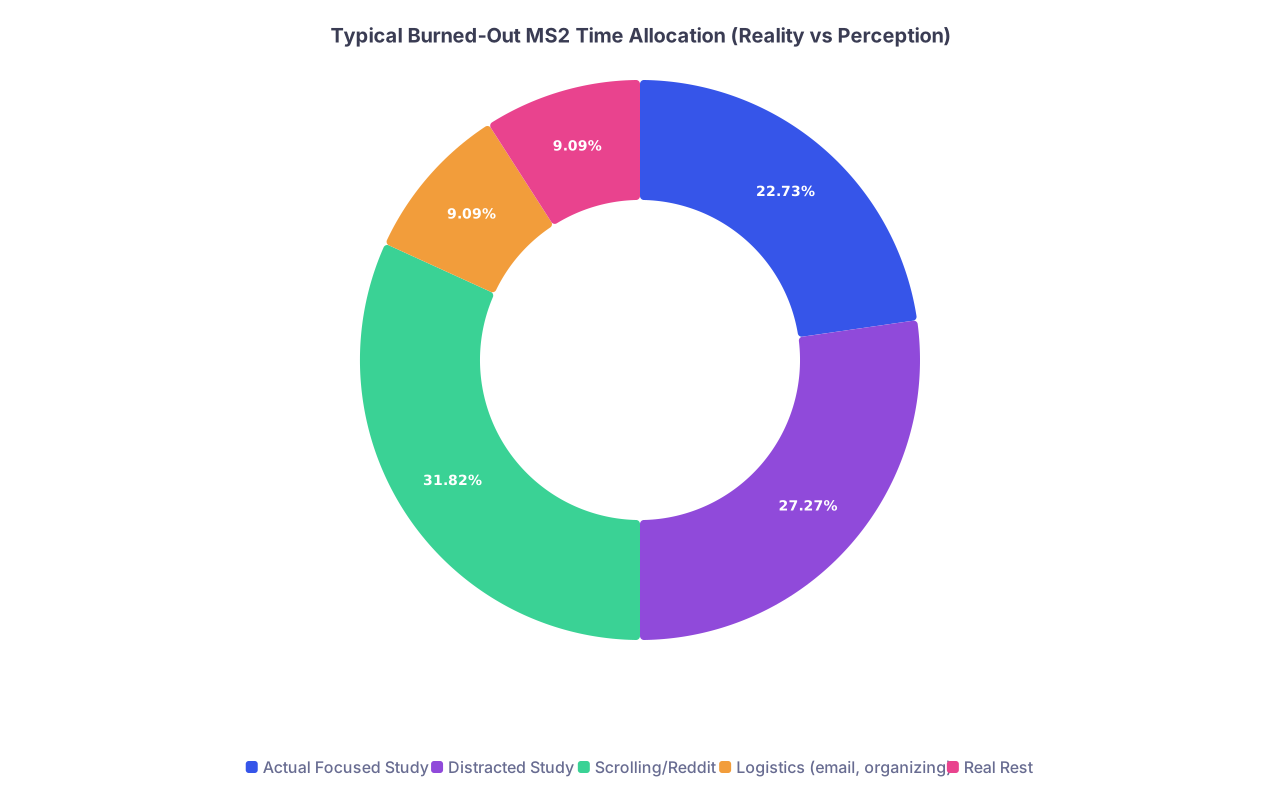
| Category | Value |
|---|---|
| Actual Focused Study | 150 |
| Distracted Study | 180 |
| Scrolling/Reddit | 210 |
| Logistics (email, organizing) | 60 |
| Real Rest | 60 |
Step 1: Declare a 7‑Day “Containment Week”
For 7 days:
- No new resources
- If it is not already in your rotation, you are not adding it.
- No “catching up 6 weeks of missed lectures”
- You will never brute-force your way out of a 200‑lecture hole. That is fantasy.
- Cap total work time at 9 hours per day max
- Yes, including lectures, Anki, questions, everything.
- If 9 sounds impossible, that tells me your system is bloated, not that med school is inherently 14 hours a day.
Your immediate goal this week is not to learn everything.
Your goal is to regain control of your time and your head.
Step 2: Do a Ruthless Resource Audit
Pull out a blank page. List everything you are trying to use right now:
- Lectures (live or recorded)
- Anki (what decks? custom vs premade?)
- Qbanks (UWorld, AMBOSS, school-specific)
- Videos (Pathoma, Sketchy, Boards & Beyond, etc.)
- Notes apps (Notion, OneNote, Word docs, handwritten)
- “Extras” (Flashcard add-ons, group study, tutors, cheat sheets, etc.)
Next, force everything into one of three buckets:
- Primary (keep)
- Anything that:
- Teaches you core concepts efficiently or
- Gives you direct question practice aligned with exams/Step
- Anything that:
- Secondary (limit)
- Helpful but only after primary work is done.
- Trash (kill)
- Things you are doing mostly because other people said they do it, but:
- You dread it
- You cannot tie it to higher scores or clearer understanding
- It eats time without measurable benefit
- Things you are doing mostly because other people said they do it, but:
Be brutal. You are overcommitted. That is why you are burned out.
Concrete example of a sane “Primary” set for MS2:
- School lectures: Slides + targeted note review (not word-for-word transcription)
- One Qbank (UWorld or AMBOSS)
- One main board‑oriented video line (Pathoma for path, plus maybe Boards & Beyond for weak systems)
- Anki: One main Step deck or curated cards for your courses (not five overlapping decks)
Everything else? Secondary or trash.
Step 3: Design Your Temporary “Containment Schedule”
For this first week, build a simple daily schedule template. Not beautiful. Just clear.
Example “Containment Day” (9-hour cap):
- 8:00–9:00 – Morning warm‑up:
- 30–45 min Anki reviews
- 15–30 min skim of today’s lecture objectives
- 9:00–11:00 – Deep work block #1
- 1–2 lectures at 1.25–1.5x speed
- Or 1 video + reviewing associated slides
- 11:00–12:00 – Light work
- Finish small tasks, small Anki set, organize next block
- 12:00–13:00 – Mandatory lunch away from desk
- 13:00–15:00 – Deep work block #2
- 20–30 Qbank questions + review
- Or attacking a weak system with focused resources
- 15:00–16:00 – Admin + light review
- Quick pass on tomorrow’s material, tidy Anki, answer emails
- Evening (no specific hours, but total cap 9h):
- Optional: 30–45 min of low-intensity review if needed
- Then done.
Key rule:
Once you hit 9 hours of total work, you stop. Even if your brain whispers, “But you still have so much…” That whisper is what burned you out.
Step 4: Build a Reality‑Based Task List
During Week 1, replace vague goals like “study cardio” with concrete, time‑bounded tasks:
Bad:
- “Catch up on renal”
- “Do UWorld”
Good:
- “Watch Pathoma renal ch. 1–2 (x1.5), annotate slides – 1.5h”
- “Do 20 UWorld renal questions in timed mode + full review – 2h”
Limit yourself to what fits into your 9‑hour cap. If the list is too long, you cut tasks, not sleep.
Week 2: Rebuild a Lean, Board-Aligned Study System
Now that you have contained the chaos, we start building the actual system you can use through the rest of MS2.

| Step | Description |
|---|---|
| Step 1 | Week 1 Contain |
| Step 2 | Week 2 Rebuild System |
| Step 3 | Week 3 Stress Test & Adjust |
| Step 4 | Week 4 Lock In & Protect |
Step 1: Decide Your Core Study “Loop”
Every effective MS2 system is some variant of this loop:
- Preview / orient to material
- Learn it (lecture or video)
- Convert it into active recall (Anki / questions)
- Revisit it with spaced repetition and board-style questions
You need a version of this you can run every day without collapsing.
Example core loop for a typical system-based MS2 block (e.g., cardio):
- Preview (15–20 min per topic)
- Look at learning objectives
- Skim first‑aid/Step-aligned summary of topic
- Learn (45–90 min)
- Lecture at 1.5x, or
- Pathoma/Boards & Beyond + slides
- Convert (30–45 min)
- Anki:
- Either: Do pre‑made cards tagged for that lecture/topic
- Or: Make 5–10 high-yield custom cards max (not 60)
- Anki:
- Reinforce (45–60 min)
- Qbank block (10–20 questions) on that system or mixed if further along
- Full review of explanations; mark truly important points for future cards
That is your loop. Not mysterious. Not glamorous. Just consistent.
Step 2: Set Hard Limits on Volume
Burned-out MS2 students always underestimate this part. You cannot scale infinitely. Your brain is not a server farm.
Use these rough caps as a starting point for sustainable volume:
- New Anki cards created per day:
- Max 20 custom
- If using a premade Step deck, cap new cards at 40–60 per day total, depending on how crushed you feel.
- Qbank questions per weekday:
- 20–40 questions review included.
- Any more while you are burned out is usually sloppy review and half‑baked learning.
- Lectures/videos per day:
- 2–4 “heavy” learning items (full lectures or major videos).
- If lectures are short, maybe 5–6. But do not kid yourself.
The critical move:
When work pushes above these caps, you adjust scope, not sleep or recovery. You learn to triage.
Step 3: Triage Content Like a Clinician
You already know triage from the ED: Who dies without intervention? Who can wait?
Same thing with content.
For each lecture/unit, mentally label:
- Tier 1 – Must master
- Common conditions, core physiology, pharmacology that shows up on every exam.
- Tier 2 – Should know
- Less common presentations, nuanced details, but still board-relevant.
- Tier 3 – Low yield
- Historical context, obscure mechanisms, random slides the course director loves but never tests meaningfully.
You give:
- 60–70% of your effort to Tier 1
- 25–30% to Tier 2
- 0–10% to Tier 3
If you are burned out and short on time, it is the Tier 3 stuff that dies first, not your sleep or your sanity.
Step 4: Upgrade Your Question Practice
Most MS2s do questions badly when burned out. They:
- Rush through them just to watch the “Completed” number grow
- Read only the bolded text in explanations
- Never track patterns in their mistakes
You fix that this week.
For each Qbank block:
- Pick a modest block size
- 10–15 questions when starting the reset
- Timed mode, random within one system or mixed depending on your phase
- After the block, spend 2–3x as long on review as you spent answering
- For each miss, ask:
- Was this:
- A knowledge gap? (Never seen it / do not remember)
- A reasoning error? (Misapplied concept)
- A test-taking slip? (Rushed, misread, second guessed the right answer)
- Was this:
- For knowledge gaps:
- Add 1–3 targeted facts to Anki. No essay-cards.
- For reasoning errors:
- Write down the key reasoning pattern in a tiny notebook or note app. Example:
- “Elderly with microcytic anemia + weight loss + change in stool → colon cancer until proven otherwise.”
- Write down the key reasoning pattern in a tiny notebook or note app. Example:
- For test-taking slips:
- Tally them. If you see “changed from right to wrong” 10 times, that is a behavior pattern you can fix.

Week 3: Stress-Test and Adjust Your New System
By Week 3, you have:
- Fewer, clearer resources
- A basic study loop
- Reasonable daily volume limits
Now you pressure test it. See what breaks. Then fix that, not yourself.
Step 1: Run a “Simulated Heavy Week”
Take a real upcoming or recent-heavy block (e.g., neuro, cardio) and plan a 5‑day stretch:
- Keep your daily time cap (9–10 hours)
- Maintain:
- Anki
- Qbank
- Lectures/videos
- Add:
- 1x longer assessment (like a 40‑question block or a small NBME-style practice if you have it) mid‑week or end‑week
Track four things objectively for those 5 days:
- Hours of actual work (set a timer when truly studying)
- Number of:
- New cards
- Reviews completed
- Questions done
- Sleep (approx. hours, not minute-perfect)
- Subjective burnout at the end of each day (0–10 scale, 10 = “get me out of medicine”)
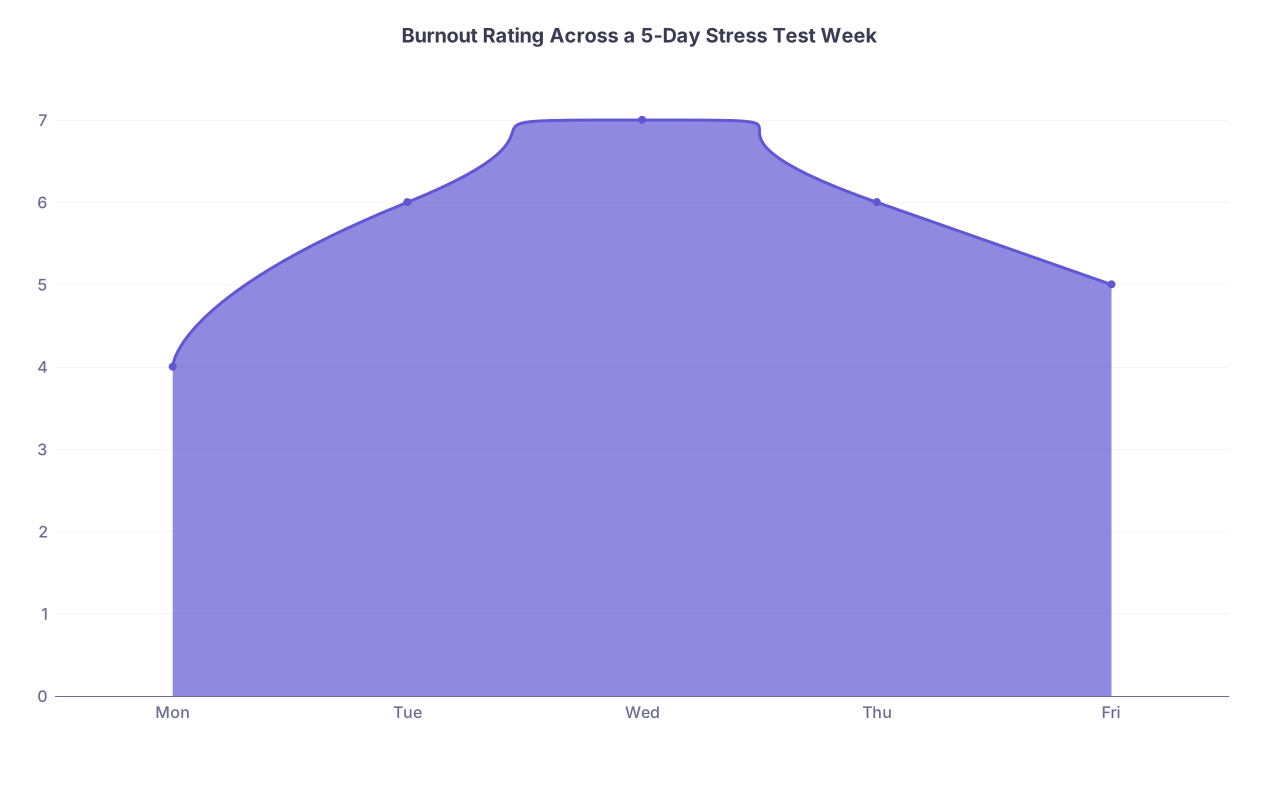
| Category | Value |
|---|---|
| Mon | 4 |
| Tue | 6 |
| Wed | 7 |
| Thu | 6 |
| Fri | 5 |
If your burnout rating is consistently ≥7 by midweek, your system is still too heavy. You then adjust the system, not your expectations of yourself.
Step 2: Identify Your Bottleneck
Look at the data and ask:
What is actually crushing me?
Common patterns I see:
- Anki overload
- 800 reviews per day, half of which you click through mindlessly
- Fix:
- Suspend or delete leech cards (the same 10 facts you miss every time)
- Reduce new cards for a week by 50%
- Use “bury related cards” to reduce redundancy
- Qbank review taking forever
- You spend 4 hours “reviewing” 20 questions because you read every explanation like a textbook
- Fix:
- For questions you got right and understand: skim the explanation for 15–30 seconds max
- Only deep‑read misses or lucky guesses
- Lecture bloat
- You are watching 4‑hour recorded lectures at 1x speed and pausing every 10 seconds
- Fix:
- Force 1.5x speed as default
- One pass only. No rewatching full lectures; revisit with notes or question-based review
Step 3: Set Non-Negotiable Recovery Anchors
Here is where most high-achievers roll their eyes. Then crater 6 weeks later.
You need guardrails:
- Sleep floor: 6.5–7 hours minimum.
- I have watched people gain 10–15 points on Step scores just by not turning themselves into zombies.
- Movement: 20–30 minutes, 4 days a week.
- Walk, light gym, yoga. I do not care. Just something that is not sitting and staring.
- Off‑time blocks:
- One half‑day off study per week.
- And one evening off screens (or at least off study) per week.

These are not “nice to have.” They are part of the system. You are not a CPU.
Step 4: Communicate and Negotiate
If your curriculum is truly insane (and some are), you may need to push back or get help.
Practical moves:
- Talk to upperclassmen who scored well:
- Ask: “What did you stop doing in this block that saved you?”
- Office hours / course directors:
- Show them your workload honestly:
- “If I fully review every lecture and every assigned reading, this is 12+ hours per day. What do you recommend I prioritize for exams?”
- Show them your workload honestly:
- Study group negotiation:
- If your group is actually draining you (3 hours of people talking about how stressed they are, 30 minutes of work), you adjust the format or leave.
You cannot fix burnout while pretending your environment is reasonable if it is not.
Week 4: Lock In Your System and Protect It
By Week 4, you should have:
- A stable, realistic daily routine
- Known limits on Anki/questions/lectures
- Early signs that your brain is not screaming all day
Now we:
- Formalize your system
- Plan for exam blocks and Step
- Install safeguards against future burnout
Step 1: Write Your “Study Operating Manual”
Yes, literally. A one‑page document called:
“My MS2 Study System – v1.0”
Sections to include:
- Daily structure (school day)
- When you:
- Do Anki
- Do questions
- Watch lectures / videos
- Stop
- When you:
- Daily structure (weekend/heavy prep day)
- Resource rules
- Primary tools:
- Ex: “Lectures + Pathoma + UWorld + Anki”
- Secondary tools (only used if core is done):
- Ex: “Sketchy micro if time”, “Boards & Beyond for specific weak topics”
- Banned during semester:
- Any new deck/resource unless tested during a planned break
- Primary tools:
- Volume caps
- New Anki: __ / day
- Qbank: __ / weekday, __ / weekend
- Max total work time: __ hours per day
- Recovery anchors
- Sleep minimum
- Movement schedule
- Off‑time blocks
| Block | Task Focus |
|---|---|
| 7:30–8:15 | Anki reviews + light preview |
| 8:15–11:00 | Lectures / primary videos |
| 11:00–11:30 | Short break / snack |
| 11:30–12:30 | Qbank block (10–15 questions) |
| 12:30–13:30 | Lunch away from desk |
| 13:30–15:30 | Review weak topics / notes |
| 15:30–16:00 | Admin, plan next day |
This is the document you come back to when panic hits and your brain says, “We should add three more resources!”
You answer: “No. We run the system.”
Step 2: Build an Exam-Week Protocol
Exams change everything. People throw out the system and cram. Then wonder why they feel wrecked.
You need a separate protocol for:
- School block exams
- NBME-style/CBSE practice
- Eventually Step 1/Level 1, but that is later
For a typical school exam week, use a 5‑day funnel:
- T‑5 to T‑3 (3–5 days out)
- Focus:
- Finish coverage of all Tier 1 material
- Daily:
- 20–40 Anki new + reviews
- 20–30 Qbank questions from that system
- Focus:
- T‑2
- Focus:
- Consolidation
- High‑yield summary pass (First Aid, school objectives, your brief notes)
- Focus:
- T‑1
- Focus:
- Light review only
- No massive new content
- Sleep is non‑negotiable
- Focus:
For practice NBMEs/CBSE:
- Treat as race‑simulation:
- Night before:
- No heavy cramming
- Day of:
- Feed and hydrate properly
- After:
- Full review over 2–3 days
- Extract patterns, not just individual facts
- Night before:

| Step | Description |
|---|---|
| Step 1 | Coverage & Questions |
| Step 2 | Coverage & Questions |
| Step 3 | Consolidation |
| Step 4 | Light Review & Sleep |
| Step 5 | Exam Day |
Step 3: Set Up a Weekly Review Ritual
To keep yourself from drifting back into chaos, you need a 30‑minute weekly reset.
Once a week (Sunday works well):
- Look back at:
- Hours studied
- Cards done
- Questions done
- Burnout rating averages
- Ask:
- “What worked this week?”
- “What made me feel more drained than it was worth?”
- Adjust one variable:
- Example:
- Drop new cards from 60 to 40
- Shift Qbank to mornings instead of evenings
- Add 1 more short walk break
- Example:
Not ten changes. One. Then repeat next week.
Step 4: Future-Proof Against the Comparison Trap
If you do not control this, it will wreck everything you built.
Specific rules:
- Social media limits during heavy blocks
- 10–15 minutes max of Reddit/Instagram per day.
- Set a timer. When it rings, close it. Done.
- No blind copying of other people’s systems
- You can test a new idea for 1 week during a lower-stress period.
- You do not tear up your whole method 3 weeks before a big exam because someone posted their “260+ schedule.”
- Anchor to your own data
- If your practice scores are improving and you can sleep and function, your system is working.
- You do not need to match someone else’s volume.

Quick 4-Week Reset Checklist
Use this as a summary you can screenshot and keep.
Week 1 – Contain
- Cap total work at 9 hours/day
- Audit and cut resources (Primary / Secondary / Trash)
- Build a simple daily template and stick to it
Week 2 – Rebuild
- Define your core loop: Preview → Learn → Convert → Reinforce
- Set volume caps for Anki, Qbank, lectures
- Triaging content: Tier 1 / 2 / 3 and cut Tier 3 when overloaded
Week 3 – Stress-Test
- Run a 5‑day “heavy week” with metrics
- Identify your bottleneck (Anki, Qbank, lectures, life)
- Install recovery anchors and make at least one environment adjustment
Week 4 – Lock In
- Write your 1‑page “Study System – v1.0”
- Design exam‑week protocols
- Start weekly 30‑minute review ritual
- Put hard limits on social media and comparison
FAQ (Exactly 4 Questions)
1. What if I am already way behind on lectures when I start this 4‑week plan?
Then you stop pretending you will watch every second of every missed lecture. That fantasy is part of why you are burned out. For backlogged content, you:
- Get the objectives / high-yield summaries for each lecture
- Use:
- Condensed resources (Pathoma, First Aid, Boards & Beyond sections) to cover the same ground in less time
- Only watch:
- Truly crucial or notoriously tested lectures at increased speed (1.5–2x), ideally with slides printed or open beside you
- Accept:
- That some “nice to know” details will be skipped. You will make up for that through board-style questions and spaced repetition.
Your job is to catch up to current content and stop the backlog from getting worse, not to perfectly relive the last 8 weeks.
2. How do I know if I should keep using Anki or switch to another method?
Look at outcomes, not vibes. If:
- Your reviews are >800 per day on average
- You are clicking “Good” or “Easy” on cards you barely read
- You still miss the same facts on Qbank questions
Then your Anki system is broken. Instead of ditching Anki completely, try:
- Slashing new cards for 1–2 weeks
- Suspending low‑yield or overly wordy cards
- Shifting focus to Qbank-driven cards (making cards only for missed questions and true knowledge gaps)
If after 2–3 weeks of a tuned-down system your recall and scores do not budge, then yes, consider switching more of your time to question-based learning and concise written notes. But change systematically, not impulsively.
3. Can I still score high on Step 1 if I reduce my daily workload like this?
You are not reducing work. You are reducing waste. High scores come from:
- Consistent exposure to high‑yield material
- Lots of high-quality question practice with honest review
- A brain that is actually capable of focusing during those activities
I have watched students churn 12–14 hours a day and get average scores because half their time was scattered, passive, and exhausted. A well‑designed 8–9 hour system, run consistently over months, beats chaotic marathons every time. You are playing a long game. Protect your ability to think.
4. What if my classmates seem to be doing way more than me after I implement this plan?
They might be. They might also be lying, cherry-picking their “best” days, or mindlessly grinding without retention. You have no idea. You do have your own:
- Question performance over time
- Practice exam trends
- Day-to-day energy levels
Those are real. Anchor to those. If your practice scores are stable or rising and you are not mentally destroyed, your system is working. If their approach were truly superior for you, it would show up in your own data when you test small pieces of it. Until then, you run your system, not theirs.
Bottom line:
You are not the problem. Your overloaded, unstructured, comparison‑driven study system is. Strip it down. Rebuild it deliberately. Protect it fiercely. Three moves that matter: cut resources ruthlessly, cap your daily volume, and treat recovery as part of the plan, not a reward.