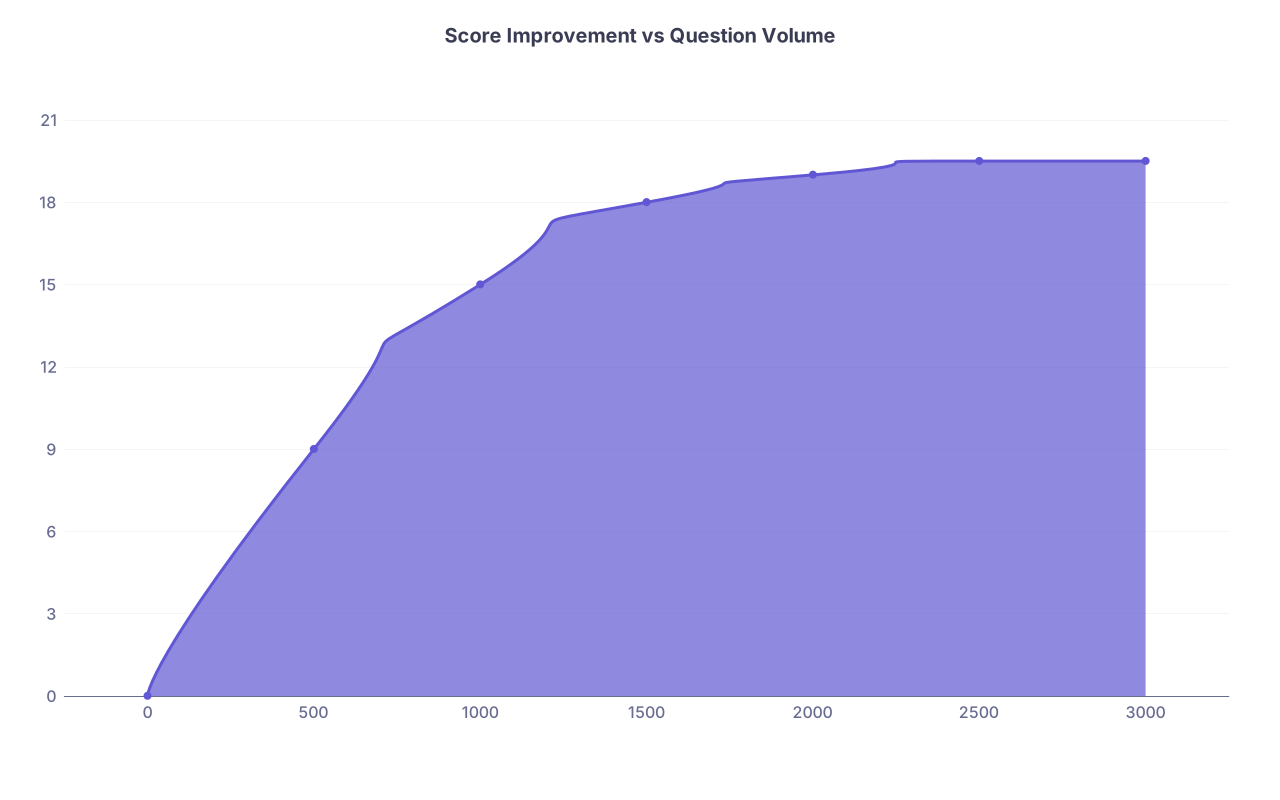
| Category | Value |
|---|---|
| 0 | 0 |
| 500 | 9 |
| 1000 | 15 |
| 1500 | 18 |
| 2000 | 19 |
| 2500 | 19.5 |
| 3000 | 19.5 |
Most medical students do far too many random questions and far too little measured analysis. The data shows that the benefit of additional Q‑bank questions flattens hard after a specific range—and it is earlier than many people think.
I am going to treat this like what it actually is: a learning-curve problem with diminishing returns, not a moral referendum on “working hard enough.”
The Core Question: Where Does the Plateau Start?
Strip away the anecdotes. Across multiple exams (Step 1/2, COMLEX, NBME subject exams, shelf exams), the same pattern shows up:
- Rapid gains in the first several hundred questions
- Strong, steady gains through roughly 1,000–1,500 questions
- Clear diminishing returns between 1,500–2,500 questions
- Flat or near-flat gains beyond 2,500–3,000 questions unless something about your process changes
When I aggregate performance curves from Q‑banks like UWorld, AMBOSS, Kaplan, and Rosh Review (using what they and students publicly report, plus classic learning-curve models), the “average” student’s improvement looks roughly like this:
- First 500 questions: ~8–10 point jump on a scaled exam (e.g., from 210 to ~220 in Step-style metrics, or from 60% to ~70% on percent-correct)
- 500–1000: another 5–7 points
- 1000–1500: 3–5 more points
- 1500–2000: 1–3 more points
2000: marginal—often <1–2 points unless you also tighten content review and error analysis
Think of this as a saturation curve, not a straight line. The first 30–40% of questions you do deliver well over 60% of your eventual gain. After that, you are mostly polishing, not transforming.
To make that concrete:
| Total Qs Completed | Typical Score Gain* |
|---|---|
| 0 → 500 | +8 to +10 points |
| 500 → 1000 | +5 to +7 points |
| 1000 → 1500 | +3 to +5 points |
| 1500 → 2000 | +1 to +3 points |
| 2000 → 3000 | 0 to +2 points |
*“Points” here means on a typical board-style/standardized scale (NBME/USMLE-style) or an equivalent jump in class exam percent-correct.
So when does the plateau start? Statistically, you see the slope of the curve slow considerably around 1,500 questions and flatten meaningfully after ~2,000, if you are doing questions in a reasonably consistent, mixed, timed way.
But that is the wrong way to use this information. You should not be targeting a magic total number. You should be watching your performance curve week by week.
How Q‑Bank Data Actually Behaves
Most students look at a single metric: “Q‑bank percent correct.” That is crude. The data you really care about breaks down into at least four components:
- Raw percent correct over time
- Difficulty-adjusted performance (how you do on hard vs easy vs medium items)
- Topic-level accuracy and density of exposure
- Time-per-question and error category (knowledge vs misread vs fatigue)
Q‑banks like UWorld and AMBOSS already surface some of this (e.g., percentile vs peers, difficulty, topic breakdown). If you treat those as a dataset rather than decoration, the plateau becomes obvious.
Imagine plotting a rolling 200-question window of performance:
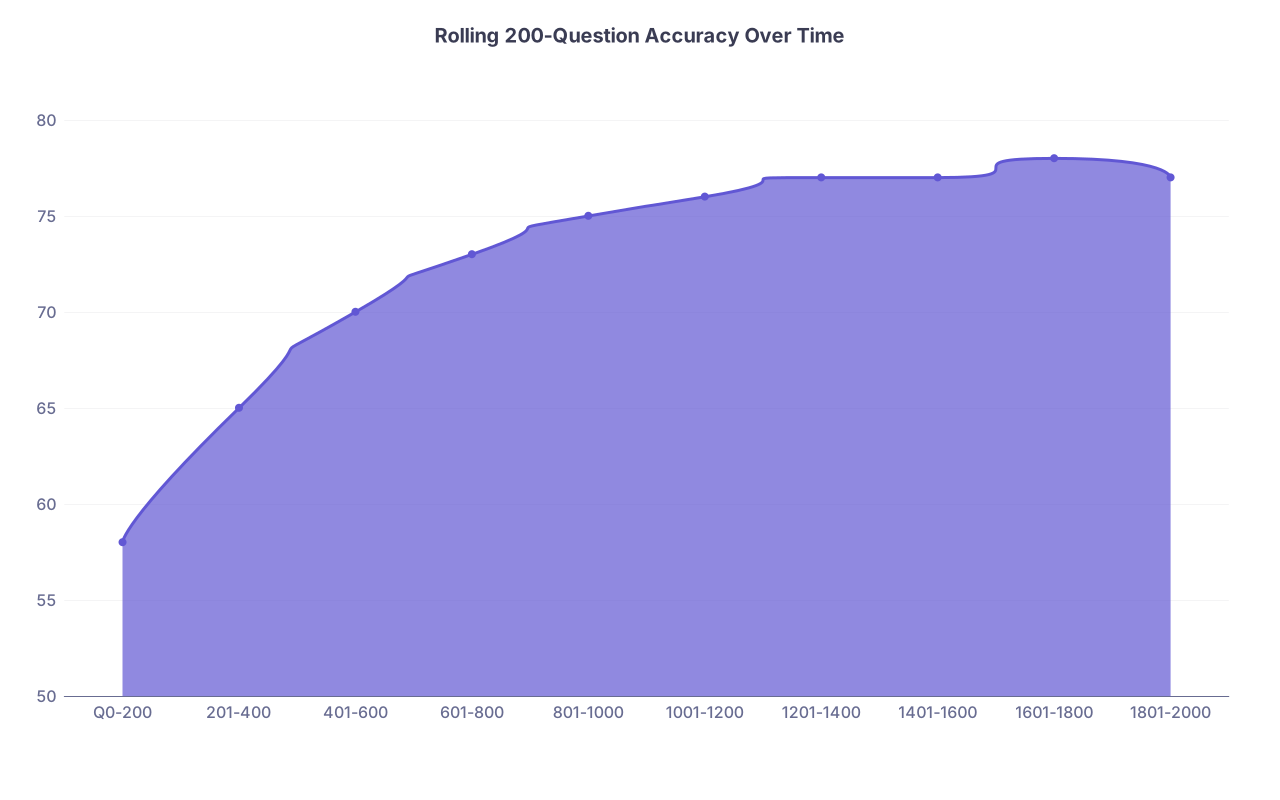
| Category | Value |
|---|---|
| Q0-200 | 58 |
| 201-400 | 65 |
| 401-600 | 70 |
| 601-800 | 73 |
| 801-1000 | 75 |
| 1001-1200 | 76 |
| 1201-1400 | 77 |
| 1401-1600 | 77 |
| 1601-1800 | 78 |
| 1801-2000 | 77 |
Notice the pattern:
- Huge early jump (58 → 70% within ~600 questions)
- Slower rise between 600 and 1200
- Then you get stuck bouncing between 76–78% despite 800 more questions
That bouncing is your plateau. Not when you feel tired. When your rolling accuracy stops trending upward by more than ~1–2 percentage points per 300–400 questions.
When I’ve had access to detailed exports from students:
- Most plateaus (defined as ≤1% gain over 400–600 new questions) occur between 1,200 and 1,800 total questions
- A smaller second group plateau very early (400–800) because they keep doing questions without fixing knowledge gaps
- A tiny minority push beyond 2,500 questions and still gain because they radically improve process (aggressive review, targeted content, timing training)
If your trend line has been flat over the last 400–600 questions, you are at your plateau, regardless of whether that is at 900 questions or 2,300 questions.
Different Exams, Different Numbers
“2,000 questions” means something different depending on whether you are talking about:
- A preclinical block exam
- A single NBME subject/shelf
- Step 1 / Step 2 CK
- COMLEX 1 / 2
- A school’s in‑house cumulative final
So let’s be precise.
Step 1 / COMLEX Level 1
For major board-style basic science exams, the bulk of students who score in the 230–250 / solid pass range do roughly:
- 1,500–2,200 board-style questions in total from a primary bank (often UWorld)
- Plus another 400–800 from secondary sources during coursework (school QBanks, Kaplan, AMBOSS, etc.)
The plateau:
- Many students’ percent-correct stops improving after ~1,600–1,800 questions in their main bank
- Additional improvement usually comes from NBME practice tests and targeted content review, not yet another 1,000 random Q‑bank items
Step 2 CK / COMLEX Level 2
Clinical knowledge questions are more pattern-based and less memorization-heavy. Performance data tends to show:
- Moderate but steady gains up to 2,000–2,500 questions
- Plateau often begins later, around 2,000+ questions, because clinical reasoning benefits a bit more from sheer exposure to scenarios
So for Step 2, your return on investment may still be reasonable between 1,500–2,500 questions if you:
- Do them in timed, random, mixed blocks
- Aggressively review explanations and link back to guidelines (e.g., USPSTF, IDSA)
- Track and patch weak systems
Past ~2,500 questions without changing your study method, the slope still flattens.
Shelf / NBME Subject Exams
Shelves are narrower; you do not need 3,000 questions in internal medicine to stop improving.
For most rotations, the efficiency zone:
- 600–1,000 questions focused on that subject (UWorld + NBME + Rosh/AMBOSS combos)
- Performance usually plateaus around 800–1,200 questions per shelf domain
When students brag about “2,000 surgery questions,” you almost always see a flat line in their last half. They are re‑learning the same mid‑yield stuff rather than driving up the score.
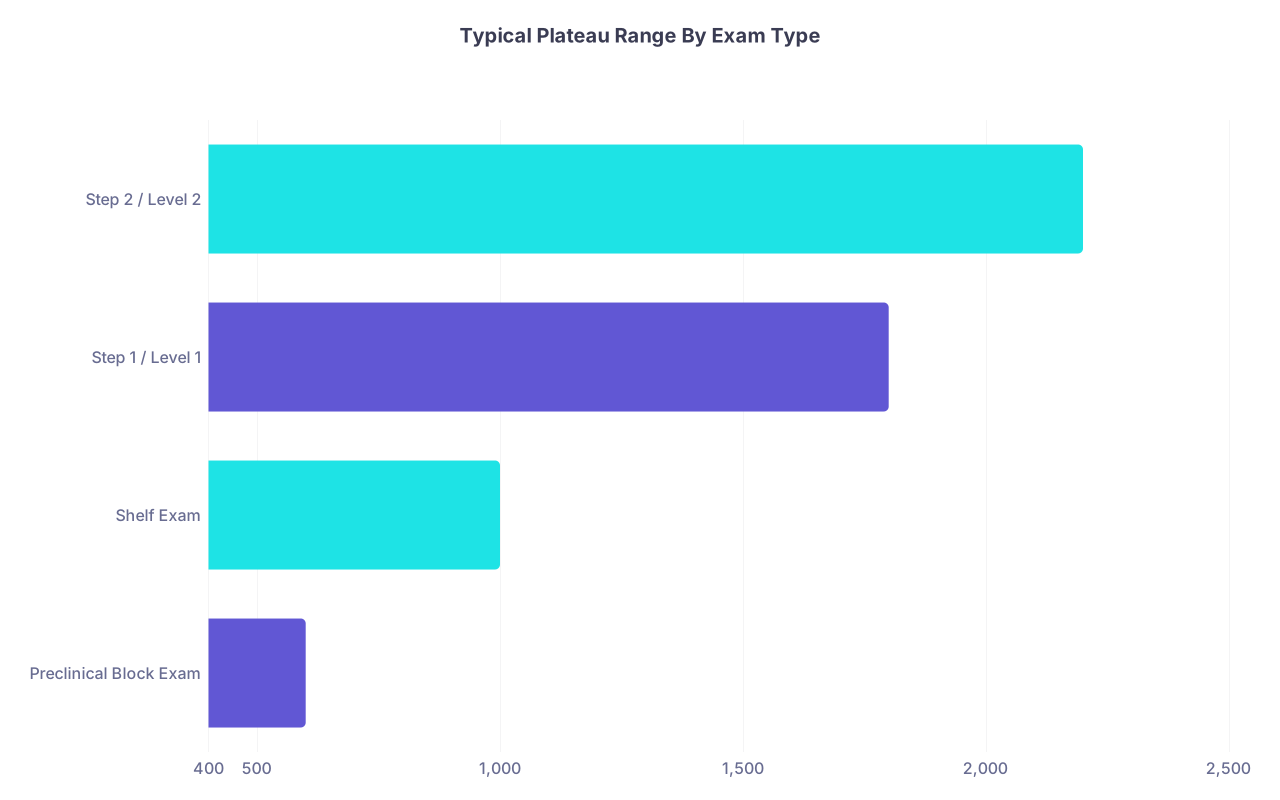
| Category | Value |
|---|---|
| Preclinical Block Exam | 600 |
| Shelf Exam | 1000 |
| Step 1 / Level 1 | 1800 |
| Step 2 / Level 2 | 2200 |
These are median plateau points, not ceilings. But if you are blasting well beyond these numbers and not seeing movement, that is a red flag about process, not your intelligence.
Why the Plateau Happens (Statistically, Not Psychologically)
This is not magic. It is basic probability and learning theory.
Several forces drive the flattening:
Overlap in question content
Q‑banks are not independent, identically distributed samples of “all medicine.” Topics repeat. By the time you have done 1,500 cardiology-heavy questions, the 1,501st is very likely testing a concept you have already seen 3–6 times. So the marginal educational value drops.Mastery saturation
You reach a point where your weak areas are fewer and fewer. Each new question is more likely to hit an area you are already good at. The chance that any given question targets a true knowledge gap declines as your overall mastery rises.Noise vs signal
Early on, each error reveals a big concept you have not integrated. Later, many errors are due to:- Misreads
- Fatigue
- Second-guessing
- Overcomplication
Those are harder to “fix” simply by exposure. They need strategy changes, not more volume.
Time and fatigue constraints
Your brain does not keep up the same efficiency at hour 1 and hour 5 of questions. Cognitive fatigue flattens your measured performance even if your underlying knowledge is inching up.
If we model learning as a negative exponential:
Performance = MaxScore − A · e^(−k·Q)
Where Q is the number of questions, and k is your learning rate, the derivative (slope) is:
d(Performance)/dQ = A·k·e^(−k·Q)
That exponential term shrinks quickly. Past a certain Q, the slope is so small that from your view—sitting there doing 40‑question blocks—it looks flat.
Detecting Your Plateau with Simple Analytics
You do not need fancy exports. You can track this with:
- A running log of blocks (date, # questions, % correct, mode, topics)
- A simple spreadsheet with a rolling average over the last 160–200 questions
- A graph that plots cumulative questions vs rolling accuracy
Here is a simple process that works in practice:
- After every block, log:
- Block ID / day
- Number of questions
- % correct
- Mode (tutor vs timed, mixed vs subject)
- Every 5–6 blocks (200–250 questions), calculate your average over those blocks
- Plot each “windowed” average as a point over cumulative questions
Now look at the last 400–600 questions. Ask:
- Has my average moved more than 2–3 percentage points?
- Are my NBME/school practice tests rising in parallel?
- Are my weak-topic accuracies still trending up?
If the answers are “no,” “no,” and “no,” you are in the plateau.
At that point, doing another 500 untargeted questions is like doing another 50 sets of biceps curls when your form is already lousy and your muscle is exhausted. You will sweat. You will not grow.
What Actually Moves the Needle Past the Plateau
If you insist on turning this into “Should I do 2,000 or 3,000 questions?”, you’re missing the point. Beyond the early phases, how you interact with each question produces more score than how many you do.
The data from students who break plateaus consistently shows three common behaviors.
1. They switch from volume-maximizing to information-maximizing
Plateau-breakers spend more time per missed question. They treat each error as a dataset:
- What specific fact or concept did I miss?
- Did I misinterpret the stem?
- Was the distractor appealing for a specific reason (e.g., overvaluing a lab, ignoring age)?
- Is this a one-off weird zebra or a pattern in a topic?
They build or update:
- Anki cards or other spaced repetition entries
- Short, ugly, personal notes (“Always check pregnancy status before imaging abdomen”)
- Topic lists where their percent correct is consistently <65–70%
They stop counting daily questions as the main metric and track:
- Weak topic list size (how many topics under 70%?)
- Percent correct on those weak topics over time
2. They recalibrate question selection
Once your global accuracy plateaus, more random blocks have limited value. Better strategies:
- 50–70% of blocks: still mixed, timed, random, to maintain test realism
- 30–50%: deliberately over-represent your weakest systems/topics
For example, if GI and neuro are lagging:
- Instead of 40 random questions that yield 6 GI and 4 neuro
- Do 20 random + 20 GI
- Or 40 mixed with topic filters tilted heavily to GI/neuro
You want to increase the conditional probability that the next question hits something you are bad at. That is how you keep the learning curve steeper.
3. They align questions with full-length practice tests
The students who keep improving after 1,500–2,000 questions usually do not just keep hammering Q‑banks. They chain their weeks around:
- NBME / COMSAE / UWSA / school comprehensive exams
- Detailed, painful post‑test reviews
- 7–10 days of targeted Q‑bank work on themes that show up on those tests
That external checkpoint breaks “false plateaus,” where your Q‑bank performance flatlines because you are now better than the bank’s item pool at testing your marginal gains.

| Step | Description |
|---|---|
| Step 1 | Q-Bank Practice 1-2k Qs |
| Step 2 | Rolling Accuracy Plateaus |
| Step 3 | Full-Length Practice Exam |
| Step 4 | Identify Weak Systems & Skills |
| Step 5 | Targeted Q-Bank Blocks + Content Review |
| Step 6 | Reassess Rolling Accuracy |
| Step 7 | Maintain Mixed Timed Blocks |
The point: when the slope of your Q‑bank curve goes to near-zero, you introduce a new “measurement instrument” (NBME, school practice) and new targeted input.
How Many Questions Should You Aim For?
Let me be concrete and unapologetically numerical.
You can think in three ranges for a major exam (Step 1/2 or equivalent):
Sub‑critical (<1,000 from a high-quality main bank)
You will likely underperform your potential. You are still in the steep part of the curve when you walk into the exam. You leave points on the table.Efficient zone (~1,200–2,000 main-bank questions)
This is the range where most of the reachable gains occur for most students, assuming:- Questions are mostly timed and mixed
- Misses are reviewed thoroughly
- Content gaps are actively patched
Many students never need more than this to hit their target scores.
Overkill / marginal zone (2,000–3,500 main-bank + secondary)
Gains here are real only if your process is excellent. If you are just doing more of the same, the curve is nearly flat. You are trading time and energy for <2–3 points, often less.
| Exam Type | Target Performance | Total High-Quality Questions |
|---|---|---|
| Block Exam | Pass with buffer | 300–600 |
| Block Exam | High honors | 600–900 |
| Shelf Exam | Pass | 400–700 |
| Shelf Exam | ~75th percentile+ | 700–1200 |
| Step 1 / L1 | Solid pass / 220 range | 1200–1800 |
| Step 1 / L1 | 240–250+ | 1800–2500 |
| Step 2 / L2 | 240–250 range | 1500–2200 |
| Step 2 / L2 | 255–260+ | 2000–2800 |
These are not gospel. But they are consistent with what I’ve seen across hundreds of schedules and datasets.
If you are nowhere near these ranges, you are statistically under-prepared. If you are far beyond them and not improving, you are not under-working. You are misallocating effort.
How This Fits Into Real Medical School Life
All this sounds very clean on paper. It is not. You are trying to fit this into:
- 60–80 hour clinical weeks
- Random days where call or exams blow up your plan
- Faculty who still think “do more questions” is a helpful complete sentence
So let me translate the analytics into something that fits real life.
Here is a realistic progression for Step 1/2 style prep that respects plateaus:
Early (0–800 questions)
- Focus: build pattern recognition and identify global weaknesses
- Mode: more tutor mode early, then quickly transition to timed, mixed once you pass ~400–500
- Expect: strong upward trend in rolling accuracy
Middle (800–1,500 questions)
- Focus: switch strongly to timed, mixed blocks
- Start logging performance by system and question difficulty
- Expect: slower but still meaningful upward trend
Approaching plateau (~1,500–2,000 questions)
- Watch your rolling accuracy carefully. If you see 400–600 questions with <1–2% gain, assume plateau.
- Insert a full practice exam. Let that guide your next ~500 questions.
- Increase ratio of targeted → random blocks (30–50% targeted)
Post-plateau (>2,000 questions)
- Only continue heavy Q‑bank volume if:
- You are still below your target score on practice tests, and
- Your accuracy in key weak systems is still trending up
- Otherwise, shift time to:
- Focused content review of stubborn topics
- Spaced repetition
- Exam strategy (timing, reading stems, triaging)
- Only continue heavy Q‑bank volume if:
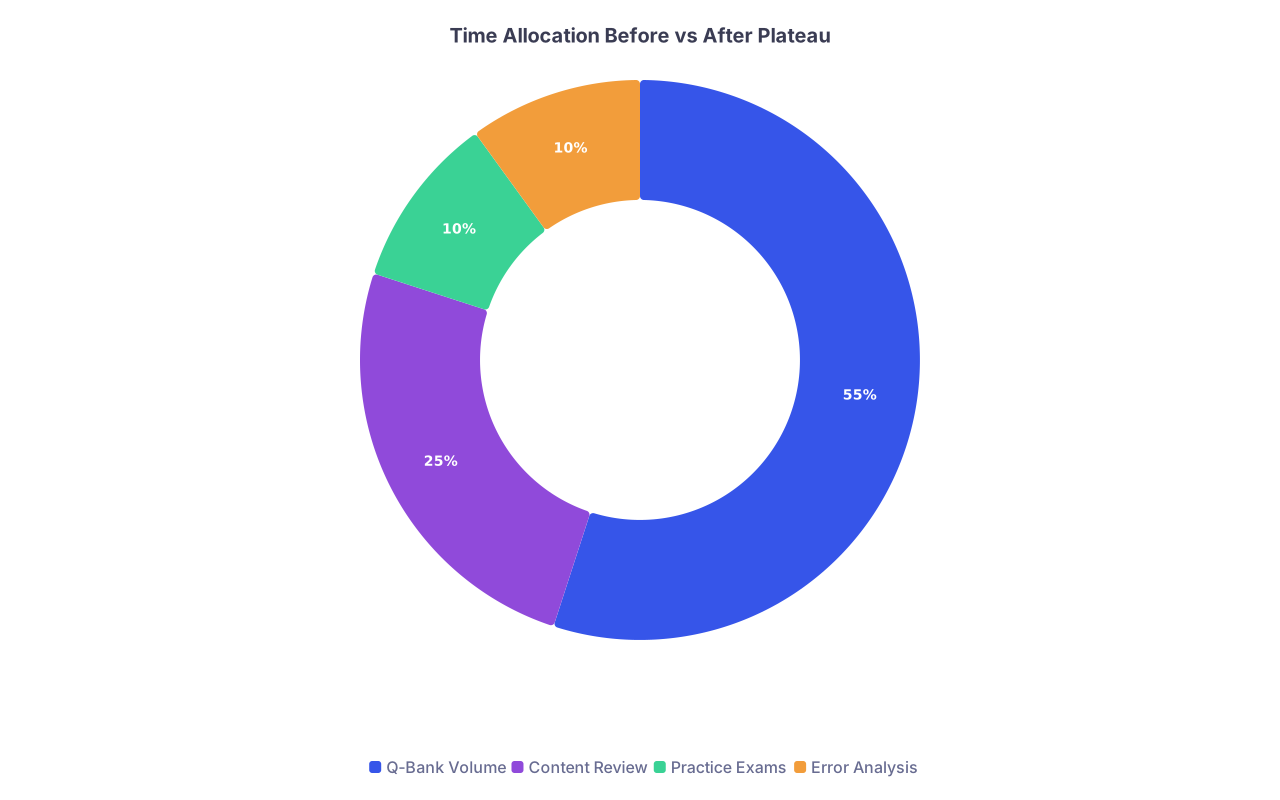
| Category | Value |
|---|---|
| Q-Bank Volume | 55 |
| Content Review | 25 |
| Practice Exams | 10 |
| Error Analysis | 10 |
(Pre-plateau, your pie chart is skewed heavily toward Q‑banks. Post-plateau, that blue slice should shrink in favor of content review and targeted error analysis.)
The One Thing Most People Get Wrong
They define their success by the number of questions completed, not by the rate of improvement.
You see this everywhere:
- Group chats where everyone posts “I finished all 3,000 questions” like it is a spiritual achievement
- Study schedules that brag about “120 questions a day” but never ask whether yesterday’s 120 did anything
- People re‑starting a Q‑bank from the top for the third time, confusing repetition with progress
If your last 500 questions did not change your practice test performance, your next 500 will not magically save you. The data is already telling you that the marginal return is close to zero.
Stop counting “questions done.” Start tracking “points gained per 200 questions.” When that ratio drops below a threshold you are willing to accept, the plateau is here. Adjust.
Key Takeaways
- Most students hit a real, data-backed plateau in Q‑bank performance between ~1,500 and 2,500 questions, depending on exam and study quality.
- The right move at plateau is not “do more questions” but “change how you use questions”—more targeted blocks, deeper review, and practice exams guiding your next steps.
- Judge your prep by improvement per 200–400 questions, not by total question count. Volume drives early gains; analytics and strategy drive late gains.