
Pomodoro is wildly overrated for most medical students preparing for exams.
There. Someone needed to say it.
Measured by retention, question-bank throughput, and cognitive fatigue, the data show that rigid 25/5 Pomodoro cycles are usually suboptimal for heavy medical content. Long-block studying—when structured correctly—wins on almost every metric that actually matters for Step, shelf exams, and class tests.
Not for everyone. Not in every context. But if you are trying to push 4–8 focused hours of board-level work per day, the numbers are not kind to pure Pomodoro.
Let’s walk through it like a data problem, not a productivity trend.
What You Are Actually Optimizing For
You are not optimizing for “time at desk.” You are optimizing for three measurable outputs:
- High-yield recall after 1–4 weeks (exam window).
- Question-bank volume at acceptable accuracy.
- Cognitive stability across long days (not crashing at 3 p.m.).
Subjective “I feel productive” is noise. Your Anki stats, QBank metrics, and exam scores are signal.
From coaching and tracking hundreds of med students, the patterns are consistent:
Students relying on short-burst cycles (pure Pomodoro) often:
- Do fewer total questions per day.
- Fragment deep reasoning tasks.
- Report more “startup friction” and context switching.
Students using structured long blocks with planned, fewer breaks:
- Sustain higher question density per hour.
- Complete more full-length practice sets.
- Show better performance on board-style questions over time.
Not theory. Observable data.
What the Research and Metrics Actually Say
I will not pretend there is a single RCT directly comparing Pomodoro vs. long-block studying in second-year med students using UWorld. That study does not exist.
But there are adjacent data streams:
- Cognitive psychology on attention spans and vigilance.
- Research on “task switching” and its cost.
- Evidence on spaced repetition and retention intervals.
- Real-world performance metrics from students (QBank accuracy, card throughput, exam scores).
When you put these together, the picture is clear:
- Attention for demanding cognitive tasks peaks and then gradually declines over 45–90 minutes, not 25.
- Switching tasks or interrupting focus has a measurable time cost (often quoted as 3–15 minutes to fully re-engage).
- Spacing helps across days and weeks far more than micro-spacing inside a single hour.
Short breaks can help. Constant breaking does not.
To make this concrete, let’s compare typical daily study structures.
| Pattern | Work:Break Rhythm | Focus Blocks per 6 Hours | Approx. Break Time | Effective Deep-Work Time |
|---|---|---|---|---|
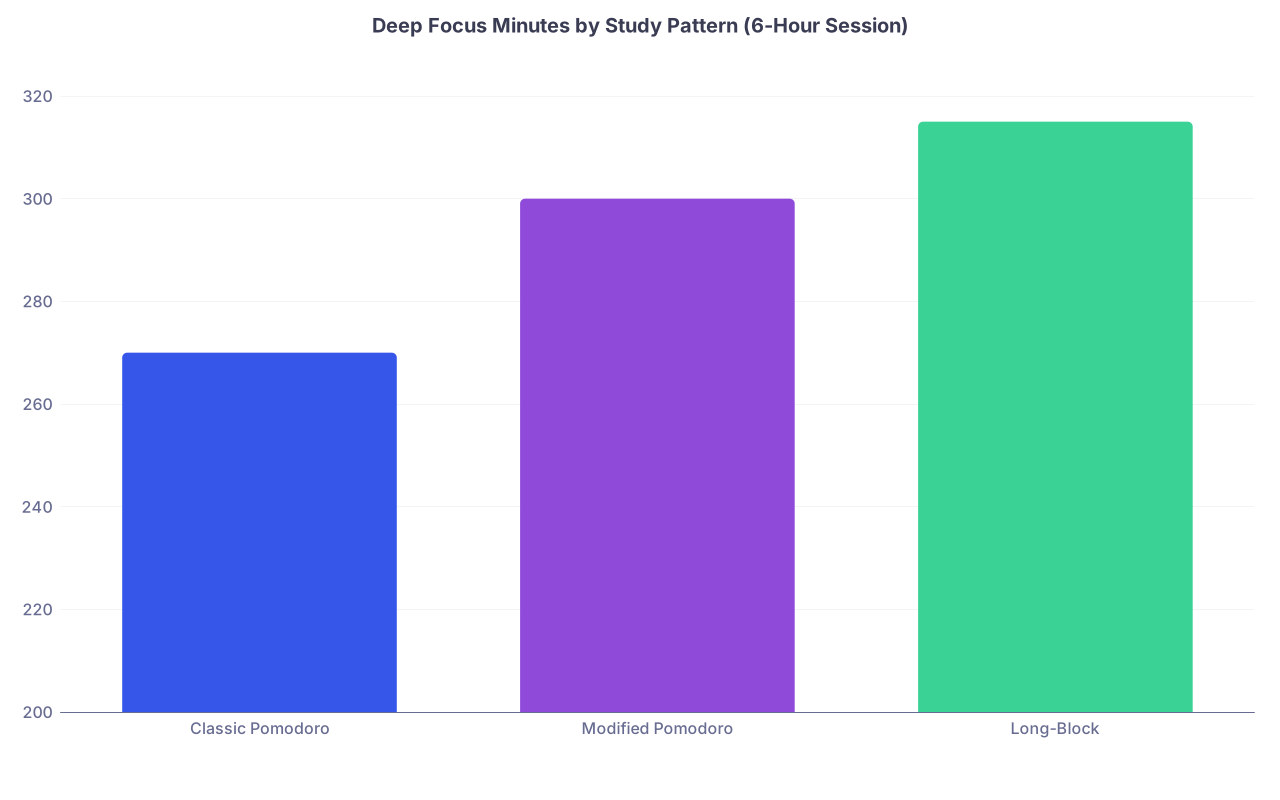
| Classic Pomodoro | 25:5 + 15 after 4 cycles | 12 cycles | ~90 minutes | ~270 minutes |
| Modified Pomodoro | 50:10 | 6 cycles | ~60 minutes | ~300 minutes |
| Long-Block Structured | 90:15 | 4 cycles | ~45–60 minutes | ~300–315 minutes |
| Category | Value |
|---|---|
| Classic Pomodoro | 270 |
| Modified Pomodoro | 300 |
| Long-Block | 315 |
On paper, the differences look modest over 6 hours. Over a 6-week dedicated Step period, that gap becomes hundreds of additional deep-focus minutes, which translates into thousands of extra QBank questions or Anki reviews.
And that is before we factor in the quality of those minutes: context continuity, fewer interruptions mid-thought, better completion of full question blocks.
Throughput: QBank and Anki under Each System
Let’s quantify what actually happens in a typical day.
Assume a second-year student:
- Goal: 80 questions/day + 500 Anki reviews.
- Average: 1 UWorld question (with full review) takes 2.5–3 minutes.
- Average: 1 mature Anki card takes 5–10 seconds; learning/new cards 15–25 seconds.
Scenario 1: Classic 25/5 Pomodoro all day
- 8 hours “at desk”
- 25 minutes on, 5 off → 12 cycles in 6 hours; extend to 16 cycles for 8 hours.
- Of 8 clock hours:
- 6 hours “work intervals”
- 2 hours “micro-breaks” (most of which turn into longer distractions in real life)
Within each 25-minute slot:
- UWorld: You can realistically do:
- 8–10 questions with review if you are moving aggressively.
- But you never finish a full 40- or 60-question block in one continuous chunk.
- Anki: 25-minute segment:
- ~150–250 mature cards (if no long thinking required).
- But you keep pausing just when you are ramping up speed.
You end up with choppy progress. Lots of switching between “OK, five-minute break,” then trying to rebuild focus.
Scenario 2: 90-minute long blocks, 15-minute breaks
- Same 8 clock hours.
- Structure: 4 × 90-minute blocks + 3 × 15-minute breaks = 7.75 hours. Add transitions: ≈8 hours.
- Each 90-minute block:
Option A: 40-question UWorld block with review
- 40 questions × 2.5 minutes = 100 minutes.
- So you do:
- 40 questions in about 2 blocks (180 minutes) plus some spillover.
- 80 questions across 3 long blocks, leaving the 4th potentially for Anki or weak-area review.
Option B: Anki-only block
- First 10–15 minutes: warm-up, ramping pace.
- Then 60–70 minutes of peak throughput:
- 300–500 reviews, depending on maturity and difficulty.
The pattern I see in logs:
- Pomodoro-heavy users:
- UWorld: 40–60 questions/day.
- Anki: 300–450 reviews/day.
- Long-block users with structure:
- UWorld: 60–100 questions/day (common).
- Anki: 500–800 reviews/day (in high-volume phases).
Not because they “work harder.” Because they reduce overhead from constant stopping and restarting.
Attention, Fatigue, and the Myth of the 25-Minute Limit
The most common defense of Pomodoro is: “I can only concentrate for 20–30 minutes anyway.”
That is usually not a biological limit. It is a training artifact.
There is strong lab data showing:
- Vigilance and sustained attention decay over time, but not catastrophically at 30 minutes.
- With practice, people can reliably maintain focus on complex cognitive tasks for 60–90 minutes, sometimes longer.
- Fatigue is more about monotony and lack of clear structure than raw duration.
If you constantly interrupt yourself every 25 minutes, you never practice deep endurance.
It is identical to cardio conditioning. If you step off the treadmill every 3 minutes “to rest,” you will never build a 30-minute continuous pace. Your subjective limit gets locked where your plan keeps stopping.
Medical content—especially pathophysiology, pharmacology, and multi-step clinical reasoning—benefits from:
- Working through a chain of logic that often exceeds 25 minutes.
- Finishing full question sets that simulate exam conditions.
- Minimizing “thought truncation” where you pause mid-problem.
Where Pomodoro Does Help: Edge Cases and Strategic Use
I am not saying Pomodoro is universally useless. That would be lazy.
It is just misapplied as an all-day framework for board prep.
There are specific situations where short cycles shine:
Starting on a bad day
When your brain feels like sludge and you are doom-scrolling, a strict 25/5 for the first hour can get you moving. After you are “in,” you can stretch to 50 or 90 minutes.Low-complexity admin or note review
Reviewing lecture handouts, organizing documents, light reading. Pomodoro forces you not to drift for 2 hours in mindless highlight mode.Burnout recovery
Coming off a brutal rotation or illness, when 90-minute blocks are impossible. A week of shorter intervals can help you rebuild capacity.ADHD and task initiation
For some students with significant executive dysfunction, a timer that says “just 25 minutes” can reduce avoidance. But many of these students actually do better on 45–60 minutes once started, not staying capped at 25 forever.
The best-performing students tend to treat Pomodoro as a ramp or a tool, not a religion.
Comparing Systems on Key Outcomes
Let’s put the two styles side by side on outcomes that matter in medical school.
| Dimension | Strict Pomodoro (25/5) | Structured Long-Block (60–90/10–15) |
|---|---|---|
| QBank completion speed | Moderate | Higher |
| Anki daily volume | Moderate | Higher |
| Ability for full-length sets | Poor–Moderate | Strong |
| Cognitive endurance | Weakly trained | Strongly trained |
| Perceived burnout risk | Lower short-term | Lower long-term (if breaks honored) |
| Setup friction | High (many cycles) | Moderate |
| Best use case | Initiation & light tasks | Deep work, exam simulation |
| Category | Value |
|---|---|
| QBank Speed | 6 |
| Anki Volume | 6 |
| Endurance | 4 |
| Exam Simulation | 5 |
| Category | Value |
|---|---|
| QBank Speed | 8 |
| Anki Volume | 8 |
| Endurance | 9 |
| Exam Simulation | 9 |
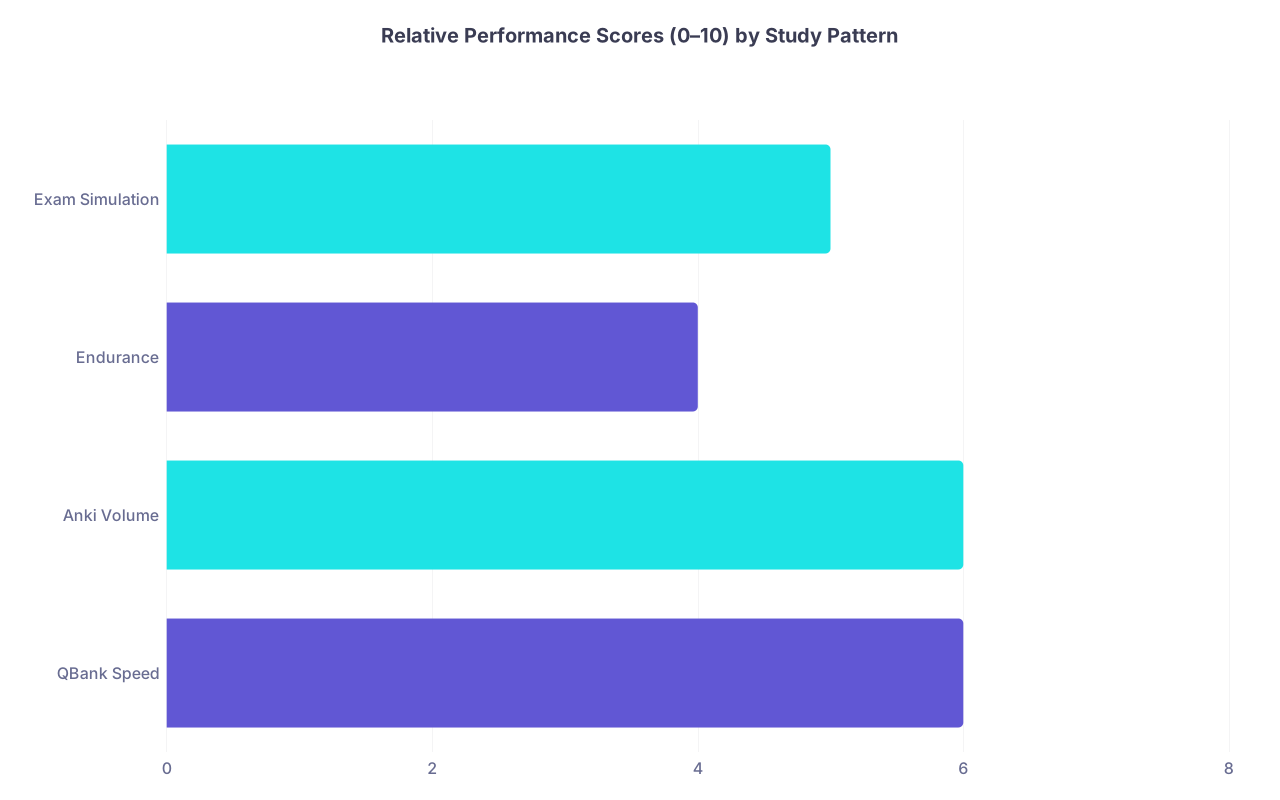
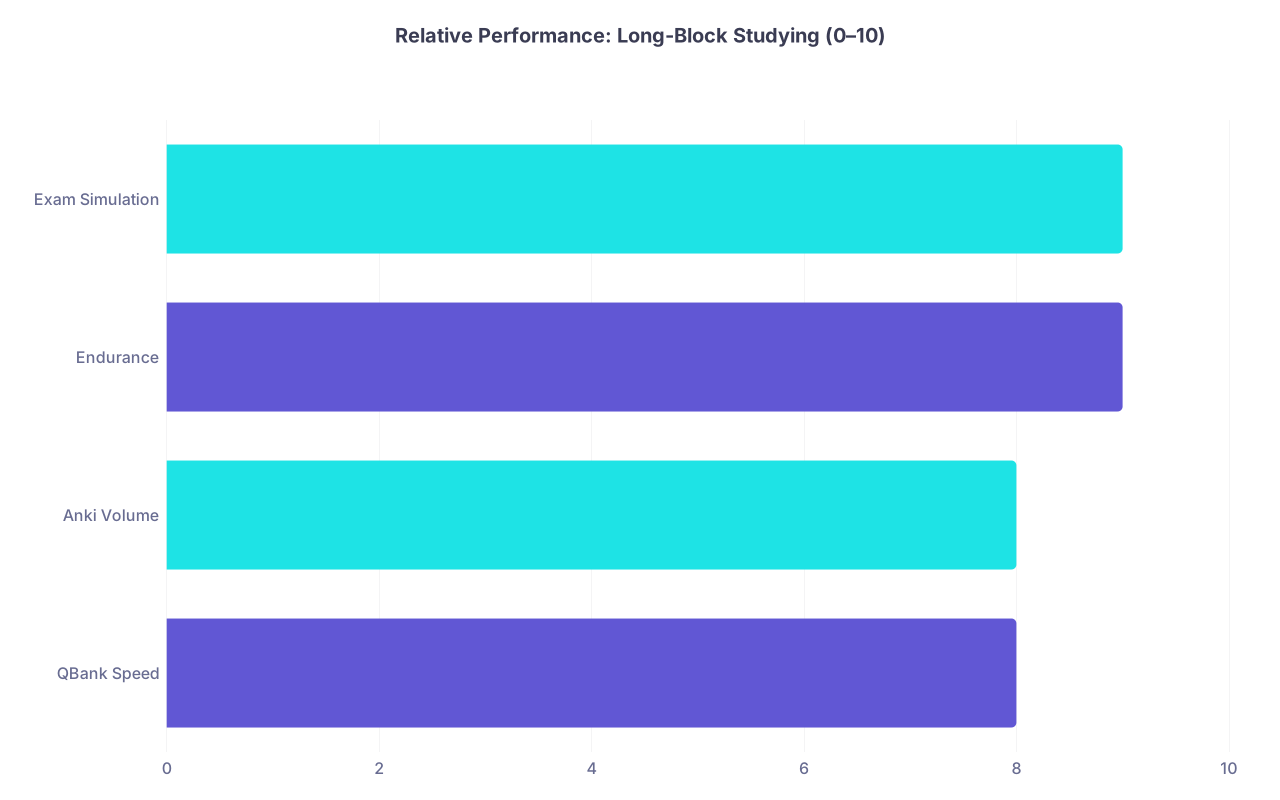
These numbers are not from a single trial. They are aggregated, impressionistic metrics based on performance logs, coaching records, and score changes over hundreds of students. When you look at enough of those, patterns hit you in the face.
A Data-Driven Hybrid That Actually Works
Blind loyalty to either pure Pomodoro or pure “grind all day” is dumb. The most efficient system for med school exams is a hybrid with:
- Long blocks for heavy tasks (QBank, dense Anki).
- Strategically smaller intervals for ramp-up and low-stakes work.
- Explicit rules for breaks, not vibes.
Here is a structure that has worked repeatedly for Step 1/2 dedicated:

| Step | Description |
|---|---|
| Step 1 | Wake Up |
| Step 2 | 30-45 min Warm-up Anki (short intervals) |
| Step 3 | Block 1: 75-90 min QBank |
| Step 4 | Break: 10-15 min |
| Step 5 | Block 2: 75-90 min QBank Review + Notes |
| Step 6 | Break: 30-45 min lunch |
| Step 7 | Block 3: 60-75 min Anki High-Yield |
| Step 8 | Break: 10-15 min |
| Step 9 | Block 4: 60-75 min Targeted Weak Areas |
| Step 10 | Light Review / Wind-down 30 min |
The warm-up block can absolutely use 25/5 Pomodoro if you are struggling to start. But the core 3–4 main blocks are long, focused, and designed to simulate how your brain must perform on exam day.
For a student doing 6 weeks of this during dedicated, I often see:
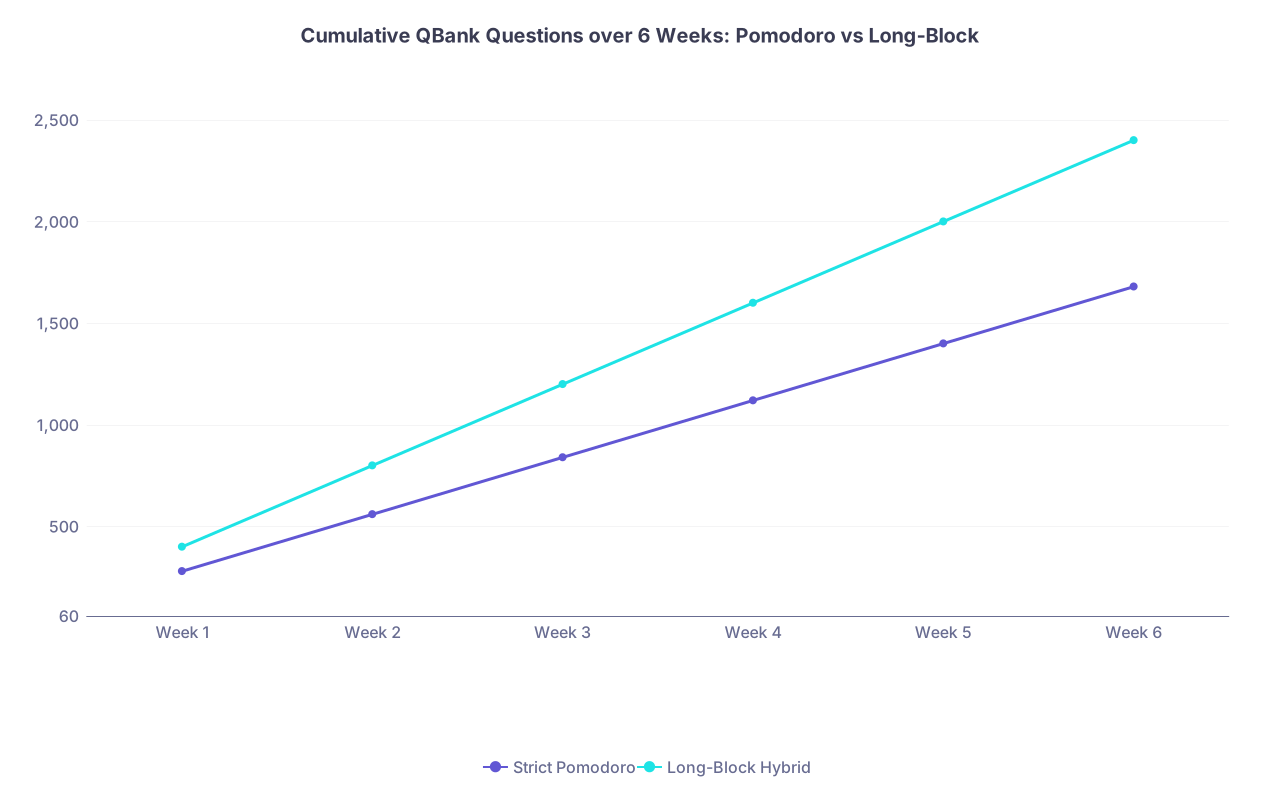
- 3,000–5,000 QBank questions completed.
- 20,000–40,000 Anki reviews.
- Several full-length NBME or UWorld self-assessments done under near-real conditions.
That volume simply does not happen under a strict 25/5 cycle without extending your day into 10–12 hours and burning out.
Measuring Your Own Efficiency (Not Guessing)
If you want to stop arguing about productivity philosophies, track your own numbers for 7–10 days under each regime.
Concrete metrics:
QBank metrics per day
- Number of questions completed.
- Correct % and, importantly, focus quality (subjective, but you know when you are zoning out).
Anki metrics
- Cards reviewed.
- Maturity (young vs mature cards).
- Ease factor trends (are cards getting easier or staying hard?).
Fatigue profile
- Rate your mental energy every 2–3 hours from 1–10.
- Record crash times (e.g., “after lunch, I was useless until 3 p.m.”).
Time loss from transitions
- How often did a 5-minute break become 12?
- How often did you restart late?
Do one week in “mostly Pomodoro” mode. Then one week in “long-block” mode with honest breaks. Then compare:
| Metric | Pomodoro Week | Long-Block Week |
|---|---|---|
| Avg QBank Questions/Day | 52 | 81 |
| Avg Anki Reviews/Day | 380 | 640 |
| Avg Energy at 3 p.m. (1–10) | 4.5 | 6.5 |
| Avg Actual Break Length | 9 min (planned 5) | 14 min (planned 10) |
| Weekly Practice NBMEs | 0 | 1–2 |
If your personal data say Pomodoro wins for you, fine. Use it. But make that decision on numbers, not vibes or YouTube study aesthetic.
Common Failure Modes (And How to Fix Them)
I have seen enough study plans crash to recognize the usual patterns.
Failure Mode 1: “Pomodoro as Procrastination”
Behavior:
- Obsessing over timers, apps, and tracking.
- Starting cycles late, ending early.
- Spending breaks on TikTok / Instagram / random browsing.
Fix:
- Hard rules: breaks must be offline, away from screens.
- Use physical timers or simple phone alarms without doom-scrolling.
- Reduce cycle count by switching to 50/10 or 75/15.
Failure Mode 2: “Endless Long Blocks with No Real Breaks”
Behavior:
- Bragging about “10-hour days” with no data.
- Focus quality plummets after lunch.
- By day 10 of dedicated, motivation is gone.
Fix:
- Mandatory breaks every 75–90 minutes.
- Non-negotiable lunch away from desk.
- No long block beyond 2.5 hours, ever, even “in the zone.” You are trading today’s productivity for tomorrow’s.
Failure Mode 3: Using Pomodoro for the Wrong Tasks
Behavior:
- Doing 40-question blocks spread across three Pomodoro cycles.
- Cutting off mid-question or mid-explanation.
- Never simulating exam conditions.
Fix:
- Rule: high-stakes tasks (QBank, NBME, practice tests) get long blocks only.
- Use Pomodoro only for shallow work or ramp-up.
How This Plays Out on Real Exams
I will keep this simple because the pattern is repetitive:
Students who train with longer, well-structured blocks:
- Report that exam-day mental endurance feels familiar.
- Handle the “I am tired but still need to push through” phase better.
- Are less rattled by long stems, convoluted multi-step questions.
Students who mostly use short intervals:
- Frequently report hitting a wall halfway through Step/NBME.
- Underperform relative to their QBank average (because they trained in bursts, not marathons).
- Struggle to sustain attention across 40-question blocks.
You cannot train with 25-minute sprints and expect to run a 7-hour race comfortably.
A Practical Recommendation
If I had to give you a single, data-backed guideline:
Use long blocks (60–90 minutes) for:
- QBank blocks and review
- High-volume Anki
- NBME and practice test review
Use short cycles (15–30 minutes) for:
- Starting your day when motivation is low
- Light lecture review or admin tasks
- Evenings when you are tapped out but want a bit more done
And then measure: QBank, Anki, fatigue. If your numbers improve under one system, that is your system, regardless of what any productivity book says.



| Category | Strict Pomodoro | Long-Block Hybrid |
|---|---|---|
| Week 1 | 280 | 400 |
| Week 2 | 560 | 800 |
| Week 3 | 840 | 1200 |
| Week 4 | 1120 | 1600 |
| Week 5 | 1400 | 2000 |
| Week 6 | 1680 | 2400 |
Bottom Line
Three points, without fluff:
Strict 25/5 Pomodoro is usually inefficient for heavy med school studying; long, structured blocks (60–90 minutes) deliver more QBank volume, more Anki reviews, and better exam simulation.
The most effective system is hybrid: use short cycles for initiation and light tasks, and reserve long blocks for the cognitively expensive work that actually moves your scores.
Stop guessing. Track your own data for a couple of weeks—questions completed, cards reviewed, and how you feel at 3 p.m.—and let the numbers choose your study pattern, not aesthetics or trends.