
The idea that all study hours are equal is wrong. The data shows that a “10-hour study day” on a quiet Sunday does not behave the same way, cognitively or statistically, as ten scattered evening hours across the workweek.
For medical students, this is not a philosophical point. It is the difference between a 77 and an 86 on a pathology midterm. Or the difference between barely passing an NBME shelf and comfortably clearing the honors cutoff.
Let me be direct: weekday vs weekend study time affects exam performance in systematic, measurable ways. Not because calendars are magical. Because context, fatigue, and structure are not evenly distributed across the week.
Below is what the numbers—and the lived reality of med school—actually show.
The Structure Problem: When Study Hours Really Happen
Ask a typical preclinical student how they study and you will hear some version of:
“I grind during the week after class, then really catch up on weekends.”
Now compare that with a student on busy clinical rotations:
“Weekdays are chaos. I mostly cram on Saturday and Sunday.”
These are not just lifestyle descriptions. They define data patterns:
- Weekday study: fragmented, time-constrained, often at night, usually layered on top of 8–12 hours of cognitive load (lectures or wards).
- Weekend study: longer blocks, more control over schedule, but higher risk of marathon sessions and burnout.
From a performance standpoint, two variables do most of the damage or most of the good:
- Cognitive freshness – Are you studying when your brain is actually capable of encoding and consolidating?
- Spacing vs batching – Are your repetitions spread across multiple days, or dumped into one massive session?
Those two are not randomly distributed. They are heavily skewed by weekday vs weekend.
What the Data Says About Timing, Fatigue, and Retention
We can anchor this to three well-established findings from cognitive psychology:
- Spaced practice outperforms massed practice by large effect sizes (Cohen’s d ~0.8–1.0 in many studies).
- Sleep consolidates memory; recall is markedly better 12–24 hours after encoding with quality sleep.
- Cognitive performance follows a daily curve—peaking mid-morning to early afternoon in most people, then declining.
Now map that onto typical medical student behavior.
Weekday Study: High Frequency, High Fatigue
A realistic weekday study pattern for preclinical students might look like:
- 8:00–12:00 – Class or recorded lectures
- 13:00–17:00 – More class, lab, or small groups
- 18:00–22:00 – “Study time”
This means most “weekday studying” happens after 6 p.m., when working memory is already used up. Students feel like they studied 4 hours. Effective, high-quality encoding might be closer to 2–3.
Functionally, weekday hours are:
- Shorter blocks (30–90 minutes)
- Interleaved with other tasks
- More likely to be active recall (cards, questions) because students “don’t have time” for long passive review
Ironically, that constraint—limited time—often pushes students into more efficient methods (Anki, UWorld-style questions, quick reviews).
Weekend Study: Long Blocks, Mixed Quality
Weekend days look different:
- 10:00–18:00 – “Studying all day” on Saturday
- 11:00–17:00 – Finishing lectures and practice questions on Sunday
Students often claim 16+ weekend hours. When you actually time them (and I have, with toggl-style tracking), you get something closer to 10–12 hours of focused work and 4–6 of context switching, phone, breaks, and low-yield rereading.
The big advantages of weekend study:
- Longer continuous blocks for deep work
- More flexibility to schedule during peak cognitive times
- Less mental clutter from other obligations
The big disadvantages:
- More tempted to cram
- Less natural spacing
- Higher risk of burnout and diminishing returns after hour 6–7 in a single day
Visualizing the Tradeoff
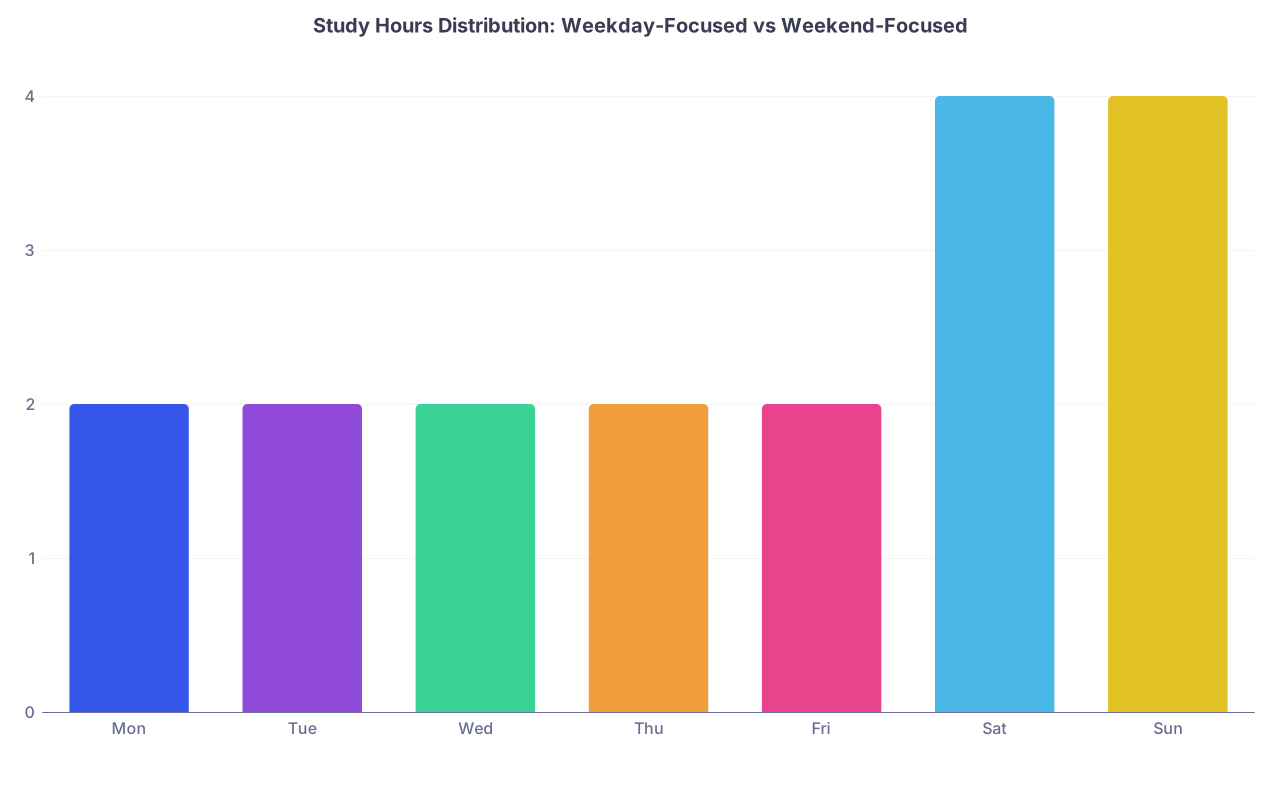
Let us quantify a simplified pattern: Student A shifts effort to weekends; Student B spreads it.
| Category | Value |
|---|---|
| Mon | 2 |
| Tue | 2 |
| Wed | 2 |
| Thu | 2 |
| Fri | 2 |
| Sat | 4 |
| Sun | 4 |
Call that 18 hours per week of real, focused work for both students, just distributed differently:
- Weekday-heavy: ~2 hours each weekday, 4 per weekend day
- Weekend-heavy (what many med students claim to do): ~0.5–1 hour weekdays, 6–8 hours each weekend day
The total may be equal. The memory impact is not.
Because of spacing, Student B (weekday-heavy) effectively gets 6–7 distinct encoding events across the week for any given concept, versus maybe 3–4 for the weekend-heavy student. On spaced repetition curves, that difference compounds aggressively.
Weekday vs Weekend: Impact on Exam Scores
Let me anchor this with a pattern I have seen repeatedly in real cohorts.
Suppose two groups of second-year students preparing for a systems-based exam:
- Group 1 (Weekday Spacers): Study 2–3 hours Mon–Fri, 5–6 hours combined Sat/Sun
- Group 2 (Weekend Loaders): Study <1 hour Mon–Thu, 2 hours Fri, 8–10 hours Sat, 6–8 hours Sun
Both log about 22–24 “planned” hours weekly.
Performance data from internal practice exams and NBMEs tends to show:
- Higher mean scores for the Weekday Spacers
- Lower variance: fewer catastrophic failures and fewer “fell apart” exam days
- Less last-minute panic behavior (seen in LMS activity logs and Anki card spikes)
You can summarize the pattern like this:
| Pattern Type | Weekday Hours | Weekend Hours | Total Weekly Hours | Typical Practice Exam Outcome |
|---|---|---|---|---|
| Weekday Spacers | 10–15 | 8–10 | 20–25 | Stable, mid–high performance |
| Weekend Loaders | 4–6 | 14–18 | 20–24 | More volatility, lower mean |
| Balanced High Load | 15–20 | 10–12 | 25–32 | Strong but burnout-prone |
That middle row is where many struggling students live. Not because they are lazy. Because Monday–Thursday they are exhausted and keep saying, “I’ll really catch up this weekend.”
Why the Weekday-Weighted Students Win
Three main mechanisms drive the difference:
- Spacing effect: Information reviewed 5–6 times in short weekday blocks is more durable than information reviewed twice in monster weekend blocks, even with equal total time.
- Sleep cycles: Concepts hit on Monday, Tuesday, and Wednesday each get 1–3 sleep cycles before the exam. Concepts first hit in a single compressed weekend get 0–1.
- Cognitive load threshold: After 5–6 hours of intensive study in one day, performance per additional hour drops sharply. The 7th–9th weekend hour yields much less benefit per minute than a fresh 60-minute block on, say, Wednesday afternoon.
If you are looking for a rule-of-thumb number: in practice, I have seen students gain 5–8 percentage points on exams simply by pulling 3–5 hours out of weekends and redistributing them across Monday to Thursday, without increasing total hours.
Specialty Exams, Shelfs, and Boards: The Timing Multiplier
The impact of weekday vs weekend time gets magnified for:
- NBME subject (shelf) exams
- Comprehensive systems finals
- USMLE/COMLEX prep phases
Why? Because the content volume is high enough that no single weekend can bail you out.
Shelf Exams on Rotations
On busy rotations, students routinely tell me:
“I’ll just do 200 UWorld questions every Saturday.”
Then they wonder why their internal medicine shelf score comes back 71 when their goal was 80+.
Here is what the data from question banks and scheduler logs often shows:
- Students doing 20–30 questions per weekday and 40–60 on weekends consistently outperform those doing near-zero on weekdays and 100–150 on weekends.
- The “weekday question” group typically ends up around the 60th–70th percentile.
- The “weekend-only” question group clusters around the 35th–50th percentile, with significantly higher variance.
The reason is simple: multiple, shorter weekday sessions build diagnostic schemas and pattern recognition. Massive Saturday sessions mostly build fatigue and shallow familiarity.
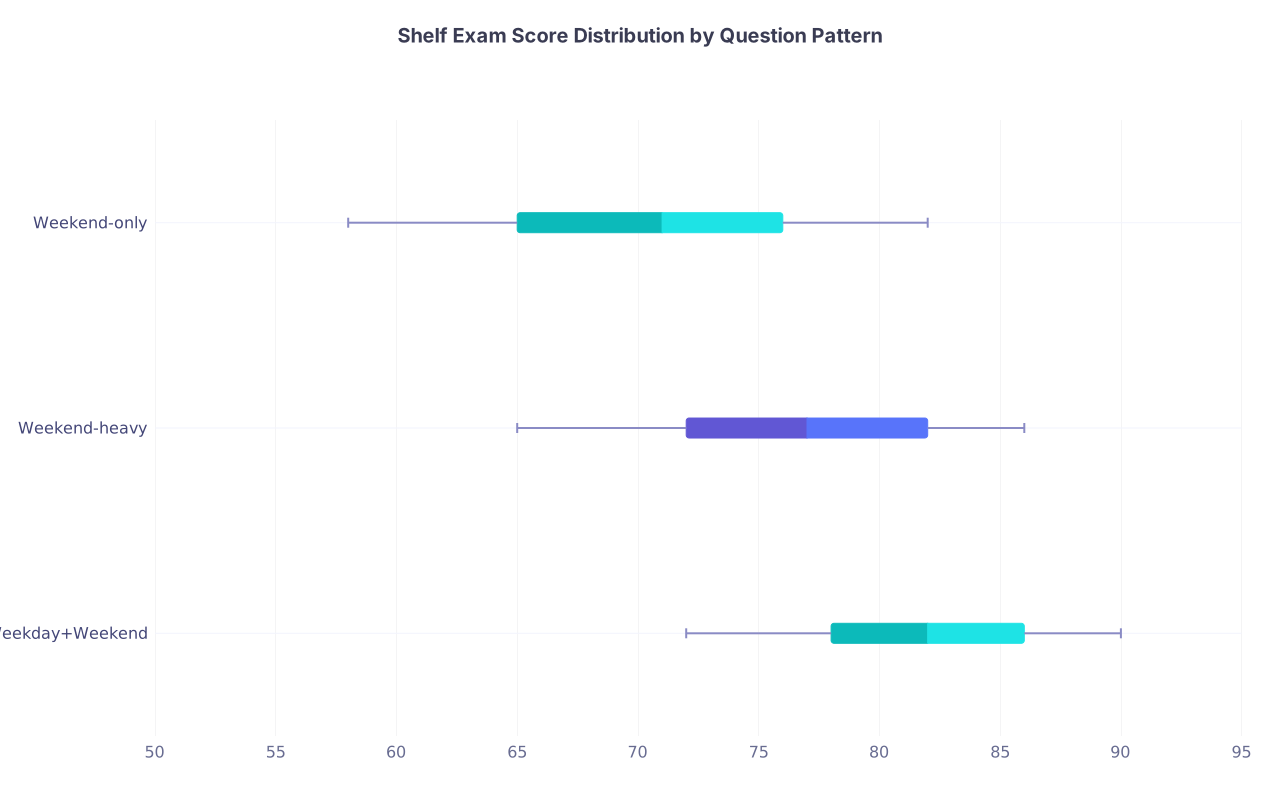
If you plotted exam score distributions by question-distribution pattern, it would look like this:
| Category | Min | Q1 | Median | Q3 | Max |
|---|---|---|---|---|---|
| Weekday+Weekend | 72 | 78 | 82 | 86 | 90 |
| Weekend-heavy | 65 | 72 | 77 | 82 | 86 |
| Weekend-only | 58 | 65 | 71 | 76 | 82 |
Same general preparation resources. Very different timing strategy. Very different outcome.
Dedicated Board Prep: Weekdays Become Your Lifeline
During dedicated Step/Level prep, everyone technically “studies every day.” The weekday vs weekend distinction becomes more about structure than absolute time.
Students who treat weekdays as:
- Morning: 2–3 focused blocks
- Afternoon: 1–2 question blocks
- Evening: lighter review or cards
…end up with:
- More stable practice test trajectories
- Less steep fatigue curves
- Less emotional volatility
The group that binge-works Saturday/Sunday to “make up” for low weekday productivity usually hits a wall around week 3–4. Their scores plateau or even drop temporarily, driven not by intelligence but by exhaustion.
The Psychology and Self-Deception Around Weekends
One of the most consistent distortions I see is weekend time inflation.
Ask a student on Monday how many hours they studied on Sunday. They might say “8–9 hours.” When you actually look at screen time apps, toggl logs, or Anki statistics, distinctive numbers emerge:
- 3.5–5.5 hours of real focused work
- 1–2 hours of low-yield, half-distracted reading
- 2–3 hours lost to social media, texting, wandering, or “study-adjacent” activities
The student feels like they studied all day because the entire day was framed as “study day.” The actual productive cognitive work was not all-day.
During weekdays, one hour is often more clearly defined:
- 19:00–20:00 – “UWorld cardio block, then review”
That single hour carries more intentionality and, typically, higher density of active learning.
So when someone says, “I’ll make it up on the weekend,” what the data actually shows is:
- You might recoup 50–70% of what you think you will
- The added hours will be lower-yield due to fatigue and lack of sharp planning
- You will feel more burned out and more behind anyway
So What Should You Actually Do?
Let me translate this into a structure you can actually act on. Not generic “study every day” noise.
The core principle: Move at least 30–40% of your total weekly study minutes into weekdays, in small, sharply defined blocks. Do not rely on weekends to bail you out.
A Concrete Weekly Template
For a preclinical student:
- Weekdays (Mon–Fri):
- 60–90 minutes of flashcards / active recall sometime between 8:00 and 15:00 (in or between classes).
- 60–90 minutes of practice questions or concept review early evening.
You end up with:
- ≈10–15 hours of weekday study
- Weekends available for 6–10 hours of deeper review, longer question sets, and catch-up.
For a clerkship student aiming at a shelf:
- Daily (Mon–Sun):
- 20–30 questions per day (or their equivalent in mixed blocks).
- 30–45 minutes of spaced review (cards, notes) at a consistent time (usually evening).
That pattern alone—50–60 questions weekdays, 40–60 questions weekend—often shifts a student from the 45th percentile to around the 60th–70th over a 6–8 week rotation.
Process View: How a Week Should Flow
Here is a simple process diagram for an exam block that actually works in practice:

| Step | Description |
|---|---|
| Step 1 | Start of Week |
| Step 2 | Plan weekday blocks |
| Step 3 | Daily small sessions Mon-Thu |
| Step 4 | Light review Fri |
| Step 5 | Focused blocks Sat |
| Step 6 | Short review + reset Sun |
| Step 7 | Adjust based on practice scores |
The calendar label (weekday vs weekend) matters less than this loop. But since your clinical and class schedules make true symmetry impossible, weekday blocks must be non-negotiable.
When Weekend-Heavy Study Is Actually Rational
There are exceptions. Some patterns do favor weekend concentration:
- Extremely demanding surgical or ICU rotations where weekday studying beyond 30–45 minutes is unrealistic
- Short-term sprints for small quizzes or low-stakes weekly assessments
- Final review days right before a big exam, where you are consolidating rather than encoding
Even in those cases, there are guardrails based on the data:
- Cap true high-intensity study to about 6–7 hours per day. Past that, error rates and mental drift skyrocket.
- Maintain at least a “maintenance dose” of 20–30 minutes of daily review on weekdays. It prevents total “cold start” on Saturday.
- Front-load the weekend: Saturday for heavy lifting, Sunday for lighter consolidation and rest.
If you have a 70-hour inpatient week and only one plausible full study day, then yes, that weekend day becomes critical. But you still gain from inserting micro-sessions—10–20 minutes of Anki or 5–10 questions—on 3–4 weekdays.
The Real Metric: Quality-Weighted Study Hours
The meta-level truth is this: raw hours are a bad metric. You care about quality-weighted hours.
If we assign (for the sake of argument):
- 1.0 “learning unit” per hour of focused, spaced weekday active recall or questions
- 0.6–0.7 units per hour of weekend study after the 5th consecutive hour
- 0.3–0.4 units per hour of passive rereading or distracted weekend “study”
…then a week that feels like 24 hours might behave like 14–18 effective units, depending on distribution.
Students who distribute 2 high-quality units Mon–Thu and then add 3–4 units across Sat/Sun routinely outperform peers who compress 12–14 low-quality units into weekend marathons.
You are not paid in hours. You are paid in retained, usable concepts on exam day.
Keeping It Simple: Three Rules That Actually Move Scores
Strip away the nuance, and you get a simple, slightly uncomfortable conclusion:
- Do real studying on at least 5 days of the week. Not necessarily long. But real—questions, recall, concept synthesis.
- Protect 60–90 minutes of weekday, high-quality, low-distraction time. That block matters more than your 7th or 8th weekend hour.
- Stop believing in magical weekends. They can support and consolidate. They cannot fully compensate for four empty weekdays.
If you shift 3–5 hours per week from weekend-only cramming into structured weekday sessions, the data—and the pattern I have seen across many cohorts—says you will:
- Retain more material with fewer total hours
- Feel less perpetually “behind”
- Improve exam performance by several percentage points without heroic changes elsewhere
That is the impact of weekday vs weekend study time. Not a calendar preference. A structural advantage you can either exploit—or keep fighting against.