
The official clerkship grading criteria you’ve seen in the syllabus is only half the story. Sometimes it is barely a third.
Let me tell you what really happens when clerkship directors and attendings decide who gets Honors.
The Myth of “Objective” Clerkship Honors
On paper, honors decisions look clean. Numeric evaluations. Shelf score cutoffs. Professionalism checkboxes. A tidy formula that churns out a fair grade.
Behind closed doors, that’s not how it works.
I’ve sat in those meetings. I’ve heard the phrases:
- “Yeah, but would you trust her on call alone?”
- “He’s great when someone is watching. Less so when you are not.”
- “She’s smart but exhausting.”
- “Solid, but not a ‘top-of-the-class’ student.”
None of that appears anywhere in your grading rubric. But it absolutely affects whether you walk away with Honors or High Pass.
Programs like to put a formula on the website, but most clerkships still have one thing you can’t standardize: human beings deciding your fate. And those human beings use patterns, shortcuts, and unspoken criteria because they are evaluating dozens of students while also trying to run a service.
That’s what we’re going to unpack.
The Real Shortlist: What Directors Privately Look For
Honor students do not just “perform well.” They hit a set of informal marks that faculty instinctively recognize. Let’s walk through those the way a director actually thinks about them.
1. “Would I Want This Person as My Intern?”
This is the single most powerful hidden criterion. I’ve heard it at every major academic center I’ve worked with—IM, surgery, OB, peds, psych, you name it.
When your evaluations get summarized, someone—director, site lead, or core faculty—asks, explicitly or implicitly:
“If this student showed up as my intern in July, would I be relieved… or worried?”
Relieved = Honors.
Comfortable but not excited = High Pass.
Worried = Pass.
They’re not thinking about your UWorld stats. They’re picturing:
- Can you be trusted to follow through?
- Will you freak out when things get busy?
- Are you going to make nurses’ lives harder or easier?
- Will I have to babysit you?
So what triggers the “yes, I’d want them as my intern” reaction?
Not brilliance. Not being the loudest on rounds. It’s a tight bundle of reliability, judgment, and interpersonal stability.
The students who get Honors consistently:
- Close the loop without being told twice. You say, “Follow up on that potassium and let me know,” and they actually do it. Every time. No chasing.
- Don’t disappear. If they step away to see a patient, go to the bathroom, or grab a snack, they tell someone. Their absence never becomes a problem.
- Handle mild chaos without drama. A busy floor, a late OR, a cranky attending—and they just keep working.
I’ve watched directors decide between two students with identical comments and shelf scores. The tiebreaker? “If something went sideways at 2 a.m., who do I want getting that first page?” That’s the honors student.
2. The “Cognitive Load” Test
Faculty do not phrase it this way, but this is what they feel: How much mental effort does it take to have you on the team?
Some students reduce cognitive load. Others add to it.
An honors student makes the day run smoother:
- They anticipate: printing lists, pre-charting key labs, knowing when family meetings are happening.
- They don’t need the same instruction five times.
- They write notes that don’t require total rewrites.
- They don’t bring drama, personal chaos, or constant anxiety into the room.
The student who is always slightly behind, slightly confused, slightly needy—even if they’re “nice” and “trying hard”—forces the resident and attending to spend extra energy managing them. That’s the difference between, “Great to have on the team” and “Fine, but not someone I’d fight for.”
And here’s the part students rarely hear: a single “high-maintenance” comment in your evals will quietly kill an Honors, even if everything else is glowing.
3. The “Trajectory” Pattern: Week 1 vs Week 4
Clerkships care more about your slope than your starting point.
I’ve seen an awkward, quiet student who stumbled for the first two weeks still get Honors because their improvement was obvious and undeniable. And I’ve seen a strong week-one superstar stagnate and end up with High Pass because they plateaued.
Faculty and residents notice:
- Did you incorporate feedback from last week’s mini-lecture?
- Are your presentations tighter, more focused, less rambling?
- Did you start formulating your own plans instead of just reporting data?
- When someone corrected something on Monday, did you repeat the same mistake on Thursday?
Behind the scenes, directors read through narrative comments not just for adjectives, but for time words: “by the end,” “over the course,” “initially… but later,” “rapidly improved.”
Those “arc” phrases are gold. They tell the director, “This student learns fast and applies feedback.” That’s an honors trait everywhere.
If your evals sound static—“good student, solid knowledge, pleasant”—with no sense of an upward curve, you’ve made your life harder. You want your evaluators to feel compelled to write, “I saw real growth.”
4. Who They Trust to Represent the Service
There’s an unspoken hierarchy: which student gets sent to talk to a consultant, a family, or present to a subspecialist.
On busy inpatient rotations, I’ve heard this exact line more times than I can count: “Send [Student X]. They’ll make us look good.”
That’s an honors signal. When the team trusts you as the “face” of the service, the evaluations reflect it—sometimes not explicitly, but in tone. Even one or two lines like “Excellent ambassador for our team” carry disproportionate weight.
Here’s what gets you there:
- You communicate clearly and succinctly. Consultants do not dread talking to you.
- You don’t overstate things. You know when to say, “I’m the medical student, I’m not sure, but I can find out.”
- Families relax when they talk to you. You’re not robotic, you’re not flustered, you’re not cold.
Clerkship directors know which comments mean, “We trusted this student with real responsibilities” versus “We let them tag along and present vitals.”
That difference is usually the line between High Pass and Honors.
5. The Political Variable No One Talks About
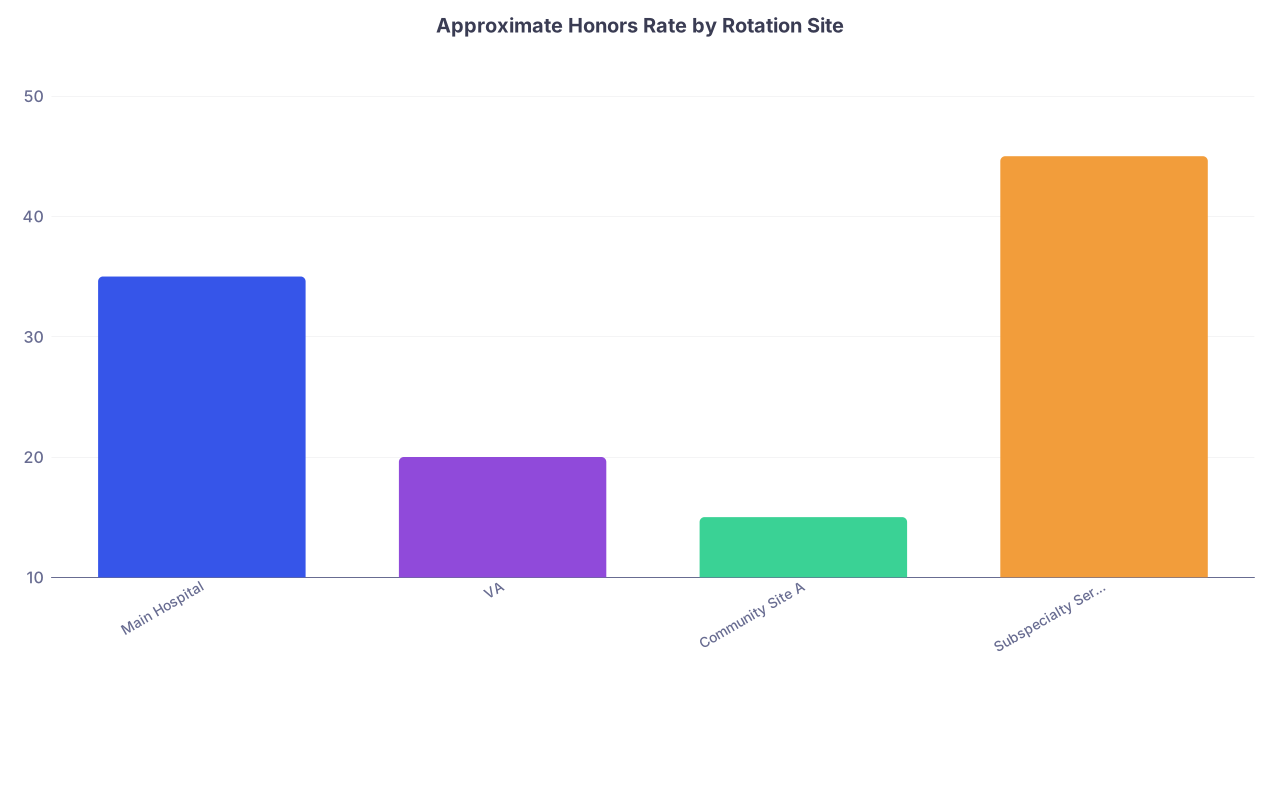
I’ll say it because most people will not: not all rotations, sites, or faculty give out Honors at the same rate, no matter what the official policy is.
There are “high-grade” sites and “stingy” sites. Director knows it. Residents know it. You usually find out too late.
| Category | Value |
|---|---|
| Main Hospital | 35 |
| VA | 20 |
| Community Site A | 15 |
| Subspecialty Service | 45 |
This is the quiet truth of many schools: a main academic site might hand out ~30–40% Honors in a given block, while a community site attending thinks “Honors should be rare” and gives 1–2 per year.
How do directors handle that disparity? They “normalize” in their heads.
I’ve seen this play out in grading meetings:
- “She got High Pass at the community site, which is basically Honors there.”
- “He got Honors at [easy site], but the comments aren’t as strong. I’m not impressed.”
- “The VA is tough this year; their High Passes are solid.”
So no, a High Pass is not always equivalent across sites. And yes, directors implicitly adjust based on who evaluated you and where.
If your school has known variability between sites, students usually have an underground map of this. Ask upperclassmen who rotated recently. Not about “which site is chill,” but: “Where do people actually get Honors?” and “Who writes detailed evals versus one-liners?”
The Specific Hidden Behaviors Attendings Reward (and Punish)
Let’s drill down to daily behaviors. What actually flips an evaluation box from High Pass to Honors?
The Honors-Level Kind of Initiative
“Shows initiative” is a cliché on eval forms. But the way attendings use it is specific.
Honor-level initiative looks like:
- You preview tomorrow’s patients the night before, have a basic plan sketched out, and are not caught flat-footed on morning rounds.
- You quietly take ownership of small but essential tasks: keeping the sign-out updated, tracking consult recommendations, knowing when key labs are pending.
- You ask “next step” questions at the right moments: “If these labs are normal, is the next step X or Y?” Not endless, random questions, but targeted ones that show you’re thinking down the road.
What it does NOT look like: barging into workflow, ordering tests without permission, giving families updates way beyond your scope, or trying to “play intern” when nobody trusts you yet.
Directors see comments like:
- “Truly took ownership of her patients”
- “Functioned at the level of an early intern”
- “Needed minimal supervision for student-level tasks”
Those are Honors phrases.
How You Handle Being Wrong
Almost every student will get publicly corrected or gently (or not-so-gently) embarrassed on rounds at some point. That’s not what harms you. How you respond is what faculty remember.
The honors students do three very specific things:
- They don’t argue without data. They might say, “I thought X because of Y—can you help me understand where that reasoning went off?” That’s respectable.
- They correct the error quickly and don’t repeat it. If you call COPD “restrictive” on Monday and again on Friday, that’s fatal.
- They don’t fall apart emotionally. You can be a little flustered. You can be quiet for a few minutes. But you can’t sulk for two days.
Faculty talk. “He got flustered once or twice but bounced back and really improved” leads to Honors. “She shut down every time she was corrected” leads to High Pass or worse.
The Invisible Professionalism Tally
Most schools claim professionalism is pass/fail. On clerkships, it isn’t. It bleeds into whether someone thinks you deserve Honors.
Here are the tiny infractions that never show up as “professionalism violations” but absolutely sink honors:
- Chronic small lateness. Not 30 minutes. 4–7 minutes. Repeatedly.
- Phone use. Glancing at your phone during rounds, even “just once,” across a rotation adds up in people’s minds.
- Complaining about being there. You think you’re being funny. Residents hear, “I’d rather be home.” They remember.
- Bailing at the earliest possible minute every single day without ever asking, “Anything I can help with before I head out?”
Nobody writes, “Docked a grade for 6 minutes of lateness.” Instead they write, “Good student, but reliability and commitment were average.” That “average” kills the honors argument. Directors are looking for “outstanding,” “exceptional,” “clearly above level.”
How Shelf and “Objective” Pieces Really Fit In
The shelf exam is the one part students think is purely objective. It isn’t, in practice.
Here’s the vendor truth from the other side of the clerkship office:
- Many schools set an internal “honors-eligible” threshold. Anything below that and the grade is capped at High Pass, no matter how stellar your evals are.
- Above that threshold, it stops being binary and starts being shading. A monster shelf score can rescue slightly weaker evaluations. A barely-passing shelf will not tank outstanding evaluations at all schools, but it will make directors hesitate.
| Component | Weight (Real-World) |
|---|---|
| Clinical Evaluations | 60–70% |
| Shelf Exam | 20–30% |
| OSCE/Assignments | 5–10% |
| Professionalism | Modifier (up/down) |
What directors actually do:
- If your clinical evals are lukewarm and your shelf is mediocre: High Pass at best.
- If your clinical evals are glowing and your shelf is in the “honors-eligible” band: they fight to give you Honors.
- If your clinical evals are glowing and your shelf is weak-but-passing: some directors will still give Honors; others will justify a High Pass. This is very school- and director-dependent.
I’ve sat in those panels where someone says, “Yes, but are we comfortable calling this an ‘honors’ level of knowledge?” when a shelf score is borderline. If two faculty in the room hesitate, the student gets High Pass even with stellar comments.
So yes, the shelf matters. But it is the tie-breaker and gatekeeper, not the whole game.
How Directors Read Your Evaluations (Not How You Think)
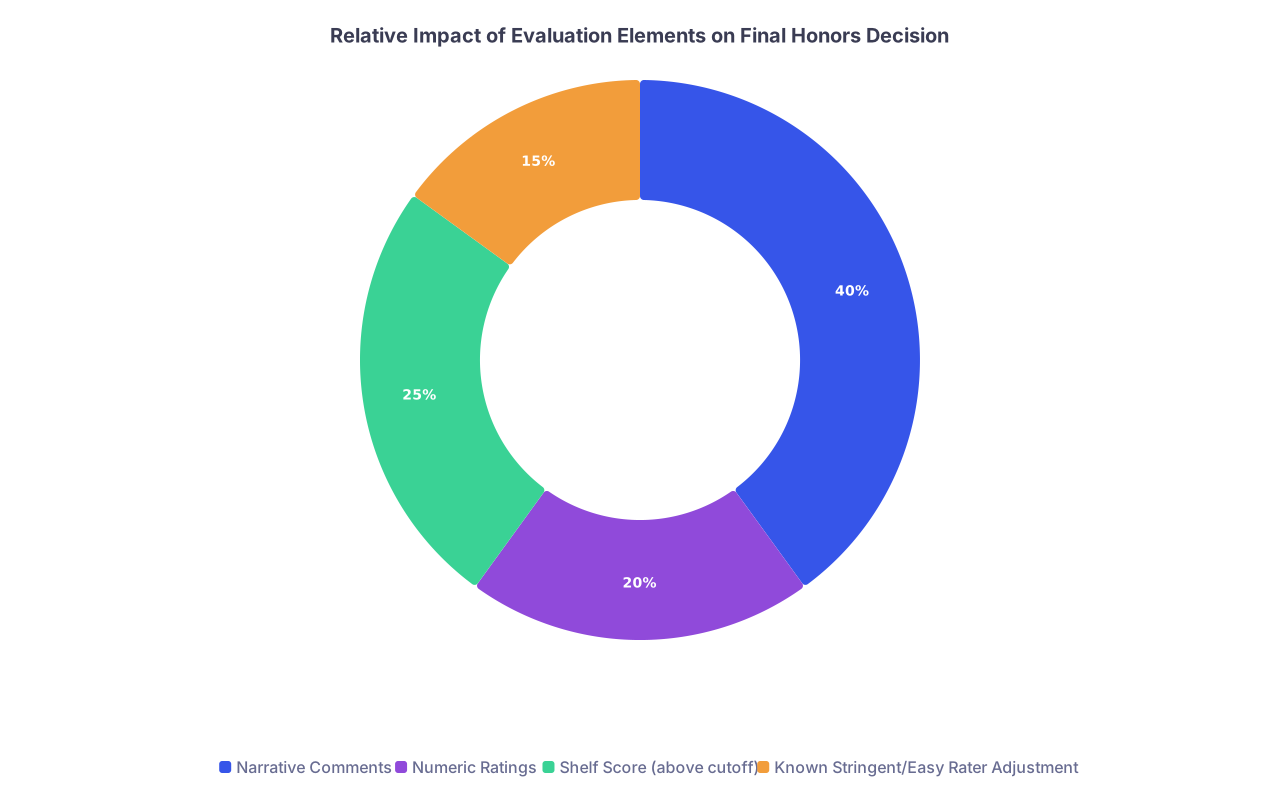
Students obsess over numeric ratings—“4.6 vs 4.8 out of 5.” Directors do not care that much about micro-variation in numbers. They scan first for patterns and phrases.
Here’s the mental algorithm I’ve seen over and over:
- Are there any red flags? Anything about professionalism, reliability, “concerns,” or “difficult interactions”? One serious negative can drop you a full grade band.
- Is there strong, consistent language? “Outstanding, exceptional, top 5–10%” across several evaluators? That sets the baseline to “probably Honors.”
- Are the comments generic or specific? “Hardworking and pleasant” means nothing. “Pre-rounded thoroughly, consistently followed up on tasks, and improved dramatically in her assessment skills” means a lot.
- Are the comments time-limited outliers? A rough first week with one negative comment may be discounted if everything else is stellar and later dated. Or it may not be, depending on the director’s philosophy.
| Category | Value |
|---|---|
| Narrative Comments | 40 |
| Numeric Ratings | 20 |
| Shelf Score (above cutoff) | 25 |
| Known Stringent/Easy Rater Adjustment | 15 |
Here’s the part you never see: directors know which attendings are harsh, which are generous, and which write lazy comments. I’ve watched a director literally say, “Ignore Dr. X’s numeric scores, they always underrate. Read the comments instead.”
If a known “tough grader” calls you “above average,” that may carry more weight than a glowing “best student ever” from an attending who calls everyone “best student ever.”
The Student Archetypes That Get Honors (and the Ones Who Don’t)
You’ll recognize these people from your own class.
The Quiet Assassin
Not flashy. Doesn’t talk constantly. Not the gunner stereotype.
Shows up early. Knows their patients cold. Notices details the team forgets. Residents trust them without thinking about it. Attendings realize halfway through, “This student hasn’t dropped a single ball all month.”
Narrative comments: “Consistently reliable,” “Outstanding ownership,” “Functioned like a sub-I by the end.”
Directors love this type. Honors almost every time.
The Charismatic Underprepared
Great on rounds. Charming. Liked by everyone. Jokes with the team.
But under the surface? Missed abnormal labs. Half-read notes. Shaky knowledge. The consult note disagrees with half their plan.
Residents will phrase it diplomatically: “Great with patients, but knowledge and follow-through are still developing.” Attendings feel uneasy: “I’d like to see more depth.”
This student thinks they’re a lock for Honors. They often get High Pass. They’re shocked.
The Technically Brilliant, Socially Draining
Scores high on everything. Crushes shelf. Knows obscure articles.
Also corrects residents publicly, challenges attendings in the wrong way, or radiates constant tension. Nurses roll their eyes behind their back. Families find them cold or condescending.
I’ve sat in discussions where a director says, “Objectively top of the class, but every comment mentions how difficult they were to work with.” That’s a very fast way to get High Pass instead of Honors.
Clerkships are not just testing knowledge. They’re testing whether people can imagine working with you at 3 a.m. for a month without hating it.
The Late Bloomer
Rough start. Struggles in the first week or two. But you can see the effort. They come back with improved presentations, better notes, more thoughtful questions. Residents notice. “She really turned it around.”
If the rotation is long enough (IM, surgery), this student can absolutely still get Honors, especially if the director values growth. But on short rotations (2 weeks, 3 weeks), there just may not be enough time to recover. Timing matters.
How to Game This System Without Being Gross About It
You can’t control everything. You can’t control site assignment, attending style, or how generous your chief resident is with praise.
But you can tilt the board.

| Step | Description |
|---|---|
| Step 1 | Start of Rotation |
| Step 2 | Ask Expectations Directly |
| Step 3 | Identify Key Residents/Attendings |
| Step 4 | Demonstrate Reliability First Week |
| Step 5 | Seek Specific Feedback Week 2 |
| Step 6 | Adjust Behaviors Based on Feedback |
| Step 7 | Take Ownership of 1-2 Patients |
| Step 8 | Ask for Summative Feedback Final Week |
There are a few moves that consistently show up in the evals of honors students:
- Early clarity: In the first 1–2 days, they ask, “What does an honors student look like to you on this rotation?” Most attendings give away their hidden grading criteria when you ask this directly.
- Visible improvement: They ask for specific feedback in week 2 and then make sure the person who gave it can see they applied it.
- Clean follow-through: They never, ever, ever drop an assigned task without telling someone. If something will be late or impossible, they communicate before it becomes a problem.
- Appropriate independence: By the second half of the rotation, they are suggesting plans, not just reciting data. Not recklessly, but enough to show they’re thinking like a clinician.
And yes, they document. Honors-level students discreetly keep track of:
- Who saw them do what.
- Which attendings watched them present.
- Which residents can speak to their growth.
So when they ask for a letter or need someone to advocate for them in grading meetings, they’re not relying on the one attending who barely interacted with them.
The Part No One Tells You Until It’s Too Late
Clerkship honors are not a pure referendum on your worth as a future physician. I’ve seen phenomenal residents who were “High Pass machines” in med school because they were slow to mature clinically, got unlucky with attendings, or simply didn’t know these invisible rules.
But pretend the game doesn’t exist and you’ll keep losing to people who do.
The ugly truth: by the time most students figure this out, they’re halfway through third year and their transcript is already locked in a pattern. A long streak of High Pass and a couple Honors, instead of the reverse.
If you’re early in your clinical years, you’re actually in a good spot. You can still adjust. You can still deliberately cultivate the specific behaviors that clerkship directors quietly reward and avoid the ones they quietly punish.
Your next move? Pay attention on your very next rotation. Listen for phrases your residents and attendings use about “great students.” Watch who they trust with more responsibility. Notice which of your classmates always seem to get asked to follow up on important tasks.
Then reverse engineer it.
You’re not just learning medicine now. You’re learning how the people in charge decide who “deserves” to advance. Crack that code early, and when it comes time for sub-Is, letters, and residency applications, you’ll already look like the person they’re picturing when they say:
“That’s the kind of student I want as my intern.”
With that foundation, you’ll be in a very different position when you hit sub-internships and audition rotations. That’s where this hidden grading system gets even sharper—but that’s a story for another day.