

The worst mistake in your final month of med school is thinking you’re “basically an intern already.” You’re not. But you can get dangerously close in 30 days.
Here’s your month-by-month, week-by-week, day-by-day game plan to sharpen the exact skills that will make your first weeks of internship survivable instead of humiliating.
Big Picture: What This Final Month Is Actually For
At this point, your goal isn’t “to learn everything.” That ship sailed years ago.
Your final 4 weeks should do three things only:
- Make you safe.
- Make you fast at the basics.
- Make you low-maintenance for your seniors.
Everything else is optional.
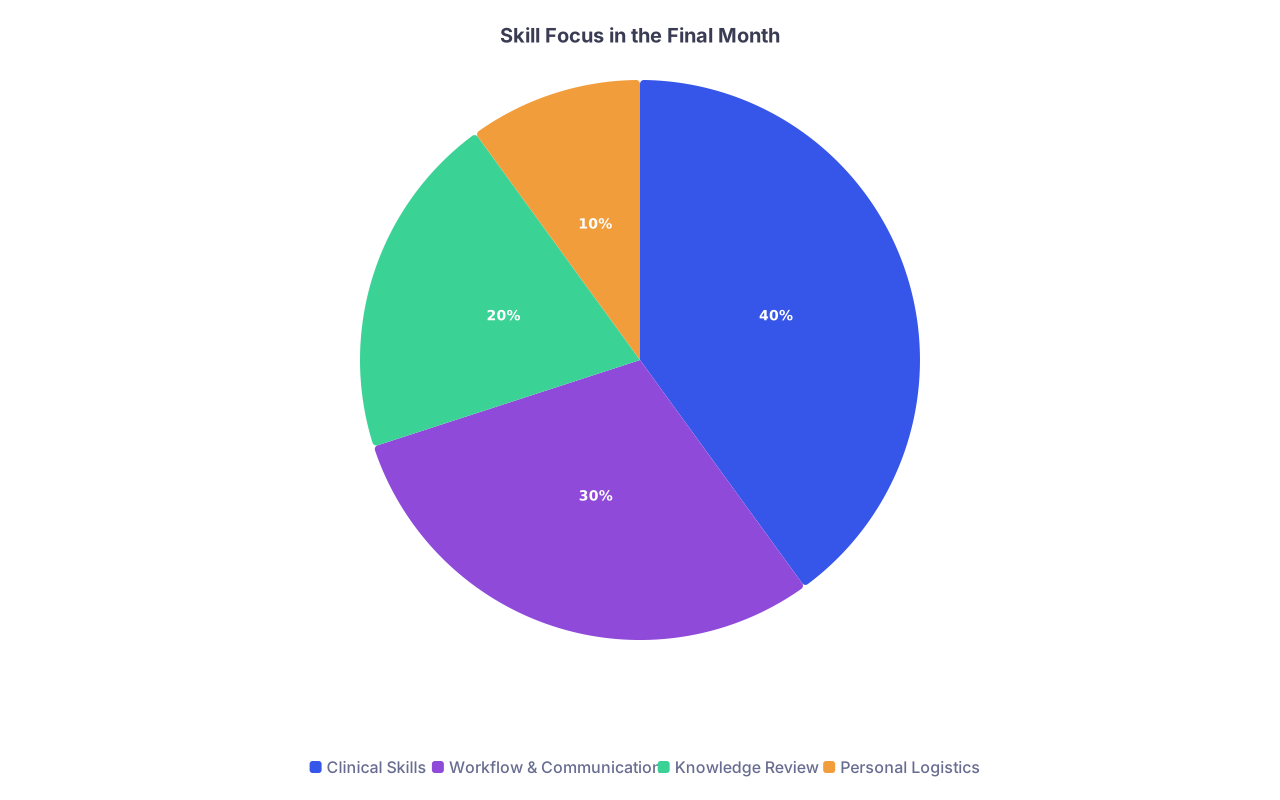
| Category | Value |
|---|---|
| Clinical Skills | 40 |
| Workflow & Communication | 30 |
| Knowledge Review | 20 |
| Personal Logistics | 10 |
If what you’re doing does not improve one of those four buckets, you’re procrastinating.
Week-by-Week Roadmap: The Final 4 Weeks
Week 4 Before Internship: Pick Your Battlefield and Tighten Your Foundation
At this point you should: choose where you’ll spend your last month. Intentionally.
If you can control your schedule, your ideal final rotation is:
- In your matched specialty or
- On a general medicine or ED service with high volume and lots of notes and pages
If you’re stuck on something random (derm, radiology), fine. But you’ll need to counterbalance outside of work hours.
Core skills to sharpen this week (Foundation Week):
- Writing clean, intern-level notes
- Presenting on rounds in 3 minutes or less
- Running a basic admission without hand-holding
Day 1–2: Audit Your Current Skill Level
Take one evening and be brutally honest. I’ve watched too many new interns crash because they never did this.
Make four columns on a page: “Comfortable / Clunky / Weak / Clueless.”
Run through these:
- Admit a chest pain patient
- Admit a CHF exacerbation
- Admit COPD exacerbation or pneumonia
- Admit DKA or hyperglycemia
- Admit sepsis / fever unknown origin
- Admit failure to thrive / elderly delirium
- Write a discharge summary
- Call a consult
- Put in admission orders
- Answer a nurse page about:
- Pain control
- Hypertension
- Hypotension
- Tachycardia
- Low urine output
- Hypoglycemia
- Low potassium/magnesium
Put each one in the right column. No ego.
By midweek 4 you should have a target list: 8–10 things you will fix over the next month.
Day 3–5: Start the “Intern Reps” Habit
Every single shift this week, force yourself to do intern-level work on at least 2–3 patients, even if you’re “just the student.”
For each of those patients you should:
- Pre-chart in the EMR like you’re admitting them
- Write a full H&P or progress note (even if not required)
- Draft orders in a Word/Notes file: fluids, meds, monitoring, labs
- Prepare a 3-minute presentation like you’ll be the one speaking to the attending
Then compare your plan to:
- The actual intern’s orders
- The senior’s comments
- The attending’s decisions
Ask explicitly:
- “What would you change in my admission orders?”
- “What’s missing from this progress note for intern level?”
- “If I presented like this as an intern, what would annoy you?”
At this point you should be hearing feedback that includes the words “intern-level,” “safe,” and “concise.” If no one is using those words, keep pushing.
Weekend of Week 4: Build Your Mini-Reference System
Stop pretending you’ll “just remember” everything in July. You won’t.
One afternoon this weekend, make your personal quick-reference:
Choose a format:
- Notes app on your phone
- OneNote/Notion page
- Small pocket notebook (yes, paper still works)
Create sections:
- Admissions: Chest pain, CHF, COPD/pneumonia, DKA, sepsis, GI bleed, AKI
- Orders: Common maintenance orders, DVT prophylaxis, diet, monitoring
- Emergency responses: Hypotension, chest pain, hypoxia, mental status changes
- Phone phrases: How to call consults, how to talk to nurses, “accepting” pages
- Dosing cheats: Common meds in your specialty (heparin, insulin, abx, pain meds)
Fill each with:
- Admission checklist (2–6 bullets, not essays)
- Starter order sets or med examples
- “Don’t forget” labs or consults
This shouldn’t be pretty. It should be brutally usable.
By Monday, you should have something you can pull out during a code brown at 3 a.m.
Week 3 Before Internship: Double Down on Core Clinical Skills
At this point you should act like an intern trainee, not a student on vacation.
Physical Exam & Bedside Skills
Most new interns are either too slow or too superficial. Fix both.
This week:
On every patient you see, perform and say out loud in your head a structured, targeted exam:
- General: sick vs not sick
- Heart: rate, rhythm, murmurs, JVP (even if you’re bad at it)
- Lungs: effort, wheezes vs crackles vs rhonchi
- Abdomen: tenderness, guarding, rebound, distention, bowel sounds
- Extremities: edema, pulses, calf tenderness
- Neuro: A&O x3, pupils, strength, face symmetry, speech
Time yourself. You should get a solid focused exam down to 3–5 minutes per patient.
One evening, grab a co-student or friend and do:
- A full mock neuro exam
- A full focused MSK exam for knee, shoulder, back
- A full focused abdominal exam
If you haven’t done a real rectal exam in months, find a senior and say:
“I’m starting internship in a few weeks. Next time there’s a patient where you’re doing a rectal exam, can I observe and then perform one with supervision?”
Uncomfortable but adult. You’re out of runway.

Notes, Orders, and Task Management
This is where interns drown.
Goal by end of Week 3: You can:
- Write a concise progress note in 10 minutes or less
- Draft a full admission H&P in 30 minutes or less
- Create a to-do list for your patients and actually check things off
Each day this week:
- Pick 2–3 patients
- Before rounds, write:
- An intern-style progress note
- A prioritized task list: [ ] follow-up CT, [ ] repeat BMP at 14:00, [ ] touch base with family, [ ] clarify discharge needs with case management
Ask your resident:
- “Can you glance at this note and tell me what would make it intern-ready?”
- “Here’s my to-do list for the day. What am I missing?”
By Friday, someone should be comfortable enough to say,
“Why don’t you write the actual note today, I’ll just co-sign.”
Week 2 Before Internship: Communication & “Adulting” Week
At this point you should stop acting like a shadow and start acting like the point person.
Handling Pages and Phone Calls
This is non-negotiable. I’ve seen fantastic test-takers crumble because a nurse called and they froze.
Each day this week, tell your intern:
- “If you’re okay with it, I’d like to listen in when you return pages and calls, and then start calling back with you listening.”
Start with:
- Calling for outside records
- Calling radiology for test timing
- Calling the lab to clarify weird results
- Calling consults with your intern listening
Use a simple structure for consult calls:
- “Hi, this is [Name], MS4 with the [service].”
- One-liner: “We have a [age] [sex] with [key problem].”
- 3–4 sentence summary.
- Specific question: “We’re wondering if you can help us with [x].”
Log phrases that work in your reference file.
Talking to Nurses Like a Real Teammate
Spend one afternoon/evening doing this the right way:
- Go to the nurse’s station.
- “Hey, I’m [Name], the med student on [service] and starting here as an intern soon. I’m trying to get better at handling pages and routine stuff. When you page me about something, can you tell me what you’d expect an intern to do?”
Then pay attention to:
- How they phrase concerns: “soft pressures,” “a little tachy,” “not acting right”
- What they expect you to check or order without calling a senior
- What truly worries them vs what’s FYI
By end of week 2, you should be able to:
- Handle routine pages: pain, nausea, mild HTN, fever workup, low K/Mg
- Know when to say: “I’m going to talk to my senior and call you back in 5 minutes.”
Personal Logistics & Life Setup
If you skip this, you’ll regret it by day 3 of internship.
This week you should:
- Lock down your:
- Housing and commute route
- Parking or transit pass
- Hospital ID/badge/EMR access timeline
- Prep your:
- Scrubs, white coats, comfortable shoes
- Bag: pen, small notebook, charger, snacks, water bottle
- Schedule:
- Haircut before start date (you’ll delay it forever once you start)
- Any medical/dental appointments
- Banking/direct deposit setup
| Item | When to Complete |
|---|---|
| Housing & commute plan | Week 2 |
| EMR & badge access | Week 2 |
| Scrubs & coats ready | Week 2–1 |
| Health appointments | Week 2 |
| Banking/direct deposit | Week 2 |
If it can be done before you start nights and 28-hour calls, do it now.
Final Week Before Internship: Simulation and Stress-Testing
This is dress rehearsal week. At this point you should stop adding new content and start testing what you’ve already built.
Day 1–2: “Mock Intern” Day
Pick one full day on service.
Tell your resident:
- “Can I run today as if I’m the intern? You obviously supervise everything, but I want to practice being the point person.”
What that means:
- You pre-round on a subset of patients
- You write their progress notes (co-signed)
- You create their to-do lists
- You carry the team phone or pager for low-risk calls (with backup)
- You present them on rounds
Debrief at the end of the day:
- “Where did I slow things down?”
- “What would frustrate you if I did it like this as an actual intern?”
- “What made your day easier that I should keep doing?”
Take notes the same day. Do not trust your July brain to remember.
Day 3–4: Emergency Response Reps
Your first real “oh no” moment as an intern will stay with you. Better to have practiced when it didn’t count.
If your hospital has:
- Simulation center: Book or ask to join any intern bootcamp early.
- Mock codes/rapid responses: Ask if you can shadow or participate as recorder or compressor.
If not, you can still run mental reps.
Each evening, run through 3–4 scenarios in your head, out loud, using a simple framework:
Hypotension page:
- Immediate: ask for vitals, mental status, UOP.
- At bedside: examine, check monitor, IV access, look at last labs.
- Orders you’d consider: bolus? hold BP meds? lactate? CBC/BMP? call senior?
Acute chest pain:
- Ask: vitals, EKG done?, troponin history.
- At bedside: exam, order stat EKG if not done, troponin, nitro if indicated.
Hypoxia:
- Confirm SpO2, check monitor, ask about O2 delivery.
- At bedside: ABCs, listen to lungs, check CXR, ABG/VBG.
Write your “first 3 moves” for each situation in your reference notes.

| Step | Description |
|---|---|
| Step 1 | Page Received |
| Step 2 | Go to Bedside Immediately |
| Step 3 | Ask Clarifying Questions |
| Step 4 | Review Vitals & Recent Labs |
| Step 5 | Go to Bedside |
| Step 6 | ABCs, Call Senior |
| Step 7 | Focused H&P |
| Step 8 | Basic Orders |
| Step 9 | Update Senior |
| Step 10 | Life Threatening? |
Day 5: Knowledge Tightening – Not Cramming
You’re not studying for Step now. You’re studying to not hurt people.
Do a 4–6 hour focused review of:
- Electrolyte management: Na, K, Mg, Ca
- Insulin basics: sliding scale, basal/bolus concepts
- Common antibiotics by syndrome (pneumonia, UTI, skin/soft tissue, intra-abdominal)
- Pain control: Tylenol, NSAIDs, PO vs IV opioids, bowel regimens
- Anticoagulation basics: VTE prophylaxis, bridging concepts
Use:
- Pocket Medicine or a similar handbook
- Your specialty’s basic intern guide if it exists
- Your own quick-reference to fill any gaps
Stop when you’re tired. This is reinforcement, not martyrdom.
Final Weekend: Reset and Rituals
At this point you should pull back and protect your brain.
- One day: completely off. No medicine. No “just one more review.” Your brain needs to hit July with some reserve.
- One day: light prep
- Lay out clothes and bag for day 1
- Review your quick-reference for 30–60 minutes
- Skim your notes from the “mock intern” day
Create your first-day checklist:
- What time you’re leaving the house
- Who you’re meeting and where
- Your password list (securely stored)
- A simple lunch plan
- When you’ll aim to leave if not on call

The goal isn’t to feel “ready.” No one does. The goal is to feel prepared enough that you can focus on patients, not logistics.
Daily Micro-Habits in the Final Month
Thread these through every single day, regardless of week:
One “Intern-Level” Task Per Day
- Write one real note
- Call one consult
- Take ownership of follow-up on one test
One “What Would You Do?” Question
- Ask your senior: “If you were alone at 2 a.m. and this happened, what would you actually do?”
One Bullet Into Your Reference
- Any time you see a pattern (“we always do X for Y”), add it.
-
- On your commute home: what felt clumsy today? What went better than last week?
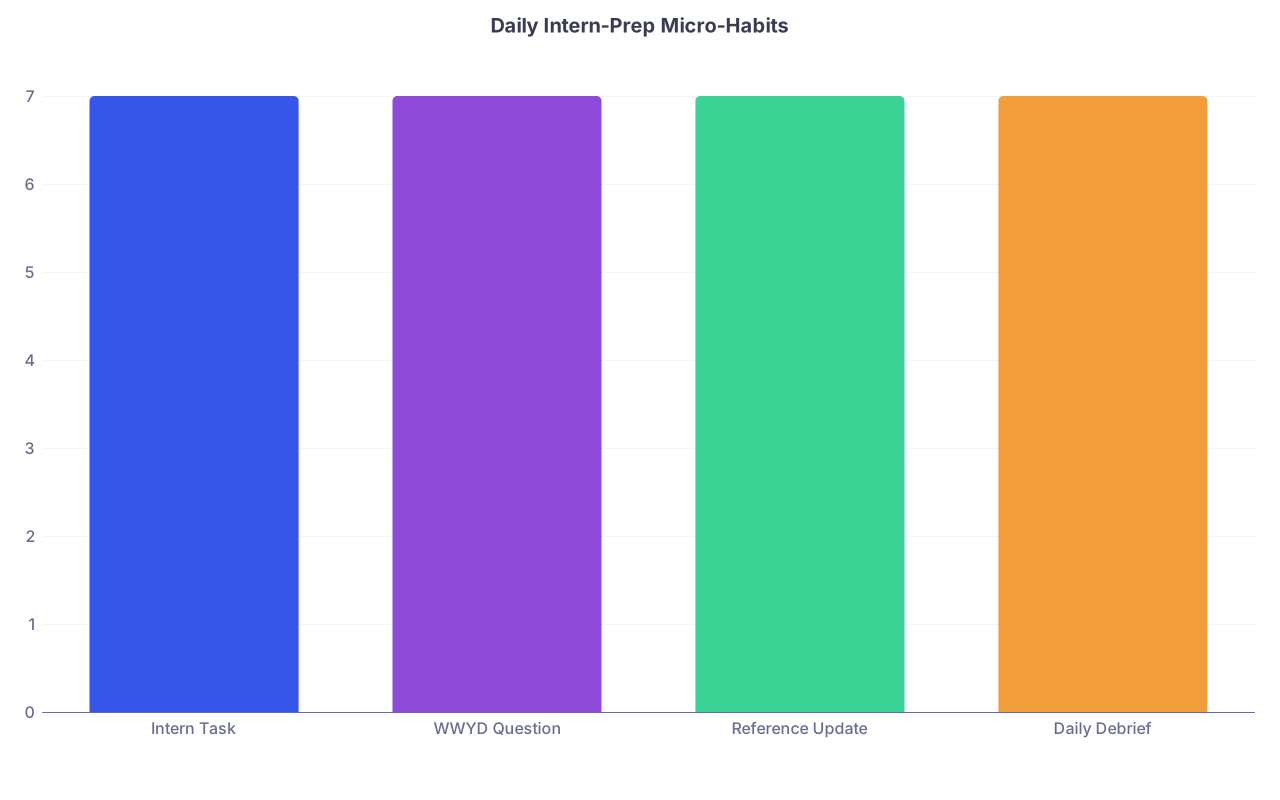
| Category | Value |
|---|---|
| Intern Task | 7 |
| WWYD Question | 7 |
| Reference Update | 7 |
| Daily Debrief | 7 |
Seven days a week? No. But close. Momentum matters more than heroic single days.
What You Should Stop Doing in the Final Month
Cut these, ruthlessly:
- Passive shadowing the resident all day “just to see how they think”
- Reading entire textbook chapters you’ll forget by August
- Over-prepping obscure zebras and ignoring CHF/AKI/COPD
- Saying “I’m just the med student” when a nurse or patient asks you something reasonable
- Staying late to impress people instead of staying with specific learning goals
Replace all of that with:
- Specific reps
- Feedback loops
- Building systems you’ll use in July

FAQ (Exactly 2 Questions)
1. What if my final month rotation is completely unrelated to my matched specialty?
Then your “at this point you should” list shifts after hours. You still show up and do good work on your assigned rotation, but you deliberately run your own side curriculum. That means: 30–60 minutes most evenings on bread-and-butter problems in your specialty, plus building your quick-reference and practicing intern-level notes on any patients you see. You can absolutely be on dermatology and still write medicine-style H&Ps in a private document, draft admission orders based on cases you read, and run mental reps for common floor pages. The rotation context is less important than your daily reps.
2. I feel like I’ve forgotten everything from third year. How much can I realistically fix in one month?
More than you think, if you stop pretending this is about “studying” and treat it like training. One month of focused, daily practice on a short, honest weakness list can transform you from “dangerously rusty” to “solidly safe beginner.” You’re not aiming for mastery. You’re aiming to recognize sick vs not sick, manage basics without panicking, and communicate clearly. Start tonight by writing your four-column audit (Comfortable / Clunky / Weak / Clueless). Then pick exactly two items from the Weak/Clueless columns to attack tomorrow with deliberate practice and feedback.


