

You are on week 2 of your first real inpatient rotation. It is 5:12 AM. You are standing in front of the workroom computer, badge not working on the first tap because of course it does not. Your resident said, “Have presentations ready by 7, we preround quickly, then see them as a team.” You still have three notes from yesterday unfinished in the drafts folder. And someone told you you are “supposed to be reading an hour a day.”
This is where most students crack. Not because the work is impossible, but because the day has no built‑in structure. If you do not create one, the hospital will eat every available minute and you will go home at 8 PM with no studying done and half-finished notes.
So let us build a daily timeline that does three things:
- Protects your studying time.
- Keeps your notes under control.
- Keeps you looking competent in front of the team.
I am going to walk you through a typical day on a general medicine inpatient service. You will adapt the clock times to surgery, peds, OB, whatever. The structure holds.
The Night Before: 15–30 Minutes That Save Your Morning
At this point, it is 9:30–10:30 PM the night before. You are tired. This is exactly when people make the mistake of just collapsing into bed.
Here is what you do instead.
0:00–0:10 (10 minutes): Quick chart review
- Open tomorrow’s list.
- For each of your patients:
- Glance at today’s note or plan.
- Check any overnight studies that were pending (CT, echo, cultures).
- Look at medication list for big changes (new pressors, diuretics, antibiotics).
Goal: Walk in tomorrow with a mental “headline” for each patient. One sentence.
Example: “Mr. Jones – pneumonia improving, now on room air, watching leukocytosis and culture results.”
0:10–0:20 (10 minutes): Micro‑study block
Pick one focused topic that actually applies to your patients.
- CHF admission today? Read 3–5 pages on acute decompensated heart failure management.
- New DKA patient? Skim a DKA protocol and pathophysiology.
- New GI bleed? Review transfusion thresholds and PPI dosing.
15–20 minutes. That is it. If you try to do an hour now, you will burn out in two days.
0:20–0:30 (optional): Pre‑template notes
If your EMR allows:
- Open tomorrow’s progress notes for your patients as drafts.
- Drop in:
- Yesterday’s problem list.
- A skeleton assessment and plan with headings:
- Leave blanks where updated data will go.
You have now pre‑loaded your brain and your notes. You will move faster tomorrow morning.
5:00–7:00 AM: Pre‑rounding and Note Scaffolding
Assume team rounds start at 9:00 AM. Your resident wants your prerounds done by 7:00–7:30. Adjust if your team is earlier or later.
5:00–5:15 AM: Arrive and triage your morning
At this point you should:
- Log in, print or pull up the patient list.
- Star/mark your patients.
- Check for any overnight admits you have been assigned.
Now, do a 30‑second triage per patient:
- Vitals trend (last 24 hours – max temp, blood pressure, O2).
- Telemetry for any overnight arrhythmias (if relevant).
- Nursing notes for “events”: fall, rapid response, restraints, new confusion.
- New imaging results.
As you skim, for each patient type 1–2 bullet points in your note draft under “Overnight events”:
- “No acute events. Afebrile, stable on 2L.”
- “Febrile to 38.5 at 2 AM, HR 110; blood cultures drawn.”
You are not writing prose. You are laying down a skeleton.
5:15–6:15 AM: Pre‑rounding in rooms
Now you move. Literally.
Per patient (5–10 minutes each):
- Knock, introduce yourself (again), focused questions:
- “How was your breathing overnight?”
- “Any chest pain, fevers, chills, nausea, or new pain?”
- “Are you having bowel movements / passing gas?”
- Very focused exam based on their problems:
- CHF? Lung exam, edema, JVP.
- COPD? Lung exam, work of breathing, accessory muscles.
- Cellulitis? Mark borders, check for spread, warmth, pain.
- Check:
- Oxygen device and flow.
- Drips or important infusions if present.
- Drains, Foley, wound vac if relevant.
Middle of pre‑rounding is where students waste time chatting or doing full head‑to‑toe exams on day 9 of the same stable admission. Do not.
Back at a computer after each room, update:
- Subjective: 2–3 sentences max.
- Objective: update vitals, one‑line exam changes.
- Add 1–2 “to do” bullets in the plan you will propose:
- “Wean O2 to maintain SpO2 > 92.”
- “Repeat CBC; consider de‑escalating antibiotics if afebrile and cultures negative.”
You are not writing full paragraphs yet. Just outline.
6:15–6:45 AM: Labs and imaging drop‑in
Labs are often posted by now.
For each patient:
- Look at:
- CBC, BMP, relevant special labs (troponin, BNP, LFTs).
- Micro results.
- Open imaging reports that posted overnight.
Immediately integrate into your draft:
- “WBC down from 16 → 11.”
- “Na improving 126 → 130.”
- “CXR this AM: improved right lower lobe opacity.”
Start a running list of questions at the bottom of your note or on a sticky:
- “Do we continue IV ceftriaxone vs switch to PO?”
- “Clarify duration of anticoagulation.”
- “Ask about PT recommendations for dispo.”
This makes you look engaged during rounds, and it reminds you what to read later.
6:45–7:00 AM: Tighten presentations, not prose
At this point you should:
- Stop editing paragraphs.
- Start rehearsing your oral presentations in your head.
For each patient, prepare:
- One‑line ID and status:
- “Mr. Smith is a 67‑year‑old with COPD and CHF, HD 3 for CAP, clinically improving.”
- Overnight events (30 seconds).
- Focused systems update.
- Assessment and plan by problem.
If your notes are 70% done as an outline, you are on track. You will finish the full notes after rounds.
7:00–9:00 AM: Check‑ins, Teaching, and Rounds
7:00–7:30 AM: Resident check‑in / workroom
Common pattern: your resident wants quick run‑throughs before attending rounds.
At this point you should:
- Give them concise versions of each patient.
- Ask: “Anything specific you want me to focus on when we see them as a team?”
- Clarify disposition and big decisions they are thinking about.
As they talk, add:
- Their key plans to your note drafts (in brief).
- Asterisks next to items you need to look up later.
This is also when:
- Orders may be put in based on morning labs.
- Discharges start brewing.
Protect yourself here: if you are asked to do something time‑consuming (“call the PCP, arrange outpatient sleep study”), write it down and ask, “Is this priority before rounds, or after?” Pin them down.
7:30–9:00 AM: Walking rounds
Rounds will vary, but structure your brain like this:
During each patient’s discussion:
- Track on three channels:
- What is changing in the plan? (Med changes, new tests, consults.)
- What I do not understand and must read about.
- What needs to be added to my note.
On the computer (if at a computer-on-wheels) or on paper:
- Under each problem in your A/P, add or edit the bullet that matches what attending says:
- “Transition IV to PO levofloxacin x total 5 days.”
- “Consult PT for home safety eval.”
- Write a tiny “R” next to any bullet that requires reading later:
- “New afib with RVR – CHADS‑VASc, rate vs rhythm control” → R
Do not try to write full sentences while your attending is talking. That is how you miss the teaching and look lost when they ask a question.
9:00–11:30 AM: Power Note Block + Task Blitz
Here is where most students let the day disintegrate. They answer every page instantly, chat in the workroom, then complain they are staying until 7 PM writing notes.
Your goal: 90–120 minutes of focused note‑writing + core tasks.
9:00–9:15 AM: Prioritize tasks
At this point you should:
- List what absolutely must be done before noon:
- Critical orders that only someone on your team can enter (resident may do that).
- Calls to consultants that affect immediate care.
- Discharge planning tasks.
- Separate:
- “Now” tasks (call cardiology, arrange stat CT).
- “Later today” tasks (PCP fax, set up home oxygen).
Check with your resident: “My plan is to finish all my notes by 11, then do [these tasks]. Anything I should flip in priority?” Most will respect this if you show you are thinking ahead.
9:15–11:15 AM: Notes first, one at a time
This is your main documentation block.
For each note:
- Open your draft with outline.
- Flesh out:
- Subjective: 2–4 sentences.
- Objective: key vitals, exams, only relevant labs/imaging.
- Assessment and plan:
- Problem‑based.
- 2–4 bullets per active problem. Short, direct.
- Link back to what was actually decided on rounds.
Example for pneumonia:
-
- Clinically improving; afebrile, WBC down 16 → 11, oxygen requirement stable.
- Continue IV ceftriaxone + azithromycin, plan transition to PO tomorrow if remains afebrile and cultures negative.
- Incentive spirometry q1h while awake; ambulate TID.
- Daily CBC, monitor for decompensation.
Do not turn this into a textbook paragraph. Your future self (and the resident skimming your note) will thank you.
Hard rule:
Do not open more than 2 notes at once. Complete one, then move on.
If the resident pages you mid‑note:
- Jot where you stopped.
- Handle the issue.
- Come back and finish the same note before checking your phone again.
By 11:15, in a normal census, you should have:
- All progress notes done.
- Maybe one complex note left (sick ICU patient, complex discharge).
If your census is huge, same rule: aim to get most done in this protected block.
11:30 AM–1:30 PM: Noon Conference and Micro‑Study
You will frequently have:
- Noon conference or teaching.
- Short lunch.
- Paging chaos.
11:30–12:00 PM: Task mop‑up before conference
At this point you should:
- Knock out quick, non‑cognitive tasks:
- Call PT/OT back.
- Put in simple orders your resident requested.
- Check on that lab that was “pending” all morning.
Try not to start a new note now. You will get interrupted.
12:00–1:00 PM: Conference = scheduled study block
Do not waste this hour scrolling.
During conference:
- Take actual notes on:
- Management pearls that relate to your patients.
- Algorithms and thresholds (e.g., when to tap an effusion).
- At the bottom of your notebook, keep a “To Review Tonight” line:
- “AKI workup.”
- “Delirium vs dementia features.”
If conference is useless (yes, it happens), turn it into a focused reading time with:
- UWorld questions on topics from your patients.
- A chapter from Step Up / Pocket Medicine / Online resource.
This way, even if your evening explodes, you did 30–45 minutes of studying already.
1:30–4:30 PM: Afternoon Checks, Follow‑ups, and Real‑Time Learning
Afternoons are dangerous. They feel looser and then suddenly it is 5 PM and you have read nothing.
1:30–2:00 PM: Status check on all patients
At this point you should:
- Re‑run your patient list.
- Check for:
- New results (echo read, CT result, updated cultures).
- Nursing concerns or pages awaiting response.
- Progress on consult recs.
Update your running to‑do list by patient.
If anything major changed (new AFib, sudden hypotension), adjust your mental plan and flag it for your resident.
2:00–3:30 PM: “Educational tasks” + case‑based reading
Here is where you strategically blend work and studying.
Pick 1–2 of your patients with interesting or new issues. For each:
Spend 15–20 minutes reading exactly what is relevant:
- New DKA patient: read DKA management including insulin drip protocols, electrolyte replacement.
- New cirrhosis admission: read ascites management, SBP prophylaxis.
- New PE: read risk stratification and anticoagulation choices.
Immediately apply:
- Draft a concise paragraph in your own notes (your personal notebook, not the EMR) summarizing:
- Diagnostic criteria.
- First‑line treatment.
- When to escalate care.
- Use that to tighten your understanding of the plan in the EMR note if needed.
- Draft a concise paragraph in your own notes (your personal notebook, not the EMR) summarizing:
This way, your “studying” is not with some random Qbank topic at 10 PM. It is welded to actual patients.
3:30–4:30 PM: Finish leftover tasks and prep for sign‑out
Use this window to:
- Complete:
- Remaining discharge summaries.
- Any calls that have been delayed.
- Clarify disposition barriers with case management if appropriate.
Start building:
- A short, clear sign‑out on each of your patients for the cross‑cover person:
- “Stable 67‑year‑old with CAP, on 2L NC. Watch for fever >38.5, increasing O2 needs; if so, repeat CXR and draw cultures.”
- “New DKA, insulin drip running per protocol. Next BMP at 20:00.”
You are not responsible for writing the official sign‑out on many services, but drafting it for yourself makes you think clearly and prepares you to present succinctly at end‑of‑day.
4:30–6:30 PM: Wrap‑Up, Reading Triage, and Getting Out
On a sane inpatient service, you should be looking to leave between 5 and 6:30 PM as a student.
4:30–5:00 PM: Final walk‑through and check‑ins
At this point you should:
- Step through each patient quickly in the chart:
- Any late labs? Critical values?
- Imaging finalized?
- Nursing notes with new concerns?
- Touch base with resident:
- “Anything else I can help with before I head out?”
- “Mind if I pre‑chart for tomorrow on [complex patient] now?”
If there is a sick patient, do not run out the door. Common sense. But if things are stable and your work is done, you are not a hero for loitering.
5:00–5:30 PM: Micro‑debrief and “study list”
This is where you protect your evening from chaos.
Before you leave the hospital, open a note on your phone or pocket notebook and write:
- 3–5 items only for today’s studying:
- “DKA insulin transitions.”
- “Hyponatremia types and treatment.”
- “Afib rate vs rhythm control basics.”
Do not make a 20‑item fantasy list. You will ignore it.
If you still have an unfinished note (it happens), tell your resident and finish it now, not at 9 PM from home if your hospital forbids that or if you need patient data.
7:00–10:30 PM: Realistic Evening Study Schedule
You get home. You shower. You eat. Suddenly it is 8:00 PM. Most students now either:
- Doom‑scroll for two hours, or
- Try to start a four‑hour study marathon and fall asleep on page two.
Aim for 60–90 minutes of real work, broken up.
8:00–8:20 PM: Targeted clinical reading (20 minutes)
At this point you should:
- Pick one of the 3–5 items from your list.
- Use:
- A short chapter from Step‑Up to Medicine / Pocket Medicine.
- An UpToDate summary (management sections).
- Take short notes in your own words.
Example: Hyponatremia
- Classify: hypovolemic, euvolemic, hypervolemic.
- Cutoffs: acute vs chronic, severe vs mild.
- When to use hypertonic saline vs fluid restriction.
Do not get stuck following links for an hour.
8:20–8:30 PM: Break
Walk. Stretch. Check messages. Do not start a show you cannot stop.
8:30–9:00 PM: Question block (30 minutes)
Now hit a small set of questions related to shelf prep:
- 5–10 UWorld or AMBOSS questions (internal med, surgery, etc.).
- Focus on:
- reading explanations.
- connecting back to patients you saw.
Write down 1–2 key takeaways per block. That is it.
9:00–9:15 PM: Tomorrow preview (repeat the “night before” block)
Loop back to where we started:
- Quick chart review.
- Check for new admits assigned to you.
- Sketch tomorrow’s focus.
If you are wiped, keep it to 10 minutes.
9:15–10:30 PM: Off
You are done. Really. Sleep is part of the job. Students who pretend they can study until midnight and wake up at 4:30 AM all month unravel by week 3.
Sample Day-at-a-Glance Timeline
| Time | Primary Focus |
|---|---|
| 5:00–7:00 AM | Pre-rounding + note outline |
| 7:00–9:00 AM | Check-in + team rounds |
| 9:00–11:30 AM | Progress notes + key tasks |
| 11:30–1:30 PM | Tasks + conference/study |
| 1:30–4:30 PM | Follow-ups + applied reading |
| 4:30–6:00 PM | Wrap-up + sign-out prep |
Visual: How Your Day’s “Study Minutes” Add Up
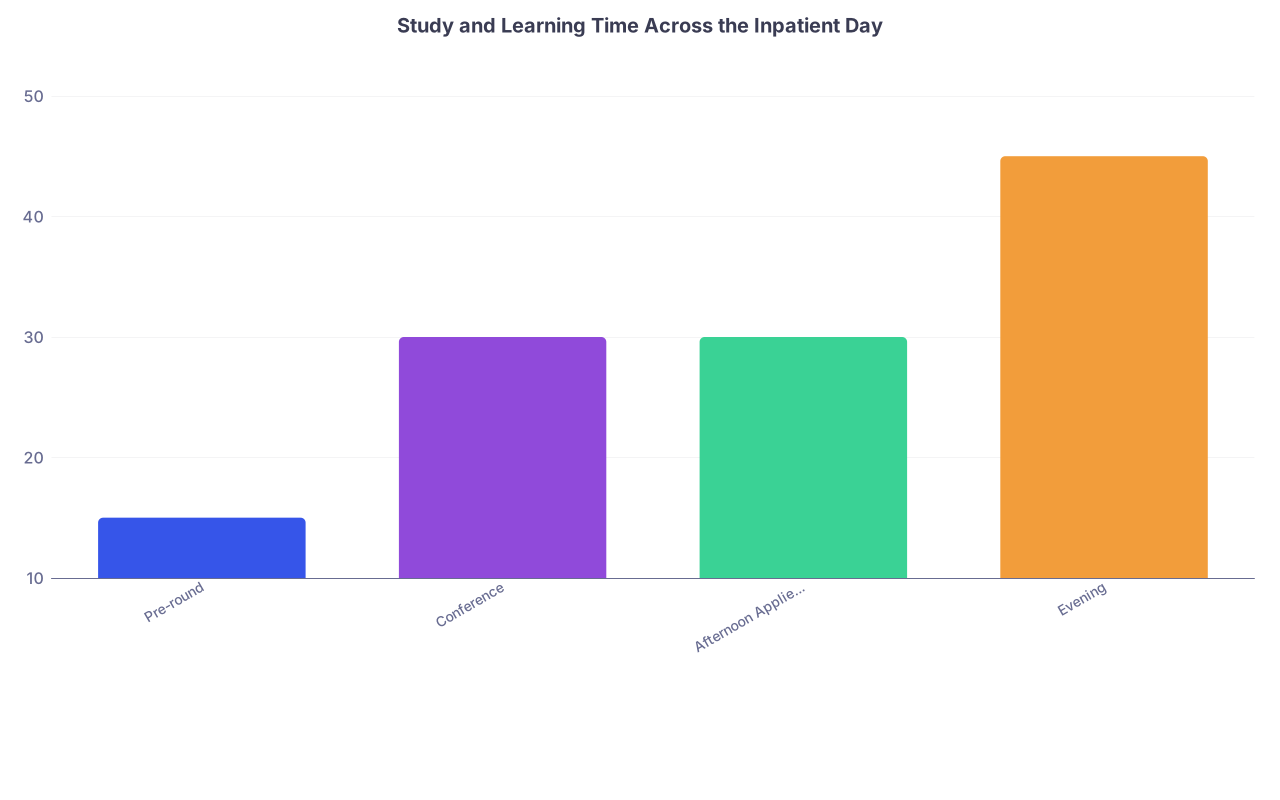
| Category | Value |
|---|---|
| Pre-round | 15 |
| Conference | 30 |
| Afternoon Applied Reading | 30 |
| Evening | 45 |
That is about 2 hours of actual learning, spread out instead of fantasized as a single impossible block.
Putting It All Together: Mental Model of the Day
Here is a simple process view of the inpatient student day:

| Step | Description |
|---|---|
| Step 1 | Arrive 5-6 AM |
| Step 2 | Pre-round & Outline Notes |
| Step 3 | Resident Check-in |
| Step 4 | Team Rounds |
| Step 5 | Focused Note Block |
| Step 6 | Noon Conference & Study |
| Step 7 | Afternoon Tasks & Reading |
| Step 8 | Wrap-up & Sign-out |
| Step 9 | Evening Targeted Study |
| Step 10 | Night-before Prep |
You will not hit this perfectly every day. A crashing patient, late consult, or endless family meeting will blow it up occasionally. Fine. The point is to have a default day so that the abnormal days stay rare.
Three Things to Remember
- Front‑load your documentation. Use 9–11 AM as a protected note block so your afternoons and evenings are for learning, not charting.
- Tie your studying to your patients. Short, focused reading on real cases beats random marathon sessions disconnected from the wards.
- Build and protect small, repeatable habits: 10–20 minutes of night‑before prep, a handful of questions in the evening, and active listening during conference. That is how you balance notes and studying without burning out.


