

The last week before your shelf is not for heroics. It is for controlled execution.
Most students blow this week by doing “a bit of everything” and finishing nothing. Then they walk into the exam with half-baked recall and scattered confidence. You are going to do the opposite: narrow, targeted, and strictly scheduled.
Below is a day-by-day, hour-blocked game plan for the final 7 days before a clerkship shelf (works for IM, Surgery, Peds, OB/GYN, Psych, FM). I will assume:
- You have already been doing some UWorld/AMBOSS.
- You have at least partial Anki decks going.
- Your exam is on Day 7 (Shelf Day).
- You still have clinical duties for at least part of the week.
Adjust volumes up or down, but keep the structure. The structure is what saves you.
Global Rules for the Week
Before we go day-by-day, lock these in. Non‑negotiable.
No new resources.
At this point you should:- Pick 1 main Qbank (UWorld or AMBOSS).
- Pick 1 rapid review text/video (e.g., Step-Up to Medicine, Pestana, Case Files high-yield notes, OnlineMedEd / Divine Intervention style summaries).
- Stick with your existing Anki deck. No new decks.
Question volume > passive reading.
Your ratio should be roughly:- 60–70% active questions
- 20–30% targeted review (explanations, notes)
- 10–20% Anki / flashcards
Timed, exam-style blocks only after Day 2.
Early in the week: mixed but untimed or lightly timed for learning.
By midweek: full timed blocks, mixed topics, real test settings.Protect sleep like it is part of the exam.
7 hours minimum. No exceptions on the last 3 nights.Each night you plan the next day.
5 minutes. On paper or in your notes app:- Number of question blocks
- Topic focus
- Where you will study (and when)
, Anki/Flashcards](https://cdn.residencyadvisor.com/images/articles_svg/chart-study-time-allocation-in-final-week-7347.svg "Study Time Allocation in Final Week")
| Category | Value |
|---|---|
| Qbank Questions | 65 |
| [Review & Notes](https://residencyadvisor.com/resources/med-school-life/note-writing-pitfalls-that-annoy-residents-and-faculty) | 20 |
| Anki/Flashcards | 15 |
Day 1 – Reality Check and Triage (6–8 days before exam)
This is the day you find out where you actually stand. No denial.
Morning: Baseline and Triage
At this point you should:
Do one 40-question mixed block (UWorld or AMBOSS)
- Mode: Tutor (yes, Tutor today).
- Timing: Normal pace but do not rush (you are sampling, not racing).
- Subject Mix: All clerkship-relevant topics mixed.
Score does not matter yet. Pattern does.
- Track your misses by topic, not by question:
- For IM: cardio, pulm, GI, renal, ID, heme/onc, endocrine.
- For Surgery: trauma, peri-op, GI surgery, vascular, postop complications, critical care.
- For Peds: newborn, infectious disease, GI, respiratory, heme/onc, development.
- For OB/GYN: OB complications, normal labor, GYN oncology, contraception, infections.
- For Psych: mood, psychosis, anxiety, substance, emergency, personality.
- Track your misses by topic, not by question:
Create a quick tally sheet.
| Topic | Missed Qs (Block 1) |
|---|---|
| Cardiology | 6 |
| Pulmonology | 3 |
| GI | 5 |
| Renal | 2 |
| Infectious | 4 |
| Endocrine | 1 |
Midday: Target the Worst Offenders
Take your top 2–3 weakest domains. For the next 3–4 hours:
- Do 1–2 focused blocks of 20–25 questions each on those weak topics.
- Mode: Tutor or Timed Tutor.
- After each block: 45–60 minutes reviewing explanations.
While reviewing:
- Write micro-pearls in a single running document or notebook:
- 1–2 lines per missed concept. No essays.
- Example (OB): “PPROM <34 wks + chorio = deliver. No steroids if already infected.”
Late Afternoon / Evening: Clean Up and Commit
- Spend 30–45 minutes on Anki:
- Only cards from your main deck + new cards from today’s missed concepts.
- Spend 30 minutes skimming your chosen rapid review resource on your worst topic from the morning (e.g., cardiology chapter in Step-Up).
End of Day 1 checklist:
- Baseline block done and reviewed
- Weak topics identified and listed
- 40–80 additional topic-focused questions done
- Micro-pearls doc started
- Next day plan written
Day 2 – Solidifying Foundations, Still Focused
Day 2 is still about plugging big holes, but with more volume.
Morning: Focused Blocks + Active Review
At this point you should:
- Do 2 blocks of 20–25 questions:
- 1 block: your #1 weakest topic.
- 1 block: your #2 or #3 weakest.
Mode:
- First block: Tutor or Timed Tutor.
- Second block: Timed (to start turning up the pressure).
For each block:
- Review explanations thoroughly.
- Add only the truly new or repeatedly-missed ideas to your micro-pearls.
Midday: Rapid Review Hit
Pick one of:
- 1–2 hours of rapid review text (Step-Up, Pestana, Case Files summary chapters, or OME notes).
- OR 1–2 hours of fast video review at 1.25–1.5x (OnlineMedEd, similar).
You are not trying to learn the whole book. You are hunting:
- Algorithms (e.g., chest pain workup, postpartum hemorrhage steps).
- Pathognomonic buzzwords and associated management.
- Classic must-not-miss emergencies.
Late Afternoon / Evening: Spaced Repetition
- 30–60 minutes of Anki, targeted:
- Suspend low-yield or overly detailed cards that you always get right.
- Keep high-yield, management, diagnostic-criteria style cards active.
- Do 1 short 10–15 question mixed block in Timed mode:
- This is more of a “pressure snack” than a learning session.
- Quick review only, focus on pattern recognition.
End of Day 2 checklist:
- 2 solid focused blocks + review
- 1–2 hours of rapid review content
- Anki pruned and done
- Timed mini-block completed
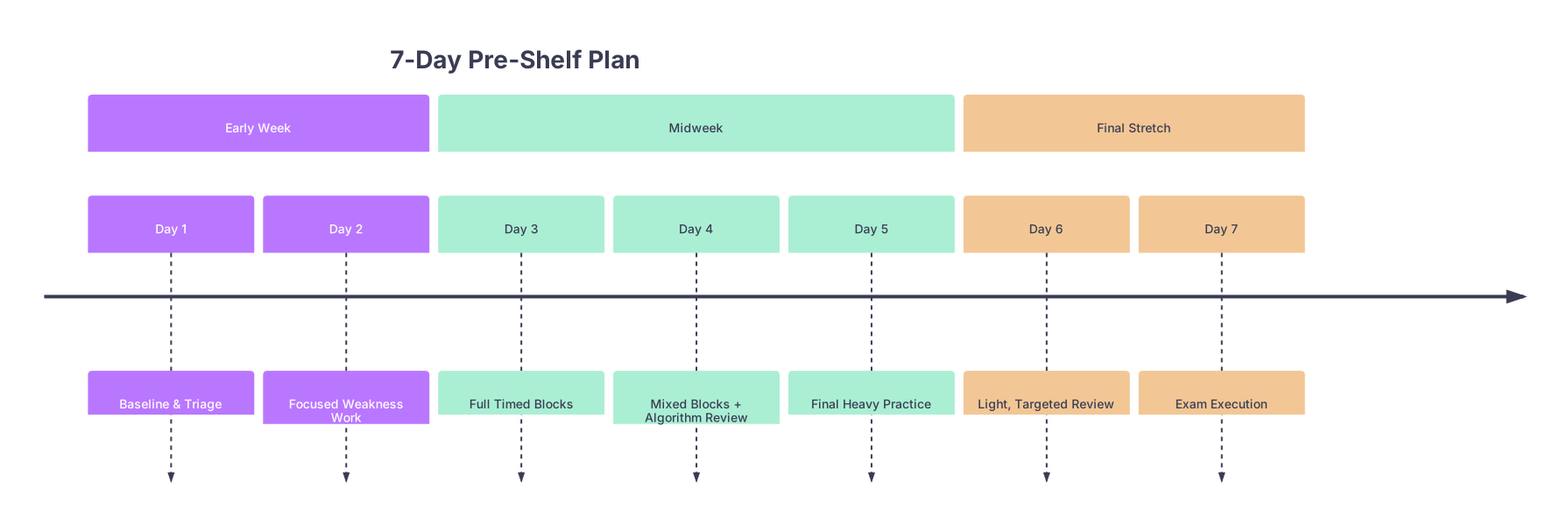
| Period | Event |
|---|---|
| Early Week - Day 1 | Baseline & Triage |
| Early Week - Day 2 | Focused Weakness Work |
| Midweek - Day 3 | Full Timed Blocks |
| Midweek - Day 4 | Mixed Blocks + Algorithm Review |
| Midweek - Day 5 | Final Heavy Practice |
| Final Stretch - Day 6 | Light, Targeted Review |
| Final Stretch - Day 7 | Exam Execution |
Day 3 – Transition to Exam Mode
Today you flip from “remediation” focus to “simulate the test” focus.
Morning: First Full Timed Block
At this point you should:
- Do 1 full 40-question mixed block:
- Mode: Timed.
- No notes, no phone, no interruptions.
- Try to mimic actual exam conditions:
- Same computer setup.
- Same scratch paper style.
- Same pacing.
After:
- Take a 10–15 minute break.
- Then spend 60–75 minutes reviewing:
- Focus deeply on:
- Questions you changed from right to wrong.
- Management steps you mis-ordered (e.g., when to image vs when to treat).
- Add patterns and pitfalls to your micro-pearls.
- Focus deeply on:
Midday: Second Timed Block or Two Shorter Blocks
Depending on bandwidth and clinic:
Option A (lighter clinical day):
- One more 40-question timed mixed block.
Option B (busy day):
- Two 20-question timed mixed blocks at different times (e.g., lunch, evening).
Same pattern: timed, then thorough explanation review.
Evening: Highlight the Algorithms
Spend 45–60 minutes doing:
- Algorithm review from your core resource.
- ACLS-style thinking but for shelf content:
- Chest pain
- Shortness of breath
- Vaginal bleeding in pregnancy vs nonpregnant
- Fever in neutropenia
- Trauma resuscitation steps (for Surgery)
- ACLS-style thinking but for shelf content:
Write these as simple arrows in your notes:
- “Unstable → immediate OR / C-section / intubate.”
- “Stable but concerning → imaging / urgent consult.”
- “Benign features → outpatient follow-up / reassurance.”
End of Day 3 checklist:
- At least 1 full timed block completed and reviewed
- Algorithms sketched for 3–5 key presentations
- Micro-pearls updated, not bloated
Day 4 – Mixed Mastery and Efficiency
This is the grind day. You know what the test feels like now. Time to sharpen.
Morning: Back-to-Back Timed Blocks
At this point you should:
- Do 2 x 40-question timed mixed blocks, separated by a 10–15 minute break.
- If that volume is too high with your rotation, do 1 full block + 1 half block (20 questions).
Keys during blocks:
- Monitor pacing:
- Aim ~1 minute 15 seconds per question.
- Practice skipping long questions early, flagging them, then returning later.
Midday: Review + Targeted Plugging
Take 2 hours for detailed review of the morning’s questions:
- Identify:
- 3 recurring weak topics.
- 3 recurring tricks (e.g., misreading age, missing vitals, ignoring a lab).
For each weak topic, do:
- 5–10 additional Qs from that topic in Tutor mode only.
- Very fast review of explanations.
Evening: Light Passive Review + Anki
- 30–45 minutes Anki
- 30–45 minutes of:
- Skimming your micro-pearls document.
- Flipping through high-yield tables in your text (infection prophylaxis schedules, vaccination schedules, staging criteria, etc.).
End of Day 4 checklist:
- 1–2 full timed blocks done
- Recurring weaknesses explicitly named
- Short topic-specific question mop-up done
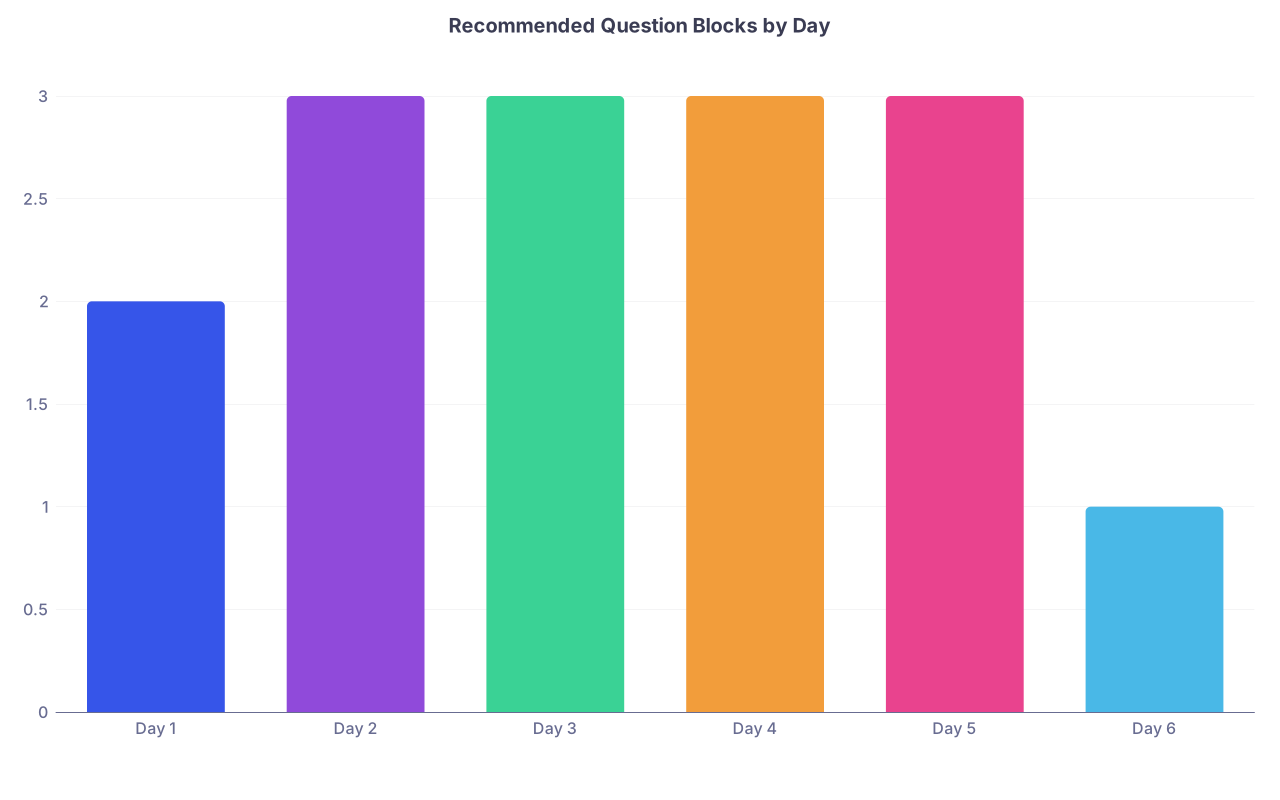
| Category | Value |
|---|---|
| Day 1 | 2 |
| Day 2 | 3 |
| Day 3 | 3 |
| Day 4 | 3 |
| Day 5 | 3 |
| Day 6 | 1 |
Day 5 – Final Heavy Practice Day
This is the last day you push hard. Tomorrow you taper.
Morning: Full-Length Simulation (if possible)
At this point you should:
- If your shelf is NBME-based (most are), strongly consider:
- Doing an NBME practice exam in one sitting, timed, like the real thing.
- Or, if you cannot access NBME: 2 consecutive 40-question UWorld/AMBOSS blocks under strict exam conditions.
During this:
- No pausing to look things up.
- Use the same break strategy you plan for test day.
Early Afternoon: Post-Mortem
- Spend 2–3 hours on review:
- On NBME: focus on concepts, not exact Qs (remember copyright).
- On Qbank blocks: go through every explanation you are not solid on.
Build a “one-page panic sheet”:
- Single page (or single screen) with:
- Top 10 diagnoses you still confuse.
- Top 5 algorithms you must remember.
- Top side effects / contraindications that keep biting you.
Late Afternoon / Evening: Gentle Consolidation
- 30 minutes Anki, strictly high-yield.
- 30–45 minutes: re-watch or re-read select high-yield segments:
- E.g., OME “OB triad of pain/bleeding/contractions” for OB.
- Peds vaccine schedule and age-based milestones.
- IM: chest pain, syncope, acute kidney injury, acid–base.
End of Day 5 checklist:
- Full-length or near full-length simulation completed
- One-page panic sheet created
- Final major blind spots identified
Day 6 – Taper and Target (Day Before Exam)
Today is not a heroic study day. It is a confidence and clarity day.
Morning: One Last Light Block
At this point you should:
- Do 1 mixed 20–25 question block, timed:
- Focus: keep the machinery running.
- Do not chase the score. This is mental warm-up.
Review:
- Only the clear mistakes and any new concept.
- Do not spiral if the block goes poorly. That is exactly why it is small.
Late Morning / Early Afternoon: Focused Review Session
Now prioritize high-yield must-know lists. For 2–3 hours, rotate through:
- Your micro-pearls document:
- Read out loud, fast. Circle anything still fuzzy.
- Your one-page panic sheet:
- Drill yourself on it until you can teach it without looking.
- A few key tables / summaries for your shelf:
- IM: murmurs, valvular lesions, heart failure meds, diuretics, antibiotics.
- Surgery: trauma primary survey, postop fever causes by POD, common postop complications.
- OB/GYN: fetal heart rate patterns, hypertensive disorders of pregnancy, bleeding in pregnancy.
- Peds: vaccine schedule, developmental milestones, congenital heart disease basics.
- Psych: first-line treatments, black box warnings, diagnostic criteria thresholds.
Late Afternoon: Stop Heavy Input
After mid-afternoon (say 3–4 pm):
- No more question blocks.
- No more dense new content.
Instead:
- 30–45 minutes of very light Anki or flashcard review.
- Quick re-skim of your panic sheet before dinner.
Evening: Protect Tomorrow
Treat this like pre-op prep:
- Set clothes, snacks, water, ID, test confirmation, earplugs/headphones out and ready.
- Confirm Test Center time and route.
- Choose a wake-up time that gives you at least 1.5 hours before needing to leave.
No heavy screens after 10 pm if you can help it.
Aim for 7–8 hours of sleep.
End of Day 6 checklist:
- Small warm-up block done
- Micro-pearls and panic sheet reviewed
- Logistics fully set for exam day
- In bed at a reasonable hour
Day 7 – Shelf Exam Day
This is execution day. You are not “studying” anymore. You are performing.
Morning: Controlled Warm-Up
At this point you should:
- Wake up with enough time to:
- Eat something real: protein + complex carbs.
- Drink water, light caffeine if you normally use it (do not change your usual dose).
- 10–15 minutes of warm-up only:
- Skim your one-page panic sheet.
- Maybe 5–10 super easy flashcards just to get the brain firing.
- No full questions. You do not want a discouraging start.
At the Testing Center
Treat this like a long case presentation you are ready for.
- On each block:
- First pass: answer everything you can confidently.
- Flag:
- Lengthy multi-step calculations.
- Questions requiring you to mentally run a long algorithm.
- Second pass: work through flagged questions slowly with remaining time.
Watch out for:
- Age traps (child vs adult vs elderly management).
- Gestational age traps (OB).
- “Best next step” where several steps are correct but not in the right order.
Between Blocks
- Quick micro-breaks:
- Stand up, stretch, deep breaths.
- Small sips of water, small snack if allowed.
- Do not debrief questions with yourself. Do not autopsy yet.
- Mentally say: “Next block is a fresh test.”
Post-Exam
Once you walk out:
- You are done. No “I should have known that.”
- If you must, jot a few topics to look up later for your own learning. Then move on.

Sample Daily Time Block Template
If you want one concrete “plug-and-play” structure, use this on heavier study days (Days 2–5):
| Time | Activity |
|---|---|
| 07:00–08:00 | Wake, breakfast, light review |
| 08:00–10:00 | Timed question block + break |
| 10:00–11:30 | Explanation review |
| 11:30–12:00 | Anki / flashcards |
| 12:00–13:00 | Lunch / clinic duties |
| 13:00–15:00 | Second question block + review |
| 15:00–16:00 | Rapid review (text/video) |
| 16:00–17:00 | Short focused question set |
| 20:00–21:00 | Light Anki + micro-pearls skim |
Adjust for clinical schedules, but keep the order:
- Block → Review → Cards → Summary.

Three Things to Remember
In the final week, structure beats heroics. A controlled mix of timed blocks, targeted review, and spaced repetition will outperform last-minute resource hopping every time.
Your micro-pearls and panic sheet are your anchors. If you cannot remember something on those by Day 6, you likely will not on test day. That is fine. Focus on maximizing what you do know.
Shelf success is mostly pattern recognition under time pressure. This plan is built to hammer those patterns in, then taper so your brain is sharp, not fried, when you sit down for the exam.


