

The biggest mistake people make with Step 2 CK is pretending it’s Step 1 with different questions. It’s not. It’s a timed clinical triage exam, and 90 days is just enough time if you treat it like a job and follow a ruthless schedule.
You want a map. Here it is—day by day, week by week—so you’re never guessing what to do “next.”
Big-Picture Structure: Your 90-Day Framework
Before we zoom into weeks and days, anchor the entire 90 days.
- Phase 1 (Days 1–30): Foundation & Systems
- Main goal: Rebuild core medicine and get your timing under control.
- Tools: UWorld (first pass), OnlineMedEd/Boards & Beyond/Divine podcasts as needed, Anki/light recall.
- Phase 2 (Days 31–60): Intensified Q‑Bank & Weakness Attack
- Main goal: Grind questions, plug gaps, simulate test blocks frequently.
- Phase 3 (Days 61–90): Exam Simulation & Refinement
- Main goal: Full-length simulations, NBME/Free 120, stamina, and last fixes.
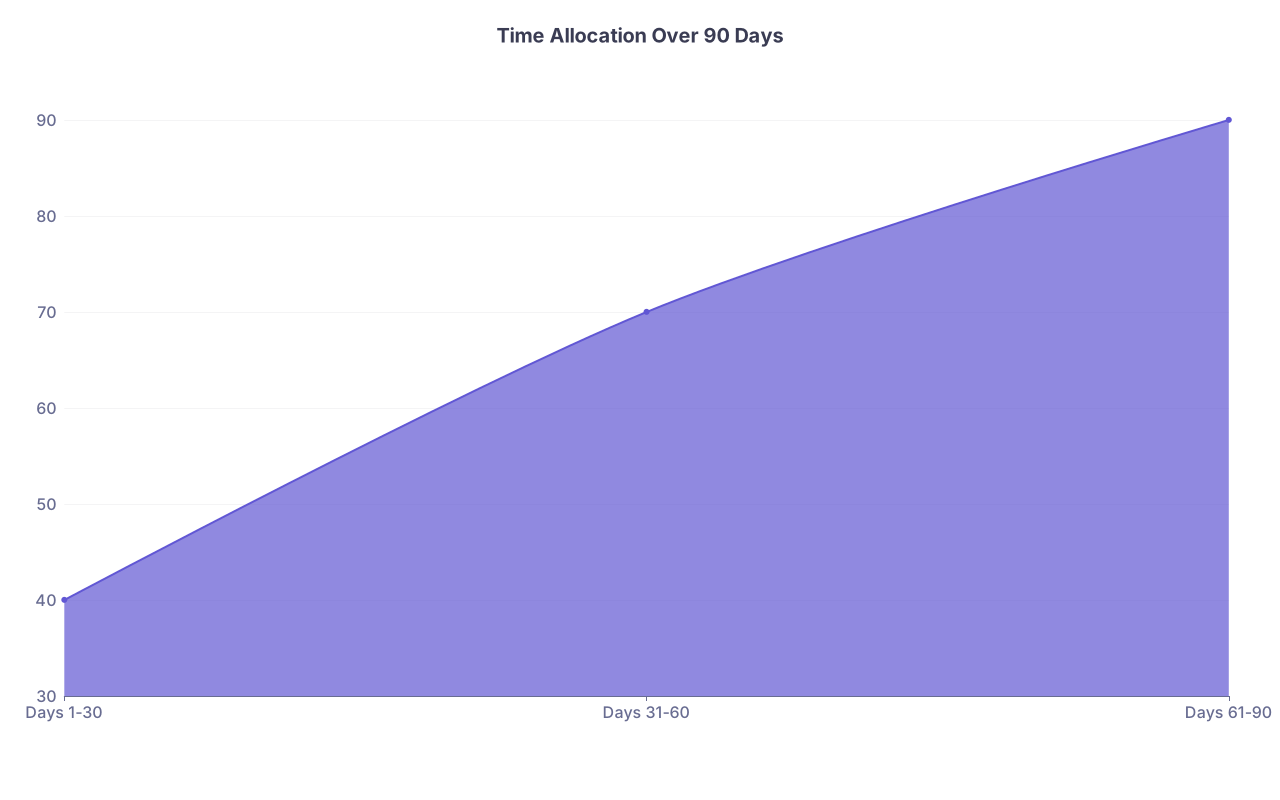
| Category | Value |
|---|---|
| Days 1-30 | 40 |
| Days 31-60 | 70 |
| Days 61-90 | 90 |
The values above roughly represent “percent Step-2-shaped” you become with each phase. Notice: serious growth happens after Day 30. So if your first month feels rough, that’s normal.
Days 1–7: Set Up and Reality Check
At this point you should stop pretending “I’ll figure it out as I go.” You won’t. Build the system now.
Day 1: Baseline & Logistics
You do today:
- Schedule the exam (if not already).
- Put the exact date and time on a wall calendar.
- Pick your core resources (and commit):
- QBank: UWorld (non-negotiable).
- Video resource (if you need it): OnlineMedEd or Boards & Beyond or Divine Intervention (not all three).
- Rapid review: Master the Boards / Step-Up / OnlineMedEd notes / AMBOSS articles for quick reading.
- Set target performance:
- Example: “Target NBME: 240+” or “I need 230+ to be competitive for IM at mid-tier programs.”
Day 2: Diagnostic Question Block
You do today:
- 2 blocks of UWorld, timed, random, mixed, ~40 questions each.
- No notes. Just see how it feels.
Then:
- Check your percent correct and more importantly, how you missed:
- Misread question?
- Didn’t know concept?
- Couldn’t decide between 2?
- Start a “Dumb Miss” list (things you should have known but blanked on).
Days 3–7: Build the Daily Template
By the end of week 1, you must have a standard study day you can repeat.
A solid template (8–10 hour study day):
- Morning (3–4 hours):
- 2 timed UWorld blocks (40 q each), random, mixed.
- Midday (3–4 hours):
- Review every single question.
- For wrongs and guesses: read explanation, skim related tables/diagrams.
- Add only high-yield facts or algorithms to your personal notes or Anki deck.
- Evening (1–2 hours):
- Targeted content: short videos or chapters on your worst system that day.
- Quick glance at your “Dumb Miss” list.
If you’re on rotation, compress but keep the ratio:
- 1 block/day minimum (timed, mixed).
- 45–60 minutes of review.
- 30–60 minutes of targeted study.

Weeks 2–4 (Days 8–30): System Pass & Timing Discipline
At this point you should stop obsessing over your UWorld percentage. Focus on reps, timing, and closing knowledge gaps.
Weekly Goals for Weeks 2–4
Each of these weeks, your targets:
- UWorld: 280–320 questions/week
- That’s ~7–8 blocks of 40.
- Content reinforcement: 5–10 hours/week
- Short videos or rapid review text.
- Mini‑assessments:
- End of Week 2: 1 “mock half-day” (3 blocks back-to-back).
- End of Week 4: Official NBME or UWSA.
| Phase | Days | Qs per Week | Total Qs (approx) |
|---|---|---|---|
| Phase 1 | 1–30 | 280–320 | 900 |
| Phase 2 | 31–60 | 360–420 | 1,200 |
| Phase 3 | 61–90 | 320–360 | 1,000 |
Week 2 (Days 8–14): Medicine-Heavy with Mixed Blocks
Focus: IM-style questions. Pneumonia, CHF, chest pain, AKI, diabetes, sepsis. Real clinic stuff.
Daily structure (off-rotation):
- 2–3 blocks UWorld/day.
- After review, pick one IM topic/day to clean up:
- Day 8: Chest pain algorithm (ACS vs PE vs dissection).
- Day 9: Pneumonia + COPD + asthma.
- Day 10: Diabetes management (outpatient + DKA/HHS).
- Day 11: Renal: AKI, CKD, electrolyte corrections.
- Day 12: Shock + sepsis management.
- Day 13: Infectious disease basics (HIV, endocarditis, meningitis).
- Day 14: Light review + 3-hour mock (3 blocks), timed, no extended breaks.
Week 3 (Days 15–21): OB/Gyn + Peds Emphasis
At this point you should stop treating OB and Peds like “annoying side topics.” They’re at least a full block or two on test day.
You do this week:
- Still 2–3 mixed blocks/day.
- After review, spend 60–90 minutes on:
- OB days:
- Prenatal care schedules and labs.
- Fetal heart tracings (get comfortable with decels and variability).
- Hypertensive disorders of pregnancy, bleeding in pregnancy, labor stages.
- Peds days:
- Vaccination schedule, developmental milestones.
- Common infections (otitis, pneumonia, meningitis).
- Failure to thrive, dehydration, congenital heart disease basics.
- OB days:
By Day 21:
- You should have algorithms written out by hand:
- First prenatal visit workup.
- Preterm labor management.
- Newborn resuscitation basics.
Week 4 (Days 22–30): Surgery, Psych, Neuro, and First Big Check
This is consolidation week for Phase 1.
Content focus:
- Surgery:
- Pre-op risk assessment.
- Post-op complications by post-op day.
- Acute abdomen algorithms.
- Psych:
- Diagnoses by time course and symptom clusters.
- First-line meds + major side effects.
- Neuro:
- Stroke types + acute management window.
- Localizing lesions only at a basic Step 2 level.
Critical event: Around Day 28–30
- Take NBME 9/10/11 (whichever is recommended by your school or mentors currently; I’d start with the one people say is “most similar”).
- Do it in exam-like conditions:
- Morning start.
- Timed, minimal breaks.
- Same day or next:
- Full review.
- Categorize misses by:
- Knowledge gap.
- Misread / rushed.
- Overthinking.
This NBME tells you if your foundation is safe. If you’re way below your target (e.g., aiming for 240, scoring 215), you do not panic. You adjust the next 30 days to be more aggressive with questions and very focused with content.
Weeks 5–8 (Days 31–60): Question Marathon & Targeted Repair
At this point you should be living inside your QBank. Content is now secondary—you watch/read only to fix specific problems.
Global Goals for Phase 2
- Finish first pass of UWorld by around Day 60–65 if possible.
- Ramp to 9–10 blocks/week (360–400 questions).
- Take 1 assessment every 2 weeks.
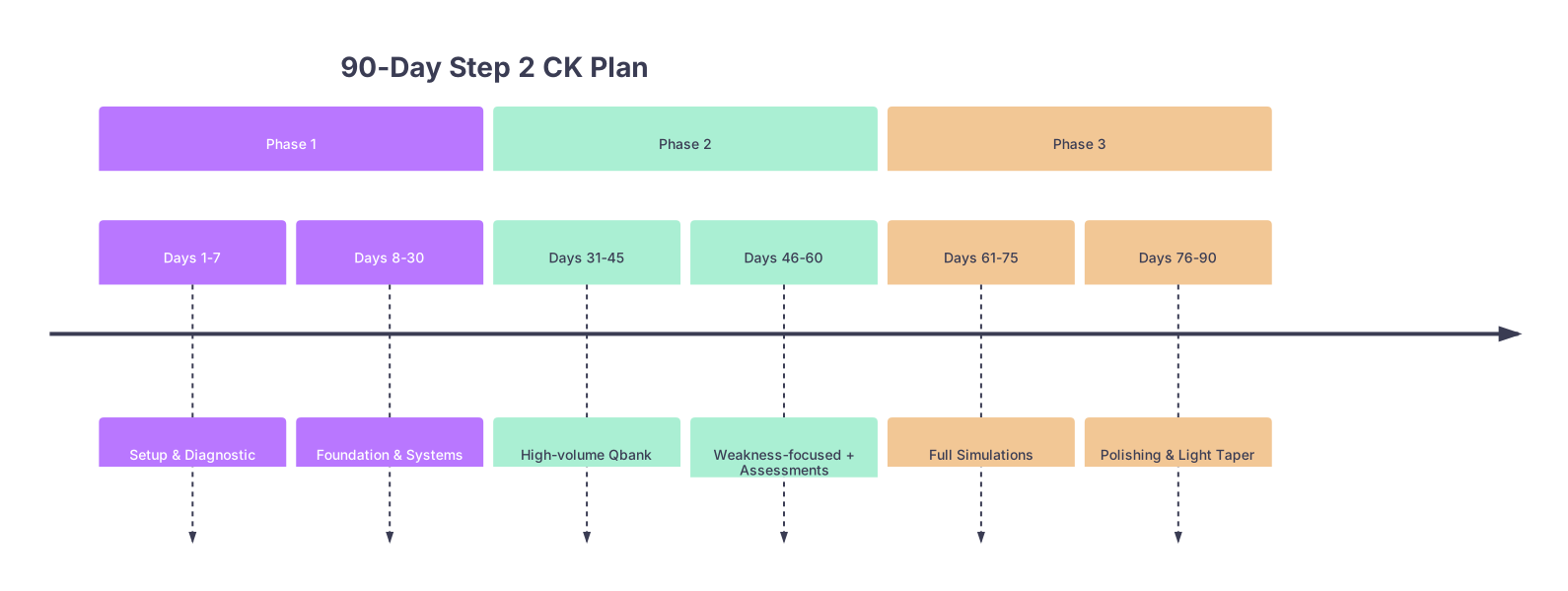
| Period | Event |
|---|---|
| Phase 1 - Days 1-7 | Setup & Diagnostic |
| Phase 1 - Days 8-30 | Foundation & Systems |
| Phase 2 - Days 31-45 | High-volume Qbank |
| Phase 2 - Days 46-60 | Weakness-focused + Assessments |
| Phase 3 - Days 61-75 | Full Simulations |
| Phase 3 - Days 76-90 | Polishing & Light Taper |
Week 5 (Days 31–37): Volume Kick-Up
You do this week:
- Most days:
- 3 blocks/day on 3–4 days of the week.
- 2 blocks/day on the others.
- For each evening:
- Choose one weak system from that day’s missed questions.
- 45–60 min of focused review (notes, short video, or high-yield chapter).
- Start annotating patterns:
- “Every time there’s chest pain + normal EKG, I forget costochondritis vs GERD vs anxiety.”
Week 6 (Days 38–44): Second Assessment & Subspecialty Clean-up
By now, your timing should be tighter. You move into nuance.
Midweek (Days 40–42): Take another NBME or UWSA
- Same test-day rules.
- Track progress from your last NBME:
- Improvement of 5–15 points is common if you’ve actually done the work.
Focus areas this week:
- Heme/Onc: anemias, leukemias vs lymphomas, transfusion reactions.
- Rheum: SLE, RA, spondyloarthropathies, basic serologies.
- Endocrine: thyroid disease, adrenal insufficiency vs Cushing, pituitary lesions.
- GI: liver disease patterns, pancreatitis, IBD vs IBS, GI bleed algorithms.
Week 7 (Days 45–51): Second-Pass Thinking
At this point you should stop saying, “I knew that but changed my answer.” That’s a Step 2 killer.
Your focus this week:
- Still high volume QBank (320–400 questions).
- But now, during review:
- For every changed answer, write down why you changed it.
- Pattern: “I talk myself out of the obvious diagnosis for exotic zebras.”
- For every changed answer, write down why you changed it.
- Add a 10-minute reflection at end of day:
- 3 things I did well.
- 3 patterns of mistakes.
- 1 specific fix for tomorrow (e.g., “I will commit earlier and stop re-reading the stem 4 times”).
Week 8 (Days 52–60): Finish First Pass & Hard Weakness Week
Your priority:
- Finish UWorld first pass by ~Day 60.
- Take third assessment (NBME/UWSA) towards the end of this week.
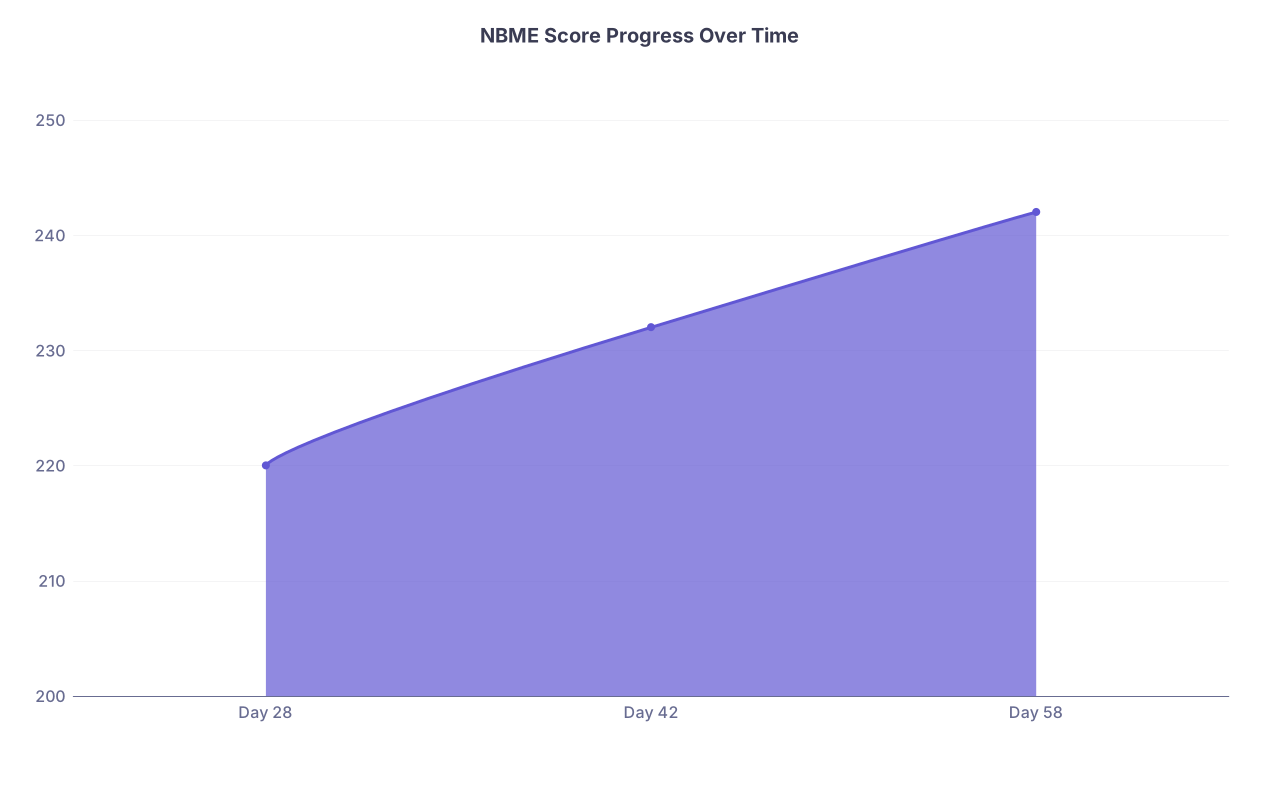
| Category | Value |
|---|---|
| Day 28 | 220 |
| Day 42 | 232 |
| Day 58 | 242 |
If your curve looks anything like that, you’re on track. If it’s flat, your “review” is too passive. You’re reading explanations but not translating to rules you can use mid-question.
What you do daily this week:
- 2–3 mixed blocks/day (you may start limited “redo” questions on UWorld if you finished early).
- Hyperfocused content review:
- Pick your bottom 2–3 systems from NBME percent breakdown.
- Every night is those systems only.
Weeks 9–11 (Days 61–83): Full Simulations & Exam Conditioning
At this point you should be closer to “sim athlete” than “student.” The content is largely in your head. Now it’s about stamina, pacing, and decision-making under time pressure.
Week 9 (Days 61–67): First Full Simulation
Key event this week:
- Around Day 63–65: Do a 7–8 block full-day simulation.
- Use a mix of unused UWorld questions or NBMEs + older self-assessments.
- Try to mimic the real schedule:
- Start by 8–9 AM.
- Standard breaks like test day (i.e., one longer 30–40 min and a couple of shorter ones).
What you’re testing here:
- Can you maintain focus past Block 5?
- Are you dropping easy questions in the last blocks?
- Do you need more or fewer calories/caffeine?
Other days this week:
- 2 blocks/day on non-sim days.
- Review the full simulation over 2 evenings, system by system.
Week 10 (Days 68–74): Refinement and Free 120
This week is more about quality than brute force.
You do:
- 2–3 blocks on 3–4 days.
- 1 lighter day (1 block + content).
- Take the newest NBME or UWSA + the official Free 120 during this window.
Free 120 rules:
- Try to do it like a mini-exam:
- 3 blocks, timed.
- Pay attention to:
- Ambiguous wordings.
- How often they want “next best step” vs “most likely diagnosis.”

End of Week 10 checkpoint:
If your NBME/UWSA scores are:
- ≥ target or within ~5 points: You’re on track.
- 10–15 points below target: You need tighter exam strategy (read stems once, commit, don’t over-change answers).
15 points below and < 3 weeks left: Now it’s triage. Focus on:
- High-yield systems (IM, OB, Peds).
- Common presentations and algorithms.
Week 11 (Days 75–83): Polishing Patterns
At this point you should stop mass-consuming content. Reading new stuff you’ll forget is a trap.
Your focus:
- 2 blocks/day, 5 days this week.
- Each day’s review:
- One algorithm to rewrite from memory (e.g., first-line treatment of heart failure, workup of upper GI bleed).
- One table to reconstruct (e.g., nephritic vs nephrotic, hyper- vs hypothyroid labs).
Also:
- Go through your “Dumb Miss” list from Day 1 onward.
- Cross out what’s now obvious.
- Keep a short “Final 2-week” list of persistent offenders.
Final Week (Days 84–90): Taper, Don’t Quit
This is where people either burn out or try to cram like it’s an M2 path exam. Both are mistakes.
Day 84–86: Light Mock + Focused Review
You do:
- 1 more pseudo-exam day, but shorter:
- 4–5 timed blocks.
- Review that over 1–2 days.
- Identify only 3–5 themes to work on:
- Example: “I still miss hyponatremia management, fetal heart strips, and psych med side effects.”
Daily structure:
- 1–2 blocks/day.
- 1–2 hours of very targeted review:
- Skim your primary notes.
- Flash through key algorithms.
- Revisit hardest systems from your final short list.
Day 87–88: Low-Volume, High-Confidence
At this point you should be protecting your brain.
- 1 block/day max.
- Review only right/wrong for patterns, don’t deep dive every obscure explanation.
- Night routine:
- Gentle walk.
- Sleep on schedule you’ll use test day.

Day 89: Stop Stuffing
No more full blocks.
Your tasks:
- 30–60 minutes: skim your short high-yield list.
- Look briefly at:
- CPR/BLS basics.
- A few key OB/peds tables.
- Pack your bag:
- ID, snacks, water, jacket, earplugs if allowed.
- Drive by or look up your testing center if you’ve never been there.
Sleep as close to 8 hours as possible. You’re not gaining 10 points from a late-night cram on Day 89.
Day 90: Game Day
You already know the plan:
- Light breakfast.
- No questions in the morning.
- At the center:
- Commit to one block at a time.
- If you get wrecked by a block, forget it. The next one is fresh.
Quick Weekly Snapshot (Printable)
| Week | Days | Focus | Key Task |
|---|---|---|---|
| 1 | 1–7 | Setup + Baseline Qs | Diagnostic UWorld + schedule |
| 2 | 8–14 | IM core + timing | 3-block mini-mock |
| 3 | 15–21 | OB/Gyn + Peds | Algorithms for OB/Peds |
| 4 | 22–30 | Surg/Psych/Neuro + NBME | First NBME |
| 5 | 31–37 | Volume increase | 9–10 blocks/week |
| 6 | 38–44 | Subspecialties + NBME/UWSA | Second assessment |
| 7 | 45–51 | Pattern recognition | Fix “changed answer” habit |
| 8 | 52–60 | Finish UWorld + NBME/UWSA | Third assessment |
| 9 | 61–67 | Full-day sim | 7–8 block mock |
| 10 | 68–74 | Refinement + Free 120 | Free 120 + NBME/UWSA |
| 11 | 75–83 | Polishing patterns | Rebuild key algorithms |
| 12 | 84–90 | Taper + exam readiness | Short sim + rest |

What You Should Do Today
You’re 90 days out (or close enough). Do not save this plan “for later.”
Today, right now:
- Open your calendar and block off the next 7 days using the Week 1 structure above.
- Schedule a timed 40-question block for today, not tomorrow.
- After that block, start your “Dumb Miss” list on paper or in a doc.
Once that list exists and that first block is done, your 90-day countdown has officially started.


