
The glowing MSPE comments do not go to the “smartest” students. They go to the students who understand how humans actually write evaluations.
Let me be blunt: the difference between “Outstanding student, one of the best I have worked with” and “Solid, dependable performance” is not a difference in knowledge. It’s a difference in how attendings and residents feel about you when they sit down, exhausted, to crank out your eval between consults.
You’re told, “Just work hard, be professional, and the comments will follow.”
That’s not how it works.
Let me tell you what really happens.
How MSPE Comments Are Actually Created
The MSPE is sold to you as this objective, comprehensive summary crafted thoughtfully by the dean’s office.
Reality: it’s a Frankenstein document stitched together from rushed evaluations written by people barely remembering who you are.
On most rotations, here’s the actual chain:
- You rotate with multiple residents and attendings.
- At the end, the clerkship office emails them eval forms.
- They open it late, half-distracted, sometimes weeks later.
- They think: “Which one was this?”
- If they remember you clearly, they write something specific.
- If they don’t, they click “Meets expectations” and throw in a generic line.
Those narrative comments then get filtered and curated by the dean’s office. The really strong, specific praise tends to make it in. So does any clearly problematic language. The forgettable stuff? Often paraphrased into generic mush.
Here’s the ugly truth: by the time MSPEs are put together, the school is not going through your life with a fine-tooth comb. They are sorting, standardizing, and avoiding liability. That’s it.
So what you think is a pure “performance document” is actually a memory document. It summarizes how vividly you stood out to tired evaluators with 20 other tasks to do.
That’s why some students with average test scores and middle-of-the-pack clinical reasoning end up with comments like:
“One of the strongest students I have worked with in years.”
While a clearly sharp, book-smart student ends up with:
“Pleasant to work with. Solid knowledge base.”
Same rotation. Same service. Very different MSPE.
The Unspoken Categories Attendings Use in Their Heads
No one will tell you this out loud, but I’ve heard versions of it behind closed doors in multiple institutions: faculty and residents mentally group students into just a few buckets.
Not “27 dimensions of professionalism and 9 ACGME competencies.”
More like:
- Star – I’d recruit this person to my program
- Good – I’d be fine working with them again
- Fine/Forgettable – Who was this?
- Problem – Please don’t send them back to my service
Your MSPE narrative largely depends on which bucket you land in.
Stars get:
“Outstanding,” “exceptional,” “among the top students I’ve worked with,” “consistently exceeded expectations,” “functions at or above intern level.”
Good students get:
“Hardworking,” “solid,” “pleasant,” “reliable,” “works well with the team.”
Forgettable students get:
“Met expectations,” “completed tasks assigned,” “demonstrated appropriate professionalism.”
Problems get… language that program directors can spot immediately. Phrases like “benefited from additional supervision,” “improved with feedback,” “continues to work on efficiency.” That’s code.
The key: The gap between Star and Good is not raw intelligence. It’s what you do with the social, practical side of clerkships that nobody formally teaches you.
The Core Levers That Create “Star-Level” Comments
I’ll walk you through what actually moves you into that Star bucket in attendings’ minds. None of this shows up on your grade rubric. All of it shows up in your MSPE.

1. Being “Cognitively Easy” to Supervise
Attendings and residents love students who lower their cognitive load.
You know who gets the “One of the best students we’ve had” comment? The one who doesn’t make the team think about them all the time.
A cognitively easy student:
- Shows up prepared so you don’t have to double-check every single basic fact.
- Updates the team before they ask. “I checked, his K is back at 3.9, and the EKG is unchanged.”
- Writes notes that are actually usable and not a liability.
- Doesn’t need constant chasing: if you assign something once, it gets done.
When an attending sits to fill your eval, the feeling they remember is: “I didn’t worry when this student was on.” That’s what turns into language like:
“Required minimal supervision for their level.”
“Functioned like an intern by the end of the rotation.”
You don’t earn that by being a genius. You earn it by never making your resident think, “Where’s my student? Did they do X? Can I trust this number?”
2. Tactical Visibility (Without Being Annoying)
The worst thing for your MSPE is not being disliked. It’s being invisible.
Forgettable students are the ones attendings struggle to recall: “Remind me, which one was she?” That’s how you end up with generic filler comments.
The strong comments come from people who were consistently visible without being in the way.
This looks like:
You speak up on rounds when it’s actually useful, not just to show off.
You present with structure, confidence, and brevity.
You ask questions that show you were actually listening to the plan.
Attendings remember:
- The student who gave one crisp 2-minute evidence summary that changed management.
- The student who caught a med dosing error before anyone else.
- The student who handled a family conversation gracefully while the resident watched.
What they do not remember: the student who did exactly what was asked, quietly, and never once made themselves indispensable.
The Quiet Advantage: Knowing How Evaluations Are Written
Here’s what no one explains: the eval form is structured, but the comment is emotional. It’s not a record of every hour you worked. It’s a snapshot of how they felt about you in a few salient moments.
Let me show you how that plays out.
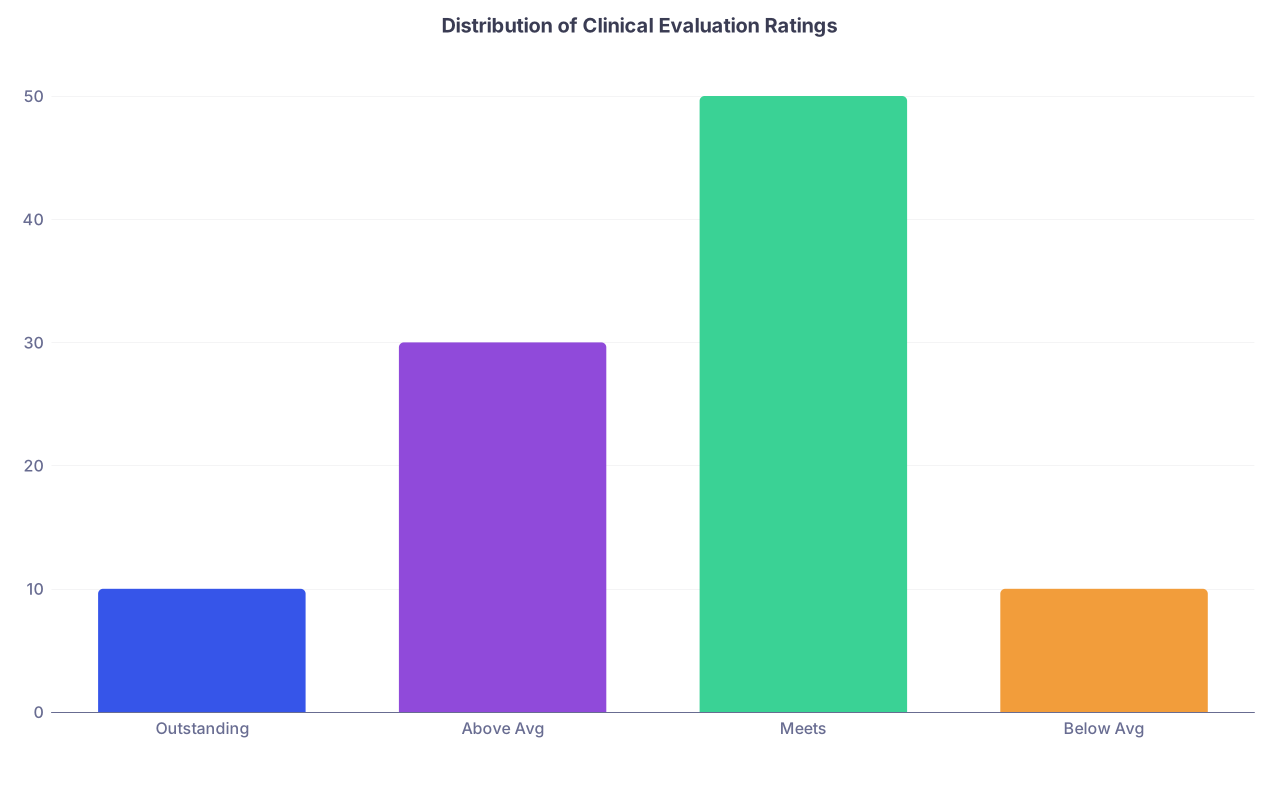
| Category | Value |
|---|---|
| Outstanding | 10 |
| Above Avg | 30 |
| Meets | 50 |
| Below Avg | 10 |
Most schools end up with this kind of distribution. Very few “Outstanding,” a decent number “Above Average,” and a ton of “Meets Expectations.” Why?
Because unless you force them to see you as clearly above the pack, most evaluators default to the safe middle.
Now look at how two students with similar performance get treated.
Student A
Did solid work, came on time, didn’t mess anything up, asked a few questions, didn’t stand out.
Evaluation comment written two weeks later:
“Pleasant student who completed assigned tasks. Demonstrated solid knowledge base and interacted well with patients and staff.”
Student B
Same knowledge level. But this student:
- Took initiative to call PT and coordinate discharge without being asked.
- Saved the team 30 minutes by preemptively organizing wound care supplies.
- Asked the attending, “Can I try writing the discharge summary so you can give me feedback?”
Evaluation comment:
“Outstanding student. Took ownership of patient care, anticipated team needs, and showed maturity beyond their level. I would be happy to have them as an intern on my team.”
Same brain. Different visibility. One ends up with “Outstanding, top 10%” type MSPE language. The other: generic fluff.
The Residents: Your Invisible Gatekeepers
You think attendings drive your comments. They don’t. Residents do.
On most services, the attending writes your official evaluation. But that evaluation is based heavily—sometimes exclusively—on what residents say about you.
Here’s the pipeline in real life:
- End of rotation.
- Attending is asked to evaluate 3–4 students.
- Attending turns to senior: “Hey, how were the students this month?”
- Resident says: “Alex was great, really on top of things. Taylor was fine. Jordan struggled early but improved.”
- Attending’s eval mirrors exactly that.
If you’re not locked into the resident’s “great” category, good luck getting strong MSPE language.
I remember a surgery attending who routinely wrote two-sentence evals. Every time:
“I agree with the senior resident’s assessment. Excellent student.”
Or
“I agree with the senior resident’s assessment. Solid performance.”
That “assessment” was 100% formed on how you treated the resident, what they saw at 3 am, how often you disappeared, and whether you made their day harder or easier.
So if you’re performing for the attending and ignoring the resident, you are playing the wrong game.
What “Star Students” Actually Do on Rotations
Let’s be concrete. I’ve watched the same patterns across med schools and hospitals. The students with the best MSPE language consistently do the following, whether consciously or instinctively.

1. They Anchor Themselves to One Resident
On day one, they find out who really runs the service: the senior resident.
Then they say something like:
“I really want to get as much out of this rotation as I can. Can you give me feedback halfway through so I can adjust?”
That does two things:
- Signals maturity: you’re not waiting until the last day to ask “How did I do?”
- Forces the resident to pay attention to you enough to have something to say.
Halfway through, they circle back. They actually implement the feedback. Visible improvement is like catnip for residents. It makes them feel like good teachers. When they fill out your eval, they remember the arc, not the starting point.
That’s how “struggled a bit at first” becomes “showed impressive growth and took feedback well” instead of “needed frequent redirection.”
2. They Take Ownership of Something Specific
You don’t need to own the whole list. But you should become “the person for X.”
It could be:
- You always know the latest labs on your patients, before rounds.
- You always update families after rounds with clear, kind explanations.
- You are the one who tracks consult recommendations and makes sure they’re implemented.
- You quietly fix the note templates so they’re consistent and readable.
Residents and attendings then talk about you in a very particular way:
“She really took ownership of her patients.”
“He made sure nothing fell through the cracks.”
Ownership is a buzzword in evals. Program directors love it. You don’t fake it; you earn it by actually deciding, “These 1–2 things are mine, and I will do them without being chased.”
3. They Are Predictably Prepared in the Same Ways
Stars are boring in the best sense: they are reliable patterns.
Every morning: notes done, vitals reviewed, overnight events known.
Every time they present: same structure, same efficiency.
Every day: they’ve read something about at least one of their patients.
Evaluators subconsciously translate this consistency into phrases like:
“Consistently prepared,” “always well organized,” “demonstrated strong work ethic.”
The bar is not genius. The bar is “I could trust this student on a busy call night and not be anxious about it.”
Why Some Average Students Get Outrageously Good Comments
Let me describe the archetype you’ve probably seen.
Not highest Step score. Not the fastest on shelf questions. But somehow, every attending loves them, and they leave clerkships with comment gold.
Comments like:
“Exceptional communicator with patients and team members.”
“Mature, thoughtful, and a joy to work with.”
“I would rank this student at the very top of those I have supervised.”
What are they doing?

They excel in the emotional memory categories:
- They make patients like them. Attendings notice when families ask, “Is that student here today?”
- They listen well. Residents vent in the workroom, and the student doesn’t try to one-up or impress, just listens and helps.
- They have good timing. They know when to ask a question and when to just quietly get things done.
The resident remembers:
“This rotation was less painful because that student was on.”
The attending remembers:
“Families trusted this student. I didn’t have to fix their communication.”
Those memories transmute into powerful language. Even if the student’s UWorld percentage is average.
Program directors read between the lines. They know what “joy to work with” really means. It means: low-drama, low-maintenance, high-value.
The Subtle Red Flags That Poison Comments
You want to know what tanks comments more than being wrong on morning rounds? Annoying patterns.
The stuff attendings and residents complain about when you’re not around:
- Always gone when work appears, magically present when things calm down.
- Chronic five-minute lateness (no one will confront you, but everyone notices).
- Presenting like you’re on a podcast—too showy, too long, clearly trying to impress.
- Asking, “Can I go home?” the moment things get quiet, every single day.
- Disappearing after you get feedback instead of adjusting visibly.
When it’s eval time, these leave an aftertaste. Comments become:
“Generally did well but should continue working on efficiency.”
“Improved over the course of the rotation with feedback.”
“Tended to be quiet on rounds; would benefit from more active engagement.”
Program directors read those as, “We had some concerns but we’re being polite.”
You’re not being punished for not knowing enough. You’re being punished for the emotional friction you created.
How This All Ends Up in the MSPE You Never Really See
You will never see the raw evaluations from every rotation at some schools. What you see is the polished MSPE. And that process matters.

| Step | Description |
|---|---|
| Step 1 | Student Performance on Rotations |
| Step 2 | Resident & Attending Evals |
| Step 3 | Clerkship Director Review |
| Step 4 | Deans Office Compilation |
| Step 5 | Edited MSPE Narrative |
Couple of behind-the-scenes realities I’ve seen:
- Some schools systematically only pull the strongest line or two from each rotation for your MSPE. If there is no strong line, you get generic mush.
- Weak or concerning comments get “softened,” not erased. So “struggled with time management” becomes “working on efficiency.” Program directors speak this dialect fluently.
- The dean’s office will quietly highlight words like “outstanding,” “exceptional,” “top,” and “best.” Those are signals to residency programs that you were a Star bucket student.
That means the game is very simple:
You’re not trying to impress every person on earth. You’re trying to create at least one or two memorable, positive sentences per rotation that survive into the MSPE.
It’s less about perfection and more about:
“Did I do anything this month that an exhausted attending would remember as clearly above the pack?”
A Quick Reality Check: What You Can and Can’t Control
You can’t control:
- Whether you get a teaching-focused attending or a burnt-out one.
- Whether your school inflates or deflates narrative comments.
- Whether you’re on service during a brutal census month.
You can control:
- Whether you attach yourself to a resident and actively seek, then use, feedback.
- Whether you become the “owner” of something meaningful on service.
- Whether you are predictable, prepared, and present.
- Whether you protect your relationships with residents and nurses (who influence how you’re talked about).
| Behavior | Typical MSPE Impact Phrase |
|---|---|
| Consistent prep + initiative | "Outstanding" / "Intern-level" |
| Quietly competent but invisible | "Solid, dependable" |
| Mildly unreliable or often late | "Working on efficiency" / "time management" |
| Strong patient/family communication | "Excellent communicator" |
| Rapid visible improvement after feedback | "Takes feedback well, impressive growth" |
You don’t need to be perfect on everything. But you do need to be intentionally excellent on a few things that evaluators actually remember and comment on.
Turning This Into Your Competitive Edge
If you’re early in clerkships, here’s the mindset shift:
Stop thinking: “How do I get honors?”
Start thinking: “What specific memory do I want my attending to have of me when they write their eval?”
That might be:
- The student who found the unexpected lab that changed the plan.
- The student who sat with a dying patient’s family for an hour while the team was swamped.
- The student who stepped up on call night and handled three admissions with poise.
- The student who came in the next day with a clear, one-page evidence summary that answered yesterday’s question.
That’s the seed of the line that ends up in your MSPE.
You don’t need ten of those moments per rotation. One or two is enough. As long as you’re consistently prepared and not a headache the rest of the time.
, Clinical Knowledge, Professionalism, Initiative/Ownership, Resident Impression, Patient/Family Feedback](https://cdn.residencyadvisor.com/images/articles_svg/chart-relative-impact-of-factors-on-strong-mspe-comments-2723.svg "Relative Impact of Factors on Strong MSPE Comments")
| Category | Value |
|---|---|
| [Shelf Score](https://residencyadvisor.com/resources/med-school-life/what-attendings-really-think-about-your-shelf-exam-scores) | 40 |
| Clinical Knowledge | 60 |
| Professionalism | 70 |
| Initiative/Ownership | 85 |
| Resident Impression | 90 |
| Patient/Family Feedback | 75 |
Notice that the highest-impact factors are the ones no one formally teaches and many students ignore: resident impression and clear ownership/initiative.
Those are precisely the levers that create the “stronger MSPE comments” you’re asking about.
So here’s the real reason some students get stronger MSPE comments: they stop playing the “please grade me on my knowledge” game and start playing the “make it impossible to forget me—in a good way” game.
They’re not always the smartest. They’re the most intentional about how they show up on real teams, with real humans, under real pressure.
With this perspective, your next rotation is not just another block on your schedule. It’s your next chance to create the raw material that will live in your MSPE for the rest of your career.
Use it well.
What you do with that chance—and how you handle the residents, the work, and the moments that matter—will decide how your story looks on paper when programs read your name in a stack of hundreds. What comes after that is the interview trail and how you cash in on those written impressions. But that’s a story for another day.