
It is week 4 of your internal medicine rotation. You just got your second NBME practice score back. The first was a 72. This one is a 65. You are working more, sleeping less, and your scores are going in the wrong direction.
You are not confused. You are scared.
You start doing what most students do:
- Add another question bank “for reinforcement”
- Watch more videos “to shore up weak areas”
- Promise to “work harder” on days off
And your trajectory still does not change.
Let me be blunt: if your scores are falling mid-clerkship, you do not need “more resources.” You need a complete reset of how you are studying. Different system. Different rules.
Here is the fix, in three concrete steps.
Step 1: Diagnose the Exact Problem (48-Hour Audit)
Before you change anything, you need to know why the scores are falling. “I am just bad at standardized tests” is not a reason. It is an excuse that prevents you from making real adjustments.
You have four main failure modes. Almost every struggling student is trapped in one (or a mix) of these:
- Too many resources, not enough mastery
- Wrong question strategy (clicking, not thinking)
- No consolidation (you keep relearning the same facts)
- Clerkship life chaos (fatigue and schedule wrecking your plan)
You are going to figure out your mix in the next 48 hours.
1A. Do a Brutal Question Review Snapshot
On your next off-block or lighter day, sit down and do:
- 40 timed questions from your primary question bank (AMBOSS, UWorld, or NBME) in exam mode, random, mixed.
- Strict timing: 1 minute 15 seconds per question maximum.
- No notes, no pausing, no looking things up between questions.
When you finish, do a structured post‑mortem:
For every missed or guessed question, label it:
K = Knowledge gap
You read the explanation and think: “I literally did not know that fact / concept.”A = Application error
You knew the underlying facts but misapplied them. Examples:- You knew CHF guidelines but chose the wrong diuretic in the acute setting.
- You knew the labs for SIADH but misinterpreted the stem.
R = Reading / rushing / carelessness
You misread the question, ignored age, missed “most appropriate next step,” or changed from right to wrong at the end.T = Test-taking / pattern failure
You got trapped by distractors, overthought, chose “fancy” instead of common, or picked an answer that does not match the question type (diagnosis vs management vs workup).
Make a quick tally:
| Error Type | Count (out of ~40) |
|---|---|
| K (Knowledge) | ? |
| A (Application) | ? |
| R (Reading) | ? |
| T (Test-taking) | ? |
(I do not care about the exact number. I care which column is highest.)
Interpretation:
- Mostly K → Your content foundation is thin or scattered. You are “learning” passively, not actually encoding.
- Mostly A → You have facts but cannot use them under pressure. You are not practicing thinking through questions.
- Mostly R → Your reading habits are sloppy. This is mechanical and highly fixable.
- Mostly T → You do not have a clear approach to clinical reasoning or answer elimination.
You now know the type of problem. Do not skip this. Otherwise you will “fix” the wrong thing.
1B. Do a 7-Day Time & Energy Audit
Falling scores mid-rotation usually correlate with one thing: your life is chaos.
For the next 7 days, track three numbers each day in your notes app:
- Total work hours in hospital (pre-rounds → sign-out)
- Total dedicated shelf time (phone off, questions / Anki / review only)
- Sleep time (bed to wake, not “lying in bed scrolling”)
At the end of the week, calculate daily averages:
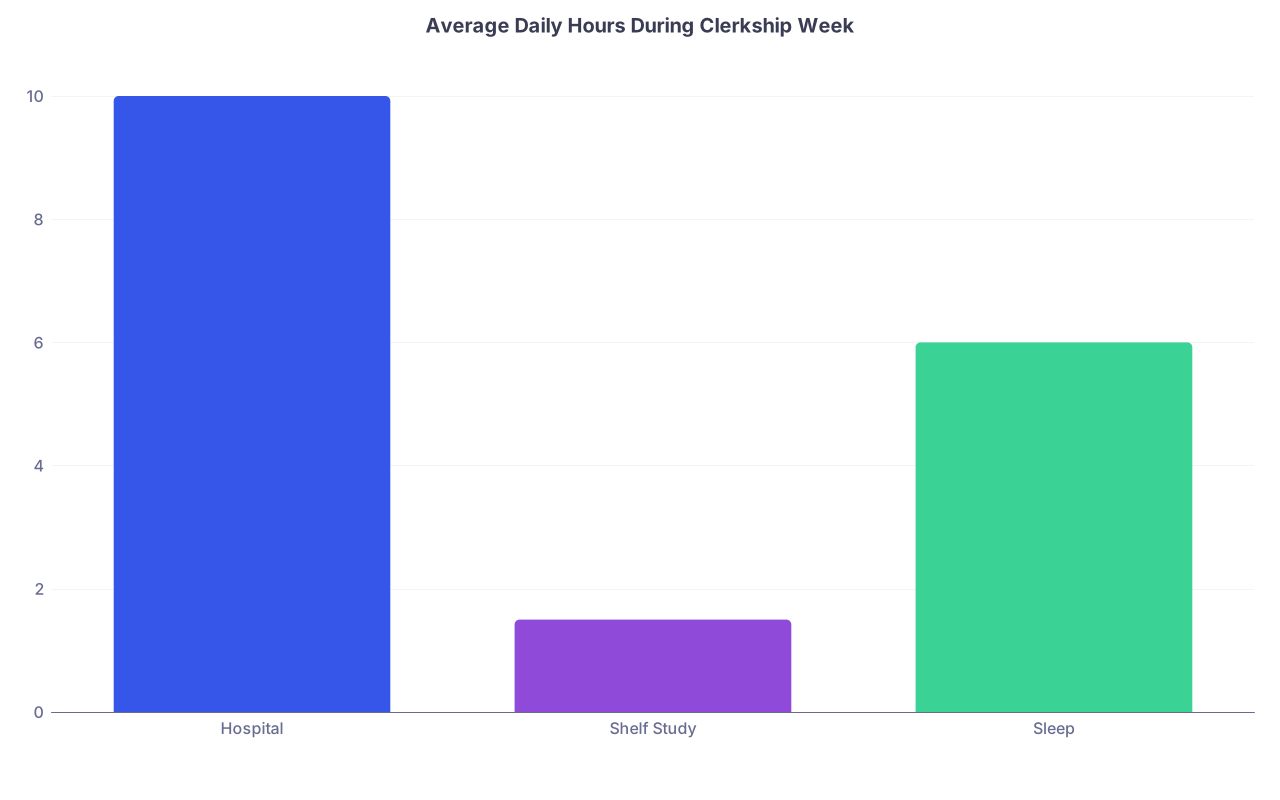
| Category | Value |
|---|---|
| Hospital | 10 |
| Shelf Study | 1.5 |
| Sleep | 6 |
Strong students in heavy rotations (IM, surgery) who maintain or improve scores typically average:
- 9–11 hours in hospital
- 2–3 hours of true, focused shelf study
- 6.5–7.5 hours of sleep
If your “Shelf Study” average is under 90 minutes or your sleep is under 6 hours, the score drop tracks. Your brain is just done.
48-hour deliverable:
By the end of 2 days, you should have:
- Error pattern snapshot (K/A/R/T)
- A rough sense of your daily time split
This tells us what kind of intervention you need.
Step 2: Reset Your System – Simplify, Focus, and Lock a Schedule
You do not have time mid-clerkship to reinvent your life. You need a lean system that:
- Uses one primary Qbank + one primary content anchor
- Fits in 2–3 hours per day, even on busy days
- Prioritizes retention and exam-style thinking, not random content grazing
2A. Ruthlessly Cut Resources
You are allowed:
- One main Qbank (UWorld or AMBOSS; NBME practice forms are for assessment, not daily use)
- One content spine:
- Internal Med / Surgery / Peds: OnlineMedEd or Emma Holliday slides + concise notes
- OB/Gyn / Psych / Neuro: same approach; add a slim review book if you like, but only one
- One memory tool:
- Anki (light, targeted decks) or your own condensed notes – not both in full blast
Everything else goes on hold:
- Extra YouTube channels
- Long video series “explaining everything”
- Second and third question banks
You are not writing a textbook. You are passing a shelf.
2B. Build a Non-Negotiable Daily Template
You need a template that repeats every day. Do not “wing it” based on how you feel after call. That is how scores slide.
Take your 7-day audit and build from reality. Example:
You typically:
- In by 6:30, out by 5:30–6:00
- Totally fried by 9:30–10:00
You build:
On normal days (out by 6 p.m.):
6:00–6:30 p.m.
Eat, decompress, 0 studying6:30–7:45 p.m. (75 minutes)
Block 1 – Timed Qbank set (20–25 questions)- Strict timing
- No looking up answers mid-block
7:45–8:15 p.m. (30 minutes)
Break, shower, short walk8:15–9:00 p.m. (45 minutes)
Block 2 – Review + consolidation- Deep review of missed & marked questions only
- Add 5–15 high-yield cards/notes max
9:00–9:30 p.m. (30 minutes)
Targeted content from your spine based on that day’s misses (see below)10:00 p.m.
In bed. No heroic late-night marathons.
Total:
~2.5 hours focused, repeatable, sustainable.
On heavy days (post-call, late cases):
You drop to a minimum viable dose:
- 25 Qbank questions (timed, no breaks)
- 30 minutes review of only the biggest misses
That is it. You protect sleep over extra content.
2C. Connect Questions → Content Immediately
Here is the key change that stops score decay:
You never do content in isolation. Content follows questions.
Workflow per day:
- Do your timed block (20–40 questions).
- Tag each missed question as K/A/R/T.
- For knowledge (K) and application (A) misses:
- Open your chosen content spine (e.g., OME notes, Emma slides).
- Find the exact topic (e.g., “acute pancreatitis management,” “post-op fever timeline”).
- Read only that section for 3–7 minutes.
- Create 1–3 ultra-condensed notes or flashcards per major gap, e.g.:
- “Post-op day 1–3 fever: atelectasis, treat with incentive spirometry, not abx.”
- “Acute pancreatitis: NPO, IV fluids, pain control. CT only if dx uncertain or no improvement.”
Notice what you are not doing:
- You are not watching a 45-minute video about all of GI.
- You are not starting an entire Anki deck from scratch.
You are wiring your brain the way the exam tests you:
Clinical stem → Recall framework → Apply → Choose.

2D. Decide Your Weekly Question Volume
Mid-clerkship, your goal is not to “finish everything.” It is to reverse the slope of your scores.
Rough targets (per week):
- IM/Surgery: 180–280 questions
- Peds/OB/Psych/Neuro: 150–220 questions
Translate that to daily:
| Rotation Type | Daily Questions (avg) |
|---|---|
| Heavy (IM/Surg) | 30–40 |
| Medium (OB/Peds) | 25–35 |
| Lighter (Psych/Neuro) | 25–30 |
If you are currently doing:
- 10–15 questions here and there: not enough reps
- 60+ questions daily with shallow review: too much volume, not enough learning
You want the sweet spot: 30–40 questions with serious review.
Step 3: Run a Two-Week Turnaround Protocol
Now you have:
- Your error pattern
- A lean resource set
- A daily template
You are going to run a 14-day focused protocol. This is where scores actually turn.
3A. Customize the Protocol to Your Error Pattern
If you are mostly K (Knowledge gaps)
Your problem: You never built a clean mental framework. You are learning in fragments.
Fix:
- Each night after questions, pick 1–2 core topics from your biggest misses. Examples:
- IM: COPD exacerbation vs asthma, chest pain workup, DKA vs HHS
- Surgery: post-op fever, SBO vs ileus, trauma primary survey
- Spend 20–30 minutes on those only, using:
- One concise source (lecture notes, brief video, or high-yield outline)
- Build a one-page cheat sheet per topic over the 2 weeks. Focus:
- Triggers / keywords in stem
- Key labs / imaging patterns
- First-line vs second-line management
By Day 14 you should have ~10–14 tight one-pagers. These are gold in the final week.
If you are mostly A (Application errors)
Your problem: You “know the list” but cannot decide what to actually do next.
Fix:
- Add 5–10 “slow questions” daily:
- Take 3–4 minutes per question.
- Before looking at answer choices, force yourself to:
- Summarize the case in one sentence.
- Say (out loud or in writing): “They are really asking: what is the best next step in management / most likely diagnosis / most appropriate test?”
- Predict the answer conceptually.
- Only then look at the options.
You are training your brain to think clinically, not just pattern-match buzzwords.
If you are mostly R (Reading / rushing)
Your problem: Sloppiness, not intelligence.
Fix (this is mechanical and works fast):
For the next 14 days, for every single question, you must:
- Underline / mentally mark:
- Age, sex
- Time course (acute vs chronic)
- Key vitals, one or two most abnormal labs
- Before selecting an answer, explicitly:
- Re-read the final sentence of the question stem.
- Say in your head: “They are asking for: ___.”
- If you catch yourself finishing a question in under 25 seconds, force a 5-second pause to re-scan for trap words (except / most likely not / initial vs best next).
You will hate this for 3 days. On day 4–5 you stop bleeding points to nonsense.
If you are mostly T (Test-taking / pattern)
Your problem: You pick answers that sound right but do not match exam logic.
Fix:
- Create a simple elimination habit:
- For every question, explicitly cross out / mark two wrong answers first.
- Force yourself to justify discarding them:
- “Too aggressive for stable patient”
- “Not the next step; this is done later”
- “Treats symptom but not cause”
- During review, write down 1-line exam rules when you see them, e.g.:
- “Stable + risk factors → noninvasive test before cath”
- “Always rule out ectopic in reproductive-age woman with pain + bleeding”
- “Never treat asymptomatic bacteriuria unless pregnant or urologic procedure”
You are building your own mini “exam playbook” of decision rules. 20–30 of these can swing several points.
3B. Plan Your NBME Checkpoints
You cannot fly blind. You need data. But you also cannot take an NBME every 4 days. Too much time, too much anxiety.
For a mid-rotation rescue, I like:
- Baseline: You already have at least 1 NBME or school practice exam that showed the drop.
- Checkpoint: One NBME-like assessment 7–10 days after you start the protocol.
- Final: One more NBME (or school practice) within 5–7 days of the real shelf.
Schedule it:
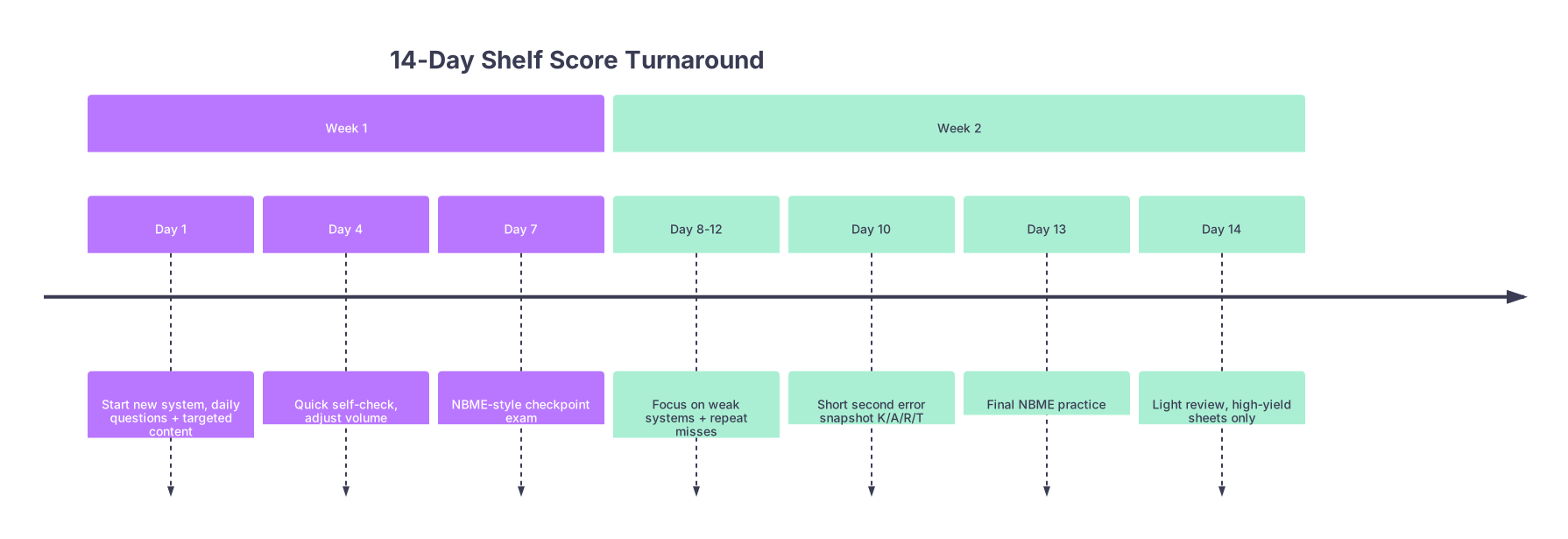
| Period | Event |
|---|---|
| Week 1 - Day 1 | Start new system, daily questions + targeted content |
| Week 1 - Day 4 | Quick self-check, adjust volume |
| Week 1 - Day 7 | NBME-style checkpoint exam |
| Week 2 - Day 8-12 | Focus on weak systems + repeat misses |
| Week 2 - Day 10 | Short second error snapshot K/A/R/T |
| Week 2 - Day 13 | Final NBME practice |
| Week 2 - Day 14 | Light review, high-yield sheets only |
Target trend: even a 5–7 point bump on the NBME between baseline and checkpoint is a good sign that the plane is pulling up.
3C. Use Your Clerkship Days, Do Not Let Them Use You
The shelf is not separate from the rotation. Your brain is sitting on a goldmine of real patients and attending pimp questions. Right now you are probably wasting most of it.
For the next 2 weeks, do this on the wards:
- When you see a classic case (COPD flare, DKA, appendicitis, preeclampsia), quickly jot down 2–3 bullets in your pocket notebook:
- Presenting features
- Key labs/imaging
- What the team actually did first
- That night, do 3–5 questions on that exact topic. Short, focused burst.
- If an attending grills you and you bomb:
- Write the question down word-for-word right after.
- Look it up that night.
- Convert to a 1-line flashcard or note.
You essentially turn every embarrassing moment into points on the exam.
Common Pitfalls That Will Derail the Fix
You now have a structured three-step plan. Here is where students blow it anyway.
Pitfall 1: Panic-Adding Resources
You see a low NBME. You buy:
- A new review book
- Another video course
- A full new Anki deck
Result? You fracture your focus and dilute your time.
Rule: Until after this shelf, you are on a resource “lock.” One Qbank + one content spine + your notes. Nothing else.
Pitfall 2: Review Without Changing Behavior
You spend an hour reading explanations. Then answer the next day’s questions exactly the same way.
Fix: After each review session, ask:
- “What will I do differently on the next question like this?”
If you cannot state a behavioral change in one sentence, you did not really learn.
Pitfall 3: Sacrificing Sleep to Chase Volume
You push to 1 a.m. to hit 60 questions. Next day in clinic, your brain is sludge.
Sleep is not optional. Memory consolidation is not a myth; I have watched sharp students implode by trying to out-grind physiology.
Rule of thumb:
If it is past 11 p.m. and you are still studying mid-clerkship, you are probably harming your long-term score.
Quick Case Study: What This Looks Like in Real Life
Student: M3 on Surgery, week 3
- Baseline NBME-equivalent: 68
- Two weeks later (self-studying randomly): 61
- Panic, email: “I think I am going to fail the shelf.”
We ran exactly what I just laid out:
- Error snapshot: 50% K, 30% A, 20% mixed R/T
- Time audit: 12+ hours in hospital, ~1 hour “sort of” studying, 5.5 hours sleep
- Intervention:
- Cut resources down to UWorld + one surgery rapid review
- Daily: 30 questions + structured review + 25–30 minutes targeted content
- Sleep minimum: 6.5 hours
- Two-week protocol with a checkpoint NBME at day 10
Results:
- Day 10 NBME: 72
- Final practice 4 days before exam: 76
- Real shelf: passed solidly, not honors, but no remediation and no asterisk on the transcript.
Was it magic? No. It was focused reps + sleep + no new shiny objects.
Your Action Plan for the Next 24 Hours
Here is exactly what you do today and tomorrow:
Today:
- Do a 40-question timed block from your primary Qbank.
- Tag every miss as K/A/R/T and count your pattern.
- Make a list of all resources you are using. Circle:
- One Qbank
- One content source
Everything else goes on pause.
Tomorrow:
- Sketch your daily template around your real schedule (start/end times, meals, commute).
- Set a question target for the next 7 days (e.g., 30/day = 210 for the week).
- Pick a date 7–10 days from now for your checkpoint NBME and block 3 hours for it.
Then, start the protocol. Not next week. Tonight.
Open your Qbank, set 20–25 questions to timed, mixed, and run your first block using the new rules above. That is the first brick in turning the scores around.