
Failing a shelf exam is not a sign you do not belong in medicine. It is a sign your current system is broken. Systems can be rebuilt.
Let me be direct. I have watched excellent future physicians fail shelves, repeat rotations, and still match into strong residencies. I have also watched students ignore the warning and spiral into remediation on Step 2, probation, and near-dismissal. The difference was not intelligence. It was what they did in the 2–4 weeks after the failure.
This is your damage-control window. You are going to use it.
Step 1: Stop the Bleeding (First 48–72 Hours)
Your first goal is not to study harder. It is to stop making the situation worse academically and psychologically.
1.1 Get the facts in writing
Do not guess. Do not rely on rumors from classmates.
You need:
- The exact score and the passing cutoff
- The full grading policy for your clerkship and shelves
- How this failure affects:
- Rotation grade
- Transcript
- Class standing / academic status
- Remediation requirements and timing
Write an email to your clerkship coordinator or academic affairs that looks roughly like this:
“Dear [Name],
I received my [Clerkship] NBME shelf score and understand that it did not meet the passing threshold. I want to ensure I fully understand the implications and the remediation plan.
Could you please confirm:
- The passing cutoff for this exam
- How this result affects my clerkship grade
- The required remediation steps and expected timeline
I am committed to addressing this promptly and effectively.
Sincerely,
[Your Name]”
You are not arguing. You are gathering rules so you can play the game correctly.

1.2 Prevent a chain reaction
Your risk now is a domino effect: one failed shelf → panicked over-studying → poor clinical performance → another weak shelf → Step 2 disaster.
You need to:
- Tell your current attending or senior that you are dealing with an assessment issue and are actively addressing it. Keep it brief, professional.
- Do not massively cut sleep to “make up for it” this week. Chronic sleep debt is how you fail the next test too.
- Avoid immediate, drastic changes to every study method you use. You will do a structured post-mortem first.
1.3 Allow 24 hours for emotional decompression
You do not need to “be fine” instantly. You do need to avoid self-destruction.
For 24 hours:
- No rewriting your entire life plan
- No telling yourself you are stupid, an impostor, or doomed
- No impulsive withdrawal from rotations or boards registration
Do three things instead:
- Tell one trusted person (classmate, partner, mentor). Say the words. Shame gets weaker when exposed.
- Move your body: 30–45 minutes walk, run, gym. You need to drain the adrenaline.
- Sleep like it is pre-call night: 7–9 hours, phone away from the bed.
Then the emotional phase ends. You are switching to engineer mode.
Step 2: Dissect the Failure (Brutal But Necessary)
You cannot fix what you have not precisely defined. “I just did not study enough” is lazy analysis. You are going to be specific.
2.1 Identify the true failure mode
Your failure is usually a combination of 4 domains:
- Content knowledge gaps
- Question strategy / test-taking errors
- Time management issues
- Systemic overload (burnout, schedule mismanagement)
You are going to score yourself (1–5) on each, honestly.
| Domain | 1 (Low Problem) | 5 (Severe Problem) |
|---|---|---|
| Content knowledge gaps | ||
| Question strategy errors | ||
| Time management on exam | ||
| Burnout / overload |
Fill this out. Do not overthink. Your gut is usually right.
2.2 Forensic review of your prep history
Pull out:
- Study schedule or planner (if you had one)
- Question bank history (UWorld, AMBOSS, etc.)
- NBME practice tests (if any)
Answer these, briefly, in writing:
- How many questions per week did you actually complete?
- What was your average Q-bank percentage?
- Did you complete at least 70–80% of a high-quality Q-bank?
- Did you do any timed, exam-length blocks before the real shelf?
- How many hours per week of focused study did you average? Not “time sitting near a book.”
If your honest answer is “I have no idea,” then poor tracking and lack of objective feedback was one of your main problems. That is fixable.
2.3 Performance pattern on the exam (if available)
If your school provides a breakdown (by system or topic), use it. If not, reconstruct from memory while it is fresh:
- Did you run out of time and guess on the last 10–15 questions?
- Did you find yourself constantly changing answers?
- Were there question stems you literally did not recognize conceptually?
- Did you panic early (first 10 questions) and never recover?
If you had a practice NBME:
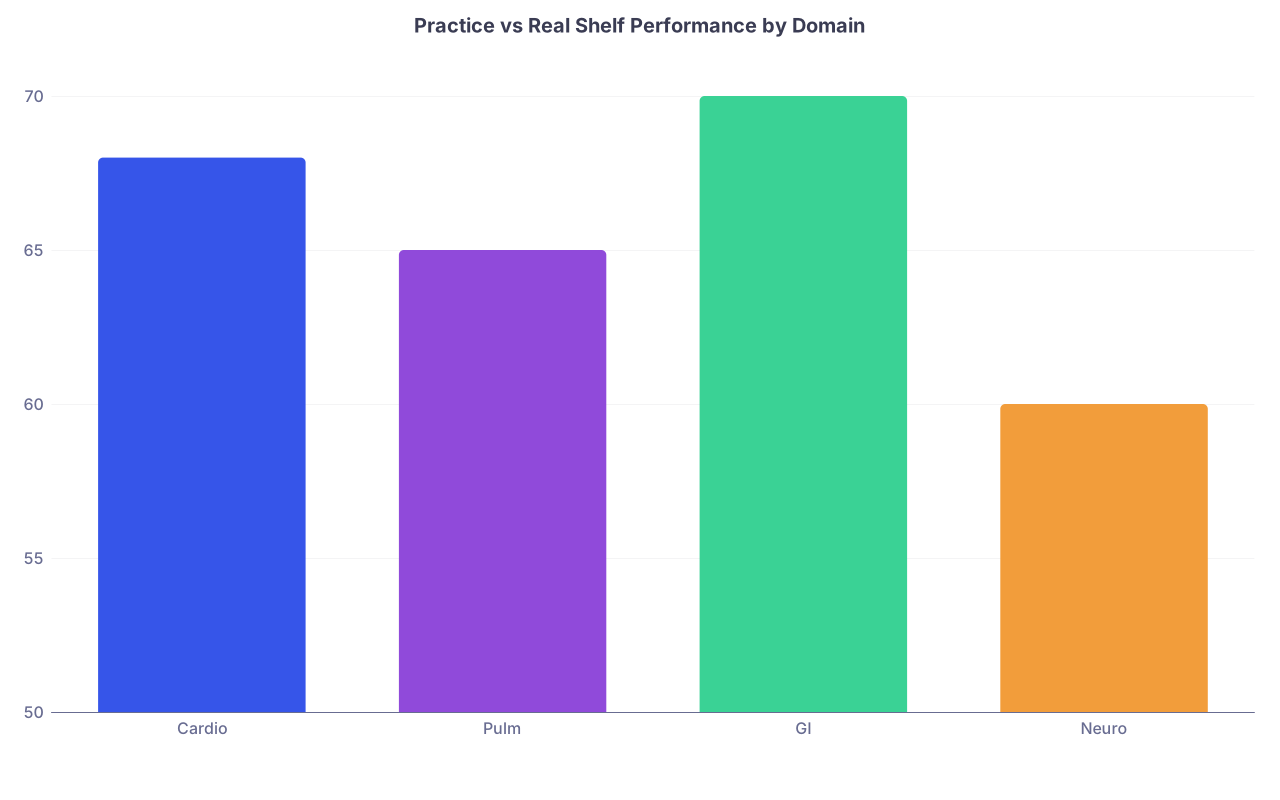
| Category | Value |
|---|---|
| Cardio | 68 |
| Pulm | 65 |
| GI | 70 |
| Neuro | 60 |
If your scores dropped unexpectedly from practice to real, that points to stress or timing more than raw knowledge.
Step 3: Talk to the Right People (Not Everyone)
Random classmate advice is how you got here. You need targeted, experienced input.
3.1 Meet with your clerkship director or site director
You are not begging. You are collaborating.
Agenda for a 20–30 minute meeting:
Brief recap:
- “I failed the shelf with a score of X; cutoff is Y.”
- “My clinical evaluations have been [state actual feedback: strong/average/concern].”
Show that you have reflected:
- “I reviewed my prep. I completed [X]% of UWorld/AMBOSS with [Y]% correct, but I did not regularly do timed blocks or full-length practice NBMEs.”
Ask for targeted feedback:
- “From your perspective, what do students who bounce back from a failed shelf usually do differently?”
- “Are there institutional resources (tutors, faculty coaches) you recommend I work with?”
Clarify logistics:
- “When will I be allowed/required to retake the shelf?”
- “Does this necessitate repeating the rotation, or is a successful retake sufficient?”
You are collecting constraints and resources.
3.2 Schedule a session with academic support or learning specialist
If your school has one, use them. And do not sugarcoat.
Bring:
- Your self-assessment from Step 2
- Q-bank history screenshots
- Any practice NBME score reports
Tell them explicitly: “I am not looking for generic study tips. I want a concrete 4–8 week rescue plan to pass my next shelf and my remediation.”
They should help you build that; if they do not, we will do it in Step 4.
3.3 Decide who else actually needs to know
You do not need to broadcast your failure to every group chat. A tight circle:
- One or two classmates whose study habits you respect
- A trusted resident/mentor in that specialty or another core field
- Your partner / closest friend
That is it. Over-sharing tends to invite noise, pity, and bad advice.
Step 4: Build Your Academic Rescue Blueprint (4–8 Weeks)
Now the work. This is where most students either overreact and burn out, or underreact and repeat the same outcome. You are going to be surgical.
You must simultaneously:
- Pass the next shelf
- Prepare for the remediation shelf
- Hold your clinical performance steady
So your plan has three layers:
- Daily structure
- Content and Q-bank strategy
- Assessment and feedback loop
4.1 Non-negotiable: Daily structure that you can actually follow
You need a realistic, repeatable weekday template. Example for a typical clerkship day:
- 06:00–06:30: Quick review (Anki or flashcards) – 30 min
- Clinical day (rounds, cases, notes)
- 17:30–18:15: Break, food, decompress – 45 min
- 18:15–20:00: Q-bank block + review – 1 h 45 min
- 20:00–20:30: Short content fill-in from missed questions – 30 min
- 22:30: Hard stop, sleep target – at least 7 hours
Weekend template:
- Morning: 2 x 40-question timed blocks + review (3–3.5 hours total)
- Afternoon: Targeted content review of weakest systems / UWorld incorrects (2 hours)
- Evening: Light review only (Anki, quick tables, algorithms)
Adjust for your specific rotation hours. But the pattern stands:
- Daily questions
- Daily review
- Weekly deep dive
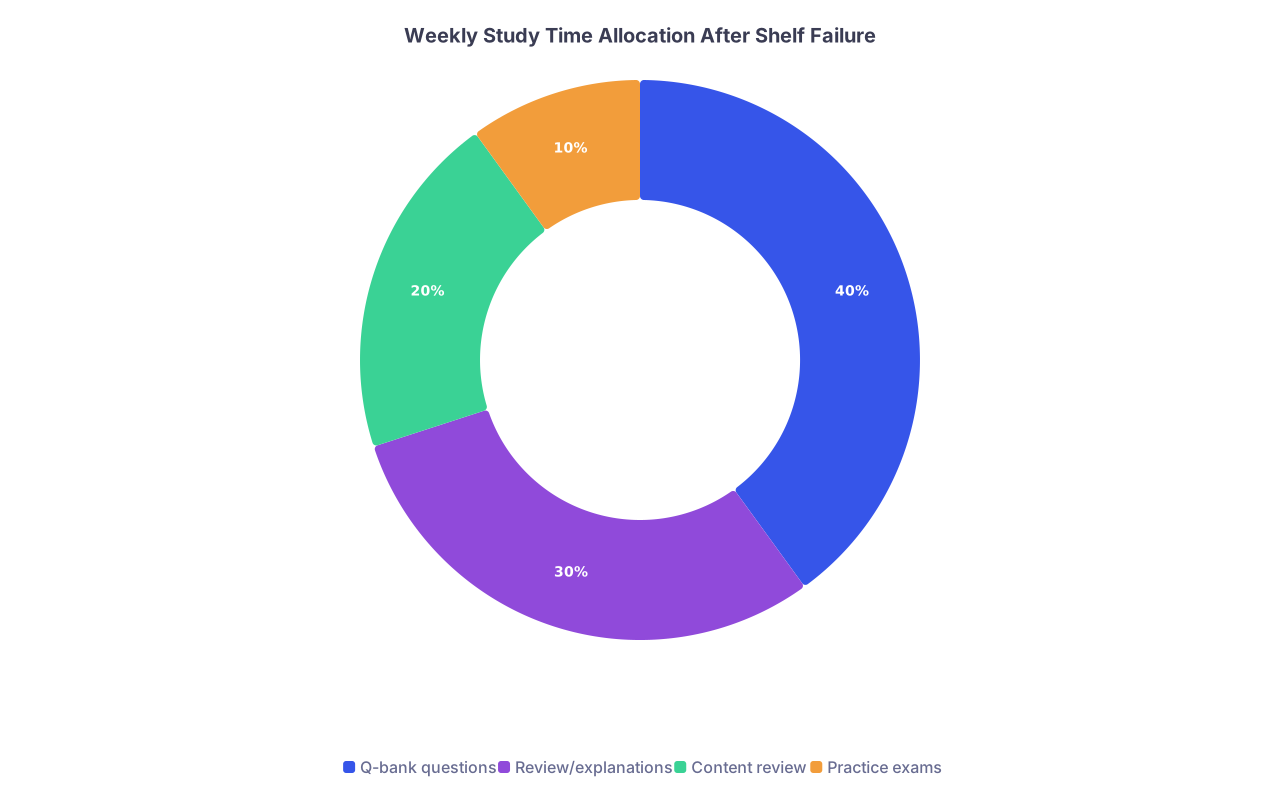
| Category | Value |
|---|---|
| Q-bank questions | 40 |
| Review/explanations | 30 |
| Content review | 20 |
| Practice exams | 10 |
This is the ratio you are aiming for: heavy on practice and review, not endless passive reading.
4.2 Q-bank: How to use it like an adult, not a victim
Most students “do questions.” Few exploit them.
Your rules:
Mode: Timed, random blocks once you are 1–2 weeks into the rotation. Not tutor mode, not same-topic binge forever.
Block size:
- Weekdays: 20–40 questions
- Weekends: 2 x 40-question blocks
Review method (the real studying):
- For each question:
- Identify why you got it wrong:
- Did not know fact
- Misread question
- Narrowed to 2 and chose wrong
- Time pressure
- Write a 1–2 line rule or takeaway, not an essay.
- Example: “Post-op day 3 fever + atelectasis myth – more likely UTI, pneumonia, or line infection. Think sources.”
- Identify why you got it wrong:
- For each question:
If you are not reviewing like this, you are just collecting statistics, not building skills.
4.3 Content: Laser-focused, not Encyclopedia of Medicine
You do not have time to read every chapter. You need high-yield, rotation-specific resources.
For each clerkship, pick:
- 1 primary question bank (UWorld/AMBOSS)
- 1 concise text or video series (e.g., OnlineMedEd, De Virgilio for surgery, Case Files)
- Optional: Anki deck aligned to the shelf (Zanki, AnKing, clerkship-specific decks)
Then apply this rule:
- Q-bank drives your content.
- Content fills in what questions expose.
If you missed multiple questions on nephrotic vs nephritic syndromes, that triggers:
- 30–45 minute focused review of that one topic
- Maybe a short YouTube/OnlineMedEd video
- A quick table summarizing differences
You are not allowed to “start reading the whole renal chapter because I feel weak there.” That is how you waste hours you do not have.
Step 5: Design Your Remediation Strategy Without Nuking Everything Else
You probably have one of these scenarios:
| Scenario | Remediation Timing |
|---|---|
| Retake during same rotation | End of current rotation |
| Dedicated remediation block | 2–4 weeks off rotations |
| Retake during another clerkship | Evening/weekend studying |
| Repeat the entire rotation | Fresh shelf at the end |
Each scenario has a different risk profile.
5.1 If retake is during the same rotation
Problem: You have limited extra time.
Plan:
- Protect 1–1.5 hours per weekday and 3–5 hours per weekend day for shelf prep.
- Reduce non-essential commitments (research meetings, extra shadowing, side jobs) temporarily. This is not forever.
- Use your Q-bank data to identify 2–3 weakest systems and over-represent those in your weekend blocks.
Your target is not to become a master of the field. It is to get your aggregate competency above the passing standard.
5.2 If you get a dedicated remediation block (2–4 weeks)
Use it like a bootcamp. Most students waste this time with half-intensity effort.
Your 4-week blueprint might look like:
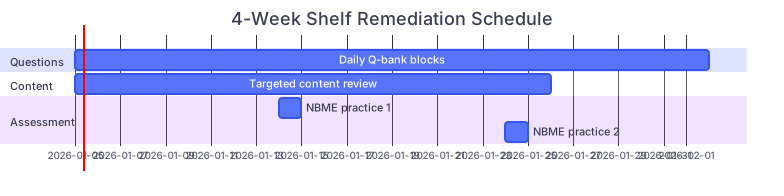
| Task | Details |
|---|---|
| Questions: Daily Q-bank blocks | a1, 2026-01-05, 28d |
| Content: Targeted content review | a2, 2026-01-05, 21d |
| Assessment: NBME practice 1 | a3, 2026-01-14, 1d |
| Assessment: NBME practice 2 | a4, 2026-01-24, 1d |
- Week 1–2:
- 60–80 questions/day (2 x 40 or 3 x 30)
- Aggressive review, build notes on recurrent misses
- Week 3:
- First NBME practice exam → analyze results
- Focus on 2–3 weakest systems with deeper content pass
- Week 4:
- Second NBME or mixed UWorld self-assessment
- Taper to 40–60 questions/day with more emphasis on review and mental freshness before the exam
You treat this like Step 2 prep in miniature.
5.3 If retake overlaps with a different clerkship
You are now running two marathons at once. Dangerous, but manageable with boundaries.
- Limit total academic work (clinical + studying) to 12–13 hours most days. Beyond that, quality plummets.
- Build a rotation-neutral study slot: e.g., 20:00–22:00 every weeknight is “shelf rescue time,” no matter which service you are on.
- Lighten expectations: you are not chasing honors on this overlapping rotation; you are securing your academic survival.
Step 6: Fix Your Test-Taking Mechanics
Some of you did know enough and still failed. That is a test-taking problem, not purely knowledge.
Three big mechanical issues:
- Poor time management
- Answer changing without strategy
- Crumbling under pressure
6.1 Time: Stop donating points in the last 15 questions
Your rule on practice and real exams:
- 1 question every ~75 seconds on a 2-hour/100-question exam, or whatever matches your shelf’s timing.
On every block you do:
- At the halfway mark (time and question count), check: are you roughly halfway done? If not, speed up slightly.
- If you are stuck >90 seconds on a question, you will:
- Eliminate 1–2 obvious wrong choices
- Pick the best remaining
- Mark it, move on
No heroic marathons on one stem. You are trading 1 maybe-point for 3–5 sure points later.
6.2 Answer changing: Put yourself on a leash
You follow this simple rule:
- You are allowed to change an answer only if:
- You misread the question stem or answer choice initially
- You recall a new, specific fact that clearly changes the likelihood
You are not allowed to change because “this other option feels better now” without new evidence. On practice blocks, track how often changing answers helps versus hurts. Most students discover they are sabotaging themselves.
6.3 Pressure: Simulate the real thing, repeatedly
If you only ever do 10-question untimed blocks at midnight, of course the real shelf feels like a different planet.
At least once a week until your retake:
- Do a full-length or near-full-length timed block (60–100 questions).
- Sit at a desk. No phone. Only allowed breaks match the real exam.
- At the end, rate your anxiety 1–10 and track over time.
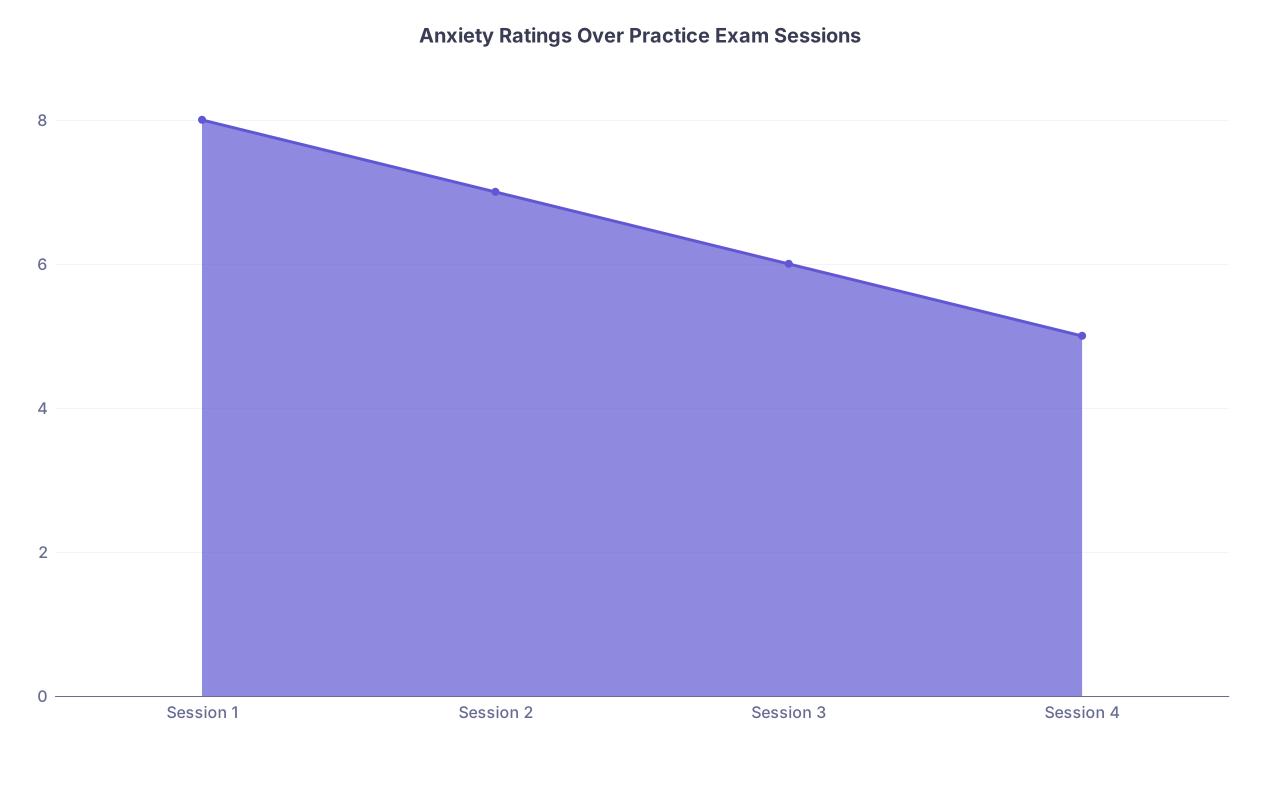
| Category | Value |
|---|---|
| Session 1 | 8 |
| Session 2 | 7 |
| Session 3 | 6 |
| Session 4 | 5 |
If anxiety stays ≥8 despite repeated simulations, you should include a mental health professional in your plan. That is not weakness. That is professional risk management.
Step 7: Contain the Damage to Your Record and Future Plans
Failed shelves do not automatically kill your residency chances. But they are not invisible either. Your job is to keep this as a single data point, not the beginning of a pattern.
7.1 How schools and programs typically see it
I have seen:
- One failed shelf + strong retake + solid Step 2: usually explained and forgiven.
- Multiple failed shelves, especially without upward trend: red flag.
- Failed shelf + low Step 2 + remediation: serious concern.
You must engineer an upward trajectory:
- Pass the retake, ideally with a comfortable margin
- Show stable or improving performance on subsequent shelves
- Crush Step 2 within realistic bounds of your ability
7.2 Control what you can on paper
You control:
- Step 2 score (one of the strongest counterweights)
- Clinical evaluations: be the student residents want on their team
- Narrative comments from attendings who can later write strong letters
- How you explain this blip in your Dean’s letter/ERAS personal statement if it comes up
If asked directly in an interview or later in your career:
- Own it: “I failed my [X] shelf.”
- Show insight: “My approach relied too heavily on passive reading and I was not doing timed practice blocks; I was also stretched too thin on extra commitments.”
- Show change: “Since then I built a structured question-based system, passed the retake, and my subsequent shelves and Step 2 improved progressively.”
That confession + concrete growth story is survivable.
Step 8: Burnout, Mental Health, and When to Pull the Brake
Sometimes the failed shelf is not the problem. It is the symptom.
Warning signs I have seen students ignore:
- You are chronically sleeping 4–5 hours per night
- You have lost interest in everything outside medicine
- You are using caffeine, stimulants, or substances just to stay functional
- You feel numb, hopeless, or fantasize about walking away from everything
If that sounds close, your academic rescue blueprint must include:
- Appointment with student mental health or counseling within 1–2 weeks
- At least one full day off every 7–10 days. Not a “study light” day. A real day off.
- A realistic ceiling on daily studying. More is not always better when you are cooked.
No shelf exam is worth a psychiatric hospitalization. I have watched students get that close. You are not going to be one of them.
Step 9: Turn This Into a System, Not a One-Off Fix
The point of this mess is to force you to build a system that will carry you through:
- Remaining shelves
- Step 2
- In-service exams in residency
Your system going forward should include:
Quantified tracking
- Weekly targets for questions, hours, and practice blocks
- Quick Sunday night check-in: “Did I hit 70–80% of what I planned?”
Regular formative assessment
- Practice NBMEs at predictable intervals
- Honest review of score trends, not wishful thinking
Feedback loop with a mentor
- Send a short update every 4–6 weeks to a mentor or academic coach:
- “Here is my recent shelf score / NBME,”
- “Here is what I changed in my approach,”
- “Here is my plan for the next block.”
- Send a short update every 4–6 weeks to a mentor or academic coach:
Basic life infrastructure
- A default sleep window
- A default exercise plan (even 2–3 times/week)
- A “no study” block each week to prevent slow-burn collapse

What You Do Today
You are not going to fix this in your head. You are going to take one concrete action before you go to bed.
Do this now:
- Open a blank page (paper or digital).
- At the top, write: “[Clerkship] Shelf Failure – Rescue Plan.”
- Answer these, in short bullet points:
- Why did I actually fail? (3–5 specific reasons)
- What is my earliest possible retake date?
- Which Q-bank and resource will be my primary tools?
- Schedule two things on your calendar:
- A 20–30 minute meeting with your clerkship director or academic support
- Your next timed 40-question block within 48 hours
Then do that timed block. Start rebuilding your system, one question at a time.