
Pimping does not make you smarter. How you respond to pimping does.
Let me be blunt. You are not freezing up because you are dumb, unprepared, or “not cut out for medicine.” You are freezing up because pimping is a deliberately stressful, public performance exercise that nobody actually teaches you how to handle.
So I will.
This is the playbook I wish every MS2 got handed before stepping onto the wards. You cannot control who pimps you, when it happens, or how fair the questions are. You can control your response, your preparation, and your recovery.
We will fix three things:
- What you do before rounds (so you have something useful to say)
- What you do during questions (so you stop going blank)
- What you do after (so every painful moment actually improves you)
1. Understand What Pimping Really Is (And What It Is Not)
Pimping is not an exam. It is a performance. Different rules.
Most students freeze because they misinterpret what is being graded. They think:
- “If I do not know the answer, I fail.”
- “If I say ‘I do not know,’ they will think I am lazy.”
- “If I guess and I am wrong, I will look stupid in front of everyone.”
Reality on most teams:
- You are being evaluated on how you think, not just recall.
- Showing organized reasoning under pressure scores higher than a random correct fact you got from a cheat sheet.
- How you handle being wrong matters as much as being right.
Let me decode what many attendings are actually probing when they pimp:
| What They Ask | What They Are Really Looking At |
|---|---|
| “What’s your differential for…?” | Organization of thinking |
| “Why did you choose that drug?” | Understanding of reasoning, basics |
| “What lab would you order next?” | Prioritization and clinical judgment |
| “What’s the mechanism of…?” | Depth of basic science recall |
| “What’s the next step?” | Safety and knowledge of guidelines |
If you see pimping as a firing squad, you will freeze.
If you see it as a live demo of how you think, you can start managing your performance.
2. Pre-Rounds Protocol: Prepare to Be Pimped (Smartly)
You cannot “out-study” pimping. There is infinite content. But you can target what gets asked most and set up mental scaffolding so you have something to say even when you do not know the exact answer.
2.1. The 30-Minute “Anti-Freeze” Prep
Night before or early morning, run this for your main patients. Not a 4-hour rabbit hole. Thirty focused minutes.
For each patient, quickly outline:
One-liner
“65-year-old male with history of COPD presenting with 2 days of worsening shortness of breath, admitted for COPD exacerbation.”Top 3 diagnoses / problems
- COPD exacerbation
- Possible pneumonia
- Hypoxemia
For each key problem, list these 4 items:
- Likely etiology or cause
- Key data that supports it (labs, imaging, exam)
- 1–2 alternative diagnoses
- Most important next step in management or workup
That gives you automatic talking points when asked things like:
- “What is your differential?”
- “Why do you think it is X and not Y?”
- “What do you want to do next?”
Now layer in one high-yield fact per problem:
- COPD: “First-line inpatient therapy is systemic steroids + bronchodilators; antibiotics if concern for infection — most often a macrolide or doxy depending on risk factors.”
- CHF: “Most common cause is ischemic heart disease, watch for triggers like dietary indiscretion, medication non-adherence, new arrhythmia.”
You are not trying to become an UpToDate PDF in human form. You are building just enough content to avoid going blank.
2.2. Predictive Pimping: Call Your Own Shots
On each patient, ask yourself:
- “If I were the attending, what three questions would I ask a student about this case?”
Write them down. Then answer them.
Example – patient with new onset atrial fibrillation:
- What causes atrial fibrillation?
- How do you decide whether to anticoagulate?
- How do you rate control vs rhythm control?
This kind of predictive work is powerful. I have seen entire weeks where 50% of the questions asked in rounds were versions of what a student predicted the night before.
2.3. Build Personal One-Page “Pimp Sheets”
Have one physical sheet or small notebook per rotation with your pimp “hot spots”:
- Internal medicine: chest pain workup, shortness of breath, altered mental status, sepsis, electrolyte derangements.
- Surgery: pre-op clearance basics, post-op fever differential, wound infection vs dehiscence vs seroma.
- Pediatrics: vaccine schedule, dehydration assessment, bronchiolitis vs asthma basics.
- OB/GYN: stages of labor, categories of fetal heart tracings, hypertensive disorders of pregnancy.
Each topic: 5–7 bullet points max. You are not rewriting the textbook; you are giving your brain handles.
Keep it in your white coat. Flip it during dead time. That is your “between-patients” training ground.
3. On-the-Spot Technique: How to Answer Without Freezing
This is where most students fall apart. They know content at home. On rounds, their brain does a hard reboot.
The fix is not “know more.” The fix is having a default structure for what comes out of your mouth when you are under fire.
3.1. Use the “Pause–Repeat–Structure–Answer” Method
Here is the protocol, step by step:
Pause (1–2 seconds)
Do not fire off the first random thing that pops up. Take a breath.Repeat or Reframe the Question
- “You are asking what the next step in management should be for this patient with…”
- “So you are asking for the causes of anion gap metabolic acidosis?”
This buys your brain time and confirms you heard correctly.
Announce Your Structure
Before the specific answer, give them the shape of what you are about to say:- “I would divide the causes into pre-renal, intrinsic, and post-renal.”
- “I think about this in three steps: initial stabilization, diagnostic workup, and then long-term management.”
- “I would consider life-threatening causes first, then more common benign causes.”
Deliver a Confident, Bounded Answer
Even if incomplete:- “For life-threatening causes of chest pain, I think of MI, aortic dissection, PE, tension pneumothorax, and esophageal rupture.”
- “Initially I would stabilize with airway and breathing assessment, ensure IV access, get an EKG, and check troponins, then proceed to additional labs and imaging as indicated.”
This does three things:
- Shows organized thinking
- Prevents the “uh… uh…” freeze
- Lets them interrupt you in a useful way (“Good. Now focus on the dissection workup.”)
3.2. Use “Floor Answers” When You Do Not Know
You will not know many answers. That is fine. What is not fine is going silent.
Use a floor answer: a structured, honest response that still shows thought.
Template:
- Admit your limit.
- Offer your best guess or partial reasoning.
- State how you would look it up.
Examples:
- “I do not recall the exact percentages, but my understanding is that the most common cause of community-acquired pneumonia in adults is still Strep pneumoniae, followed by atypicals like Mycoplasma. I would confirm those numbers in UpToDate.”
- “I am not sure of the specific classification system, but I know fetal heart tracings are divided into categories 1 through 3, with category 3 being high-risk requiring prompt intervention. I would review the criteria tonight and can report back.”
- “I do not know the answer to that right now. I would start by checking our hospital guidelines and a recent review article and follow up with an answer tomorrow.”
You get credit for:
- Humility without collapse
- Reasoning
- Initiative to close the gap
What loses you points is pretending you know when you do not, or going mute.
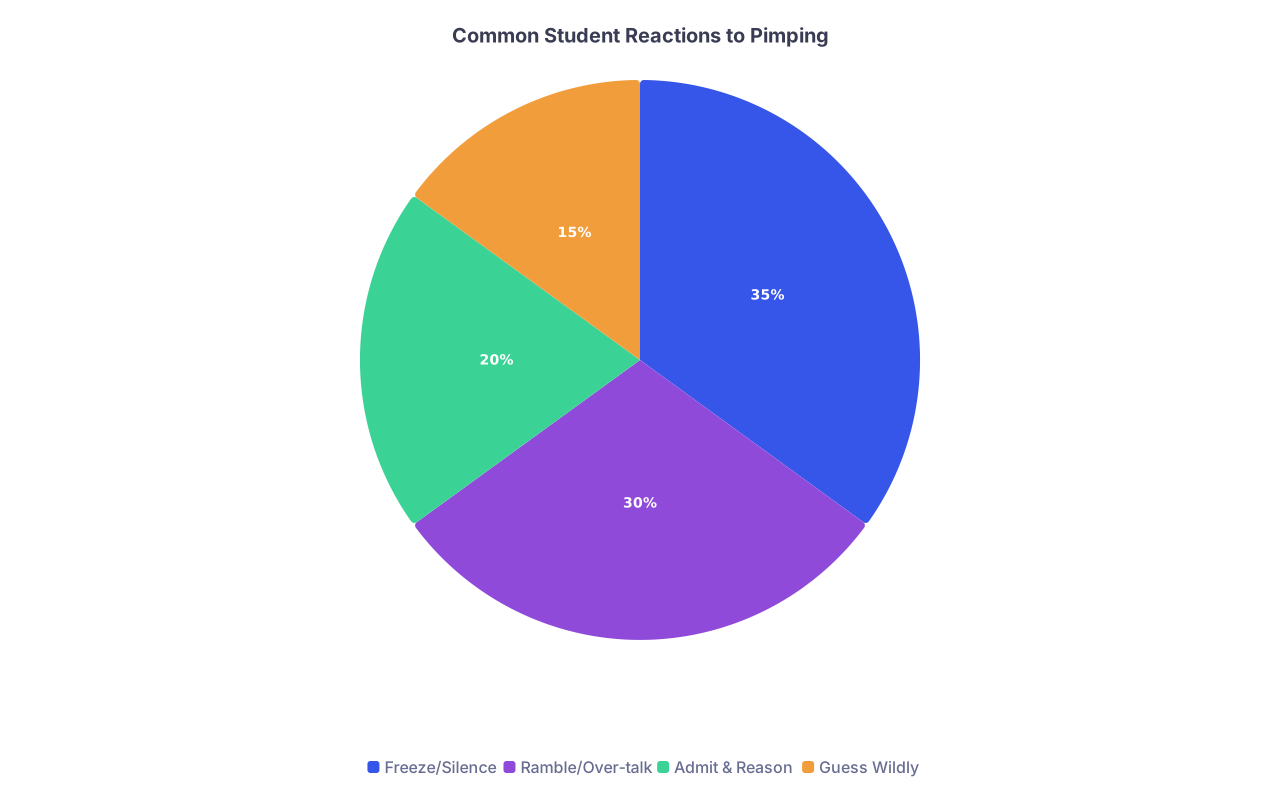
| Category | Value |
|---|---|
| Freeze/Silence | 35 |
| Ramble/Over-talk | 30 |
| Admit & Reason | 20 |
| Guess Wildly | 15 |
4. Script Your Phrases: Stop Improvising Under Stress
You should not be inventing your language while your amygdala is in fight-or-flight mode. Have stock phrases ready.
4.1. When You Kind of Know But Not Fully
- “I am not completely sure, but my understanding is that…”
- “I might be mixing this up, but I think the key factors are…”
- “I believe the main step here would be…, and I would confirm the exact details.”
This signals: I am trying, I have something, but I know my limits.
4.2. When You Are Totally Lost
- “I am honestly not sure. I would need to read about that.”
- “I do not know the answer to that right now, but I would be interested in looking it up and getting back to you.”
- “That is not something I have learned yet; how would you approach it?”
The last one is especially good: it flips the situation into a teaching moment without sounding defensive.
4.3. When They Push Deeper and You Are at the Edge
Attending: “Okay, but what is the mechanism at the receptor level?”
You:
- “That is where I get fuzzy. I know it blocks beta-1 receptors in the heart, decreasing heart rate and contractility, but I cannot recall the downstream second messenger pathways.”
This is honest, bounded, and gives them a clear target to teach into.
5. Managing the Emotional Side: Staying Functional, Not Crushed
Let us not pretend this is just academic. Pimping hits pride, anxiety, impostor syndrome. I have watched excellent students walk off rounds convinced they were idiots because they missed a trivia-level question.
You will not stop feeling things. The trick is preventing those feelings from controlling your performance.
5.1. Normalize Being Wrong—Explicitly
Set a mental rule:
If I get everything right, I am being under-challenged.
You are supposed to miss questions. If you are not missing questions, the teaching level is wrong.
After rounds, ask yourself:
- “Did I think clearly, even when I did not know?”
- “Did I handle being wrong with composure?”
- “Did I get at least one useful new teaching point out of today?”
That is success. Not “I aced every question.”
5.2. Micro-Resets During Rounds
If one question goes badly, students often mentally check out for the rest of rounds. They spiral.
Practice a quick reset after a rough moment:
- Inhale for 4 seconds.
- Hold for 4.
- Exhale for 6.
- Internally say, “Next question.”
You are basically telling your nervous system: we are done with that one. Move on.
5.3. Separate Reputation From One Bad Day
Everyone has “that day”:
- Post-call attending in a bad mood.
- Obscure cardiology question on your first day on the service.
- You are tired, hungry, your brain is mush.
Do not build a narrative: “They all think I am incompetent.” You do not know what they think. What you can control is:
- Show up prepared the next day.
- Reference prior teaching: “Yesterday you mentioned X, so I read about it and found…”
- Demonstrate trajectory. Faculty love visible improvement.

6. Turn Pimping into a Learning Engine (Not Just Survival)
Most students treat pimping like dodgeball: avoid getting hit, survive the game. That is a waste.
Use it as a targeted feedback system.
6.1. The 10-Minute Post-Rounds Debrief
After rounds, before you scroll your phone or collapse:
Write down questions you were asked that you:
- Did not know
- Knew partially
- Knew but answered poorly / disorganized
Pick three max. Look them up properly:
- Brief UpToDate read
- One good diagram or table if needed
- Jot 3–5 bullet points in your “pimp sheet”
Optional but powerful: Tell the attending or resident the next day:
- “I looked up the causes of anion gap metabolic acidosis you asked yesterday. The main ones I remember are…”
- “You asked about the management of DKA; I read about it and made a quick outline if you want to see if I missed anything.”
This does two things:
- Reinforces learning like nothing else.
- Signals work ethic and responsiveness, which almost always shows up positively in evaluations.
6.2. Build a Rotation-Specific “Question Bank”
For each rotation, maintain a running list:
- Questions attendings actually ask.
- Pearls they repeat often.
- “Classic” pimp questions (e.g., “5 causes of post-op fever,” “Why not use beta-blockers in cocaine chest pain?”).
By week 2 or 3, you have a high-yield, reality-based micro syllabus. Way more useful than vague “know everything about CHF.”
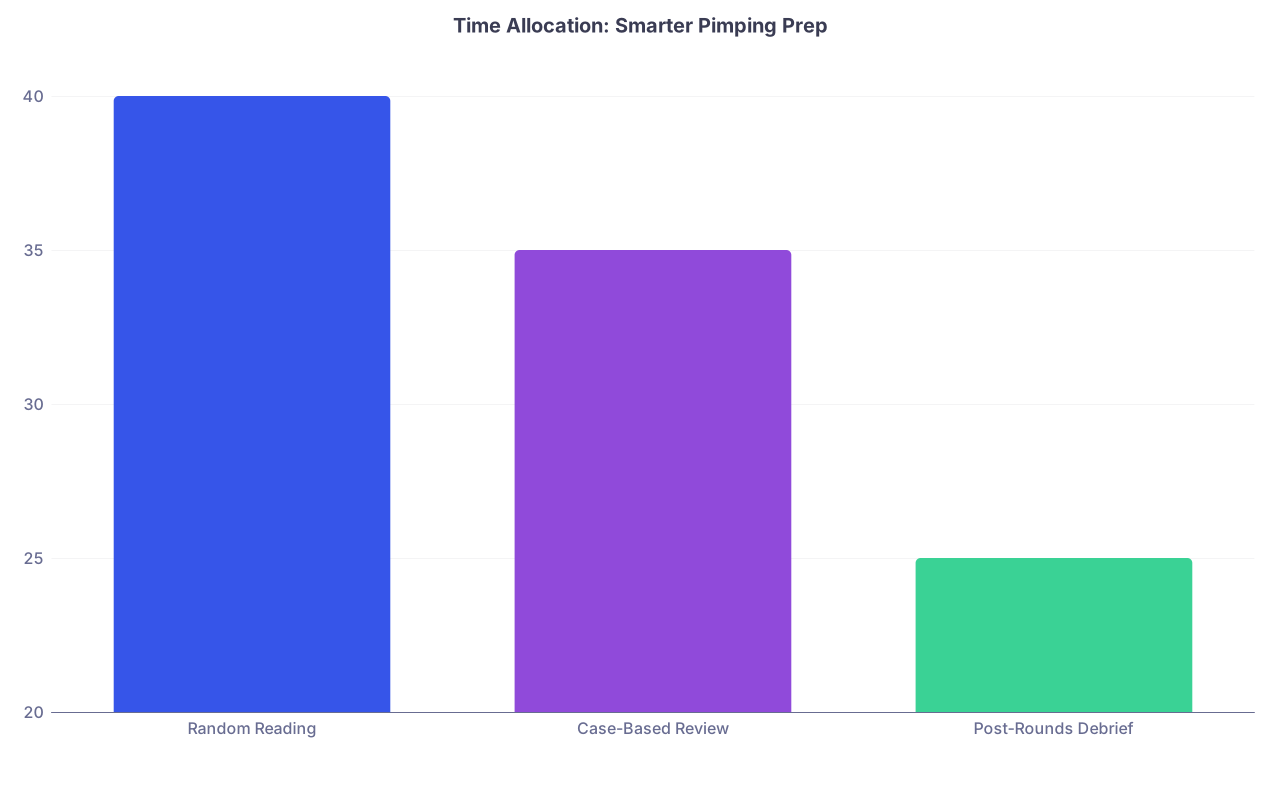
| Category | Value |
|---|---|
| Random Reading | 40 |
| Case-Based Review | 35 |
| Post-Rounds Debrief | 25 |
7. Handling Bad or Abusive Pimping
Let us be real. Some attendings use pimping badly:
- Questions far above your level (“Explain the molecular structure of…” to an MS3 on day 1).
- Rapid-fire humiliation, cutting students off, mocking wrong answers.
- Public shaming: “Did you even go to medical school?”
This is not “you being weak.” This is bad teaching.
7.1. Protect Yourself in the Moment
Your goal shifts from “learn as much as possible” to “stay intact and safe.”
Use minimal, calm, bounded responses:
- “I do not know the answer to that.”
- “That is above my current level of training, but I can read about it.”
- If they keep pushing: “I am not sure how to answer that.”
Do not argue. Do not try to joke your way out. Keep your tone calm and neutral. Let them burn themselves out.
7.2. Debrief With Someone You Trust
Afterward, talk with:
- A senior resident you trust.
- Another attending you have rapport with.
- The clerkship director if the behavior is egregious.
Start simple:
- “I felt pretty humiliated on rounds this morning when Dr. X did Y. I am not sure if I am overreacting, but I wanted your perspective.”
Good residents will often validate and help buffer on future rounds. Clerkship leadership cannot fix what they never hear about.
7.3. Document if a Pattern Appears
Short, factual notes on:
- Date/time
- Who was present
- What was said/done
No emotional editorial. Just facts. If things escalate, this matters. Especially if multiple students report the same pattern.
You are not obligated to “take it” because you are a student. There is a difference between challenging teaching and harassment.

8. Tactical Adjustments by Training Level
8.1. MS3 on First Clinical Rotation
Your goals:
- Basic safety
- Clear communication
- Show willingness to learn
Stick to:
- Recognizing sick vs not-sick.
- First steps in workup.
- Major red flags.
Responses like:
- “I am not sure beyond the initial stabilization and workup, but I would ask my senior for guidance on definitive management.”
You are not expected to manage ICU patients solo. Do not pretend.
8.2. MS4 or Sub-Intern
You will be held to a different standard.
You must:
- Own your patients’ active problems.
- Know first and second line options for common issues on your service.
- Anticipate questions about decisions you proposed.
On a sub-I, if you suggest starting anticoagulation, you had better be able to answer:
- “Why this drug?”
- “What dose?”
- “What contraindications did you check?”
- “What is your plan if the patient needs a procedure tomorrow?”
Your prep shifts accordingly: more guideline familiarity, more practical dosing and contraindications.

| Step | Description |
|---|---|
| Step 1 | Attending asks question |
| Step 2 | Pause 1-2 sec |
| Step 3 | State structure |
| Step 4 | Give concise answer |
| Step 5 | Admit partial knowledge |
| Step 6 | Offer best reasoning |
| Step 7 | State plan to confirm |
| Step 8 | Admit you do not know |
| Step 9 | Describe how you would look it up |
| Step 10 | Do you know it? |
9. Concrete Daily Routine to Get Better at This
If you want an actual plan, not vague “be more confident,” here it is.
Every day on rotation:
Before Rounds (20–30 min):
- For each patient: one-liner + top 3 problems + next step.
- Predict 2–3 pimp questions per patient.
- Scan your rotation “pimp sheet” for 5 minutes.
During Rounds:
- Use Pause–Repeat–Structure–Answer for each question.
- Use floor answers when unsure.
- Treat each question as a rep, not a verdict on your worth.
-
- Write down 3–5 questions asked that you missed or fumbled.
- Look them up properly; add bullets to your pimp sheet.
- Optionally, bring 1–2 back the next day.
Do this for 2–3 weeks. You will notice the difference.