
A bad evaluation does not ruin your career; your reaction to it might.
I have watched students with mediocre evaluations match into top programs because they handled feedback like professionals. I have also seen objectively strong students get quietly blacklisted because they responded defensively, disappeared, or tried to debate every comment. The difference was not clinical skill. It was how they followed up.
You are in medical school. You will get at least one painful eval. Probably more. The question is: what do you do in the 72 hours after you see it?
That window is where you either:
- Cement your evaluator’s low impression, or
- Force them to rethink you as “the student who owned it and got better fast.”
This article gives you exactly what to say, how to say it, and when. Scripts included. You can almost read them off the page.
Step 1: Diagnose the Evaluation Before You React
Most students skim the overall rating, feel sick, and immediately jump to, “This is unfair.” That is the wrong first move.
You treat this like you would a patient: gather data before you start interventions.
1. Break the evaluation into parts
Open the eval and do this on paper or a blank document:
Write three columns:
- Column A: Specific negative comments
- Column B: Specific positive comments (if any)
- Column C: Ratings / checkboxes (below expectations, meets, etc.)
Copy comments word-for-word into A and B. No interpretation yet.
Under Column A, for each negative comment, answer three questions:
- Is this about: knowledge, work ethic, communication, professionalism, or “fit”?
- Do I have any objective evidence this is partly true?
- Did I get any warning signs during the rotation?
If you do this correctly, you will often realize the eval is not “they hate me.” It is:
- “Slow to follow up on tasks,” or
- “Defensive when corrected,” or
- “Struggles to synthesize plans,” or
- “Not visible on the team.”
Vague pain becomes specific targets you can work on.
2. Separate “unfair” from “uncomfortable but accurate”
There are three broad types of poor evaluations:
| Type | Core Problem | Your Strategy Focus |
|---|---|---|
| Accurate but painful | You really did struggle | Skill-building + ownership |
| Mixed / partially unfair | Some truth, some distortion | Clarify + targeted growth |
| Truly off-base / inappropriate | Way out of proportion or hostile | Document + professional escalation |
You do not decide this in 30 seconds. You decide after:
- You sit with the comments,
- You compare to prior feedback, and
- You replay specific moments in the rotation.
If three prior attendings said, “Great work ethic, needs more confidence presenting,” and this one says, “Frequently late and unprepared,” something is off. That does not mean you attack them. It means your follow-up will be more about clarification and less about apology.
Step 2: Decide Your Goal Before You Contact Anyone
You are not emailing just to “talk about my evaluation.” That is vague and unfocused.
You should be clear on what you are trying to achieve. Pick one primary goal:
- Repair your professional relationship with this attending/resident.
- Learn specifically what to fix for the next rotation.
- Correct factual errors or major misunderstandings.
- Document and protect yourself if there is genuine bias or inappropriate behavior.
Sometimes you will have more than one. But having a main goal changes the script you use.
- If the evaluation is mostly accurate: your goal is growth and relationship repair.
- If the evaluation is partly inaccurate: your goal is clarification plus clear future plan.
- If the evaluation is hostile or discriminatory: your goal is safety, documentation, and support, not “convincing them to like me.”
Write your goal at the top of your notes: “Goal: understand what I did poorly and show I am serious about improving.” Then you script.
Step 3: Use a Scripted Follow-Up Email That Does Not Backfire
You get exactly one chance to respond without sounding reactive. Use it well.
Core rules for the email
- Short. No walls of text.
- Zero defensiveness.
- One concrete ask: usually a brief meeting or call.
- You show insight, but you do not litigate the evaluation by email.
Here are working scripts you can adapt.
Script A: Evaluation is mostly fair, you want to improve
Subject line options:
- “Follow-up on [Clerkship] Evaluation – Request for Feedback”
- “Thank you for your feedback on [Clerkship] rotation”
Email body:
Dear Dr. [Last Name],
I recently reviewed your evaluation from my [name of rotation] and wanted to thank you for taking the time to provide detailed feedback. I see clear areas where I did not meet expectations, especially regarding [briefly name 1–2 themes, e.g., “clinical efficiency and independent thinking”].
I am committed to improving in these areas on my upcoming rotations. If you are open to it, I would appreciate 10–15 minutes by phone or Zoom to ask a few specific questions about what you observed and how you recommend I work on these skills.
I understand you have a busy schedule, so if a meeting is not feasible, even a brief reply with 2–3 concrete suggestions would be very helpful.
Thank you again for your time and for working with me this rotation.
Sincerely,
[Your Name], MS[1/2/3/4]
[School]
You are not groveling. You are not arguing. You look like a future colleague.
Script B: Evaluation feels partly unfair, you want clarification
Subject:
- “Request to Discuss [Clerkship] Evaluation”
Email:
Dear Dr. [Last Name],
I reviewed your evaluation from my [name of rotation] and appreciate you taking the time to complete it. I noticed there were several areas where I fell short of your expectations, particularly [name 1–2 domains from the eval form]. I want to understand your perspective better so I can address these concerns going forward.
There were also a few comments that surprised me based on feedback I received during the rotation, and I am concerned that I may have missed opportunities to correct things in real time. Would you be willing to meet for 10–15 minutes (phone or Zoom) so I can clarify what you observed and how you formed your impressions?
My goal is not to contest your evaluation but to understand it as clearly as possible and adjust my approach.
Thank you for considering this.
Sincerely,
[Your Name], MS[Year]
[School]
Read that middle line again: “My goal is not to contest your evaluation but to understand it.” That sentence disarms a lot of defensiveness on their side.
Script C: Evaluation may be hostile / discriminatory, you need support
This one is not to the attending. It is to your clerkship director, site director, or student affairs.
Subject:
- “Concern Regarding [Clerkship] Evaluation – Request for Guidance”
Email:
Dear Dr. [Last Name],
I am writing regarding a recent evaluation I received from [Evaluator Name] on my [name of rotation] clerkship. After reviewing the comments carefully, I am concerned about aspects of the evaluation that feel inconsistent with the feedback I received during the rotation and with my prior evaluations. There are also specific comments that I worry may reflect bias or inaccurate assumptions.
I want to handle this professionally and in a way that supports my growth while also ensuring my record is fair and accurate. Would you be available to meet briefly to review the evaluation and discuss how you recommend I proceed?
I have attached the evaluation and can provide any additional context that would be helpful.
Thank you for your time and guidance.
Sincerely,
[Your Name], MS[Year]
[School]
You are not accusing yet; you are flagging concern and asking for a process.
| Category | Value |
|---|---|
| Avoid / Ignore | 55 |
| Defensive Email | 25 |
| Constructive Follow-Up | 20 |
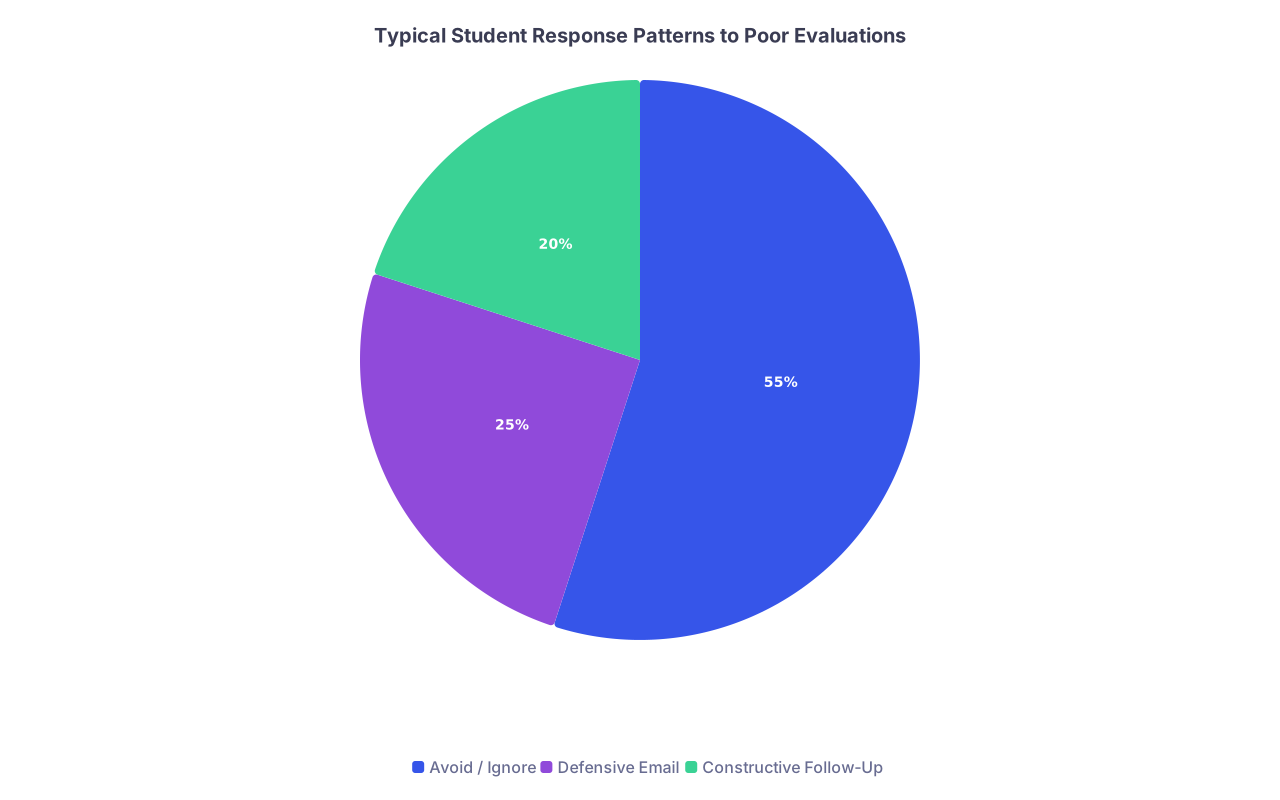
Most students avoid the evaluator or send a defensive email. You are going to be in the 20 % who follow up constructively.
Step 4: Run the Follow-Up Conversation Like a Professional
If they agree to meet, you are on the clock. This is your chance to flip the narrative.
1. Your mindset going in
You are not on trial. You are doing a chart review on your own performance.
Your goals:
- Show maturity.
- Extract specific behaviors to change.
- Leave them thinking, “I might have been a bit harsh; this student is actually serious and thoughtful.”
2. Open the conversation
Use this structure. Do not improvise wildly.
“Thank you for taking the time to meet with me. I wanted to follow up on your evaluation because I saw several areas where I did not meet expectations, and I do not want to repeat the same mistakes on future rotations.
I am hoping you can help me understand specifically what you were seeing so I can target those areas and improve.”
Then stop talking. Let them respond.
3. Ask targeted questions, not “Do you have any feedback?”
Bad question: “Do you have any additional feedback?”
Better questions:
- “You mentioned I seemed unprepared on rounds. Can you recall specific instances or patterns that led you to that conclusion?”
- “On the form, you rated my clinical reasoning as below expectations. Was that more about my assessment, my plan, or how I presented my thinking out loud?”
- “What did the strongest students you have worked with on this service do differently day-to-day?”
Write down what they say. Visibly. People treat you differently when they see you taking notes.
4. Sample dialogue for common problem areas
A. “You seemed disorganized / slow to follow up”
You can say:
“I hear that you experienced me as slow with follow-up. Looking back, I can think of a few times when I did not close the loop on tasks as quickly as I should have, especially [give 1 example]. For my next rotation, would it be more helpful if I checked back after each task is done, or is there a better system you have seen students use to stay on top of things?”
You are doing three things:
- Admitting something real.
- Giving a concrete example.
- Asking for a specific strategy.
B. “You were defensive when corrected”
Hard to hear. But fixable.
You:
“You noted that I came across as defensive at times. I know I care a lot about doing things right, and I can see how that might come out as explanation instead of simply accepting feedback. Were there particular moments where that stood out? I would like to replay those and think about how I could have responded differently.”
Then shut up. Do not explain yourself again. That only confirms the pattern.
C. “Knowledge base below expected level”
You:
“You rated my knowledge base below expectations. I agree there were times I was not as prepared as I should have been. From your perspective, was it more that I was missing core facts, or that I did not connect what I knew to the specific patient? And for students who have improved in this area, what did they do day-to-day that actually made a difference?”
Often they will say some version of: “You need to pre-read on your patients at night and come in with a plan.” Good. Now you have an action.
5. How to address clear misunderstandings without arguing
Sometimes an attending will state something that is factually wrong. Example: “You were late three times,” when you know you were late once and stayed late on several days.
You respond like this:
“I appreciate your perspective. I want to make sure I understand accurately. I recall being late on [date] when the bus broke down, and I did inform the resident. I do not remember other late arrivals, but it is possible I misunderstood what time you expected me there. For future rotations, I will clarify start times upfront so there is no ambiguity.”
You are not calling them a liar. You are gently presenting your recollection and focusing on future behavior.
6. Close the conversation with intention
End with this:
“Thank you for being specific. I am going to focus on [list 2–3 concrete behaviors] on my next rotations. If I were to rotate with you again in six months, what would you want to see that would make you say I had improved significantly?”
That question plants a seed: they start imagining a better version of you. That matters.

| Step | Description |
|---|---|
| Step 1 | Read Evaluation |
| Step 2 | Extract Specific Issues |
| Step 3 | Decide Goal |
| Step 4 | Send Scripted Email |
| Step 5 | Prepare Questions |
| Step 6 | Have Professional Conversation |
| Step 7 | Create Concrete Action Plan |
| Step 8 | Email Follow-Up: Ask for 2–3 Suggestions |
| Step 9 | Implement Changes on Next Rotation |
| Step 10 | Meeting Granted? |
Step 5: Turn the Feedback Into a Concrete Behavior Plan
This is where most people fail. They have one “good conversation,” then keep doing the same things.
You need an actual plan. Not vague intentions.
1. Translate comments into observable behaviors
Take each theme from the evaluation and translate to behaviors you can see and track.
Example: “Below expectations in clinical reasoning.”
Convert to behaviors:
- Pre-round: write out 1–2 differential diagnoses for each patient.
- On rounds: explicitly state “Given X and Y, I think the most likely diagnosis is…”
- After rounds: look up one key article or guideline for the top 1–2 patients.
Example: “Not proactive / not a self-directed learner.”
Behaviors:
- Identify at least one question per patient to look up daily.
- Volunteer once per day for a concrete task: “I can call radiology / pharmacy / follow up on that consult.”
- Send your intern a short list by 2 pm: “Here is what I have done; is there anything else I can take on?”
2. Put it into a simple weekly checklist
Do not overengineer this. One page, printed or on your phone.
| Domain | Daily Actions (Yes/No) |
|---|---|
| Preparation | Pre-read on all patients |
| Clinical reasoning | State differential on rounds |
| Initiative | Volunteer for 1+ new task |
| Follow-through | Close loop on all assigned tasks |
| Feedback | Ask for brief feedback 1x/week |
At the end of each day, mark yes/no. At the end of the week, look for patterns.
Step 6: Proactively Rewrite the Story on Your Next Rotation
You are not just fixing skills. You are rebuilding your reputation.
1. Start each new rotation with a 60-second expectations conversation
On day one with your attending or resident:
“I want to make you aware of something upfront so I can make the most of this rotation. On a prior clerkship, I received feedback that I needed to improve specifically in [state 1–2 areas, e.g., ‘closing the loop on tasks and making my clinical reasoning more explicit’].
I have been working on this by [name 1–2 concrete behaviors]. If you notice me slipping in those areas, I would appreciate if you could flag it early so I can correct it in real time.”
This does two things:
- Shows maturity and insight.
- Puts them on your team. Now they are watching for your improvement, not for your failure.
2. Ask for mid-rotation feedback like this
Halfway in:
“We are about two weeks in. Could I ask you for 2–3 minutes of feedback on how I am doing, especially in [the 1–2 areas you are targeting]? Even one very specific behavior I could change this week would be helpful.”
Do not ask, “How am I doing overall?” That invites vague reassurance.
3. Track your evaluations over time
Do not rely on memory. Create a simple table for yourself:
| Rotation | Key Weakness Targeted | What I Changed | Evaluation Comment Trend |
|---|---|---|---|
| IM | Follow-through | Task checklist; text updates | From “slow to follow up” to “reliable” |
| Surgery | Clinical reasoning | Explicit differentials on rounds | From “hesitant” to “more confident” |
| Peds | Proactivity | Volunteered for tasks daily | “Took initiative” comments appear |
When you meet with your dean, advisor, or program director, this becomes your data. Not “I got a bad eval once,” but “I had a weakness, and here is the documented arc of improvement.”
Step 7: Protect Yourself When an Evaluation Is Truly Problematic
Not every bad evaluation is a growth opportunity. Some are a problem.
Red flags:
- Personal insults or degrading remarks (“lazy,” “stupid,” “emotional”).
- Comments on gender, race, accent, or other protected characteristics.
- Threatening language (“This student should not be a doctor”).
- Completely outlier ratings compared to multiple other rotations without any clear explanation.
When you see this, you shift from “fix my performance” to “protect my career.”
Your protocol in these cases
Save everything. Screenshots, PDFs, dates, names.
Write your own factual account of the rotation:
- Who supervised you.
- Any conflicts or incidents.
- Any witnesses (residents, other students, nurses).
- Feedback you received in real time (or lack thereof).
Contact a safe person:
- Clerkship director who is not the evaluator.
- Office of Student Affairs.
- Trusted faculty mentor.
- Ombuds office if your school has one.
Use a version of Script C (above) and bring printed copies of the evaluation and your own timeline.
Your ask is not “Make this go away.” Your ask is:
- “How is this type of evaluation usually handled?”
- “What is the process for adding my response or context to my record?”
- “Can this evaluation be reviewed for potential bias or inconsistency?”
Most schools have a process, even if they do not advertise it loudly.
Step 8: Reframe the Narrative for Letters and Interviews
If you are early in school, one bad evaluation will statistically fade if you fix the pattern. Still, you should control the story.
1. Discuss it proactively with your dean’s letter writer
When you meet for your MSPE / dean’s letter meeting:
“I want to be transparent about a weaker evaluation I received on [clerkship]. The main issues were [short list]. Since then, I have focused on [specific behavior changes], and on later rotations like [X, Y] I received feedback that these had improved, for example [quote short positive comment]. If this comes up in my file, I would appreciate if the arc of improvement could be highlighted.”
You are not trying to hide it. You are giving them the “before and after” story.
2. If asked in interviews
If an interviewer asks, “I see one rotation evaluation that was not as strong. What happened?” you already know the script:
- Own it concisely.
- Name the lesson.
- Show proof of change.
Example:
“On my third-year internal medicine clerkship, I initially struggled with efficiency and making my reasoning explicit. The attending correctly noted that I sometimes failed to close the loop on tasks, which created extra work for the team. It was hard to read, but accurate.
I met with them afterward to ask for specifics, and I built a system for task tracking and pre-round preparation. On my subsequent surgery and ICU rotations, attendings specifically commented that I was reliable and that my plans were much clearer on rounds. It ended up being a turning point in how I approach my day.”
That is not a red flag. That is a maturity point.
The One Thing to Do Today
Do not wait for your next bad evaluation to figure this out.
Right now, do this:
- Open your most recent clerkship evaluation, even if it was “fine.”
- Pull out one negative or lukewarm comment.
- Draft a 3–4 sentence email to that evaluator using Script A or B, asking for one specific suggestion you can implement on your current or next rotation.
You are building the muscle of professional follow-up now, not in crisis later.