

What if the one thing that feels safest to do on rounds—staying quiet—ends up being the exact thing that tanks your evaluation?
Because that’s what it feels like, right? You’re on rounds, heart pounding, brain fried from call, and you’re thinking: If I ask this, I’ll sound stupid. If I don’t ask anything, I’ll look disinterested. Either way I lose.
Let’s talk about that fear head‑on. No sugarcoating.
What attendings actually see when you’re silent
Here’s the part that messes with your head: you think you’re being “neutral” by saying nothing.
You’re not.
Silence doesn’t read as neutral on most teams. It gets interpreted. And not always kindly.
Here’s how I’ve repeatedly seen silence interpreted on wards:
- “They’re not interested in this specialty.”
- “They’re unprepared and don’t want to expose it.”
- “They’re shy but I can’t grade ‘shy,’ I have to grade performance.”
- “They’re hiding in the back. They don’t really want to be here.”
Is that fair? Not always. Do busy residents and attendings always differentiate between “terrified” and “checked out”? No. They often don’t have the time or emotional bandwidth.
But here’s the important nuance:
You don’t need to be the loudest student. You don’t need to be the “gunner.”
You do need visible engagement.
And asking something is one of the clearest ways to show that.
Does not asking questions hurt your grade?
Let me be direct: being totally silent, day after day, can absolutely hurt your grade.
Not because there’s a secret rubric that says “must ask 3 questions per day,” but because of how evals are actually written.
Real eval phrases I’ve seen and heard translated:
- “Quiet on rounds” → usually not a compliment
- “Would benefit from asking more questions” → borderline / average
- “Engaged and curious learner” → usually at least “above expectations”
- “Did not seem very interested in the rotation” → big red flag
So yeah, if your default strategy is:
“Say nothing so they don’t know what I don’t know”
that can backfire.
But here’s the twist: you don’t have to ask brilliant, pimp‑level questions to be seen as engaged. The bar is lower than you think.
They’re not expecting you to ask about cutting‑edge trials for every patient. They’re mostly looking for signs that:
- You read
- You think
- You care
That’s it.
The trap: perfectionism and terror of sounding dumb
Here’s the honest internal monologue most students have but never say out loud:
- “If I ask this, they’ll realize I don’t know anything.”
- “Everyone else probably already knows this.”
- “My question will slow down rounds and they’ll be annoyed.”
- “What if the attending answers with ‘we learned this in M2’ and I get exposed?”
So you hold it in. Question after question.
You tell yourself: I’ll look it up later.
And then you get home and you’re exhausted and scroll for 40 minutes and maybe half‑skim an UpToDate page and it all blends together.
That constant suppression of questions creates a few problems:
- You actually learn less efficiently.
- You look less engaged.
- You feel more isolated and anxious.
Not fun. But fixable.
What “good engagement” actually looks like (without becoming that gunner)
Let’s make this less abstract. Here’s what attendings and residents usually interpret positively. Notice how low‑drama most of this is.
Visible engagement can look like:
- Asking one or two targeted questions on rounds per morning
- Asking a resident a clarifying question after rounds
- Bringing up a question that clearly came from reading:
“I was reading about COPD last night and saw X—how do you usually handle that on the wards?”
You don’t need to interrogate the attending.
You don’t need to “perform curiosity.”
You just need occasional, real, simple questions that show your brain is on.
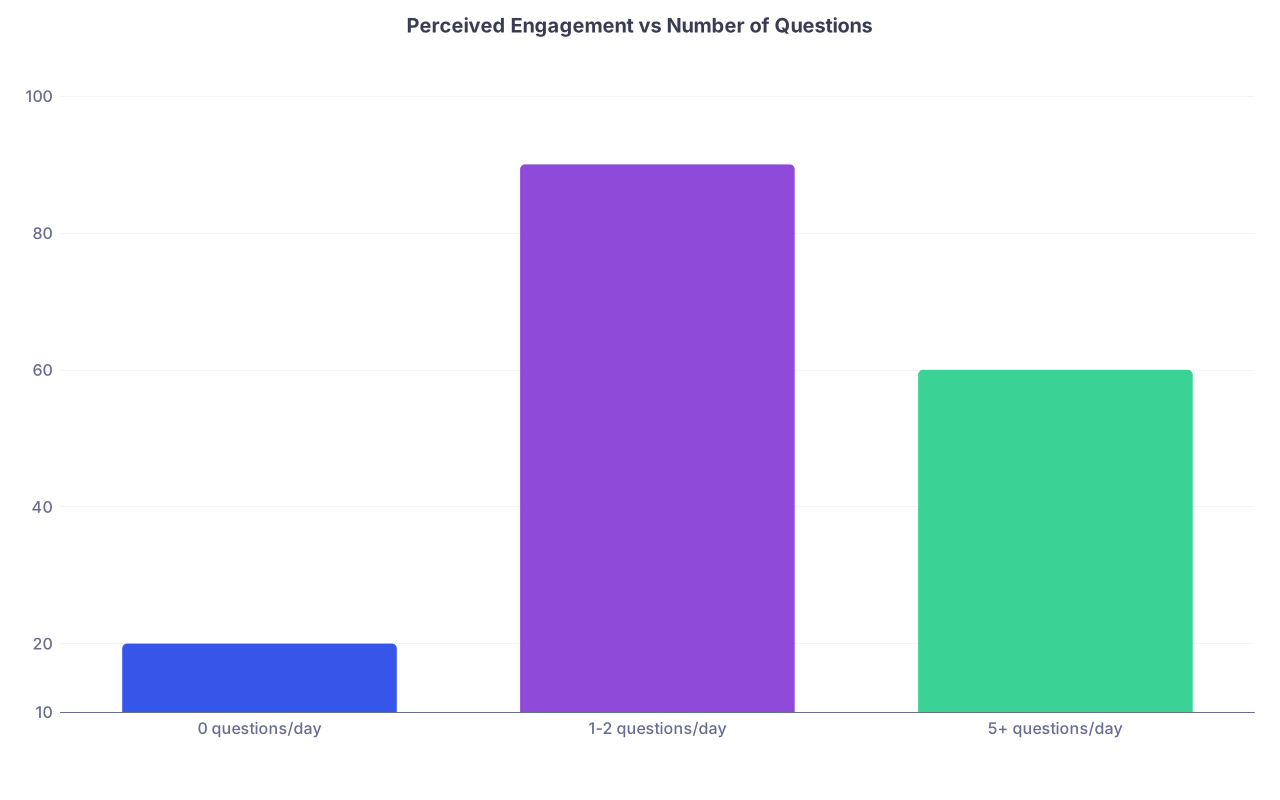
| Category | Value |
|---|---|
| 0 questions/day | 20 |
| 1-2 questions/day | 90 |
| 5+ questions/day | 60 |
Roughly how this plays out:
- 0 questions/day → often perceived as disengaged or anxious/shy (and they can’t always tell which)
- 1–2 questions/day → usually “appropriately engaged”
- 5+ questions/day → sometimes great, sometimes “gunner,” sometimes annoying, depends on team dynamic
You want the middle bar. Solid, steady, not chaotic.
What if you’re genuinely shy or have social anxiety?
This is the part nobody acknowledges openly on rounds, but a ton of people feel.
If you’re the person whose heart rate spikes just thinking about asking something in front of a group, you’re not alone. I’ve watched:
- Students rehearse a question in their head 10 times… and still never say it.
- People literally open their mouth, then close it because the attending moved on.
- Students save every question for one “safe” resident who isn’t scary.
You’re not broken. But you do need a strategy that respects your wiring.
Here’s a practical compromise model that tends to work:
One “public” engagement moment per day.
Could be:- A question on rounds
- A brief comment: “I read about X last night, and I was wondering about Y.”
- Asking to clarify a plan: “Just so I’m clear, we’re doing A before B because…?”
One “private” question after rounds.
With:- Your senior resident
- An intern
- The attending when the whole herd isn’t watching
You don’t need to be “on” all the time. You just need a small daily footprint that says: “Yep, I’m here and I’m trying.”
Safe types of questions that rarely backfire
Here’s where the anxiety really spikes: “What if my question is stupid?”
So use categories of questions that almost never get judged harshly.
1. Clarification of the plan
These are very safe — they show you’re paying attention.
Examples:
- “For this patient’s DKA, are we switching to subQ insulin once the anion gap closes or when they can eat?”
- “Just to clarify, are we holding the beta‑blocker because of the soft blood pressure or another reason?”
2. “From my reading last night…”
This signals work. Attendings love this phrase.
- “I was reading about heart failure last night and saw that some people still use digoxin more—do you see that much here?”
- “I read that we should usually avoid X in CKD—are there exceptions where we still use it?”
Even if your reading was 7 minutes of UpToDate at 11:50 p.m. while half‑asleep, the fact that it happened at all is a win.
3. “Big picture” questions
These feel less risky because they’re not about some obscure lab value.
- “What’s usually the biggest thing that delays discharge for patients like this?”
- “If this patient didn’t have insurance, would our management change much?”
Those are the questions attendings remember in evals. Because they feel a little more mature.
How much does this really affect your grade?
Let me show you how this plays out with evaluations.
Most clerkships use some version of:
- Medical knowledge
- Clinical reasoning
- Communication
- Professionalism
- Initiative / engagement / teachability
Silence mostly hits that last bucket: initiative/engagement.
| Evaluation Domain | Effect of Chronic Silence |
|---|---|
| Medical Knowledge | Indirect (they see less of what you know) |
| Clinical Reasoning | Negative (you share your thinking less) |
| Communication | Negative (seems withdrawn) |
| Professionalism | Usually neutral unless extreme |
| Initiative/Engagement | Clearly negative |
So can you still get “pass” if you’re quiet and solid on notes and exams? Yeah, often.
Can it cost you an “honors” or “high pass”? Very easily.
What stings is when the narrative comment is something like:
- “Quiet but clearly smart—would encourage more active participation.”
- “Knows material but doesn’t always share reasoning or ask questions.”
Translation: your silence was noticed. And it put a ceiling on you.
What if you really, truly don’t have any questions?
Here’s the scary thought:
“What if I just… don’t have any questions? Am I just dumb or not curious enough?”
Sometimes it’s not that. Sometimes:
- You’re so overwhelmed you can’t even formulate a question.
- You’re mentally stuck on “don’t say the wrong thing” so creativity shuts down.
- The attending is lecturing nonstop and there’s literally no space to ask anything.
So use structured prompts to generate low‑pressure questions.
Some go‑to mental prompts:
- “What would we do next if this doesn’t work?”
- “What would we do if this patient were younger/older/pregnant/no insurance?”
- “Is there a rule of thumb you use for X?”
You can plug those into almost any topic.
Example on GI bleed:
- “If he keeps bleeding after this scope, what’s usually the next step?”
- “Would our transfusion threshold change if he had CAD?”
- “Do you have a rule of thumb for when to call IR in GI bleeds?”
You’re not trying to be clever. You’re just showing your brain is tracking.
A simple script for actually getting the words out
Because theory is nice, but your mouth still locks up when 8 people are staring at you.
Try this very mechanical approach:
Before rounds, write down 1–2 questions at the bottom of your patient list.
Not in your head. Literally on paper.When an appropriate moment comes (after your presentation, after the plan is set), use a stock phrase to force the door open:
- “I had one quick question about this patient, if that’s okay?”
- “Can I ask a clarifying question?”
Then read your question almost verbatim. You don’t need to improvise.
That way you’re not inventing sentences under pressure; you’re executing a pre‑written task. Lower cognitive load. Less panic.

| Step | Description |
|---|---|
| Step 1 | Before Rounds: Write 1 Question |
| Step 2 | Wait for Natural Pause |
| Step 3 | Save for Resident After Rounds |
| Step 4 | Use Stock Phrase |
| Step 5 | Read Question from Notes |
| Step 6 | Listen & Take 1-2 Notes |
| Step 7 | Is Attending Rushed? |
How to ask questions without slowing everyone down
Another huge fear: “They’re all tired and hungry. If I ask something, they’ll hate me.”
You’re not wrong. Timing matters.
Better times to ask:
- After you present and they’ve agreed on the plan
- While walking between rooms, when things are a bit looser
- At the end of rounds: “I had one quick question from earlier…”
Worse times:
- While they’re mid‑critical decision
- When the attending is clearly behind and speed‑walking away
- Right after they said, “We’re short on time today so let’s move fast”
Use this simple rule:
Don’t ask questions that change the plan when the plan is still forming, unless you’re genuinely confused about safety.
Save “academic curiosity” type questions for the slightly calmer moments.
Using residents as a safer bridge
If the idea of asking the attending directly makes you want to disappear, use residents as a buffer. That’s what they’re there for (partly).
Strategy:
During a lull, say to your resident:
“I had a couple questions from rounds—could I run them by you later today?”Ask your questions in the workroom. Write down the answers.
Sometimes the resident will say, “You should ask Dr. X that—they’d love that question.”
That’s your in. Now it’s not “you vs attending,” it’s “our team being curious.”

And yes, residents absolutely notice which students seek them out with questions. Often they’re the ones writing a big chunk of your eval.
What about attendings who seem scary, sarcastic, or dismissive?
You will meet them. The ones who:
- Roll their eyes at “basic” questions
- Answer with “We did this in second year”
- Treat questions like interruptions, not opportunities
They’re real. And they’re exhausting.
You don’t have to transform yourself into a fearless extrovert for these people. Instead:
- Lower the bar: aim for minimal but visible engagement. One short clarifying question. That’s it.
- Use residents more heavily for deeper questions.
- When you do ask, make it clearly tied to patient care or safety. Those are harder to dismiss without looking bad themselves.
If someone repeatedly mocks or belittles you for questions, that’s not “just how medicine is.” That’s someone being unprofessional. Document it. Talk to the clerkship director or a trusted resident if it feels safe.
But don’t let the memory of one bad attending scare you into permanent silence on every future team.
If you’ve already been quiet for weeks… is it too late?
No. But you’ll have to actively shift how you’re seen.
You can literally reset the narrative mid‑clerkship with something as simple as:
- To your resident: “I realized I’ve been too quiet on rounds because I get nervous, but I’m really interested in learning. I’m going to try to ask at least one question each day—if you ever have feedback on how I can do better, I’d appreciate it.”
Most residents will respect that. A lot. You just showed:
- Insight
- Motivation
- Willingness to change
Those three things are gold in clinical training. And they often get mentioned positively in evals.
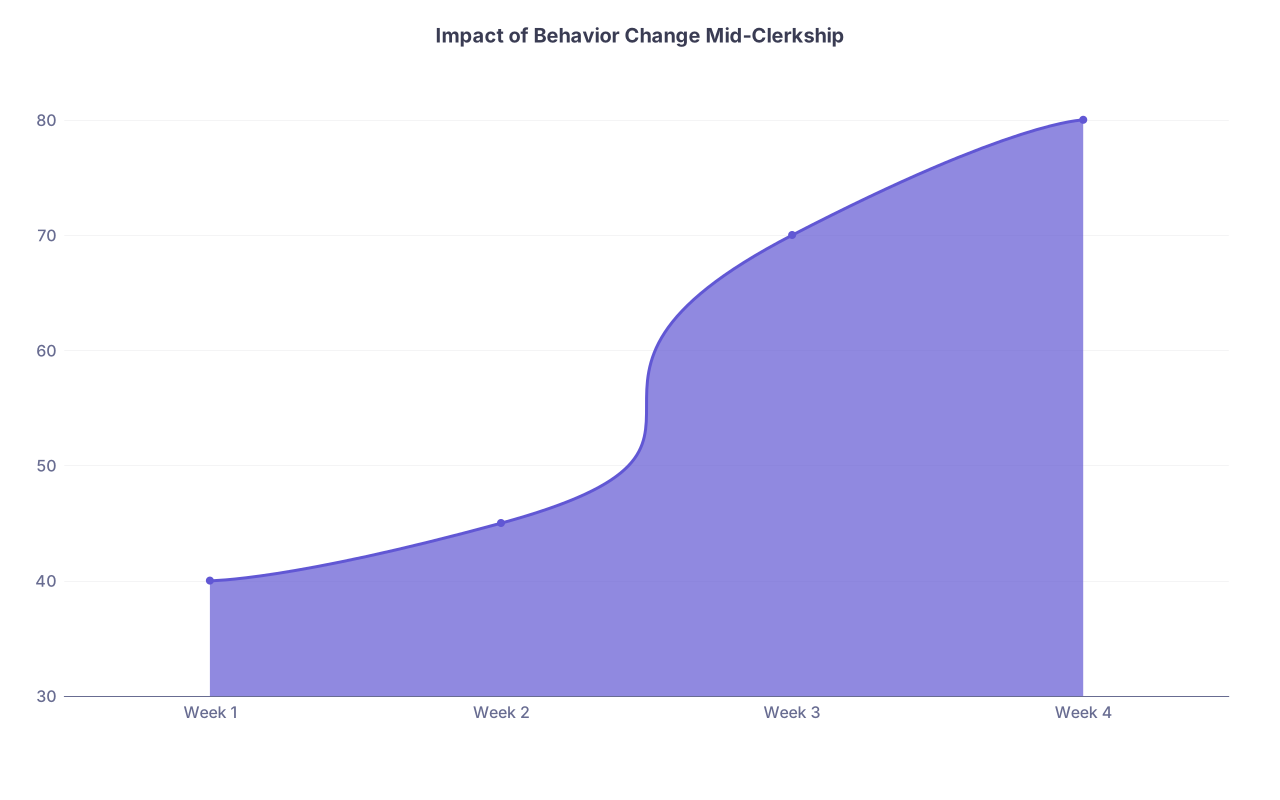
| Category | Value |
|---|---|
| Week 1 | 40 |
| Week 2 | 45 |
| Week 3 | 70 |
| Week 4 | 80 |
I’ve seen students start as “the quiet one in the back” and finish with comments like:
- “Really grew over the rotation and became more engaged.”
- “Started off shy but increasingly contributed thoughtful questions.”
Growth is part of what you’re graded on. Use that.
Quick checklist: are you “too silent” on rounds?
If you’re spiraling, run through this honestly:
- Did I ask at least one question today (to anyone—resident or attending)?
- Did I say anything beyond my presentations? Even “I read about X…” counts.
- Have I ever approached a resident outside rounds with a question?
- In the last week, have I said some version of “I was reading about…” at least once?
If you’re answering “no” to all of these for days on end, yeah, that’s a risk for your eval. Not fatal. But a real risk.
Pick one of those items and fix it tomorrow. Just one.

The painful truth, and the hopeful one
Painful truth:
Staying silent feels safe, but academically and professionally, it’s risky.
You can absolutely hurt your grade by disappearing into the background.
Hopeful truth:
You don’t have to be brilliant. You don’t have to be fearless.
You just have to be visible and curious in small, consistent ways.
One question a day.
One “I was reading about…” a week.
One honest conversation with a resident about being nervous.
That’s enough to change how people see you.
FAQ (exactly 4 questions)
1. Can I still get honors if I’m naturally quiet?
Yes, but only if “quiet” doesn’t look like “absent.” Most honors students aren’t the loudest; they’re the ones who:
- Show they’ve read
- Ask thoughtful occasional questions
- Communicate clearly with the team and patients
If your quietness means people don’t know what you know, that can cap you at pass/high pass. If you’re introverted but still visibly engaged (even in small ways), honors is absolutely still in play.
2. What if my attending literally never pauses for questions?
Then stop waiting for the perfect opening. Use tiny interruptions or alternate channels:
- After your presentation: “I had one quick question about this patient…”
- At the end of rounds: “Could I ask two quick questions from earlier today?”
- Grab the resident: “I had questions from rounds—can I run them by you?”
And if the attending truly shuts everything down every time, that’s reflected in everyone’s experience, not just yours. Don’t blame yourself entirely for a structurally bad learning environment.
3. Will asking “basic” questions make me look stupid?
If your “basic” question is about something that’s clearly in every M1 syllabus, and you do it all day, yeah, people might question your preparation. But:
- One or two “basic but honest” questions won’t tank you.
- Framing helps: “I think I may be mixing this up—can I clarify X vs Y?” sounds thoughtful, not clueless.
- If you’re really rusty on basics, review the night before so your questions are one level up, not at the “what is CHF” level.
Curious with gaps is better than silent with gaps. The gaps are there either way.
4. I’m terrified my evals already say I’m “too quiet.” What should I do tomorrow?
Concrete plan:
- Pick ONE patient tonight and read something (10–15 minutes max).
- Write down exactly ONE question about that patient.
- Tomorrow on rounds, after you present, say:
“I had one quick question about this patient, if that’s okay…” and then ask it.
That’s it. Don’t try to overhaul your personality in a day. Just prove to yourself you can get one question out of your mouth in front of the team.
Next step right now:
Grab your current patient list (or imagine tomorrow’s), choose one patient, and physically write down a single question you could ask on rounds about them. Just one sentence. Get it on paper before your brain talks you out of it.


