

Your clinical evaluations are not a moral verdict on whether you deserve to be a doctor.
They feel like that. I know. But they aren’t.
You’re probably staring at your evals thinking: “Meets expectations. Meets expectations. Solid performance. Professional. Pleasant to work with.” No glowing “top 5%.” No “best student I’ve ever worked with.” Just… fine. And your brain immediately jumps to:
“I’m doomed. Programs only want rockstars. Average equals reject.”
Let’s walk through this like two people sitting in the call room at 11 PM, doom-scrolling MyERAS and Reddit between consults.
What “Average” Clinical Evaluations Really Mean (and Don’t Mean)
Here’s the uncomfortable truth: most clinical evaluations are inflated, vague, and borderline meaningless at face value.
I’ve seen this over and over:
- Attending who marks everyone “above average” and writes one line: “Great to work with.”
- Resident who gives everyone the same canned comments because it’s 2 AM and they’re post-call.
- Rotation director who literally told us, “We don’t fail people unless you’re unsafe.”
So when you see “average,” your brain reads “mediocre human,” but the system often just means “you were totally fine.”
What “average across the board” usually means in reality:
- You showed up.
- You were safe.
- You weren’t a nightmare to work with.
- You did what was asked, learned, and didn’t stand out in a bad way.
Program directors know this. They see thousands of evals. They know most are:
- Too nice.
- Non-specific.
- Dependent on who filled it out and how rushed they were.
They do NOT sit there going:
“Hmm, this student got ‘meets expectations’ in ‘professionalism.’ Disgusting. Reject.”
That’s not how this works.
The Nightmare Scenario in Your Head vs. What PDs Actually See
Let’s be brutally honest about the worst-case scenario in your head. It usually looks like this:
“I have:
- Average pre-clinical grades
- Average Step 2
- Average clinical evals
- No home run honors rotations So I’m basically invisible. Why would any residency pick me over the gunners with honors everything?”
I’m not gonna lie: if everything is truly average, you’re not going to magically match at the top 5 programs in the country in a hyper-competitive specialty.
But that’s not the same as:
- “You won’t match.”
- “You’re a bad clinician.”
- “No one will want to work with you.”
Residency programs care about:
- Will you show up?
- Will you be safe with patients?
- Will you not make everyone miserable?
- Will you progress into a competent, independent physician?
“Average” evals with no red flags say:
“Yes. This person is fine.”
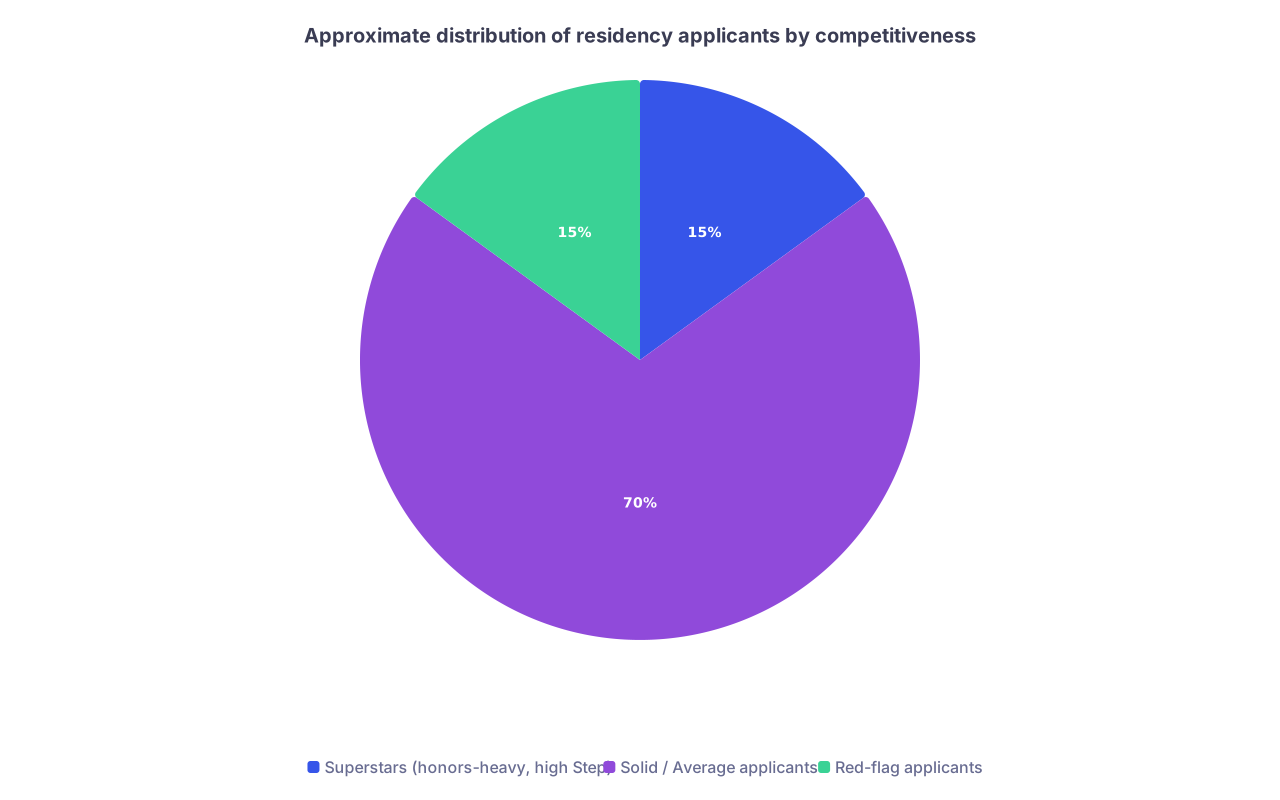
To give you some grounding, look at how often “average” people match. It’s… most of them.
| Category | Value |
|---|---|
| Superstars (honors-heavy, high Step) | 15 |
| Solid / Average applicants | 70 |
| Red-flag applicants | 15 |
Program directors build their classes mostly out of that middle 70%. You’re not some weird outlier because your evals aren’t poetry.
Where “Average” Evals Can Actually Hurt You (and How to Fight Back)
Here’s where your anxiety isn’t totally irrational.
“Average” starts to hurt when:
You’re aiming for a very competitive specialty
Dermatology, plastics, ortho, integrated vascular, ENT, rad onc, neurosurgery. These fields are flooded with applicants who look fantastic on paper.You ALSO don’t have:
- Strong Step 2 score
- Real research in the field
- A couple strong letters from known faculty
- Something that makes someone remember your name
Your evals are not just “average” but also:
- Very short
- Vague
- No specific praise at all
- Zero “I would love to work with them again” type lines
Let me show you how this plays out.
| Specialty Type | Competitiveness | Effect of Average Evals |
|---|---|---|
| Primary Care (FM, IM, Peds) | Lower–Moderate | Usually fine if no red flags and good Step 2 |
| Hospital-based (Neuro, EM, Psych) | Moderate | Fine if paired with decent scores and letters |
| Surgical (GS, OB/GYN, Anesthesia) | Moderate–High | Need at least a few strong comments/letters |
| Highly Competitive (Derm, Ortho, ENT, Plastics) | Very High | Can be limiting without standout letters or honors |
So yeah, in very competitive fields, “average” across the board makes you just one of many. But that’s not the end of the story.
You still have levers you can pull.
Step One: Stop Treating Every Box as Equal
Not all “average” is equally concerning.
These hurt more if they’re just “meh”:
- Sub-internship / acting internship in your chosen specialty
- Required clerkships that matter to your specialty (e.g., surgery for ortho)
- Rotations where letters are expected (internal medicine sub-I if you’re applying IM)
These matter less:
- Early rotations when you were still figuring out where the bathrooms were
- Random elective in a field you’re not going into
- Evaluations from people who barely worked with you
If your “average” is:
- Early third year + random electives = low concern
- Across sub-I + home specialty + away rotations = more real concern
But even then, you’re not helpless.
Step Two: Extract Every Possible Win from “Average” Evaluations
You might be looking at your evals as one gray, depressing blob. But there’s usually more there than you think.
Go back and look line by line. You’re searching for things like:
- “Hardworking”
- “Reliable”
- “Strong team player”
- “Good with patients and families”
- “Shows improvement with feedback”
- “Would be a solid resident”
These aren’t throwaway lines. They’re gold you can recycle:
Into your personal statement
“Multiple attendings have commented on my reliability and team focus. I’m not the loudest person in the room, but I’m consistent. I show up, follow through, and try to make the work easier for the team.”Into your MSPE / dean’s letter summary
Your school often pulls exact phrases from evaluations. If you have repeated themes, your dean can highlight them as core strengths.Into your interview answers
“My evals describe me as reliable and calm under pressure, even if I’m not the flashiest student. On my medicine rotation, the senior resident wrote that I ‘quietly kept the whole team organized.’ That’s the kind of resident I want to be.”
You’re terrified because your evals don’t scream, “Best student ever.” But programs like:
- Steady.
- Reliable.
- No-drama.
- Teachable.
“Average” plus those traits is still very matchable.
Step Three: Build Strengths in Places You Still Control
You can’t go back and re-do your third-year rotations. I wish. But there are levers still available:
1. Crush Step 2 (if you haven’t taken it yet)
Yes, it’s annoying that one exam still matters this much. But it does. A strong Step 2 can offset a lot of “nothing special” on the wards.
| Category | Value |
|---|---|
| Step 2 | 25 |
| Clerkship grades | 20 |
| Clinical evals comments | 10 |
| Research | 15 |
| Letters of rec | 20 |
| Personal statement | 10 |
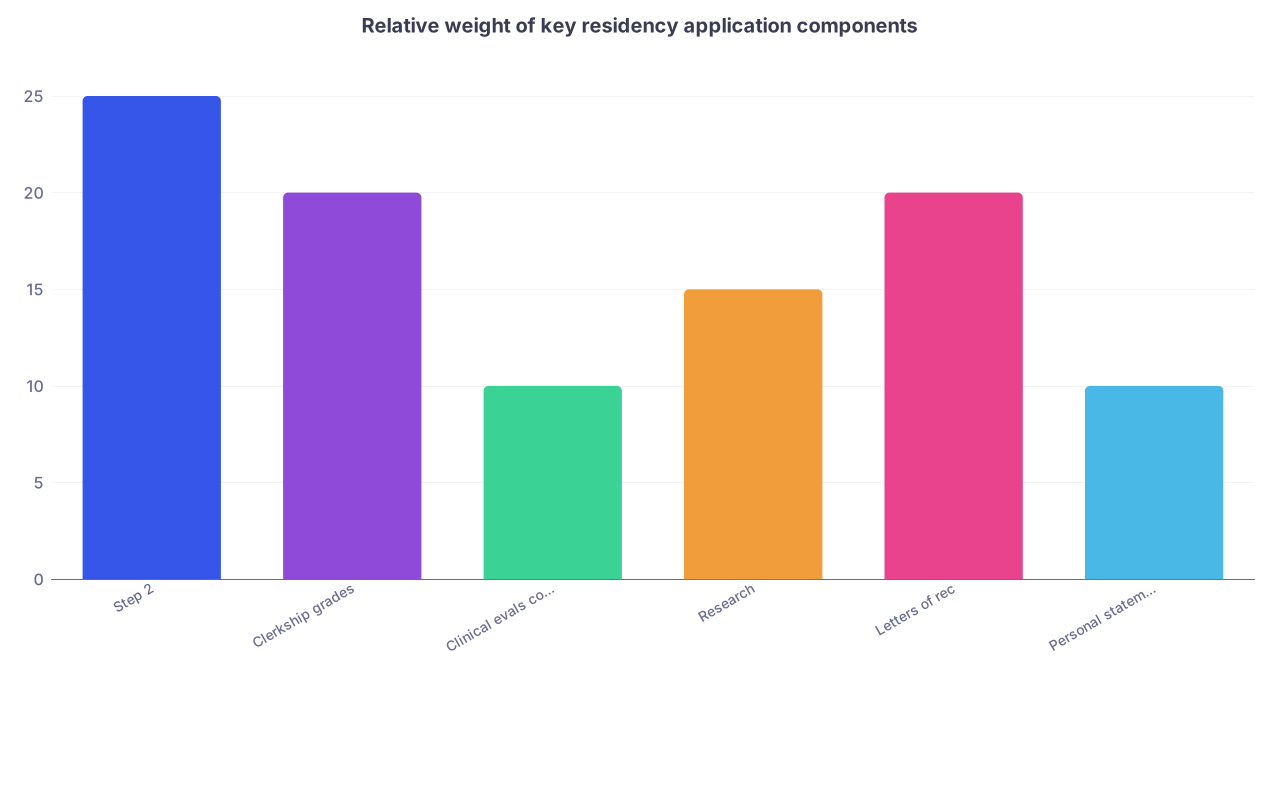
Those numbers aren’t exact, but the pattern is real: clinical evals are one slice, not the whole pie.
If you can lift any part of your app above “average,” Step 2 is a big one.
2. Get at least 1–2 strong letters, even if your written evals are bland
Letters can absolutely outshine checkbox evals.
Concrete things you can do:
- Identify 1–2 attendings who actually saw you work over time.
- Ask to meet with them and say, “I really enjoyed working with you and wanted to ask for feedback on how I can grow. Also, I’m hoping to apply to X. Do you feel you know me well enough to write a strong letter of recommendation?”
That word — “strong” — matters. It gives them an out if they can’t.
I’ve seen people with:
- Boring evals + one killer letter from a respected faculty member do way better than they thought they would.
3. Use your sub-I or late rotations to change the story
If you’re still in med school, your sub-internship is your redemption arc.
On your sub-I:
- Be early. Always.
- Volunteer for the unsexy work (calling families, following up labs, discharge summaries).
- Make the intern’s life easier. They will talk about you.
- Explicitly ask the senior: “I really want to grow clinically. Can I ask for weekly feedback?”
Then ask for a letter if it went well.
This becomes part of your narrative:
“My early evals were fine but not standout. Once I found my footing, I leaned into responsibility. On my sub-I, the team trusted me with X, Y, Z…”
Step Four: Fix the Story in Your Own Head (Or It Will Leak Everywhere)
Here’s the part nobody talks about: if you walk into interviews radiating “I’m just average, why would you want me?” people feel that.
You don’t have to pretend you’re a world-beater. But you do need a coherent, confident story that goes something like:
- “I’m not the loudest person or the flashiest.”
- “My evaluations show I’m reliable, kind to patients, and good to work with.”
- “I show up, learn, and improve.”
- “I care more about being a solid, trustworthy resident than impressing people for one month.”
That’s not spin. That’s honest.
Use this mental reframe:
- Your evals are baseline proof of safety and professionalism.
- Your letters, Step 2, sub-I, and interviews are where you show upside.
Without this reframe, everything you say on the trail will have this quiet apology baked into it. And you don’t owe anyone an apology for being “meets expectations” as a third-year med student.
A Visual of What You’re Actually Up Against
Let’s make this even clearer.

| Step | Description |
|---|---|
| Step 1 | Applicant File |
| Step 2 | Academic Metrics |
| Step 3 | Clinical Performance |
| Step 4 | Personal Factors |
| Step 5 | Overall Impression |
| Step 6 | Interview + Top of List |
| Step 7 | Middle of List |
| Step 8 | Lower or Not Ranked |
| Step 9 | Rank Highly? |
Your “average” evals are only one part of C → Clinical Performance.
They feed into E along with:
- Step 2
- Clerkship grades
- Class rank (if your school does it)
- Letters
- Research
- Interviews
- Personal statement
- Fit with the program
You’re obsessing over one node as if it’s the whole graph.
FAQ: The Stuff You’re Probably Still Spiraling About
1. Be honest — can “average” evals keep me from matching?
If by “average” you mean:
- Normal comments, no serious concerns
- Mostly “meets expectations,” maybe a few “above” or “below” boxes
- No narrative red flags (unprofessional, unsafe, poor reliability)
Then no, on their own, they won’t keep you from matching in most specialties. They might limit reach programs or hyper-competitive fields if you don’t have other strengths, but they’re not an automatic “you’re done.”
2. My evals say I’m “quiet” and “reserved.” Is that code for “we didn’t like you”?
Usually it’s code for… quiet and reserved. And programs actually need those people. It can become a problem only if it’s paired with “seems disinterested” or “doesn’t engage.” If you’re worried, you can address this by saying in interviews: “I tend to be more thoughtful and less loud on teams, but I’m very engaged and reliable. I’ve learned to be more vocal when it comes to patient care and speaking up when something’s important.”
3. I didn’t get honors in any core rotation. Combined with average evals, am I screwed?
No. It’s not great for the most competitive specialties at top-tier places, but for a ton of solid programs in IM, FM, peds, psych, EM, many surgery and OB programs — you’re still very much in the game. You’ll just need to be smart about your application list, school tiers, and backing up with slightly less competitive programs or fields if you’re aiming high.
4. Should I ask attendings to “fix” my evals or change them?
Don’t do that. It looks bad, and most won’t do it unless there’s an actual error. What you can do is ask for more detailed feedback while you’re still on the rotation: “Could you share specific things I’m doing well and things I should work on?” That sometimes nudges them to write more thoughtful comments. But after the fact, asking them to change evals is rarely helpful.
5. Will average evaluations affect my fellowship chances later?
Fellowships care more about:
- How you performed in residency
- Your residency PD’s letter
- Your research or scholarly work
- Your reputation as a resident
Your med school evals become background noise. If you match into a decent residency, work hard, get along with people, and find a mentor, your “average” M3 comments basically fade into oblivion.
6. What’s one concrete thing I can do this week to feel less powerless?
Two ideas:
- Make a short, brutal inventory of your app: Step 2, grades, eval themes, research, letters, extracurriculars. Circle what’s actually strong. Underline what’s weak.
- Pick one thing you can still improve and go hard on it — Step 2 studying, asking for a strong letter, reaching out for a research project, or meeting with your dean to plan your application strategy.
You’re not stuck. You just don’t have the fantasy “perfect” file. Almost no one does.
Key points to walk away with:
- “Average” evals mostly say you’re safe and fine, not that you’re a failure.
- Residency decisions are based on the whole picture—scores, letters, fit, and your story matter as much or more.
- You still have control: focus on Step 2, sub-I performance, strong letters, and owning your narrative instead of letting a few bland comments define you.


