
What if you get to the end of third year, look at your transcript, and realize you didn’t honor a single clerkship?
That’s the nightmare, right? Everyone else “crushed” surgery and “destroyed” medicine, and you’re sitting there with a wall of High Passes and Passes thinking: did I just tank my career? Did I quietly become a “bad” med student without noticing?
Let me be blunt: not honoring any clerkships is not the nuclear disaster your brain is telling you it is. But it can matter, depending on context, specialty, and everything wrapped around those grades.
You’re not crazy for worrying about this. The system kind of trains you to.
First: Are you actually “not honoring,” or is your school the problem?
I’ve seen this play out so many times. Someone spirals over “no honors,” and then we look at their school’s grading policy and… yeah. Almost nobody honors anything.
Some schools do this fun thing where they technically have Honors/High Pass/Pass, but only give Honors to like 5–10% of students per clerkship. Others don’t even offer Honors on certain rotations.
If your dean’s letter (MSPE) literally says “Our school rarely awards Honors in core clerkships,” program directors don’t read your transcript like, “Wow, what a disaster.” They read it more like, “Okay, this is a systems thing.”
You need to know which world you live in:
| Context Type | What 'No Honors' Usually Signals |
|---|---|
| Honors given to 30–40% | Red flag-ish, needs explanation |
| Honors given to 10–15% | Pretty neutral, depends on rest of app |
| No Honors option at all | Non-issue, programs know |
| Known tough-grading school | Often neutral to slightly positive |
If you’re at a tough-grading school, “no honors” is closer to “you’re normal” than “you’re doomed.” Your anxiety is probably 3x out of proportion to the actual impact.
How bad is it really for different specialties?
This is where your brain is probably doing the catastrophizing math: “No honors → no good residency → no fellowship → career over → I should quit now.”
Let’s cut that up into reality.
I’m going to be very honest here:
- Some specialties truly don’t care much about clerkship honors.
- Some care, but only in context.
- A few hyper‑competitive ones will quietly screen based on them.
Lower and moderately competitive fields
Family medicine, psych, peds, internal medicine (in most places), PM&R, path, neurology, EM (historically, though it’s changing)… in these, having zero honors is usually not an application death sentence.
If you’ve got:
- Solid Step 2 score (or at least not awful)
- Good narrative comments in your MSPE
- Strong letters
- Maybe some research or community work that makes sense for the field
…no one is sitting there like, “But where is the Honors in Pediatrics?”
They’re asking, “Do I want to work with this person at 3 a.m.?” not, “Did their school give them the top tier label 12 months ago?”
Where it might sting: very competitive programs within those specialties (big-name academic IM, elite pediatrics programs, etc.). They get to nitpick if they want. Honors can become one more “tie-breaker.” But you’re not shut out from the specialty.
Middle–high competition: IM at top places, OB/GYN, anesthesia, neurology at name programs
Here, “no honors” can start to make your app… less sparkly. Not fatal, but you’ll probably need something else to stand out.
I’ve seen people match into anesthesia and OB/GYN at solid programs with no clerkship honors, but they usually had:
- A strong Step 2
- Great letters (“top 10% student I’ve worked with,” that kind of language)
- Some alignment with the specialty (electives, research, interest story that actually feels real)
Program directors in these fields will notice your lack of honors, but if the rest of the file looks good, they chalk it up to grading, late bloomer, test anxiety, whatever—especially if your narrative comments contradict the raw grade.
Hyper‑competitive: derm, ortho, plastic, ENT, neurosurg, ophtho, urology, top‑5 IM, top‑tier rads
Here’s where I’m not going to sugarcoat: having zero honors in clerkships can hurt you. Sometimes a lot.
Not in a “you can never match” way. But in a “your odds at the very tippy‑top places just dropped” way.
These fields are literally swimming in applicants with:
- Multiple honors in core clerkships
- Strong research
- Great scores
- Department letters that glow in the dark
When you bring “no honors” into that pool, it doesn’t automatically drown you, but you’re starting slightly behind. Not impossible. Just harder.
And yet—I have personally seen:
- A derm applicant with no core honors but multiple derm pubs and a killer home department letter match.
- An ortho applicant with all Pass/High Pass, great Step, tons of research, honor in sub‑I only, still match at a strong program.
- A radiology applicant with only High Passes everywhere match at a very solid academic place because their letters were insane and they were clearly obsessed with imaging.
So your anxiety of “no honors = game over” is wrong. But “no honors doesn’t matter at all” is also wrong. It matters more the higher you aim.
The part no one wants to hear: your narrative might matter more than the grade label
This is the underrated piece.
Program directors don’t just see: “Internal Medicine: High Pass.”
They see pages of comments like:
- “Outstanding clinical reasoning, easily functioning at intern level”
- Or: “Quiet, often needed prompting, minimal initiative”
If your grades are mediocre but your comments are glowing, that’s way better than a random Honors with tepid feedback.
A lot of students obsess over the letter grade and completely ignore the written stuff. That’s what PDs actually read when they’re deciding if they like you.
This is why “no honors” doesn’t always equal “bad clinical performance.” Sometimes:
- Your NBME score dragged the grade down even though attendings loved you.
- Your school’s grade cutoffs are brutal.
- You had one evaluator decide not to give out Honors on principle.
- You improved late in the year, but early clerkships were weighed heavily.
Your file is a whole story. Honors is one line.
But what if I genuinely struggled on the wards?
Let’s say it straight: you didn’t just get “unlucky.” You struggled. Maybe:
- You froze when pimped.
- You were slow with notes.
- You didn’t speak up in rounds.
- Your feedback said “needs to work on confidence” or “time management issues.”
Does that doom you? No. But it does give you a responsibility: you have to show a visible upward trend and evidence you worked on it.
Program directors aren’t allergic to growth. They’re allergic to denial and stagnation.
If your sub‑I or later rotations show:
- Better comments
- Concrete improvement (“dramatic growth,” “took feedback well,” “much stronger by end of rotation”)
- Maybe a strong letter saying “they really came into their own”
…then your earlier non-honors become part of a “late bloomer” narrative, not a permanent tattoo on your forehead.
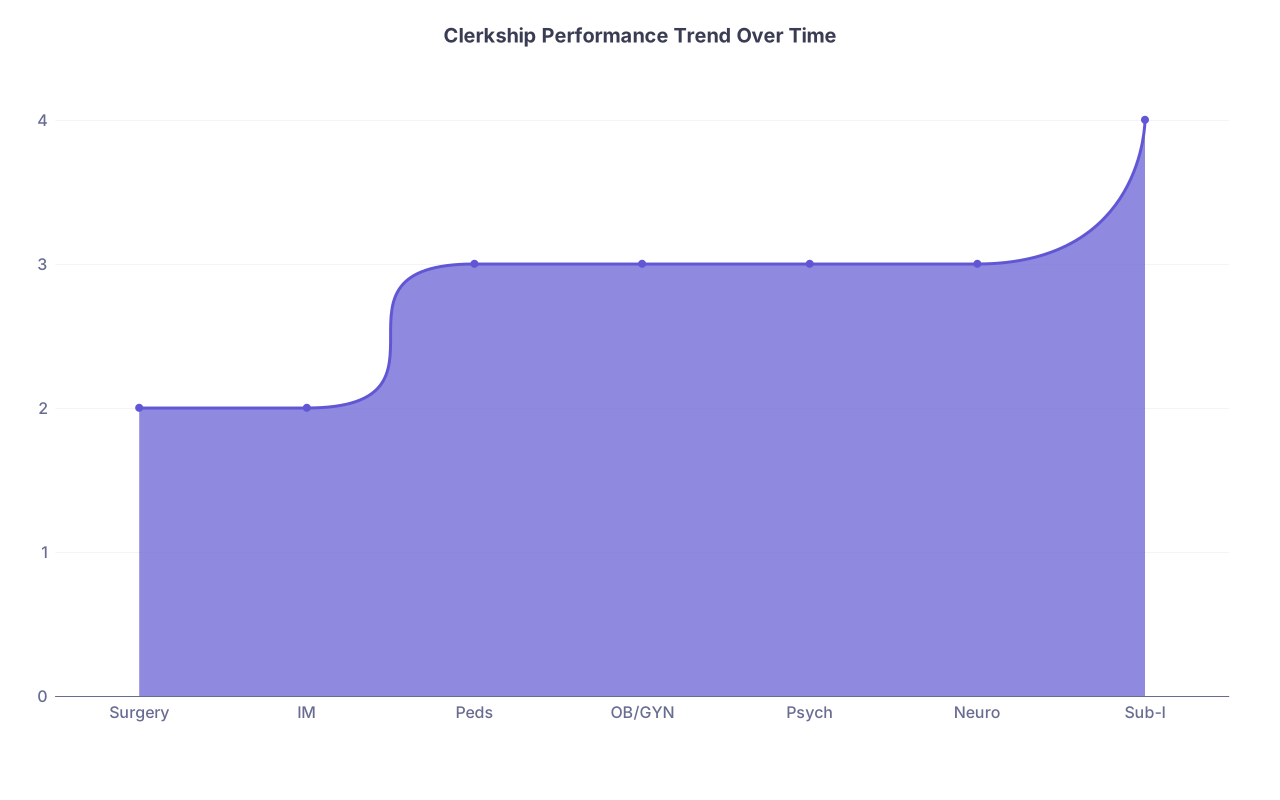
| Category | Value |
|---|---|
| Surgery | 2 |
| IM | 2 |
| Peds | 3 |
| OB/GYN | 3 |
| Psych | 3 |
| Neuro | 3 |
| Sub-I | 4 |
(Imagine 1 = Pass, 2 = High Pass, 3 = strong HP with good comments, 4 = sub‑I really shining.)
If that’s you, you’re not broken. You’re human.
The Step 2 / away rotation / sub‑I “rescue options”
If you’re panicking about third year being “over” and feeling like you wasted your shot, here are the levers you still actually have:
Step 2 CK
Like it or hate it, Step 2 can help partially compensate for a weaker clerkship record. Not magic, but real.
- A higher Step 2 makes some PDs say, “Okay, they know the medicine. Maybe the grading system was just weird.”
- It shows you didn’t plateau at mediocre forever.
No, you don’t need a 270. But being clearly above average for your specialty helps soften the “no honors” sting.
Sub‑internships (sub‑Is)
These are your chance to prove: “I might not have honored anything, but I’m ready to work.”
If you can:
- Be early
- Be prepared
- Pre-round without being asked
- Anticipate intern needs
- Own your patients (within reason)
…you can get a letter that matters way more than a clerkship label from 18 months ago.
I’ve seen applicants with zero MS3 honors get a sub‑I honors and a letter that basically said, “If we had to pick one student to be our intern, it’d be them.” That moves the needle.
Away rotations (for some specialties)
In things like ortho, EM, some surgical subs, rads, etc., aways are like extended job interviews. If you show up and kill it, they don’t care that much what your third-year grade label was.
They care how you act on their turf, with their residents and attendings, under their workload.

| Step | Description |
|---|---|
| Step 1 | No Honors in Clerkships |
| Step 2 | Strong Step 2 Effort |
| Step 3 | Plan High-Impact Sub-I |
| Step 4 | Strategic Away Rotation |
| Step 5 | Better Overall Application Signal |
| Step 6 | Powerful Department Letter |
| Step 7 | More Interview Invitations |
When “no honors” actually doesn’t matter as much as you think
There are some cases where you’re burning mental energy for nothing.
You’re probably over-worrying if:
- Your school is known for grade deflation and your dean’s letter literally explains their grading scheme.
- You’re going into a less competitive specialty, applying broadly, willing to be flexible about location.
- Your narrative comments are consistently positive (“team player,” “hard worker,” “excellent with patients”).
- You’ve got a coherent story (e.g., strong longitudinal research, long-term community involvement, prior career).
I’ve watched people with zero honors:
- Match FM in good cities.
- Match psych in very solid university programs.
- Match IM in respectable academic centers.
- Match PM&R and path basically without drama.
Were they “top of the class”? No. Did they end up employed, trained, and practicing in their chosen fields? Yes.
Your brain imagines this stark binary: honor-or-fail. Reality is way more gray.
Things that hurt more than “no honors” that you’re probably ignoring
Your anxiety is zoomed in on one metric. But PDs are also looking at:
- Failed Step attempts
- Massive professionalism issues
- Scary narrative comments (“dismissive,” “unreliable,” “dishonest”)
- Gaps or unexplained LOA
- Weak or generic letters (“did fine,” “pleasant,” nothing specific)
No honors with strong professionalism and good comments > Honors with sketchy behavior or lukewarm letters.
I’ve heard actual PDs say stuff like:
“I can teach someone medicine. I can’t teach them not to be a jerk.”
“I’d rather have a solid High Pass student who’s normal than an Honors gunner who makes everyone miserable.”
Your brain acts like they sit in the office chanting: “Honors… honors… honors…” They don’t. They’re scanning for: “Are you safe? Are you teachable? Will you be a decent doctor and decent coworker?”
What you can do right now if you’re freaking out
Let’s say your transcript is locked and the grades are what they are. You’re staring at “no honors” and spiraling.
Here’s how you actually respond instead of just doom-scrolling Reddit:
Talk to your dean/advisor.
Not performatively. Bring your actual transcript. Ask them where students like you have matched before. They know patterns from your school that strangers online don’t.Get honest about your target range.
If you’ve got no honors, average-ish Step 2, mediocre research, and you’re aiming for derm at a top program “or I’ll be miserable forever,” that’s an expectations problem, not a clerkship problem.Plan a strong sub‑I and letters.
You want at least one letter that really advocates for you, not just describes you. That often comes from someone who’s seen you work hard in a high-responsibility role.Work on the story.
In your personal statement and interviews, you don’t need to whine about grades. But you can highlight growth, reflection, and what you actually bring to a team. People underestimate how much that matters.Stop using Reddit as your primary data source.
Every “I matched ortho with 280, 12 honors, and a Nobel Prize” post just feeds your worst-case spiral. You’re seeing the outliers, not the median.
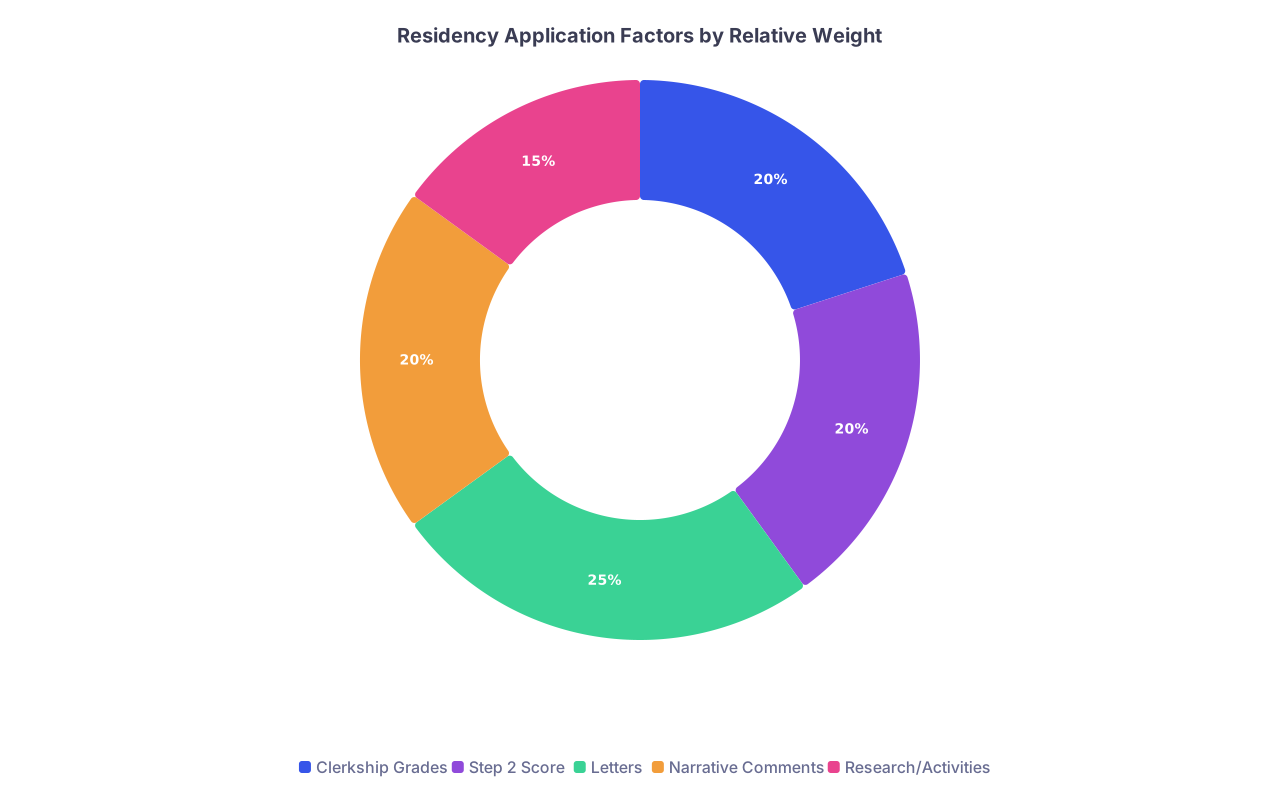
| Category | Value |
|---|---|
| Clerkship Grades | 20 |
| Step 2 Score | 20 |
| Letters | 25 |
| Narrative Comments | 20 |
| Research/Activities | 15 |
This is obviously not exact, but you get the point: clerkship honors are one chunk of a much bigger pie.
Quick reality check before your brain goes back to catastrophizing
You didn’t honor any clerkships. Fine. That stings. It’s okay to be disappointed.
But here’s the actual bottom line:
- It’s not an automatic career-ending disaster.
- It matters more in hyper‑competitive fields and less in many others.
- Your Step 2, sub‑Is, letters, and narrative comments can absolutely blunt or even outweigh the damage.
If you remember nothing else: “No honors” is a data point, not a verdict.