
Clerkships do not ruin you because you’re “not smart enough.” They ruin you because you make the specific mistakes that make attendings stop trusting you.
And once an attending stops trusting you, everything else collapses:
- You get micromanaged
- You stop getting autonomy
- Your evals quietly tank
I’m going to walk through the clerkship mistakes that actually get talked about behind workroom doors. The ones that make attendings say, “I can’t rely on this student,” even if they never say it to your face.
Avoid these, and you immediately jump a tier above most of your classmates.
1. The “Everything’s Fine” Lie
This is the fastest way to make an attending distrust you: pretending you’re on top of things when you’re not.
Typical versions:
- Nodding along when you don’t understand orders or the plan
- Saying “no acute events overnight” when you didn’t actually check
- Presenting data that’s “approximate” because you were rushed
I’ve watched students do this on rounds:
- Attending: “What was his urine output overnight?”
- Student: “Uh… it was okay, he was making urine, I don’t remember exactly.”
- Translation to attending: “I don’t check basics and I will hide it with vague language.”
Once that pattern appears twice, that student doesn’t get trusted again.
How to avoid this mistake
Do not fake certainty. Ever. You will get caught, and after that, even when you are right, they’ll doubt you.
Say things like:
- “I don’t know, but I can find out now.”
- “I didn’t check his UOP yet; I’ll look it up before we leave the unit.”
- “I’m not sure I understand that—could I repeat it back to you to make sure?”
Attendings do not punish honest uncertainty. They punish confident wrongness and bluffing.
2. Vanishing From the Floor
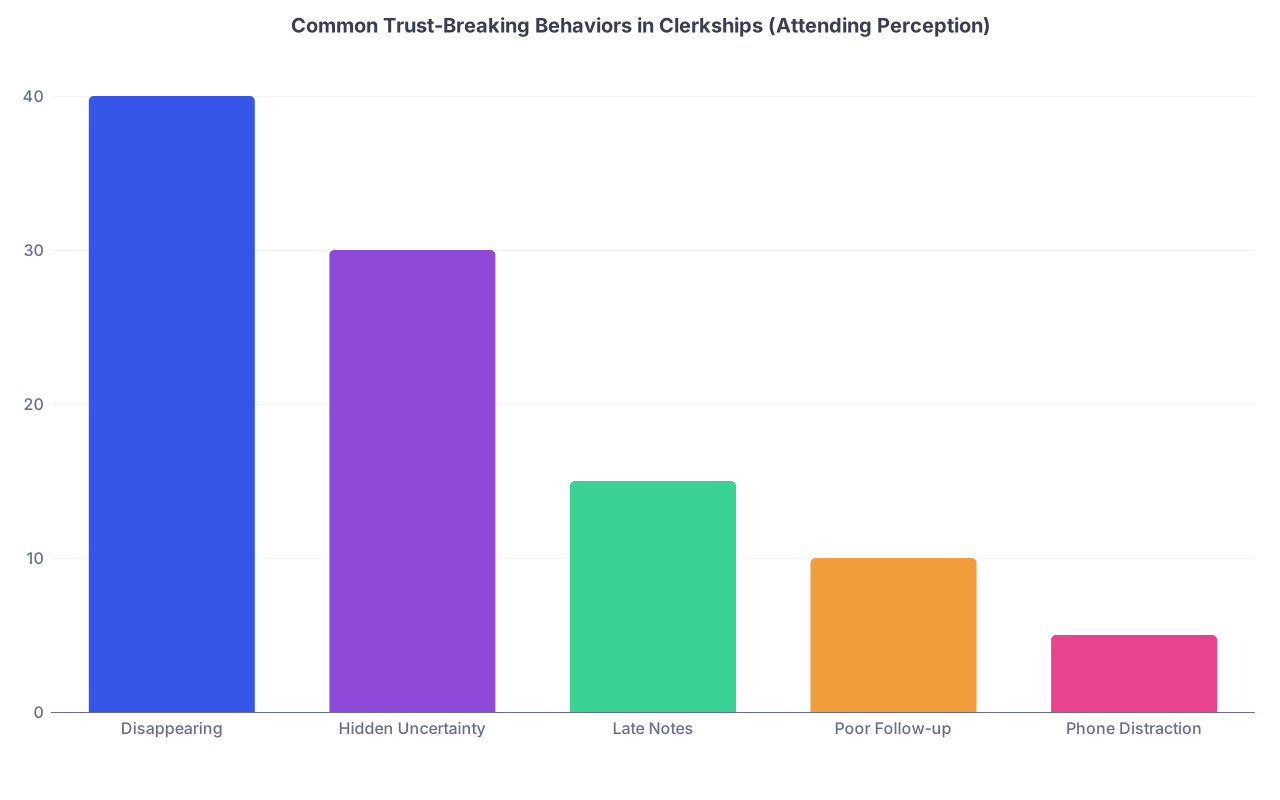
| Category | Value |
|---|---|
| Disappearing | 40 |
| Hidden Uncertainty | 30 |
| Late Notes | 15 |
| Poor Follow-up | 10 |
| Phone Distraction | 5 |
You know what freaks attendings out? Not knowing where their students are.
Trust-killing behaviors:
- Disappearing for long stretches without telling the team
- Leaving the hospital before confirming you’re done for the day
- Skipping family meetings or procedures because “no one told me I had to be there”
- Hiding in a corner “studying” while active patient care is happening
Here’s the mental model: If they can’t physically find you, they assume they can’t rely on you. And if they can’t rely on you, you get written off as dead weight.
The worst version is the “stealth early departure”:
- Team is still in the ED or consults
- Student quietly vanishes around 3 p.m. because “We were basically done”
- Attending finds out later and says nothing to you—but definitely writes it in the eval
How to avoid this mistake
Anchor yourself to the team. Basic rules:
- Always tell someone where you’re going: “I’m going to check on 402’s labs and then will be in the workroom.”
- Before you leave for the day, explicitly ask: “Is there anything else I can help with before I head out?”
- If you’re told you can study, clarify: “Do you want me in the workroom, or is it okay if I find a quiet spot? And can I still help with anything that comes up?”
You are allowed to go eat, go to the bathroom, and study. You’re not allowed to be unaccounted for.
3. Sloppy, Unreliable Data
Nothing destroys confidence faster than realizing your numbers are wrong. Not occasionally wrong. Pattern-wrong.
- Misstating vitals on rounds (BP 120/70 when it’s 88/50)
- Presenting labs from two days ago as “today’s labs”
- Mixing up which patient has which diagnosis
- Writing a note that clearly doesn’t match the chart
I’ve seen this: Student presents, “His creatinine is stable at 1.3,” while the real value is 2.7. Attending checks. Quietly furious. Trust gone.
You never want your attending thinking, “I have to re-check everything this student says.”
How to avoid this mistake
Slow down. You’re not a court stenographer; you’re supposed to think.
- When you pre-round, refresh the chart immediately before seeing the patient
- Before rounds, do a last 2–3 minute check of vitals/labs for each patient
- In your notes, double check:
- Date
- Lab times
- Does the story logically match the data?
And if you realize you gave incorrect info, correct it proactively:
- “Dr. Smith, I checked again—earlier I said her sodium was 134; it’s actually 132. Sorry about that, I misread the lab timestamp.”
Owning the error helps restore some trust. Hiding it destroys it completely.
4. Pretending to Follow Up (When You Didn’t)
This one gets students destroyed in evaluations, and they never know why.
Scenario:
- Attending: “Can you follow up that CT and let me know what it shows?”
- Student: “Yes.”
- Hours pass. No update.
- Attending eventually checks themselves.
- CT was abnormal. No one knew.
Or:
- “Call the lab and see why that troponin is delayed.”
- Student says “Okay,” gets busy, never calls.
- That’s a direct hit to your reliability score.
In an attending’s mind, each unfollowed task = one more vote for “I cannot trust this person with even small responsibilities.”
How to avoid this mistake
New reflex: if someone gives you a discrete task, you close the loop.
- Write it down immediately in a to-do list
- Once it’s done, report back without being asked:
- “I followed up the CT—no acute findings, just chronic changes.”
- “Lab said the sample hemolyzed, they’re redrawing now.”
If you can’t complete it (you get pulled into something else):
- “Dr. Lee, I wasn’t able to get through to radiology before rounds; would you like me to keep trying now or is someone else already on it?”
Tasks half-done or never closed make you look scattered and unsafe.
5. Chronic Last-Minute / Late Behavior
Yes, people hate tardiness. But in clerkships, consistent lateness isn’t seen as rudeness. It’s seen as a pattern of unreliability.
Concrete examples that make attendings quietly mark you down:
- Strolling into pre-rounding 10 minutes after the intern has already seen patients
- Logging on to morning sign-out 3 minutes late, repeatedly
- Submitting notes so late they’re useless to the team
- Being the last one to show up for an OR case you were supposedly excited about
One student on surgery showed up “on time” for the case—meaning wheel-in time. Attending and residents had already been there, scrubbed, and went through the plan. That student was never trusted with anything sharp again.
How to avoid this mistake
You don’t need to be a martyr, you just need to be predictably present.
- Aim to be 10–15 minutes early to anything scheduled (rounds, clinic, OR)
- Ask: “When should I be there?” and then show up slightly before that
- For notes, ask what’s useful:
- “Would it be more helpful if my notes are in before noon?”
- Then actually hit that mark daily
Once you show them you respect the clock, they stop worrying about you.
6. Phone Addiction in Clinical Space
You might think “I’m just checking UWorld” or “I’m reading UpToDate.” Attendings usually think: “This student is on Instagram again.”
Perceptions that get you burned:
- Looking at your phone during teaching, rounds, or family meetings
- Scrolling at the nurse’s station while everyone else is clearly working
- Looking down at your pocket whenever a notification buzzes
You do not want the narrative, “They’re more interested in their phone than the patient.”
How to avoid this mistake
Use your phone intentionally and transparently:
- Keep it on silent and out of sight during rounds and teaching
- If you must use it for something clinical, say it out loud:
- “I’m just going to pull up the CT report on my phone.”
- “I’m looking up the CHADS-VASc score real quick.”
If you need to deal with something personal:
- Step away and say: “I need to handle a quick personal issue—may I step out for 2 minutes?”
- Then actually come back in 2 minutes
Otherwise, assume that any glance at your phone looks bad unless you clearly label what you’re doing.
7. Weak Ownership of “Your” Patients
Students lose trust when attendings feel like they care more about the list than about actual human beings.
Red flags:
- You present well but never re-check on your patients during the day
- Nurses mention concerns to you and you just nod without telling anyone
- You don’t know simple updates when asked:
- “Has his pain improved?” — “I’m not sure, I haven’t seen him since rounds.”
The internal story attendings tell: “They don’t own their patients; they’re just performing for rounds.”
How to avoid this mistake
Act like you’re the primary person responsible for knowing your patient’s story, even if you have zero actual order-writing power.
That means:
- Check in with “your” patients at least once again later in the day
- After any big change (new oxygen, new fever, procedure), go see them
- Ask the nurse: “Anything you’re concerned about with Mr. X today?”
Then, when asked, you can say:
- “I checked again this afternoon; his pain was down to 3/10 and he was able to walk a bit with PT.”
- That’s how trust is built: you don’t have more power, you just have more awareness.
8. Being Defensive Instead of Curious
Nothing turns an attending off faster than a student who argues every piece of feedback.
Common patterns:
- Explaining every mistake instead of owning it
- Saying “Well, on my last rotation they wanted it this way” as a rebuttal
- Getting visibly annoyed or shutting down after critique
Here’s the quiet calculation: “If I can’t correct this student without drama, I won’t give them responsibility.”
How to avoid this mistake
You don’t have to enjoy criticism. You just have to handle it like an adult.
Better responses:
- “Got it—I’ll focus on being more concise with my assessment.”
- “Thanks for pointing that out; I hadn’t thought about it that way.”
- “Can I clarify one thing so I get it right next time?”
Do not rebut unless there’s real patient safety at stake. Most of the time, just absorb, adjust, move on.
9. Overstepping Without Backup
There’s a difference between initiative and recklessness. Attendings lose trust when students skip the “check in” step.
Risky moves:
- Telling a patient, “You’ll probably go home tomorrow,” when no one has said that
- Giving medication counseling that contradicts the actual plan
- Calling a consult or ordering tests without discussing it with the team
- Making promises about pain meds, imaging, work notes, etc.
When attendings discover you’ve been freelancing medical decisions, you drop several notches instantly.
How to avoid this mistake
General rule: Think like a doctor. Act like a student.
You are absolutely allowed to:
- Suggest ideas: “Should we consider a CT here given X and Y?”
- Draft plans: “I was thinking we could do A, B, then C—does that make sense?”
- Practice counseling: “Can I run through the discharge instructions with you while you listen in?”
You are not allowed to:
- Make commitments for the team
- Give definite prognoses or timelines
- Start processes that bind the team (consults, tests, big promises)
When in doubt, preface:
“I’m just the medical student, so don’t take this as the final word—your doctor will confirm the plan.”
10. Poor Documentation Habits
Your notes are not “just paperwork.” They’re another trust signal.
Red flags in notes:
- Copy-pasting old information without updating
- Writing essays in the assessment with no clear plan
- Leaving out critical info (pressors, oxygen changes, new fevers)
- Finishing notes at 5 p.m. on a patient who had morning rounds
If your written work is always messy, late, or inaccurate, attendings stop believing you can track real clinical details.
How to avoid this mistake
Treat your first few weeks as documentation training camp.
Ask a resident or attending:
- “Can I see an example of a good SOAP note for this service?”
- “What’s the most important thing to include in the assessment and plan here?”
Then:
- Keep your assessment structured by problem
- Make sure the note clearly reflects the current situation, not last week’s
- Time your notes so they’re done when the team actually needs them
If the attending sees that your notes match reality, that’s one more vote for trusting you.
11. Not Tracking Your Own Learning Gaps
One underrated trust-breaker: students who keep repeating the same misunderstandings because they never actually fix them.
Pattern:
- Attending explains heart failure management on Monday
- Student nods, doesn’t write anything, doesn’t read later
- On Thursday, student still can’t outline basic HF plan
That screams: “I am not self-correcting.” And if you’re not self-correcting as a student, what happens when no one’s watching you as a resident?
How to avoid this mistake
Make your learning visible and intentional.
- Keep a tiny pocket list or note on your phone: “Things to look up tonight”
- When you see a recurring topic, actually learn it (even 15 minutes helps)
- The next time it comes up, show growth:
- “Since we had that patient on Monday, I read a bit about diuretic strategies…”
Attendings trust students who improve week to week. They mentally downgrade students who stay at the same level all rotation.
Quick Comparison: Trust-Building vs. Trust-Breaking Behaviors
| Area | Trust-Building Behavior | Trust-Breaking Behavior |
|---|---|---|
| Uncertainty | Admits not knowing, asks to clarify | Fakes understanding, bluffs answers |
| Tasks | Closes the loop and reports back | Says “I’ll do it” then never follows up |
| Presence | Always tells team where they are | Frequently disappears without explanation |
| Data | Double-checks labs/vitals before presenting | Repeatedly presents outdated or wrong data |
| Feedback | Receives and adjusts | Argues, deflects, or shuts down |
A Simple Mental Model: Safety + Reliability + Effort
Most attendings are really doing one thing with students: quickly judging if you are safe, reliable, and worth investing in.
Here’s how they subconsciously score you:
- Safety: Do you recognize what you don’t know? Do you ask for help appropriately?
- Reliability: If I give you a task, can I forget about it because I know you’ll follow through?
- Effort: Are you trying to understand the patient and the plan, or just punching the clock?
Everything we just went through plugs into one of those three buckets.
You don’t have to be brilliant. You do have to be someone they’d be willing to sign out a sick patient to at 2 a.m. someday. Clerks who get strong evals aren’t necessarily geniuses. They just never trigger the “I don’t trust this person” alarm.

| Step | Description |
|---|---|
| Step 1 | Start of Rotation |
| Step 2 | Shows up early, prepared |
| Step 3 | Late, disorganized |
| Step 4 | Low expectations |
| Step 5 | Closes loop, follows up |
| Step 6 | Forgets, incomplete |
| Step 7 | Increased autonomy |
| Step 8 | Micromanaged, low trust |
| Step 9 | Strong evals |
| Step 10 | Weak evals |
| Step 11 | First Impression |
| Step 12 | Given Tasks |
FAQ (Exactly 4 Questions)
1. Can I recover if I already made one of these mistakes early in the rotation?
Yes, if you change fast and visibly. Say you dropped the ball on following up a lab. Do not over-apologize. Just say, “I missed that yesterday; I’ve started writing down every follow-up task so it won’t happen again.” Then actually never miss follow-up again. Attendings care more about your trajectory than a single bad day. Persistent patterns are what kill you.
2. Is it better to ask a lot of questions or stay quiet so I don’t annoy people?
Both extremes are bad. What destroys trust is asking the same question multiple times or asking questions that show you didn’t listen two minutes ago. Ask focused, relevant questions—especially “why” questions about the plan. When the team is slammed, save non-urgent questions for a lull or the walk between floors. Curiosity that respects workflow builds trust; nonstop noise breaks it.
3. How much initiative is too much as a medical student?
Initiative is good when it makes the team’s life easier without committing them to anything. Examples: pre-writing discharge instructions, printing relevant imaging reports, drafting notes, calling to confirm that transport has been arranged. It crosses the line when you start making promises, calling consults, or implying decisions to patients that the team hasn’t agreed to. If something affects the plan, run it by someone before acting.
4. What if my attending already seems uninterested—does any of this still matter?
Yes. Residents and nurses often have massive influence on your evaluation. Many attendings explicitly ask, “What did you think of this student?” If you’re reliable, present, and safe, that filters up, even if the attending never fully warms to you. Also, habits you build on one rotation follow you into the next. You are not just getting through this month; you’re building (or destroying) your professional reputation pattern by pattern.
Remember:
- Don’t fake it. Honest uncertainty is fine; confident nonsense is not.
- Don’t disappear—physically or from your responsibilities. Be where you’re supposed to be, doing what you said you’d do.
- Don’t repeat the same mistake twice. Show you learn, adjust, and can be trusted a little more each week.