
Last year on rounds, a third‑year proudly presented his patient: smooth, confident, hit all the major points. Then he walked away and the attending opened his note. The entire team watched her face change from impressed… to annoyed… to done. Same student. Same patient. But his SOAP note told a very different story about him than his presentation did.
You think your SOAP note is “just documentation.” Your faculty read it like an X‑ray of your brain. And they catch things you do not even know you’re broadcasting.
Let me walk you through what we’re actually seeing when we scroll your note at 10:47 PM after a 12‑hour day.
1. The Hidden Story in Your Subjective: What You Didn’t Ask
Most students think the Subjective is about what the patient said. Faculty use it to judge what you thought about.
When I read:
“Pt c/o SOB x 2 days. Worse with exertion. +cough. Denies CP, fevers, edema.”
I am not just checking content. I am reconstructing your interview in my head. And I can see the holes.
Here’s what runs through an attending’s mind with that exact line:
- “SOB x 2 days” – Fine. But where is the baseline? SOB compared to what? COPD? CHF? Deconditioning?
- “Worse with exertion” – Ok. But what about lying flat? Waking up at night gasping? Orthopnea? PND?
- “Denies CP” – Good. What about pleuritic pain? Hemoptysis? Leg swelling? Recent travel?
- No smoking history here. No prior episodes. No trigger. No sick contacts. No med changes.
There’s a basic rule we all know but rarely say out loud: a thin Subjective usually means a thin differential. And a thin differential means you did not think through the problem.
Faculty notice:
- When your Subjective is generic across patients: it tells us you’re using the same script for everyone.
- When it doesn’t match the chief complaint: “SOB” with a detailed GI review but nothing about cardiac or pulmonary risks screams copy‑paste.
- When you hide behind “ROS negative”: That phrase is a red flag. What did you actually ask? We know you didn’t do a 14‑point review.
The big thing you do not realize: we can usually tell exactly how long you spent with the patient just from the Subjective. Three‑minute interview? It shows. Fifteen‑minute careful history? That shows too.
If your ROS always reads like: “Denies f/c, n/v, cp, sob, abd pain, diarrhea, dysuria, HA, vision changes, rash,” on every single note, every single patient, we know you’re not tailoring your questions. You’re protecting yourself medicolegally, not thinking clinically.
On a good medicine or surgery service, that kind of templated nonsense gets clocked fast. People do not always call you out. But they notice—and they start trusting your notes less.
2. Objective: The Subtle Ways You Tell Us You Didn’t Examine the Patient
Every attending has said some version of this behind closed doors: “If you write ‘normal’ for every system, you didn’t examine that patient.”
You think you’re being thorough. We see laziness or fear.
Look at this:
“Gen: NAD. CV: RRR, no m/r/g. Lungs: CTAB. Abd: soft, NT/ND. Ext: no edema. Neuro: grossly intact.”
Here’s how that reads to faculty:
- “NAD” on someone in clear respiratory distress? You just told me you don’t know what distress looks like.
- “CTAB” on a pneumonia patient already diagnosed on CXR? That’s either a lie or a useless exam.
- “Neuro: grossly intact” on a stroke patient. Translation: “I did not do a neuro exam but I’m hoping this phrase covers me.”
We also notice when your Objective doesn’t match your own prior notes. If yesterday you documented:
“Crackles at bases bilaterally, 2+ pitting edema to knees.”
And today you write:
“Lungs CTAB. Ext: no edema.”
…with no treatment that explains that rapid a change, I assume you:
- Didn’t re‑examine carefully, or
- Are copy‑pasting from the wrong note template.
On some services, that’s the quiet moment where a resident decides whether they can trust you with sick patients or not.
The other thing: vitals. You love to paste them. You rarely interpret them. Faculty pick up on that immediately.
We notice:
- When you list vitals from midnight on a 7 AM note and don’t mention the 4 AM BP of 82/46 that woke up the night team.
- When you write “afebrile” but Tmax was 38.1 °C an hour before your pre‑round.
- When you ignore trends: HR climbing over three days, MAP quietly dropping.
A sharp SOAP note doesn’t just dump vitals. It tells us you saw and thought about them:
“Temp now 37.4 after Tmax 38.6 overnight; defervesced without Tylenol. BP trending down from 120s/70s to low 100s/60s over past 12h but asymptomatic.”
That one sentence tells me you:
- Looked at trends, not just one number
- Noticed the fever pattern
- Understand relevance enough to mention or dismiss it briefly
That’s the difference between “student documenting” and “intern who might not hurt people.” Faculty are absolutely screening you for that.
3. Assessment: Where Faculty Really Decide How Strong You Are
This is the section that separates serious thinkers from copy‑pasters. And your attendings read it much more carefully than your Subjective or Objective.
You think the Assessment is where you list diagnoses. We know it’s where you show your reasoning—or your lack of it.
Here’s the typical student assessment for a complicated patient:
“1. Sepsis
2. UTI
3. AKI
4. DM2
5. HTN
6. HLD
7. Depression”
Technically accurate. Academically useless. And it tells me you don’t yet understand hierarchy or synthesis.
What I’m really looking for:
- Do you prioritize problems correctly? Sickest, most acute issues first. Chronic back pain goes after septic shock, not before, no matter what med school rubric you memorized.
- Do you connect the dots? “AKI likely pre‑renal in setting of sepsis and poor PO intake” is so much stronger than “AKI.”
- Do you make a call? Or do you hedge infinitely?
Faculty notice when you refuse to commit.
For example:
“Dyspnea likely multifactorial including possible CHF exacerbation, pneumonia, PE, ACS.”
That’s your brain avoiding responsibility. What this says to a program director reading your notes during an audition rotation is: “This student doesn’t know which diagnoses are more likely and won’t stick their neck out.”
Compare that with:
“Acute dyspnea most consistent with CHF exacerbation given orthopnea, JVD, bilateral crackles, and elevated BNP; pneumonia less likely with clear CXR and no fever; low suspicion for PE (no pleuritic pain, no leg swelling, normal D‑dimer).”
See the difference? You showed your work. You did not sit on the fence. You still acknowledged alternatives. That’s what strong looks like on paper.
Faculty also pick up patterns over time:
- Your assessments are always just restatements of the diagnosis: “Pneumonia – patient has pneumonia.” That’s a sign of superficial thinking.
- You never explain “why now.” That screams template use rather than real clinical reasoning.
- You repeat the same canned phrases from UpToDate or UWorld. It’s obvious.
Here’s the uncomfortable truth: on some rotations, your written Assessment matters more than your oral presentation. The note is what gets read later when people actually have time to think about whether you understand what’s going on.
And during grading discussions, I’ve heard this more than once: “Their presentations were okay, but their notes were just lists. No synthesis. I wouldn’t want them as an intern yet.”
4. Plan: Where We See If You Can Actually Manage a Patient
The Plan tells us whether you’re just listing guidelines or whether you understand management.
Most students write plans like this:
“1. Sepsis
- Continue IV antibiotics
- Follow cultures
- Monitor vitals
- Trend lactate
- AKI
- Monitor BMP
- Avoid nephrotoxins
- Strict I/Os”
Sounds fine. Reads generic. Faculty see:
- No actual antibiotic named or reasoning for choice or duration
- No fluid plan—rate, type, goal
- No clear threshold to escalate care (ICU, pressors, call rapid response)
- No explicit link between the AKI and sepsis management
We care about details because they tell us whether you really thought about the patient or just regurgitated phrases.
For example, look at two versions of a plan for the same CHF patient:
Student A:
“CHF exacerbation
- Continue diuresis
- Monitor weights and I/Os
- Daily BMP”
Student B:
“Acute on chronic HFrEF exacerbation
- Continue IV furosemide 40 mg BID; goal net –1.5 to –2 L/24h
- Check BMP and Mg daily; replete K to >4, Mg >2
- Strict I/Os and daily weights
- If SBP persistently <90 or rising creatinine >0.3 from baseline, notify team and consider decreasing diuretic dose
- Once euvolemic, transition to PO diuretic and resume home ACEi”
Student B is still a student. They’re not writing orders solo. But from that plan, I know they:
- Understand the goal of therapy (net negative, not just “diuresis”)
- Anticipate complications (hypotension, AKI, electrolyte changes)
- Have thresholds for action
- Think about disposition and transition to home meds
That’s the intern mindset we’re looking for.
We also see when your Plan is a Frankenstein monster of copy‑paste from multiple prior notes. Classic tells:
- You order a CT scan that was already done yesterday with a result in your own Objective.
- You write “continue heparin gtt” on a patient who was switched to apixaban 2 days ago.
- You “monitor” things that no longer matter.
On some services, the senior resident will quietly rewrite your plan and never say a word. On others, you’ll get a direct teaching moment. But across the board, people are judging whether your written Plan shows budding judgment—or lack of it.
5. The Stuff You Think No One Notices: Style, Language, and Hidden Attitudes
Let me be ruthless for a moment. Faculty absolutely judge you on style. Not just content.
We notice:
- When your note is a wall of text with zero paragraph breaks. That reads as chaos. Disorganized thinking usually pairs with disorganized writing.
- When you use casual or inappropriate language: “Pt is a poor historian because they’re kind of out of it” or “Pt was whining about pain again.” Instant red flag for professionalism.
- Overuse of abbreviations that no one else uses. It doesn’t make you look smart. It makes your note unreadable.
- Spelling. Grammar. Yes, in medicine. Look, nobody cares about a missed comma. But consistent sloppy writing often tracks with sloppy data gathering.
And then there’s attitude. Your SOAP note leaks your mindset in ways you don’t expect.
Examples I’ve actually seen:
“Patient continues to refuse recommended treatment.”
Reads like: “This difficult patient won’t listen.” Faculty would rather see:
“Patient declines recommended treatment after discussion of risks and benefits, citing concern about side effects and desire to try lifestyle changes first.”
That second line shows respect, understanding of autonomy, and acknowledgment that you actually talked to the patient like a human.
Or this:
“Pt denies drug use.”
Sure, maybe that’s exactly what happened. But if every note you write about a patient with a substance‑use history is just, “Pt denies,” we start wondering if you’re having real conversations or just checking boxes.
The truth: your language around “non‑compliant” patients, patients with obesity, chronic pain, or substance‑use disorders tells faculty a lot about your maturity and empathy. It’s not just a woke talking point. It literally affects how safe you’ll be as a doctor.
6. The Quiet Red Flags: Things That Make Faculty Lose Trust Fast
Every year there are one or two students whose notes become… unreliable. Once that happens, it’s hard to come back from.
Here are the patterns that trigger that shift:
Documented exams that obviously did not happen.
Writing “pelvic exam WNL” on a busy ED shift when we know no one did a pelvic on that patient. Or “detailed neuro exam nonfocal” on someone with altered mental status you saw for two minutes. This crosses from sloppiness into integrity.Copy‑paste errors that change patient reality.
“Denies previous surgeries” on a patient with a midline laparotomy scar and multiple prior admissions. Or “no known drug allergies” when the banner at the top of the chart is flashing “PENICILLIN – ANAPHYLAXIS.”Inconsistent stories across team members.
Resident note: “Pt expresses suicidal ideation without plan.”
Your note: “Denies SI/HI.”
Faculty see that and wonder: Did you not ask? Did they not tell you? Did you just copy yesterday’s ROS? None of those answers are good.Magic recoveries you’re the only one to notice.
Everyone else documents severe pain, high oxygen needs, or repeated confusion. Your note: “Pt comfortable, pain well controlled, A&Ox3, no distress.” You’re not “more observant.” You’re clearly not seeing the same patient we are.
And here’s what students don’t realize: those concerns get discussed behind the scenes. “I wouldn’t trust their exam.” “Always double‑check their labs.” That kind of reputation lingers long after the rotation.
7. What a “Strong” SOAP Note Actually Looks Like to Faculty
Let me spell out what attendings quietly reward, because you rarely get explicit feedback on this.
A strong SOAP note:
- Matches the situation. A crashing ICU patient’s note should not read like a stable clinic follow‑up. If your format never changes, you’re probably not adapting to clinical reality.
- Shows selection, not just collection. You didn’t vomit every data point into the Objective. You picked what matters for today’s decisions.
- Reflects temporal thinking. “Better,” “worse,” “unchanged,” with evidence. No one cares that their creatinine is 1.6 in isolation. We care that it was 0.8 yesterday.
- Admits uncertainty but doesn’t hide behind it. “Most consistent with X, but will also evaluate for Y given Z.”
- Has a Plan that implies you actually care what happens between now and tomorrow.
Here’s the not‑so‑secret secret: faculty aren’t expecting you to write perfect attending‑level notes. We know you’re learning. What we’re really scanning for is trajectory. Are you thinking like a future intern, or are you still thinking like a pre‑clinical student trying to impress us with completeness?
The students who stand out are not the ones who write the longest notes. They’re the ones whose notes make it very easy for the team to know what’s going on and what should happen next.
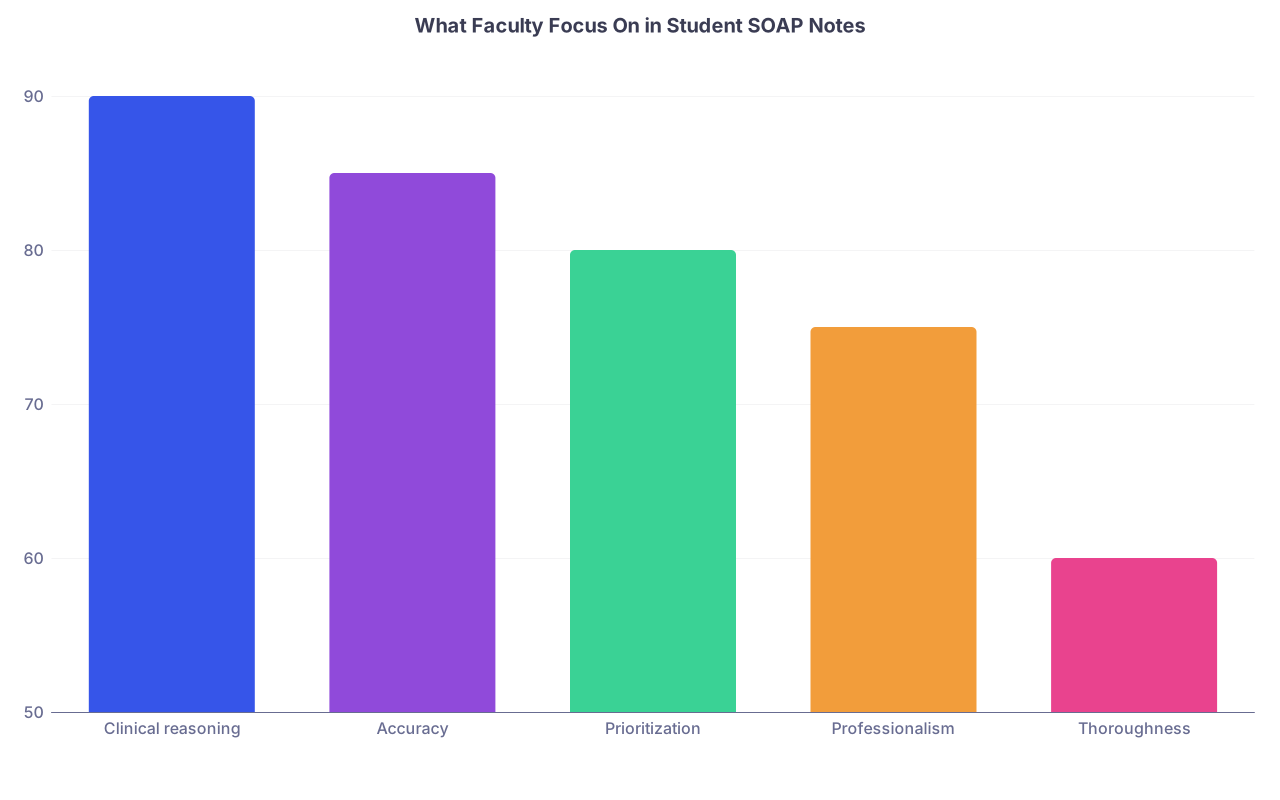
| Category | Value |
|---|---|
| Clinical reasoning | 90 |
| Accuracy | 85 |
| Prioritization | 80 |
| Professionalism | 75 |
| Thoroughness | 60 |
8. How This Actually Affects Your Evaluations and Letters
You think attendings grade you based on one or two presentations and whether you seemed eager. That’s part of it. But on services that value documentation—medicine, surgery, OB, psych—your SOAP notes absolutely affect your end‑of‑rotation comments.
Here’s the pattern I’ve seen in evaluation meetings more times than I can count:
- “They’re quiet on rounds, but their notes are solid. Good reasoning, organized. I’d be comfortable with them as an intern.” → This student gets “Exceeds expectations” or honors.
- “They talk a good game, but when you read their notes it’s clear they don’t really get it.” → This student gets “Meets expectations,” maybe a lukewarm letter.
- “Their documentation is sloppy—lots of copy‑paste, inconsistencies.” → This student gets flagged for professionalism or “needs close supervision.”
And when we write letters of recommendation, the subtext shows up. Phrases like:
- “Their documentation was consistently clear and clinically useful.” → That’s code for “You can trust this person with notes and patient care.”
- “With continued supervision, they will grow into a strong clinician.” → Translation: “Not there yet. Needs close oversight.”
Program directors read between those lines. They’ve all seen students who looked fine on paper but whose notes told a different story.

9. Practical Tweaks That Make You Look Instantly More Advanced
I’m not going to waste your time with “be thorough” or “double‑check your work.” You already know that. Here are the insider moves that actually change how faculty read you:
Write one sentence at the top of Assessment that synthesizes the patient.
“67‑year‑old man with DM2 and COPD admitted with sepsis likely from pneumonia, improving hemodynamically but still requiring 4L O2 via NC.”
That sentence alone puts you above half your class.Use “most likely… less likely… unlikely” language.
Stop listing five equal possibilities. Force yourself to rank them. We will respect you more for it, even if you’re slightly off, because we can correct your reasoning.Always answer ‘better, worse, or same’ in your Assessment.
For each major problem: include a phrase like “clinically improved,” “unchanged,” or “slightly worse with X new finding.” That’s actual thinking, not regurgitation.Tie every lab or test to a decision.
Don’t order a CT “for evaluation.” Order it “to evaluate for X, which would change management by Y.” Even in your note. It shows you understand why you’re clicking buttons.End each major Plan item with a “watch for” or “if/then” statement.
“If fever recurs or WBC rises >15, will broaden antibiotics and re‑evaluate for occult source.”
That’s how we think. Seeing you do it too makes us trust you more.

| Step | Description |
|---|---|
| Step 1 | See Patient |
| Step 2 | Key Symptoms & Timeline |
| Step 3 | Focused Exam & Vitals Review |
| Step 4 | Prioritize Problems |
| Step 5 | Form Working Diagnosis |
| Step 6 | Plan With If/Then Branches |
| Step 7 | Document SOAP Note |
| Aspect | Weak SOAP Note | Strong SOAP Note |
|---|---|---|
| Subjective | Generic, same template for all | Tailored to chief complaint |
| Objective | Copy-paste, everything "normal" | Focused, matches disease and trends |
| Assessment | List of diagnoses only | Prioritized, explains "why" and "why now" |
| Plan | Vague "continue, monitor" | Specific meds, goals, and contingencies |
| Tone/Style | Sloppy, judgmental language | Professional, concise, respectful |
FAQ: What Faculty Notice in Your SOAP Note That You Don’t Realize
1. Do attendings actually read my whole SOAP note, or just skim?
Depends on the service and the time of day. On busy inpatient teams, many attendings skim the Subjective and Objective but read your Assessment and Plan closely. On slower services or when a case is complex, they’ll read everything—and that’s when templated or contradictory content gets exposed. Residents almost always read your notes more carefully than you think, because your documentation influences their sign‑outs and orders.
2. Is it better to be brief or thorough in a SOAP note as a student?
Neither extreme. Bloated notes with every possible detail tell us you cannot prioritize. Hyper‑minimalist notes read as laziness. What we look for is selective thoroughness: enough detail to support your reasoning and management decisions, without drowning us in noise. If your Assessment and Plan are clear and well‑reasoned, we’ll forgive a slightly long Objective. Not the other way around.
3. How honest should I be about my uncertainty in the Assessment?
You should be explicit, but not paralyzed. “Most consistent with X, but also considering Y given Z” is what maturity looks like. Writing five possibilities without ranking them looks like you’re afraid to think. Faculty don’t penalize well‑argued uncertainty; we penalize hand‑waving and fence‑sitting.
4. What’s the fastest way to improve how my SOAP notes are perceived?
Focus on two things: prioritizing your problem list and making your Plan concrete. Put the sickest and most acute problems first, and under each one, write specific actions, goals, and contingencies. If in doubt, grab a resident and ask, “Can I show you one of my notes and get feedback on my Assessment and Plan?” Very few students do this. The ones who do usually leap ahead quickly.
5. Can bad SOAP notes actually hurt my grade or chances at an honors or strong letter?
Yes. I’ve seen students with decent knowledge and good work ethic land in the “meets expectations” bucket because their documentation was consistently disorganized, generic, or unreliable. On the flip side, I’ve pushed for honors for quieter students whose notes showed serious clinical reasoning. Letters often mention documentation quality explicitly or implicitly. Your SOAP notes are part of the portfolio you’re unknowingly building.
You’re going to spend an absurd amount of time in front of an EMR in your career. You can treat SOAP notes like a chore, or you can treat them like reps for your clinical brain. Start writing the way good interns think now, while someone else is still co‑signing your mistakes. Because soon enough, the note you dash off at midnight won’t just shape how faculty see you—it’ll shape what actually happens to your patients. And that’s the next step in your training.