
Clinical question answering errors are the fastest way to look unprepared in front of your team.
Not your GPA. Not your Step score. The way you answer questions on the wards.
You can know a ton, study every night, and still look like you have no idea what you’re doing if you commit the classic question-answering mistakes that attendings quietly hate and residents have no patience for.
Let me walk through the traps I’ve watched students fall into again and again—and how you can avoid being that student on rounds.
The Biggest Meta-Mistake: Thinking It’s Just About “Knowing the Answer”
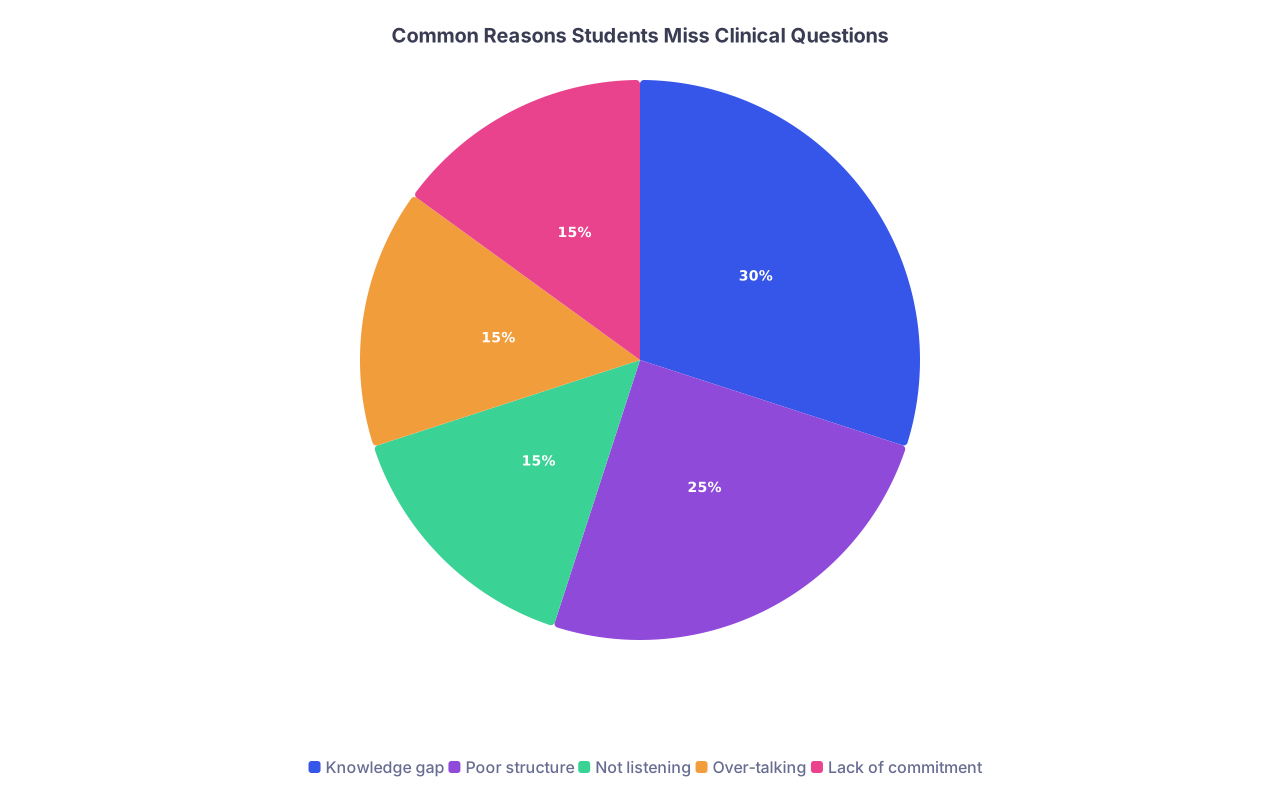
| Category | Value |
|---|---|
| Knowledge gap | 30 |
| Poor structure | 25 |
| Not listening | 15 |
| Over-talking | 15 |
| Lack of commitment | 15 |
Clinical questioning is not a trivia game. It’s a performance of:
- How you think
- How you communicate
- How safe you will be with actual patients
If you treat it like Jeopardy, you will look unprepared even when you’re technically correct.
The core mistake: believing that content knowledge alone will save you. It won’t.
To look prepared, you need three things:
- A clear, concise structure for answers
- The ability to say “I don’t know” without sounding helpless
- Accurate reading of what the questioner is actually asking
Miss any of those and people start thinking: “This student isn’t ready.”
Mistake #1: Talking in Circles Instead of Answering the Question
This is the one that makes attendings visibly irritated.
You get asked:
“Why are we giving this patient furosemide?”
And you launch into:
“So furosemide is a loop diuretic that works at the thick ascending limb of the loop of Henle and it blocks the Na-K-2Cl co-transporter and… also we have to monitor electrolytes like potassium and magnesium and…”
You still haven’t answered the question.
What this looks like in real life
- You recite everything you remember on a topic instead of giving the requested fact.
- You start with pathophysiology from M1 instead of the clinical reason today.
- You answer a related question, not the actual question.
Translation to your team: This student can’t prioritize. This student doesn’t listen.
How to avoid this
Use a brutally simple rule:
Answer first. Justify second. Expand only if asked.
Example:
Attending: “Why are we giving this patient furosemide?”
Prepared student: “To relieve her volume overload from decompensated heart failure by promoting diuresis. It reduces her pulmonary congestion and peripheral edema. Mechanistically, it’s a loop diuretic inhibiting the Na-K-2Cl transporter in the thick ascending limb.”
That’s the right order:
- The clinical reason today
- The clinical consequence
- The mechanism (only then)
If you catch yourself needing more than 2–3 sentences before even addressing the main point, you’re already off track.
Mistake #2: Rambling Histories and Presentations
On rounds, time is blood. Nobody wants a 7-minute story about a straightforward UTI.
The mistake: thinking more details automatically equals “thorough” and “prepared.”
Wrong. Too many details without triage looks like you don’t know what matters.

| Step | Description |
|---|---|
| Step 1 | Hear the question |
| Step 2 | Ask brief clarifying question |
| Step 3 | Answer in 1 sentence |
| Step 4 | Add brief reasoning |
| Step 5 | Give focused details |
| Step 6 | Stop talking |
| Step 7 | Clarify needed? |
| Step 8 | Asked for more? |
What this looks like on the wards
You get asked: “Anything important on his social history?”
And you say:
“He lives alone in a two-story home, he works as a mechanic, he has three kids who live in different states, he previously smoked for 10 years but quit 5 years ago, he occasionally drinks…”
You lost them after the first clause.
A prepared answer would be:
“Lives alone in a two-story home, no reliable caregiver support, limited finances, ex-smoker, no current alcohol or drug use. Main concern is safety at home after discharge because of his mobility issues.”
Short. Prioritized. Clinically useful.
How to avoid this
Before you open your mouth, force yourself to:
- Identify the headline: What actually matters for today’s decisions?
- Group related facts: “Social support, home setup, finances.”
- Kill the trivia: If it doesn’t affect management or risk, it’s probably not worth saying unprompted.
If you’re chronically long-winded, practice out loud at home with a 30-second limit. It feels dumb. It works.
Mistake #3: The Cowardly “Guess Then Hide” Approach
You know this one. Attending asks:
“What’s the next best step in management?”
Student:
“Maybe… we could consider… starting antibiotics… and also possibly getting imaging… like a CT scan… and checking labs like a CBC and BMP…”
That answer says: “I want credit for thinking of everything, but I refuse to commit to any of it.”
Why this is a problem
Clinical medicine is about decisions. You can’t hedge forever with “maybe,” “possibly,” “you could consider.”
When you’re vague and scattered:
- It’s hard to tell if you know the right answer.
- You sound unsure, even if one of your 4 half-answers is correct.
- You look unsafe, because in real life, “maybe everything” is not a plan.
How to fix it
Use this structure:
- Commit: “The next best step is ___.”
- Then expand if needed: “We’d also do ___ after that depending on results.”
Example:
“For this febrile neutropenic patient, the next best step is immediate broad-spectrum IV antibiotics, such as cefepime, within an hour. We’ll also get cultures and additional labs, but treatment should not be delayed for those.”
You’re allowed to be wrong. You’re not allowed to be so vague nobody can even tell what your plan is.
Mistake #4: Saying “I Don’t Know” the Wrong Way
You’re terrified of being wrong, so you blurt out:
“I don’t know”
and then stop talking.
Silence. Awkward. You look like you didn’t even try.
Or worse, you do know the ballpark but you’re so afraid of exact numbers that you refuse to even approximate.
The bad versions of “I don’t know”
- “I don’t know.” (full stop)
- “We could do a lot of things.”
- “I haven’t seen that before.”
- “We haven’t covered that yet.”
All of these translate to: I didn’t even attempt to think this through.
The safe, professional way to not know
You need three pieces:
- Acknowledge the gap
- State what you do know
- Say how you’d find out
Example:
“I’m not sure of the exact number, but I know the CHA₂DS₂-VASc threshold for anticoagulation in atrial fibrillation is higher for women than men, and it’s based on stroke risk factors like age, hypertension, and diabetes. I’d like to look up the exact cutoffs and dosing guidelines before making a recommendation.”
Or:
“I don’t know the specific guideline recommendation for this scenario, but I suspect we should involve cardiology because of her worsening heart failure and low EF. I’d check the most recent ACC/AHA guidelines and discuss with the team.”
That answer shows:
- You’re thinking clinically
- You’re aware of evidence and guidelines
- You know how to close your own knowledge gaps
That looks prepared—even when you don’t know the answer.
Mistake #5: Not Listening to the Clues in the Question
Attendings rarely ask questions in a vacuum. They embed hints.
Students who look unprepared miss them completely.

Common ways students ignore clues
- The attending emphasizes a word (“given that he’s on chronic steroids…”) and you ignore it.
- The question is obviously about risk vs benefit, and you give pure pathophysiology.
- The question starts with “In this specific patient…” and you answer with generic textbook nonsense.
Example:
Question: “In this hemodynamically stable patient with a suspected PE, what’s the next step?”
Unprepared-sounding answer: “We could give tPA or start anticoagulation or get a CT scan or maybe just monitor…”
You ignored the word “stable.” That was the entire point.
Better:
“Because he’s hemodynamically stable, the next step is confirmatory imaging—CT pulmonary angiography—before starting anticoagulation, unless there’s a contraindication or a delay that would be unsafe.”
You used their own language to structure your answer. That’s what prepared sounds like.
How to avoid this
- When the question starts, stop writing. Look at the person.
- Listen for: emphasized words, patient status (stable vs unstable), time frame (now vs outpatient).
- If something is unclear, ask one tight clarifying question:
“Do you mean immediately in the ED, or longer term outpatient management?”
You’ll get partial credit in their mind just for clarifying intelligently.
Mistake #6: Overcomplicating When the Team Wants Simple
On rounds, your goal is not to show you can recite NEJM articles you skimmed at midnight.
Your goal is: clear, actionable, safe.
I’ve watched students destroy themselves by turning a simple question into a mini-lecture.
Attending: “What’s the treatment for uncomplicated cystitis in a young woman?”
Student: “Well, there have been many evolving guidelines about this. Some people prefer fosfomycin, some favor TMP-SMX, but with rising resistance patterns we have to consider local antibiograms and also…”
You lost them at “evolving guidelines.”
Prepared answer:
“First-line is typically nitrofurantoin, 5 days, assuming no contraindications and local resistance patterns are acceptable. Alternatives include TMP-SMX or fosfomycin depending on resistance and allergies.”
Done. You can offer to discuss details if they seem interested. Don’t force it.
Mistake #7: Disconnect Between Answer and Patient in Front of You
Another big one.
You give answers that sound like they came from UWorld, not from the bedside.

Example:
Question: “What’s the most important thing to monitor in this septic elderly patient?”
Student: “Lactate levels.”
Technically not wrong. But shallow.
Better answer that sounds prepared:
“Her hemodynamics and end-organ perfusion: blood pressure, mental status, urine output, and lactate trends. I’d be especially concerned if her mental status worsened or urine output dropped despite adequate fluids.”
You just tied your answer to the actual human being down the hall instead of some faceless board question.
How to avoid this
Ask yourself right before you answer:
“How does this apply to this patient, today?”
Then add one patient-specific element:
- Age
- Comorbidity
- Vital sign trend
- Lab value
- Current treatment
That tiny adjustment makes you sound like a clinician instead of a test-taker.
Mistake #8: Forgetting That Tone and Body Language Count
You can know the answer and still look unprepared if your nonverbal communication screams “I’m lost.”
Patterns that hurt you:
- Answering while still flipping through your notes.
- Never making eye contact with whoever asked.
- Talking so quietly they have to strain to hear you.
- Sounding apologetic before you’ve even answered.
| Situation | Unprepared Behavior | Prepared Behavior |
|---|---|---|
| Being questioned | Looking at notes, mumbling | Looking up, clear steady voice |
| Not knowing answer | “I don’t know” then silence | Structured “don’t know but will find” |
| Long question sequence | Rambling, losing structure | Pausing, organizing, then answering |
| Challenging question | Defensiveness or excuses | Curiosity, follow-up question |
You don’t need to be slick or fake-confident. Just:
- Face the questioner.
- Speak at a conversational volume.
- Pause for 1–2 seconds before answering instead of blurting.
- Stop talking once you’ve answered.
Students underestimate the power of simply owning what they say—even if it’s partial or imperfect.
Mistake #9: Not Having a Go-To Structure for Common Question Types
You will be asked the same patterns again and again:
- “What’s your assessment and plan?”
- “What’s the differential?”
- “What’s the next best step?”
- “What’s the mechanism?”
- “How would you counsel the patient?”
If every time you get one of these, you improvise a new way to answer, you will sound scattered.
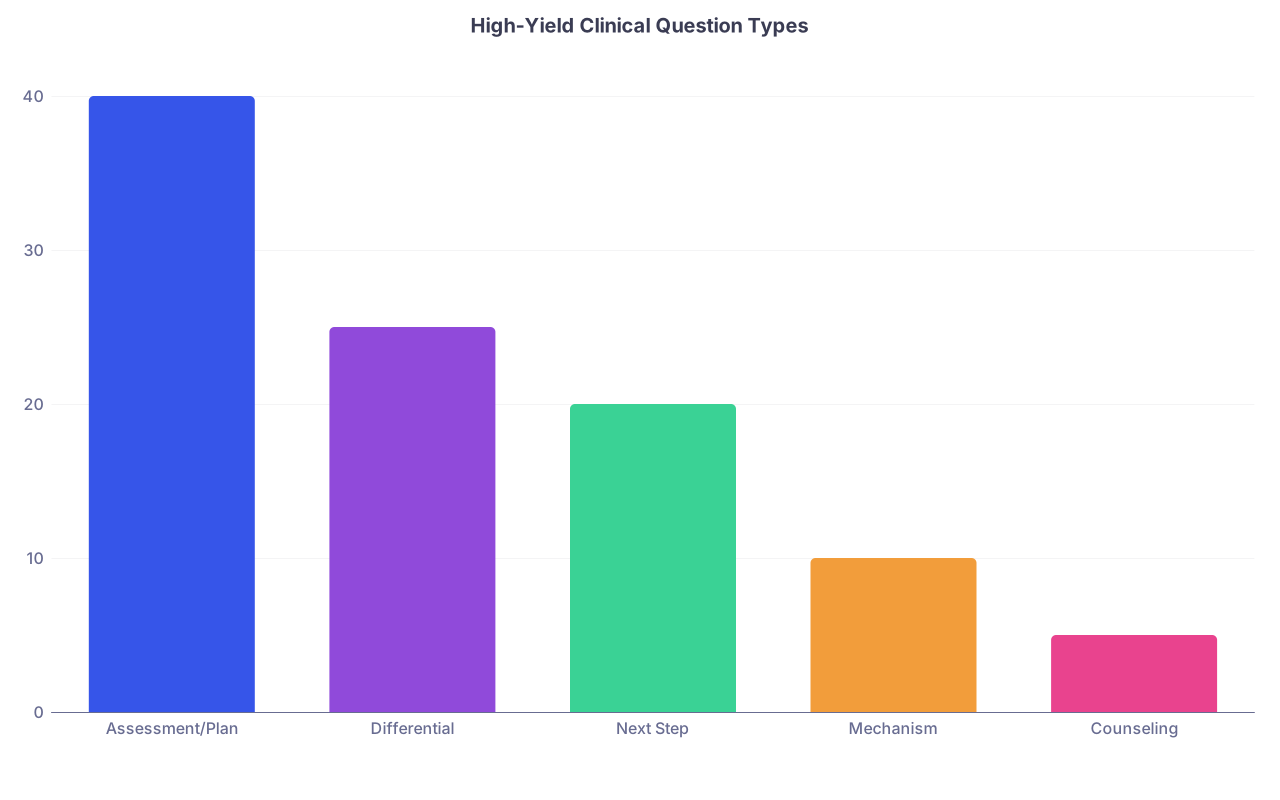
| Category | Value |
|---|---|
| Assessment/Plan | 40 |
| Differential | 25 |
| Next Step | 20 |
| Mechanism | 10 |
| Counseling | 5 |
Simple skeletons that prevent you from sounding lost
Assessment & Plan (A/P)
- Assessment: “This is a [age] [sex] with [key problem] most likely due to [leading diagnosis].”
- Plan: Organize by problem:
- Problem 1: [diagnosis] – [tests] – [treatment]
- Problem 2: …
Differential
- “Top three in my differential are: 1) ___, 2) ___, 3) ___. I favor ___ because ___, but I’d also consider ___ given ___.”
Next Best Step
- “The next best step is ___, because ___.”
- “If that’s negative/positive, then I’d ___.”
Mechanism
- Start with effect, then level, then detail:
- “It lowers blood pressure by causing vasodilation at the arteriolar level via blocking calcium channels in vascular smooth muscle.”
Rehearse these out loud. When stress hits, structure saves you.
Mistake #10: Treating Every Question as Judgment Instead of a Learning Opportunity
Yes, you’re being evaluated. No, not every question is a trap.
The students who look most unprepared are often the ones who shut down emotionally:
- They panic when asked questions slightly above their level.
- They get defensive: “We haven’t learned that yet.”
- They stop engaging, give one-word answers, and mentally check out.
Here’s the blunt truth: residents and attendings don’t expect you to know everything. They do expect you to:
- Try
- Think out loud a little
- Be curious when corrected
- Remember patterns that keep coming up

The worst mistake is not ignorance. It’s making the same error for a week straight because you never wrote it down, never looked it up, and never adjusted how you answer next time.
How to Practice So You Don’t Look Unprepared
You cannot fix this purely by reading more.
You have to practice answering out loud.

Concrete practice plan:
Use UWorld / Anki / cases differently
- After each question, pretend an attending asked you,
“So how would you explain this out loud?” - Answer in 2–4 sentences. Out loud. Not in your head.
- After each question, pretend an attending asked you,
Record yourself on your phone for 5 minutes
- Pick 3 common topics (chest pain differential, AKI workup, insulin regimen).
- Answer as if on rounds.
- Listen back once. Notice: rambling? hedging? vague plans?
Ask residents for feedback on style, not just content
- “Is the way I’m answering questions on rounds helpful, or am I giving too much / too little detail?”
- Adjust based on the team’s preference—but keep the core principles: answer first, be concise, commit.
Create a tiny ‘patterns’ notebook
- 1–2 pages: high-yield answers you keep fumbling.
- Example: “Counseling a new diabetic,” “Explaining heart failure to a patient,” “Starting anticoagulation in AF.”
- Review for 5 minutes before bed. These are the answers that change how prepared you sound.
Quick Red Flags: You’re Making These Errors If…
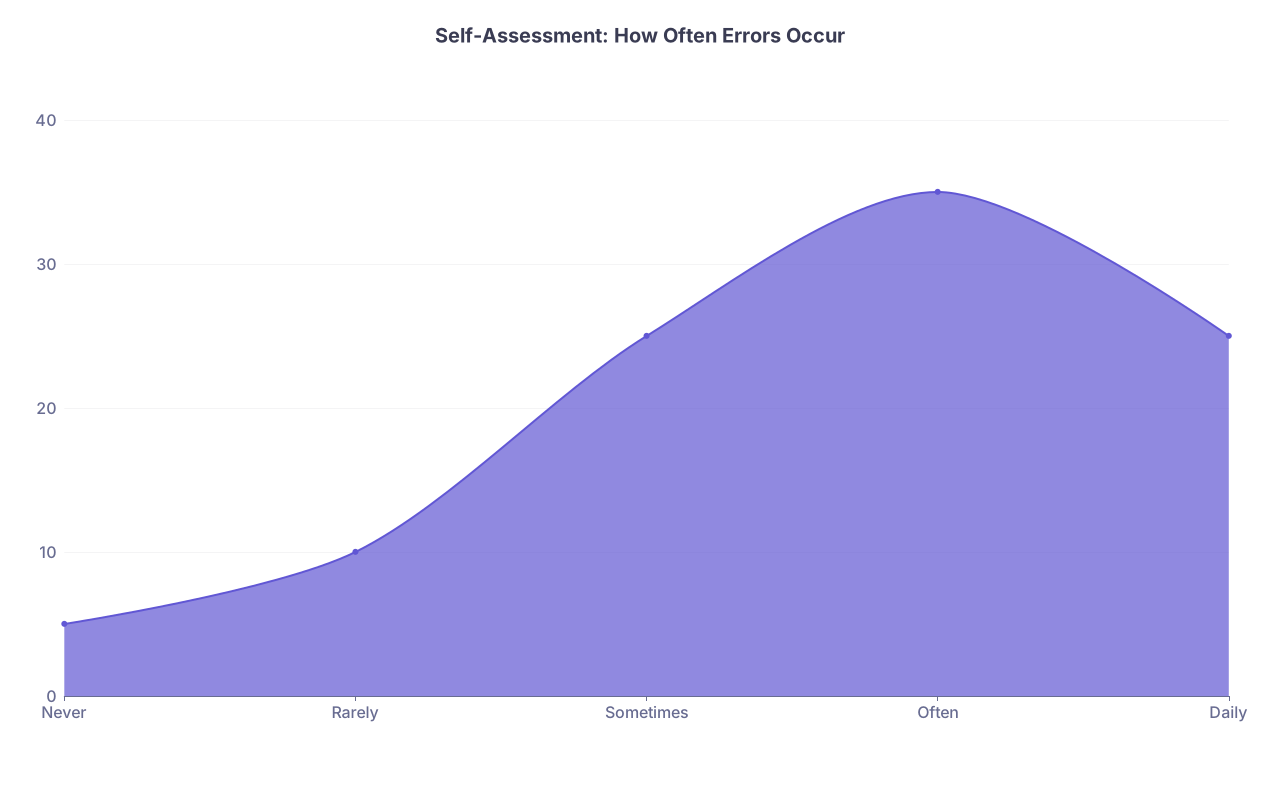
| Category | Value |
|---|---|
| Never | 5 |
| Rarely | 10 |
| Sometimes | 25 |
| Often | 35 |
| Daily | 25 |
If any of these feel familiar, you’re leaking points on your evals:
- You often hear, “So… what’s your actual plan?”
- You run out of breath mid-answer because you talk in one giant paragraph.
- You say “I don’t know” and the attending looks disappointed, not relieved.
- You get interrupted frequently with, “Just answer the question I asked.”
- You leave rounds feeling like you knew more than you were able to show.
None of that means you’re a bad student. It means your delivery is lagging behind your knowledge. Fixable. Faster than you think.
FAQ (Exactly 5 Questions)
1. What should I do if I freeze and my mind goes blank when asked a question?
Give yourself a 2–3 second reset instead of panicking. Say: “Let me think that through for a moment.” Take a breath. Then either (a) try a structured answer (“Top three on my differential would be…”) or (b) use the safe “don’t know” format: what you do know + how you’d find the rest. The freezing gets worse when you’re trying to be perfect; focus on being structured, not flawless.
2. Is it better to guess confidently or admit I don’t know?
Wild guessing with zero reasoning is a bad look. But reasoned guessing—where you commit to an answer and explain your thinking—is often exactly what attendings want. If you genuinely have no idea, admit it, but add how you’d approach the problem: “I’m not sure, but I’d look up the guideline and consider factors like X and Y.” Silence or pure shrugging looks unprepared; transparent reasoning looks teachable.
3. How much detail is enough when answering a mechanism question?
One sentence for the main effect, one for the level of action (organ/tissue), one for clinical significance. That’s usually plenty. For example: “ACE inhibitors reduce blood pressure by blocking conversion of angiotensin I to II, leading to vasodilation and decreased aldosterone. This reduces afterload and preload, which improves mortality in heart failure.” Stop there unless they push deeper.
4. What if different attendings want different answer styles?
They do. And they always will. Your job is to keep your core good habits—answer first, be concise, commit—then tune the rest. If someone clearly likes more pathophys, add one more sentence. If they cut you off a lot, shorten your answers. Early in the rotation, you can ask directly: “Do you prefer very brief answers or more explanation?” That question alone makes you look prepared.
5. How can I recover after a really bad question-answering moment on rounds?
Don’t disappear. After rounds, look up the topic properly. Write down a 2–3 sentence answer you wish you’d given. The next day, you can say: “I looked up that question about [topic] from yesterday—can I run a quick answer by you?” Most attendings love this. It flips the narrative from “unprepared student” to “student who learns fast and cares enough to follow up.”
Key points to walk away with:
- Looking unprepared on the wards is usually about how you answer, not how much you know.
- Avoid the big traps: rambling, hedging without committing, and empty “I don’t know” without reasoning.
- Practice short, structured, out-loud answers now, so when the spotlight hits on rounds, your thinking doesn’t fall apart in public.