Most students don’t lose honors in the call room or on exams. They lose it on rounds—often before they even realize they’re being judged.
Rounds are where attendings and residents silently decide: would I trust this person at 2 a.m. with my sickest patient? Honors, high pass, or “meh” grows out of that answer. Not your Step score. Not your personal statement. Your behavior, every single morning, in front of patients and staff.
Let me walk you through the landmines that tank otherwise solid students—and how to avoid being that story everyone tells after you leave.
1. Looking Disengaged: “The Ghost Student”
If you look like you don’t want to be there, they’ll believe you.
The behaviors that scream “I don’t care”
I’ve watched attendings write off students in a single round because of this cluster of red flags:
- Standing at the back, never moving closer
- Arms crossed, leaning on walls or counters
- Eyes on your phone or watch (yes, even “just checking the time”)
- Blank face during plans or teaching
- Never volunteering anything: no data, no questions, no ideas
- “Passive”
- “Not engaged”
- “Limited initiative”
You can have perfect write-ups and still get a bland “Pass” because you looked checked out on rounds.
How to avoid this
You don’t need to be loud or fake enthusiastic. You do need to look present and invested:
- Stand where you can see and hear clearly (and move with the team)
- Keep your phone away—deep in your bag or white coat pocket, face down
- Maintain open body language: arms uncrossed, slight forward lean
- Nod when someone’s explaining a plan; write something down occasionally
- Ask 1–2 focused questions per day, not 10 scattered ones
If your resting face looks annoyed or bored, you may need to intentionally soften your expression. I’ve seen excellent students misread as “disinterested” purely because of facial expression.
2. Not Knowing Your Patient Cold
Nothing kills confidence in you faster than not knowing your own patient on rounds.
Red-flag moments attendings remember
These are the ones that stick, and they do not fade by eval time:
- Attending: “What’s her creatinine today?” Student: “Uh… I don’t remember, I think normal?”
- Resident: “Is he on beta-blockers at home?” Student: “I’m not sure, I’d have to check.”
- Attending: “What’s your plan if his hemoglobin drops again?” Student: “I… haven’t thought about that yet.”
Translation in their heads:
- “Doesn’t know their patient.”
- “Unprepared.”
- “Not functioning at their level of training.”
If this happens repeatedly, say goodbye to honors.
Know this before you open your mouth
For each patient you present, you should know—without looking:
- Vitals trends (today + big changes)
- Labs that matter for their problem
- Imaging results in your own words
- Home meds + key in-hospital meds
- Overnight events (not “nursing said it was fine…”)
And then:
- 1–2 likely diagnoses (or reasons why the diagnosis is not yet clear)
- 1–3 key steps in today’s plan
If you’re consistently surprised by questions about your own patient, the problem is not the questions. It’s your prep.
3. “But the EMR Says…”: Blindly Reading Without Thinking
Nothing hurts your reputation like reading the chart back to the team with zero synthesis.
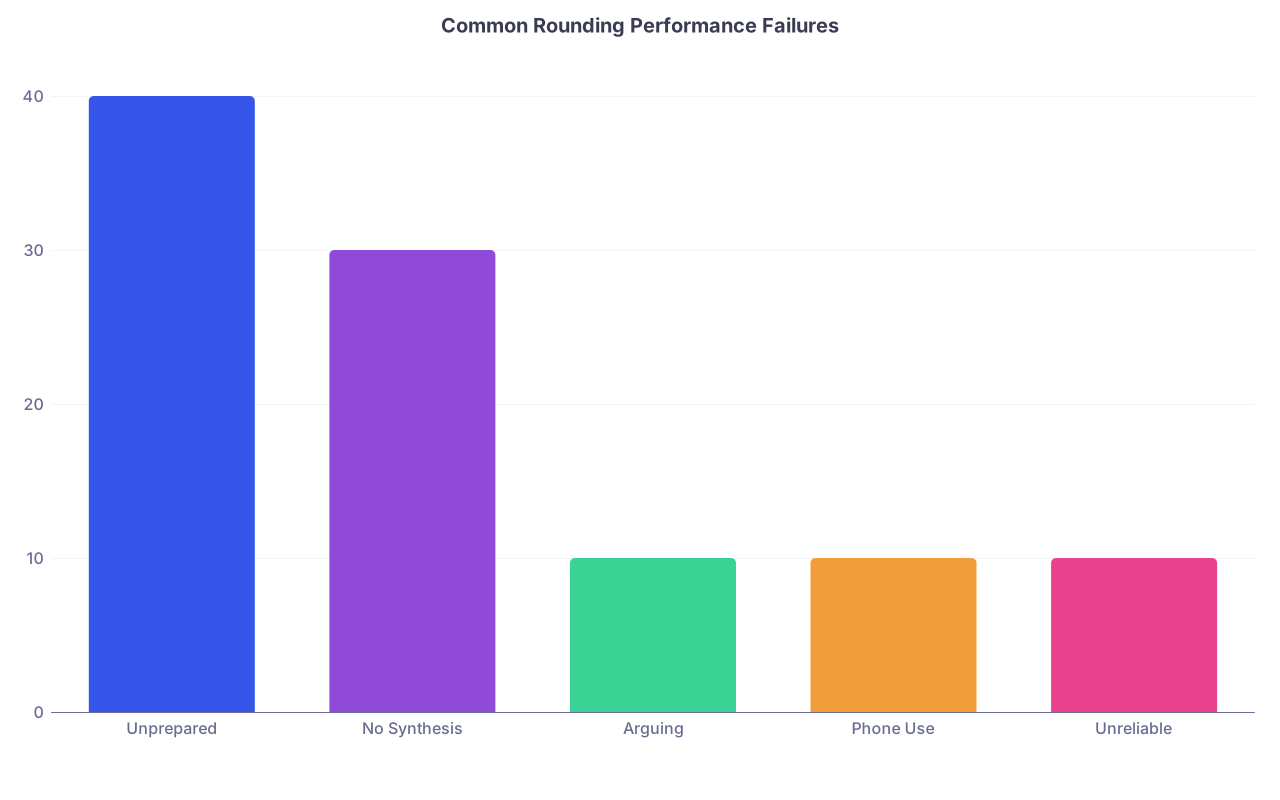
| Category | Value |
|---|---|
| Unprepared | 40 |
| No Synthesis | 30 |
| Arguing | 10 |
| Phone Use | 10 |
| Unreliable | 10 |
What this looks like
You’ve heard this kind of student presentation:
- “The WBC is 8.3… the hemoglobin is 10.1… the platelets are 235… sodium 138… potassium 4.1… chloride 102… bicarb 24… BUN 16… creatinine 0.9… glucose 108…”
Everyone’s eyes glaze over. Then the attending asks, “So what’s your concern based on these labs?” And the student has nothing. Just silence. Or: “Um… I think they’re okay?”
This is how you get:
- “Data reporting without analysis.”
- “Struggles with clinical reasoning.”
Honors students don’t just recite. They interpret.
The fix: from stenographer to thinker
Before rounds, ask yourself for each patient:
- What labs matter today? Why?
- What’s better, what’s worse, what’s new?
- Does this support or contradict my working diagnosis?
- What should I do differently because of this?
Then present like this:
- “Labs this morning show a down-trending WBC from 14 to 9, supporting improving pneumonia.”
- “Creatinine bumped from 1.0 to 1.4 after contrast yesterday. I’m concerned about contrast-induced AKI; I’d hold nephrotoxic meds and adjust fluids.”
Short. Focused. Shows you thought.
You are not the EMR’s voice. You’re supposed to be a future doctor. Act like it.
4. Arguing Instead of Owning Mistakes
You will be wrong. That’s not the problem. How you react is.
Behaviors that set off alarms immediately
The most damaging pattern I see:
- A resident corrects you gently.
- You argue. Or blame the nurse. Or say, “But that’s how we did it on my last service.”
- You look irritated or embarrassed and shut down.
Or worse:
- They point out you missed a high potassium.
- You respond defensively: “Well, I rounded late,” or “The lab was delayed,” or “I thought someone else was checking.”
What they write down later:
- “Difficult to teach.”
- “Defensive.”
- “Limited insight.”
Those are career-poison words. Programs absolutely notice this.
How to handle being wrong like someone they’d trust
The gold-standard response is simple:
- Listen fully (don’t start forming your comeback while they’re talking).
- Acknowledge clearly:
- “You’re right—I misread that.”
- “I didn’t consider that. Thank you.”
- Ask one clarifying question if needed:
- “So in someone like this, would you still start a beta-blocker?”
- Fix it and don’t repeat it.
And no eye-rolling, no sighing, no visible frustration. You’re being evaluated on teachability as much as knowledge.
5. Overstepping or Understepping Your Role
Both “trying to be an intern” and “acting like a shadow” can cost you.

| Step | Description |
|---|---|
| Step 1 | New Rotation |
| Step 2 | Ask Resident Directly |
| Step 3 | Confirm on Day 1 |
| Step 4 | Clarify: notes, orders, follow-up |
| Step 5 | Ask for More Tasks |
| Step 6 | Scale Back, Ask Before Acting |
| Step 7 | Knows Expectations? |
| Step 8 | Too Passive or Too Aggressive? |
Overstepping: the “dangerously confident” student
Red-flag behaviors I’ve actually seen:
- Placing orders without telling anyone (“I thought it would be helpful”)
- Changing pain meds or fluids solo
- Calling consults independently without staff knowing
- Giving families detailed prognostic information as if you’re the physician
This screams:
- “Does not understand their level.”
- “Unsafe.”
- “Lacks judgment.”
These comments haunt your dean’s letter.
If you’re not 100% certain whether you should do something, ask. One sentence can save you: “I can put in the order if you’d like, but I’ll check with you first.”
Understepping: the “ghost in the coat”
Being too passive is safer for patients, but deadly for your grade:
- Never volunteering to write notes
- Not offering to call consults (with resident guidance)
- Standing back while others examine the patient
- Letting residents handle everything and just “observing”
You end up with:
- “Quiet but did not take ownership.”
- “Limited initiative.”
- “Could take on more responsibility.”
Ask directly:
- “Can I try to write the note for this patient?”
- “Would it be okay if I call this consult and run the plan by you before I do?”
- “Can I start the presentation for this new admission?”
You’re trying to hit that sweet spot: engaged and willing, but never rogue.
6. Poor Time Management That Hurts Patient Care
No one cares if you studied late. They care if you show up unprepared and waste the team’s time.
What residents actually notice
Patterns that get mentioned on evals:
- Always “almost ready” when rounds start
- Presentations half-baked; basic labs not checked
- Needing to “go back and check” simple things everyone else already knows
- Always the last one to see patients in the morning
- Holding up rounds because your note isn’t done or you’re still “reviewing overnight events”
This reads as:
- “Unreliable.”
- “Struggles with organization.”
- “Not ready for next level.”
Fixes that honor students quietly use
- Pre-round earlier than you think you need. If everyone’s there at 6:30, you’re there at 6:15.
- Do a last-minute check of vital signs, labs, new notes right before rounds start.
- Use a ONE-page template or checklist per patient (diagnosis, today’s problems, vitals/labs/Imaging, plan).
- If you’re struggling, tell your senior early:
- “I’m running behind on pre-rounding. Can I focus on two patients and do them really well?”
They’d rather have you do fewer patients well than all of them badly.
7. Trash-Talking, Complaining, and Bad-Mouth Culture
You can be the smartest person on the team and still lose honors if you’re toxic.

Silent red flags that absolutely get reported
I’ve seen honors-level students knocked down for this alone:
- Complaining constantly about hours, call, or “how pointless this is”
- Making fun of other services (especially psych, family med, EM, or surgery)
- Rolling your eyes when a nurse calls or a patient has a request
- Calling patients “train wrecks,” “acutely annoying,” or similar
- Venting about attendings or residents to other staff in semi-public areas
Residents may laugh in the moment, but later?
- “Unprofessional.”
- “Negative attitude.”
- “Disrespectful to team members.”
Those are death sentences for honors.
What to do instead
Look, everyone vents. Do it with your non-hospital friends or in private, not in the workroom surrounded by people who write your evals.
On the floor:
- If you’re frustrated, keep it neutral: “That was challenging,” not “That was dumb.”
- Respect nursing and ancillary staff—publicly and consistently.
- If you disagree with a plan, ask as a learner, not as a critic:
- “Can you walk me through why we’re choosing heparin over DOAC here?”
You’re being judged on whether people would want you back on their team. No one wants the constant complainer.
8. Being Invisible When It Comes to Ownership
The fastest route to a bland eval is never really owning anything.
Signs you’re just “there” and not truly part of the team
This is the student everyone forgets:
- You present, then mentally check out until your next patient.
- You don’t follow up on consults or patient questions you bring up.
- You never circle back with updates (“I’ll check that” turns into silence).
- You don’t know how your patients feel about their care or what confuses them.
Eval phrases:
- “Pleasant but peripheral.”
- “Limited ownership.”
- “Did not consistently follow through.”
Those are the “solid pass” phrases.
How to show genuine ownership without overstepping
Start behaving like you’re the primary learner responsible for your patients:
- If you say, “I’ll find out,” then actually find out—and report back the same day.
- Check in with your patients in the afternoon when possible:
- “How are you feeling about the plan today? Anything confusing?”
- Remember and mention personal details (their worries, family, major upcoming event at home).
- On rounds, update the team about what you did:
- “I spoke with his daughter last night about the discharge plan; she’s concerned about home oxygen.”
Ownership doesn’t mean you’re the doctor. It means you’re the student who actually cares enough to close loops.
9. Weaponized Questions and Try-Hard Showing Off
Ask questions. Don’t use questions to show off or test the attending.
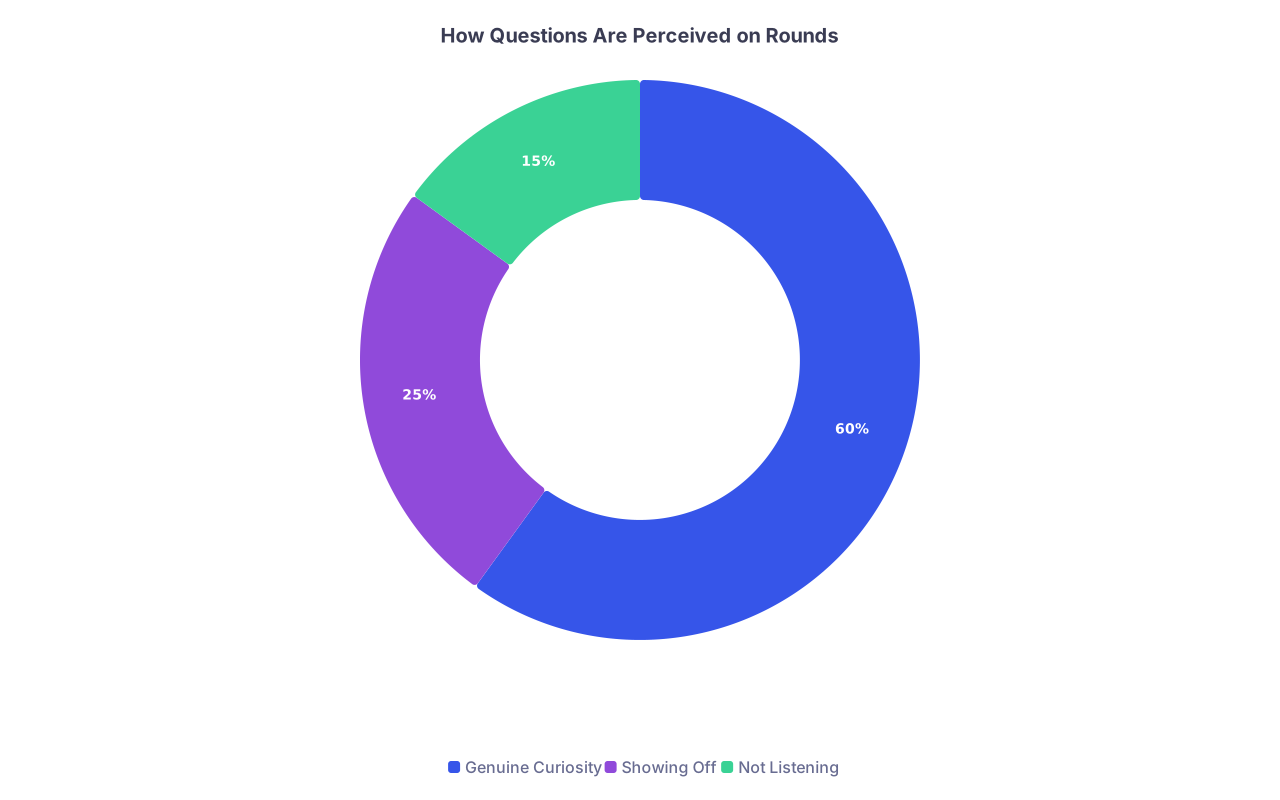
| Category | Value |
|---|---|
| Genuine Curiosity | 60 |
| Showing Off | 25 |
| Not Listening | 15 |
Red-flag question patterns
- Asking very esoteric questions just to mention you “read an article in NEJM last night…”
- Rapid-fire “what about this?” “what about that?” after a plan is clearly already decided
- Challenging attendings in front of patients to prove you’re right
- Questioning nurses’ or consultants’ decisions loudly during rounds
This often gets translated into:
- “More focused on appearing smart than learning.”
- “Disruptive during rounds.”
- “Lacks tact.”
You see where this goes.
How to ask like a future colleague, not a gunner caricature
Use questions to deepen understanding, not to flex:
- Time and place: save the complex debate for after rounds or in the workroom.
- Frame questions as curiosity, not challenge:
- “I’ve seen some people use X in this situation—how do you think about that?”
- Limit yourself. A couple of high-yield questions per session is plenty.
- Listen to the answer. Don’t ask a new question before they finish the previous one.
If you want to mention reading, do it humbly:
- “I was reading about NSTEMI management last night and saw some differences in guideline recommendations—can I ask how you think about that?”
Subtle difference. Huge impact.
10. Poor Communication With Patients on Rounds
The team sees everything about how you handle patients in those 2–5 minutes at the bedside.

Red flags that scare attendings
- Standing at the foot of the bed talking about the patient, never making eye contact
- Using dense jargon: “We’re escalating diuresis and monitoring your troponins”
- Ignoring obvious distress—patient is anxious or crying and you bulldoze through
- Contradicting the attending’s explanation right in front of the patient
- Making offhand comments that minimize their concerns: “You’re fine, don’t worry.”
Eval translations:
- “Needs work on bedside manner.”
- “Limited empathy.”
- “Struggles with communication.”
These will absolutely block honors, even if your knowledge is strong.
Simple habits that protect you
You don’t need to be a polished communicator yet; you do need baseline respect and awareness:
- Stand where the patient can see you—at eye level if you can.
- Introduce yourself briefly every time, especially early in the rotation:
- “I’m [Name], the medical student working with your team.”
- Translate at least one thing into plain language:
- “That means the infection in your lungs is getting better.”
- If they look confused, pause:
- “That was a lot of information. What questions do you have right now?”
- Never contradict the attending at bedside. If you’re unsure, ask later in private.
Even quiet students can shine here. A single moment of obvious kindness gets remembered.
11. Ignoring Feedback or Needing to Be Told Twice
This one is brutal: if they give you the same feedback twice, honors is almost always gone.

The pattern that kills your grade
- Week 1: “Try to tighten your presentations; focus more on assessment and plan.”
- Week 2: Presentations are still long, scattered, and mostly data dump.
- Week 3: “You’re still reading a lot from your notes—work on being more concise.”
On the eval:
- “Did not consistently incorporate feedback.”
- “Limited improvement across rotation.”
People underestimate how damning that is. Programs care more about growth than where you started.
How to show visible improvement
When someone gives you feedback:
- Repeat it back in your own words:
- “So for tomorrow, I’ll focus on shortening the HPI and putting more emphasis on my assessment and plan.”
- Change your behavior the very next day.
- Ask for quick follow-up:
- “Was that closer to what you were looking for?”
Make your improvement obvious. You’re trying to make it impossible for them to honestly write “didn’t improve.”
Quick Comparison: Honors vs Pass Behaviors on Rounds
| Area | Honors-Tending Behavior | Pass-Tending Behavior |
|---|---|---|
| Engagement | Moves with team, asks focused questions | Hangs back, rarely speaks |
| Preparation | Knows patients cold, anticipates questions | Reads off EMR, surprised by basics |
| Ownership | Follows up, closes loops | Brings up issues but doesn’t follow through |
| Attitude | Curious, respectful, low-drama | Complains, vents, or seems disinterested |
| Feedback Response | Changes quickly, visibly improves | Same issues week after week |
The Bottom Line: How Not to Lose Honors on Rounds
If you remember nothing else, remember this:
- Look and act like you care about your patients and your team. Engagement and ownership matter more than sounding brilliant.
- Be prepared, be safe, and be teachable. Know your patients, respect your level, and change when given feedback.
- Don’t poison the environment. No trash talk, no visible contempt, no constant complaining.
Rounds are not a performance for Instagram. They’re a daily test of whether people trust you enough to one day sign out their patients to you at 2 a.m.
Don’t make the mistakes that answer that question the wrong way.