
Your EMR mistakes will outlive your rotation. Sometimes they’ll outlive your training.
I’m not exaggerating. The electronic medical record (EMR) is one of the few places where your medical student “practice attempts” are permanently stamped with your name. And people do look.
This is where a lot of smart students mess up. They think: “I’m just a student, it doesn’t really count.” That’s wrong. Your note style, your language, your shortcuts, your copy-paste habits — they form a track record that follows you from clerkships to sub‑I to residency applications and beyond.
Let me walk you through the mistakes that quietly wreck your reputation and how to avoid them.
1. Thinking “I’m Just a Student, No One Cares What I Write”
This is the foundational mistake. If you believe your notes don’t matter, you’ll behave like they don’t matter.
Here’s what actually happens:
- Attendings open old notes to quickly see prior plans.
- Program directors skim through charting when they’re on the fence about you.
- Residents remember the student whose notes created work versus the one whose notes saved them time.
You don’t need to be perfect. But you do need to be consistently safe, professional, and not annoying.
Common versions of this mistake:
- Writing “practice” notes full of nonsense placeholders you forget to delete.
- Treating your notes as a personal notebook instead of a legal medical document.
- Putting in-jokes or “funny” comments you think no one will see.
- Shrugging off inaccuracies because “the resident will fix it.”
Here’s the mindset you want instead:
- Every note is part of the legal record, signed with your name.
- Every note is a small audition for your future specialty.
- Every note is something you might have to defend later.
If that sounds intense, good. It should.
2. Unprofessional Language That Gets Screenshotted and Shared
The fastest way to nuke your professional reputation in the EMR? Your tone.
Not your differential. Not your assessment. Your tone.
Things that will get talked about
- Calling a patient:
- “non-compliant” (instead of “reports difficulty affording meds”)
- “drug-seeking” (instead of “requests opioids; PDMP reviewed”)
- “difficult” or “unpleasant” (instead of describing specific behavior)
- Writing sarcasm:
- “Patient ‘couldn’t be bothered’ to take insulin”
- “Family insists on miracle cure”
- Using casual or slang terms:
- “Pt freaked out”
- “Pt totally lost it”
- “Pt is super anxious about…”
Someone will screenshot this and send it to their co‑resident. Then it becomes: “Yeah, that student from X school? Their documentation is… yikes.”
Safer, professional alternatives
- “Patient declines recommended therapy after discussion of risks and benefits.”
- “Patient expresses frustration with prior providers and medical system.”
- “Patient became tearful when discussing prognosis.”
- “Family strongly desires all possible life-sustaining measures despite discussion of likely outcomes.”
You’re not supposed to editorialize. You describe. Objectively. Behavior, statements, decisions. Not your personal judgment about them.
3. Copy‑Paste & Template Abuse That Makes You Unsafe
Copy‑paste is where students get lazy and dangerous.
Everyone uses templates. That’s fine. What’s not fine:
- Carrying forward old, incorrect information.
- Documenting exams you didn’t do.
- Leaving in auto-generated nonsense that contradicts your own note.
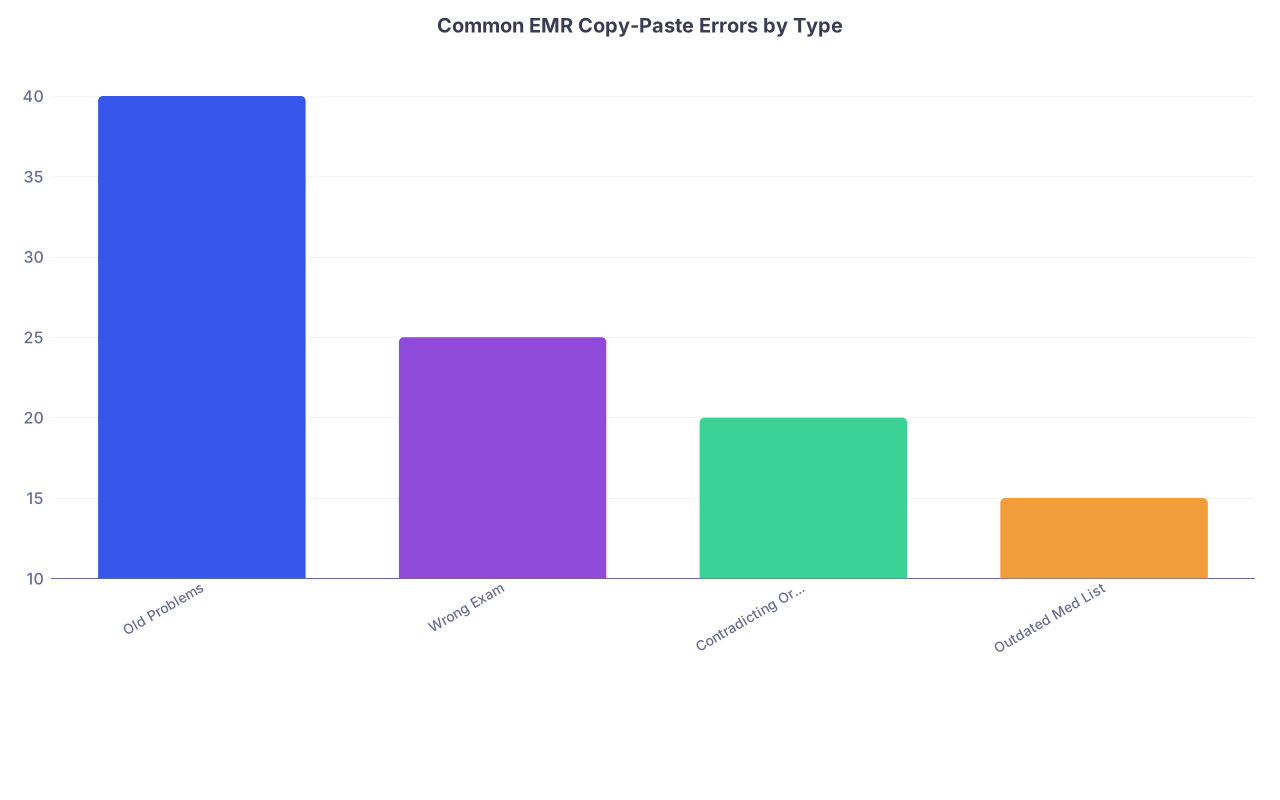
| Category | Value |
|---|---|
| Old Problems | 40 |
| Wrong Exam | 25 |
| Contradicting Orders | 20 |
| Outdated Med List | 15 |
Red-flag behaviors
- “Normal” neuro exam on every single patient. Including the intubated ICU patient you never touched.
- Copying yesterday’s 14-point ROS when you only asked about 3 things.
- Past medical history still listing “current smoker” when the patient quit 2 years ago — and told you that today.
- Auto-populated physical exam that says “no edema” while your Assessment says “worsening bilateral lower extremity edema.”
If an auditor or lawyer ever reviews that chart, they don’t care that you were “just a student.” Your name is on that note.
How to avoid this mess
- Use template structure, not template content.
- Keep the headings but clear the text.
- Before signing, scan for:
- Wrong laterality (right vs left).
- Exam pieces you did not actually perform.
- Vital signs that don’t match the story.
- When you copy forward:
- Actively delete things that no longer apply.
- Explicitly date things: “As of 1/5/26, patient reports…”
Your credibility dies the moment your note looks obviously fake.
4. Over‑Sharing: Sensitive Information That Does Not Belong in the Chart
Students often overshare because they finally got the patient to open up and they’re proud of it. Understandable. But dangerous.
Not everything a patient tells you belongs verbatim in the EMR.
High-risk areas
- Sexual history, assault history
- Immigration status
- Substance use described in detail
- Family conflicts (“husband has been cheating for years”)
- Mental health thoughts they disclosed in confidence
You’re not a therapist writing process notes. You’re writing a legal medical record.
Better ways to document:
- Instead of: “Patient reports husband has been sleeping with her sister for 3 years.”
- Use: “Patient reports significant marital stress and recent betrayal contributing to depressed mood.”
- Instead of: “Patient is undocumented and scared of being deported.”
- Use: “Patient reports fear of legal consequences affecting ability to seek ongoing care.”
If you’re not sure whether to include something:
- Ask yourself:
Will this change medical decision-making, safety, or follow-up? - If yes, document clinically relevant parts, not gossip.
- If no, consider keeping it out or discussing with your resident/attending first.
Once it’s in the record, it’s in. For years. Across systems. Across providers.
5. Sloppy, Incomplete Notes That Make You “The Extra Work Student”
This is the more boring mistake, but it’s the one that gets you silently blacklisted.
Residents remember students in two buckets:
- The ones whose notes they can quickly sign.
- The ones whose notes they have to rewrite from scratch.
You want to be in group one.
Sloppiness that gets noticed
- No clear Assessment & Plan — just a rambling paragraph.
- Missing basic data: vitals, labs, imaging, relevant exam components.
- No comparison to prior values (e.g., “Cr 1.8 today, was 1.2 yesterday”).
- Different versions of the story in HPI vs Assessment.
Ask any resident: “What makes you never trust a student’s note again?” They’ll say something like:
“I opened the note and the HPI said chest pain and the Assessment said abdominal pain. I stopped reading.”
Your job as a student:
- Tell a coherent story.
- Pull in the important data.
- Make the next person’s life easier, not harder.
| Behavior | How You Look |
|---|---|
| Copy-pasted wrong exam | Untrustworthy |
| Sarcastic patient descriptions | Unprofessional |
| No clear plan | Unprepared |
| Accurate, succinct note | Reliable |
| Diplomatically worded concerns | Mature |
6. Documenting Things You Should Never Put in Writing
Here’s the dark side no one explains clearly: some things are dangerous to write explicitly. Not because they’re untrue. Because they’re political, legal, or above your pay grade.
Examples that will haunt you
- “Attending did not see the patient.”
- “Resident refused to order test I recommended.”
- “Nurse ignored patient’s call light for 45 minutes.”
- “Surgery team made mistake with consent.”
You might think you’re being “honest” or “advocating.” What you’re actually doing is:
- Creating a discoverable legal landmine.
- Accusing colleagues in a permanent record.
- Inserting yourself into conflicts way above your level.
Does that mean you ignore safety concerns? No. It means you use the correct channels:
- In-person discussion.
- Chain of command.
- Event reporting systems (where appropriate).
- Discussing with your attending before documenting anything controversial.
Safe way to document legitimate concerns:
- “See nursing documentation for details of overnight events.”
- “Discussed concerns regarding delay in imaging with senior resident and attending; plan as above.”
- “Multiple pages placed to primary team regarding hypotension; see nursing documentation for timing and vitals.”
If you’re ever tempted to write a sentence that sounds like an accusation, stop and talk to your resident or attending first.
7. Student Opinions Masquerading as Clinical Judgment
Another way your EMR record can hurt you: being way too confident, way too early.
You’re in your third year, never seen a real DKA patient before, and your note says:
- “Patient clearly faking symptoms.”
- “No need for further imaging; diagnosis is anxiety.”
- “Unlikely to benefit from palliative care, patient should pursue aggressive treatment.”
You’re not impressing anyone. You’re flagging yourself as someone who doesn’t know their lane.
Better way to show you’re thinking
Use language that reflects your role and level:
- “Symptoms may be consistent with functional etiology, though organic causes should be ruled out. Discussed with resident; plan as above.”
- “Given atypical chest pain and low HEART score, ACS less likely but cannot be fully excluded. Following primary team’s plan for serial troponins and EKGs.”
Key moves:
- Use probability language carefully.
- Tie your thoughts explicitly to supervision: “Discussed with resident/attending.”
- Avoid absolute statements unless you’re quoting the attending’s plan.
Your note is not the place to prove how fearless and bold you are. It’s the place to prove you’re safe, thoughtful, and teachable.
8. Confidentiality & Access Missteps You Don’t Get Forgiven For
This one can end your career before it starts.
People think HIPAA violations always mean printing charts and mailing them to tabloids. Most actual student violations are subtle and dumb.
Career-ruining moves
- Opening your roommate’s chart “just to check” on their lab results.
- Looking up friends/family in the ED out of curiosity.
- Taking a screenshot of a “funny” note and texting it to your group chat.
- Typing patient details into your personal notes app or email.
Hospitals do audit access logs.
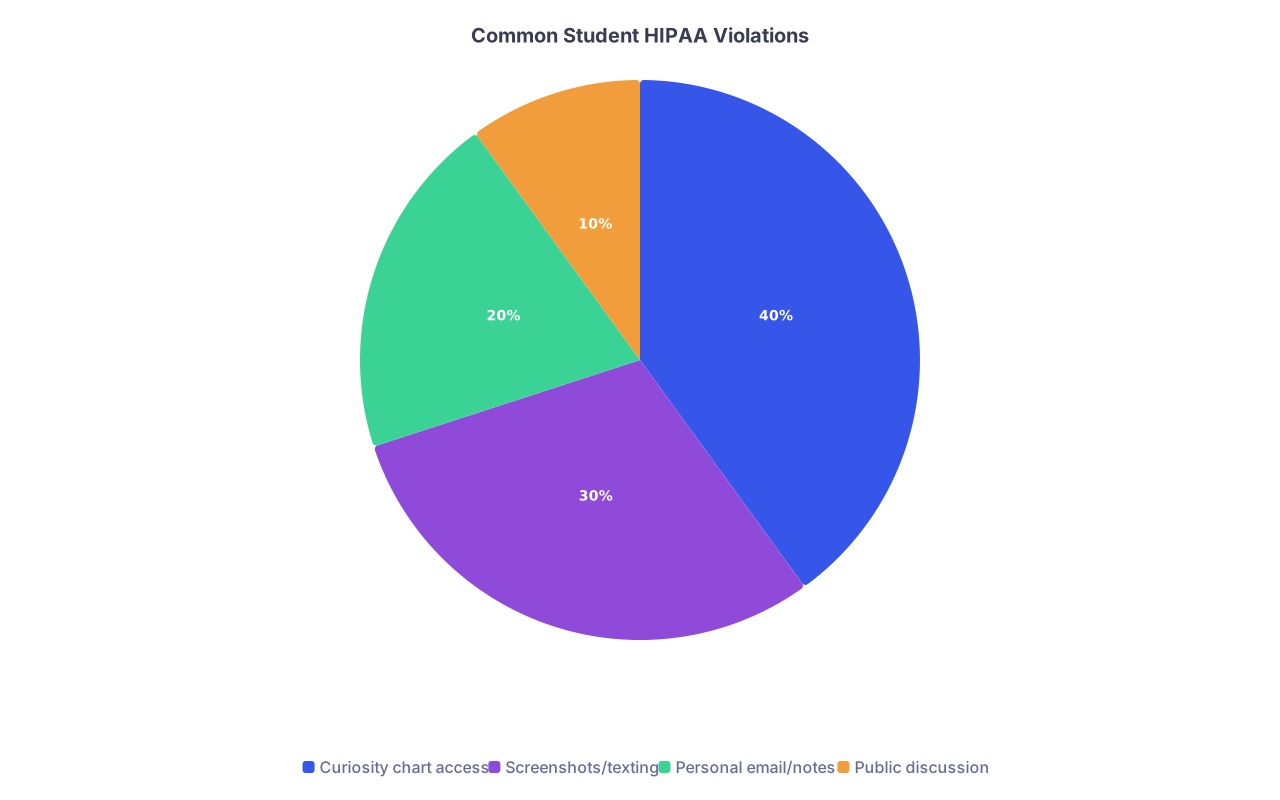
| Category | Value |
|---|---|
| Curiosity chart access | 40 |
| Screenshots/texting | 30 |
| Personal email/notes | 20 |
| Public discussion | 10 |
Every one of these is traceable to your login. Doesn’t matter if you never signed a note.
Rules you do not break, ever:
- Only open charts for patients you’re actually involved in caring for.
- Never remove PHI from the secure system unless it’s through an approved method.
- Never include identifiable details in teaching slides, group chats, or emails without proper de‑identification and permission.
“Just this once” is all it takes. Someone files a complaint, they check logs, your name is right there. That follows you into dean’s letters and GME files.
9. EMR Laziness That Brand-Labels You on the Team
There’s a softer category of EMR missteps: not illegal, not dangerous — just extremely annoying. These are the behaviors that make residents roll their eyes when they see your name pop up again.
Common ones:
- Never updating your problem list — ever.
- Leaving hundreds of unsigned notes and tasks in your inbox.
- Using all-caps or weird formatting in your notes.
- Writing essays in every section instead of using structure.
- Repeating the entire HPI in the Assessment & Plan.
Over time, these little things create a story:
- “Their notes are always a mess.”
- “They never close loops.”
- “They don’t pay attention to the way our system works.”
You want the opposite story:
- “Their notes are clean and easy to read.”
- “They remember to update things.”
- “I can use their note for my signout.”

| Step | Description |
|---|---|
| Step 1 | MS3: First Rotations |
| Step 2 | Basic EMR Competence |
| Step 3 | Consistent, Accurate Notes |
| Step 4 | Residents Trust Your Documentation |
| Step 5 | Stronger Evaluations & Letters |
You don’t need to be an EMR power user. Just not the person whose notes everyone dreads.
10. The “This Can Be Traced Back to You” Reality
Let’s talk permanence for a second.
You might think:
- “No one will care in 5 years.”
- “These notes won’t be visible once I’m in residency.”
- “People know I was just a student.”
Here’s what actually happens:
- EMR systems keep full histories. Your name is attached as “author.”
- Legal reviews don’t care that you were a student; they care what’s in the chart.
- Attendings and residents sometimes remember students by a legendary bad note.
I’ve seen this exact conversation:
“Hey, remember that student who wrote ‘patient is a trainwreck’ in the chart?”
“Yeah. From [School X]. That was wild.”
That’s years later. Different rotation. Same school. Your reputation arrives before you do.
How to Build a Professional EMR “Profile” That Helps You
Let’s flip this. You can actually use the EMR to build a quiet but powerful reputation.
Aim for this:
Accurate
- No obviously fake exams.
- Data that matches the story.
- Labs and vitals that are correct and up-to-date.
Respectful
- Neutral, descriptive language.
- No sarcasm, no judgmental labels.
- Objective documentation of behavior and decisions.
Clinically useful
- Concise HPI, clear Assessment & Plan.
- Key data pulled in and interpreted.
- Problems prioritized, not just listed.
Appropriate for your level
- You propose, your team decides.
- You document what your team is doing, not what you’d do solo.
- Complex judgment clearly attributed to attending/resident when appropriate.
If your notes consistently look like that, you gain something extremely valuable: trust. And trust is the currency that gets you responsibility, procedures, and strong letters.
FAQ (Exactly 3 Questions)
1. Can I get in serious trouble for something I wrote as a medical student, even if the attending co-signed it?
Yes. Co-signature doesn’t erase your authorship. If there’s a complaint, legal review, or institutional investigation, your note is still your work. The attending may be accountable for overseeing you, but you can face academic consequences, professionalism flags, or disciplinary action from your school or hospital. Do not rely on “they’ll fix it” as protection.
2. Is it ever okay to joke or use humor in the EMR if the team thinks it’s funny?
No. Not in the chart. I don’t care how “chill” your resident seems or how many memes the team shares in the workroom. The EMR is not where you show you’re fun. It’s where you show you’re safe. Dark humor belongs off-chart, off-record, and frankly, away from patients and families. In writing, assume every sentence could be read in court, in a complaint, or by the patient themselves.
3. How do I fix my habits if I’ve already been sloppy with EMR documentation?
Stop today. You don’t need a speech; you need a reset. Start by:
- Building a clean template and clearing auto-text you don’t understand.
- Asking one trusted resident to show you what their best note looks like.
- Focusing on accuracy and respect first, speed second.
You can’t erase old notes, but you can create a new pattern. Over a few rotations, people care a lot more about the consistent, competent version of you than the clueless MS3 you were on day one.
Key points to walk away with:
- Your EMR notes are permanent, traceable, and part of your professional identity.
- The biggest mistakes aren’t fancy medical errors — they’re tone, copy‑paste abuse, oversharing, and writing outside your lane.
- If you treat every note like it might be read aloud to the patient, your program director, and a lawyer, you’ll avoid 95% of the disasters that follow you for years.