
The fastest way to lose trust on a team is not a wrong answer. It’s bad notes.
You can be nice, hardworking, and smart. If your notes are sloppy, bloated, or unsafe, residents and attendings will quietly (or not so quietly) take you less seriously. And they will remember.
Let’s walk straight into the landmines so you don't step on them.
1. The “Copy-Paste Catastrophe”
Residents hate this one more than almost anything else.
You know the move: yesterday’s note becomes today’s note with a few half-hearted edits. Except the patient’s creatinine doubled, their oxygen needs went up, and you still have “stable respiratory status” in the Assessment.
That’s how you earn the label: “I can’t trust this student’s notes.”
Copy-paste red flags that make people stop trusting you
- Old vitals or labs that don’t match today
- “No complaints” in the subjective when they were up all night in pain
- Assessment plans that mention meds that were stopped 2 days ago
- Physical exam saying “no edema” on a patient with 3+ pitting in both legs
- A line about “will follow up CT results” when the CT came back yesterday
And the worst: contradictory information in the same note because you edited one place and forgot another.
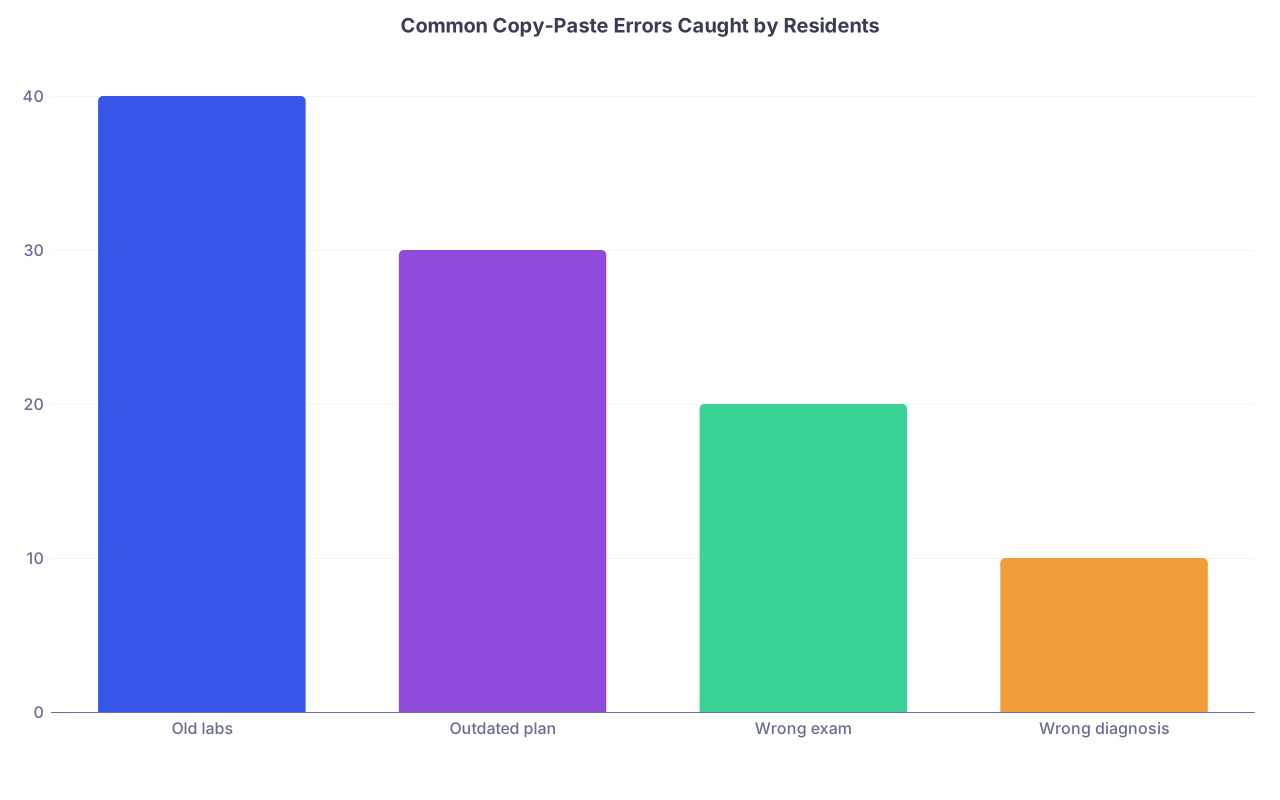
| Category | Value |
|---|---|
| Old labs | 40 |
| Outdated plan | 30 |
| Wrong exam | 20 |
| Wrong diagnosis | 10 |
How to avoid this
- Force yourself to re-type any changing data: vitals, labs, imaging interpretations, O2 requirements, code status.
- If you must copy sections, do a slow, deliberate read-through as if it’s your first time seeing the patient.
- After writing the note, compare it against the EMR flowsheet and latest results. Line by line for unstable patients.
- Ask yourself: “If I got handed this note on cross-cover, would it safely guide my decisions?”
If you’re rushed, cut content before you cut accuracy. A short, correct note beats a novel full of lies.
2. The Bloated, Useless H&P
Long does not equal good. Long and unfocused reads like someone who doesn’t know what matters.
You know the type of note that irritates an attending:
- 3 pages of ROS
- Childhood illnesses nobody cares about
- 10-line family history for a simple ankle sprain
- Every lab the patient has ever had, dumped into the assessment
Residents don’t have time for this. On a busy service they are scanning for: what’s new, what’s important, and what you think is going on.
What “bloat” looks like in real life
I’ve seen MS3 H&Ps that include:
- “History of chickenpox at age 6, treated with calamine lotion.”
- Every medication dosage rewritten even when unchanged and not relevant.
- Full, scripted ROS with 14 systems all “negative except as above” pasted daily.
- Detailed social history about number of sexual partners in a 78-year-old with CHF exacerbation, repeated every day.
No one is impressed. They’re annoyed.
How to fix it
Anchor your note to the problem list. That’s your spine.
Don’t make this mistake: writing an H&P that sounds like a template instead of a coherent story. Instead:
- Focus HPI on what explains the admission or visit today.
- Condense irrelevant chronic issues into one line unless they affect today’s problem.
- Use a targeted ROS. If the patient is admitted for chest pain, I don’t need a paragraph about their bowel habits unless there’s a reason.
- Put details where someone can use them:
- Risk factors in the HPI for ACS, not buried in social history.
- Bleeding history in the HPI for a patient starting anticoagulation.
If an intern needs to skim your H&P on call at 2 am, can they quickly grasp why the patient is here, what you think is going on, and what’s been done?
If not, you’re writing for yourself, not the team.
3. The Fictional Physical Exam
Nothing destroys credibility faster than an obviously fake exam.
Attending: “You documented a full neuro exam. Can you show me how you tested cerebellar function?”
Student: “…uh…”
You will not recover from that quickly.
Common physical exam mistakes that drive people crazy
- A complete, perfect exam on every single patient, every single day. Nobody believes you did all of that.
- Normal findings on systems you never touched. “No JVD” on a patient where the head of bed was flat and you didn’t even look.
- Contradictions:
- “Lungs clear to auscultation” on a patient we can all hear wheezing from the doorway.
- “No edema” when the nurse just charted 3+ edema and the legs are literally wrapped.
- Copying yesterday’s exam when the patient is clearly worse or in the ICU.

How to avoid the “fake exam” label
- Document what you actually did. If you only listened to heart and lungs, say that. “Focused exam: CV, pulm, abdomen.”
- Use “not examined today” instead of silently pretending.
- Be honest when you’re not sure how to test something:
“I’m not confident documenting Romberg—you’re better off teaching me before I put it in the note.” - When overnight events or nursing notes mention new findings (confusion, pain, fever), your exam better address or acknowledge that.
Residents don’t expect perfection. They expect honesty. If they catch you writing fiction, you become a liability.
4. The “Assessment and Plan” That Isn’t
Here’s the truth: most attendings barely read your Subjective and Objective. They jump to your Assessment & Plan.
If your A/P is weak, vague, or just a list of problems with no thinking, they’ll assume you’re not engaging.
A/P mistakes that make residents roll their eyes
- Restating facts with no interpretation:
“Hyponatremia: Na 128. Will monitor.” That’s not a plan. That’s avoidance. - Vague hand-waving:
“Will follow clinically.” “Will continue to manage.” “Will monitor for improvement.” Translation: I have no idea what to do. - No differential for a new issue.
New fever? Just “fever, will monitor.” Fever of what? From what? What are you ruling out? - No connection between assessment and plan.
“Likely CHF exacerbation” with a plan that ignores diuretics, weight, I/Os, or cardiology.
| Problem | Weak A/P | Stronger A/P (Student Level) |
|---|---|---|
| Hyponatremia | Na 128. Will monitor. | Likely hypovolemic vs SIADH. Check urine Na/osm, trend BMP q6–8h, cautious IVF vs consider fluid restriction based on results, review meds. |
| New Fever | Fever overnight. Tylenol given. | New T 38.5 with leukocytosis in post-op day 3. Workup for surgical site infection vs pneumonia vs UTI: order CXR, UA, repeat CBC, blood cultures if hemodynamically unstable. |
| Chest Pain | Chest pain. EKG and troponin ordered. | Pleuritic chest pain, low suspicion for ACS, higher suspicion for PE vs MSK. EKG/trop to exclude ACS, consider D-dimer vs CT-PE based on Wells score, trial NSAIDs for MSK. |
How to write an A/P residents respect
You’re not expected to be a senior resident. But you are expected to think. For each active problem:
- What do I think is going on? (even if uncertain, give your best shot)
- What’s my differential? List 2–4 realistic possibilities.
- What am I doing next to confirm/deny?
- What am I doing right now to treat or prevent harm?
Even something like:
“Hyponatremia (Na 128). Likely hypovolemic in setting of poor PO intake and diuretics, but SIADH possible given malignancy. Plan: urine Na/osm, serum osm, hold diuretics for now, gentle NS vs consider fluid restriction pending results, trend BMP q8h, monitor mental status.”
That’s a student note that makes people nod and think: “This person gets it.”
5. Disorganized, Hard-to-Use Structure
Residents read fast. They’re scanning during prerounds, in elevators, between pages. If they can’t quickly find what they need, they get frustrated.
Structural sins that slow everyone down
- Subjective paragraphs with no breaks, full of irrelevant history.
- Lab data randomly inserted into the HPI instead of in Objective.
- Problem-based A/P that jumps back and forth between systems with no logic.
- No clear headings, or headings used wrong (“Assessment” that’s actually just more HPI).
- Important updates buried halfway through a wall of text.

| Step | Description |
|---|---|
| Step 1 | Open Student Note |
| Step 2 | Scan A/P First |
| Step 3 | Stop trusting their notes |
| Step 4 | Use Student Note to Pre-round |
| Step 5 | Student seen as extra work |
| Step 6 | Clear structure? |
| Step 7 | Accurate & Focused? |
Make your note “skimmable”
You’re writing for tired people on time pressure. Help them:
- Use consistent headers: S, O, A/P or problem-based with clear bullets.
- In Subjective: lead with overnight events, new complaints, and response to yesterday’s plan. Not small talk.
- In Objective: cluster vitals, I/Os, labs, imaging, then exam. Use formatting your EMR allows (sub-headings, spacing).
- In A/P: use a problem list, most critical issues first. Group by system when appropriate (CV, Pulm, ID).
You want your resident thinking: “If I miss prerounds, I can at least scan this student’s note and know what happened.”
6. Dangerous Omissions and Incomplete Thinking
Here’s where irritation turns into anger: when your note omits something important that affects safety.
They might not say it to your face, but now you’re in the “I need to double-check everything they do” bucket.
High-yield things you must not ignore
- Code status changes or end-of-life discussions
- New oxygen requirements, pressors, or sudden mental status changes
- New chest pain, shortness of breath, fever, or bleeding
- Critical labs (K 2.9, Na 120, Hgb 6.8, troponin positive)
- New serious consult recommendations that alter management
If a nurse, RT, or lab called the team at night and something real happened, your note must reflect it.
This doesn’t mean you manage it all yourself. It means you acknowledge it, even if briefly:
“Overnight: new O2 requirement from RA to 3L, sat 88% on RA. CXR ordered, IV Lasix given by night resident. This morning still on 3L with improved work of breathing.”
A quick mental checklist
Before signing your note, ask:
- Did anything happen that would worry me if I were cross-cover?
- Are there any new diagnostics or therapies I haven’t summarized or responded to?
- Does my A/P address all of today’s actual problems, not just yesterday’s?
If your note reads like nothing happened when a lot did, expect residents to get short with you.
7. Tone Problems: The Overconfident or Invisible Student
Content aside, the tone of your notes can irritate people more than you think.
The overconfident, attending-impersonating note
You’re an MS3. Your note should not read like an attending dictation. Red flags:
- Highly definitive language with no uncertainty: “This is clearly…” “No concern for…” when it’s obviously not that clear.
- Aggressive-sounding plans without acknowledging that they’re suggestions: “Will discharge patient today” vs “Consider discharge today if stable.”
- Ordering things in your note that you have no business ordering yet: “Will start heparin drip” in a vague case without your resident involved.
This screams lack of insight into your role. Faculty notice.
The invisible, non-committal note
On the flip side, some students are so scared of being wrong they refuse to think at all.
“Assessment: abdominal pain. Plan: defer to team.”
Translation: “I’m here to write words but not to engage.” Residents don’t have time to teach people who never stick their neck out.
The sweet spot
You’re allowed—encouraged—to have an opinion. Just frame it like a learner:
“Likely CHF exacerbation given orthopnea, weight gain, exam, and CXR. Less likely pneumonia given lack of fever or focal consolidation. Consider increasing IV diuretics, strict I/Os, daily weights, and repeat BMP this afternoon. Will discuss with resident.”
That’s humble, accurate about your level, and very, very appreciated.
8. Timing, Coordination, and EMR Etiquette
You can write the best note in the world. If it’s always late, it’s still a problem.
Things that silently annoy your team
- Notes not done before rounds, so no one can use your information.
- You disappear to “finish notes” when the team needs you at the bedside or for a consult.
- You edit the note after the attending signs their note, creating confusion.
- You write something contradictory to the plan that was explicitly decided on rounds because you didn’t update your draft.
How to stay on your team’s good side
- Ask residents early: “What time do you want notes done by?” Then beat that time.
- Pre-chart smartly before seeing the patient. Have a skeleton note ready but don’t lock yourself into yesterday’s story.
- After rounds, update your A/P to reflect the final plan before signing.
- If there’s a significant change after your note (rapid response, new diagnosis, big intervention), ask if they want you to add an addendum or leave it to them.
A good rule: your notes should reduce work for residents, not create more of it.
FAQ (exactly 4 questions)
1. Should I even bother writing detailed notes if residents just rewrite them anyway?
Yes, but “detailed” isn’t the goal—useful is. Early in a rotation, residents may rewrite your notes while they figure out if they can trust you. Your job is to reach the point where they stop rewriting and start skimming/using. That happens when your notes are accurate, concise, and show real clinical thinking. The writing is also how you learn; it forces you to organize a case in your head.
2. What if I’m not sure about the assessment or plan—should I leave it blank?
Do not leave it blank. Take your best shot, clearly labeled as such. Use language like, “Most likely… less likely… consider…” and end with “will discuss with resident/attending.” People get more annoyed by students who refuse to think than by those who are wrong but thoughtful. Your assessment is a teaching tool, not a legal final word.
3. How many problems should I list in the Assessment & Plan?
Enough to cover all active issues that matter today. That usually means 3–8, depending on complexity. Group chronic, stable conditions into a brief combined item if they don’t need changes. Residents get annoyed when every distant, irrelevant diagnosis has a full paragraph, and the real issue—like sepsis or respiratory failure—gets two lazy lines.
4. Can I use templates or smart phrases, or will that annoy people?
Templates are fine. Template thinking is not. Residents only get irritated when it’s obvious you dumped a smart phrase and didn’t edit for this actual patient. Use templates as a starting point, then aggressively delete what doesn’t apply and rewrite where it matters (HPI, exam, assessment, and plan). If your note still reads like a generic script, you’re doing it wrong.
Two things to remember:
- Sloppy, copy-paste, fictional, or vague notes make residents and attendings stop trusting you. And once they stop, it’s hard to get that trust back.
- Honest, focused, problem-based notes—where you clearly think through the case at your level—make people want to teach you, advocate for you, and write you strong evaluations.
Do not aim to impress with length. Aim to be the student whose notes people quietly rely on.