
It is Sunday night. You just checked your calendar and realized you have an exam in 10 days. You also realized you have effectively not studied for the last two weeks. Maybe it was a family issue. Maybe it was burnout. Maybe you just hit a wall and stuck your head in the sand.
Now you are behind. And med school does not pause because your life got messy.
Here is the good news: you can recover from a two‑week hole. I have seen people recover from worse. But you cannot “vibe” your way out of this. You need a specific, time-bound, absolutely realistic plan.
That is what we are going to build.
Step 1: Diagnose the Damage (60–90 Minutes, Maximum)
First you need to know exactly how bad the situation is. Not vibes. Not panic. Data.
1.1 Take inventory of what you missed
Pull up all of this:
- Course syllabus / LMS (Canvas, Blackboard, etc.)
- Lecture schedule for the past 2 weeks
- Assigned readings / videos
- Problem sets, quizzes, labs
- Your Anki decks or question bank schedule
Now, list what you actually missed for the last 14 days. Not what you planned. What you did.
Make a simple, brutal list:
- Missed lectures
- Unreviewed lectures
- Skipped Anki days
- Missed question blocks
- Incomplete notes
This is not a life reflection exercise. This is triage.
1.2 Convert “missed stuff” into hours
You cannot plan time if you do not know how much you need.
For each missed item, estimate time to cover at “catch-up speed”, not perfection speed.
Reasonable starting assumptions:
- 1 hour of lecture video at 1.5–2x speed with active note review: 45–60 minutes
- 20–30 pages of dense med text: 60–90 minutes
- 40–50 Anki reviews with good focus: 20–30 minutes
- 40 mixed UWorld/AMBOSS questions with review: 90–120 minutes
Now build a rough table for yourself.
| Task Type | Unit | Time per Unit |
|---|---|---|
| Missed lectures | 1 hour recorded lecture | 45–60 min |
| Textbook reading | 25–30 dense pages | 60–90 min |
| Anki backlog | 50 reviews | 20–30 min |
| Question bank set | 40 questions + review | 90–120 min |
| Pathoma/board vid | 1 video (15–20 min) | 25–30 min |
Tally the total hours required to:
- Catch up on core content (lectures / must-know videos)
- Clear Anki backlogs or at least stabilize them
- Do a minimum number of questions for this exam
You will probably end up with something like:
- 16 hours of content
- 6 hours of Anki
- 8 hours of questions
Total: 30 hours of focused work.
Good. That is something you can actually plan.
Step 2: Rebuild a Realistic Timeline (No Hero Schedules)
Now you know the damage. Next question: how many usable hours per day do you really have until the exam?
Not theoretical. Real.
2.1 Define your “real study hours” per day
Take the next 7–10 days. For each day, mark:
- Fixed commitments: mandatory labs, problem-based learning, clinic, work
- Non‑negotiables: sleep (minimum 6.5–7 hours), meals, commuting, basic hygiene, one short break
Whatever is left is your cap for real work. Then shave 20% off for reality (fatigue, interruptions, brain fog).
Example for a weekday:
- 24 hours total
- − 7 hours sleep
- − 7 hours school / clinic / lab
- − 2 hours meals & transitions
- − 1 hour basic life admin
= 7 hours “theoretical” study time
Now cut 20%:
- 7 × 0.8 = 5.6 → call it 5.5 hours of real study capacity
Do this for every day until your exam.
2.2 Match the damage to your time
Let us say:
- You need 30 hours total
- You have 10 days
- You realistically can do 4–6 study hours most days
You are fine, if you stop doing dumb things like rewriting notes and watching lectures passively at 1x.
If your numbers do not match (e.g., 45 hours needed, 25 realistic hours available) then you must ruthlessly cut and prioritize. Not try harder. That will just fail more dramatically.
We will get to what to cut in a bit.
Step 3: Prioritize What Actually Matters for the Exam
Right now your brain is probably screaming, “I have to do everything.” That will paralyze you.
You do not have to do everything. You have to do what raises your exam score the most per hour.
3.1 Break content into 3 tiers
Make a fast judgment based on your syllabus, past exams, and what upperclassmen say.
Tier 1: Must‑know, heavily tested core
- Biochem pathways that keep showing up
- Pharm drug classes your faculty love
- Organ system path slides that appear every exam
Tier 2: Helpful but not core
- Niche mechanisms
- Detailed pathways your exam rarely touches
- “Nice to know” clinical pearls
Tier 3: Low‑yield for this exam
- Esoteric details no one remembers
- Things your professors openly say “you probably will not be tested directly on this”
Your time goes to Tier 1 first. Then Tier 2 if and only if you have extra capacity. Tier 3 is gone. You release it. You will survive.
3.2 Decide your resource hierarchy
If you are behind, you cannot be bouncing between 5 sources.
Pick a primary resource per domain:
- Core content: lecture slides + high‑yield review (Boards & Beyond, Sketchy, Pathoma, etc.)
- Practice: question bank your school recommends + old exams if you have them
- Spaced repetition: Anki, but controlled
Your rule from now until the exam:
No new resource unless it replaces something less efficient.
If you are tempted to watch a new YouTube channel, ask: “Will this actually reduce my time to master this topic?” If the answer is not a clear yes, skip it.
Step 4: Build a 7-Day Catch-Up Plan (Hour by Hour)
Now we build a schedule that is actually executable.
4.1 Use “blocks,” not vague intentions
Define 90–120 minute study blocks with specific targets. Not “study cardio.” But “finish these 2 lectures and 40 questions.”
Example structure for a heavy catch‑up weekday:
- Block 1 (7:30–9:00) – Content catch‑up (lectures / videos)
- Block 2 (9:15–11:15) – Questions + review
- Block 3 (14:00–15:30) – Content catch‑up (slides + active recall)
- Block 4 (16:00–17:00) – Anki (backlog + today’s)
Even if your exact times differ, think in discrete blocks.
4.2 Balance content vs questions vs Anki
For catch‑up, a solid ratio that actually works:
- ~50% of time: Core content catch‑up (lectures / required material)
- ~30% of time: Questions + review on current block
- ~20% of time: Anki / active recall to lock things in
If your exam is in less than 5 days, shift more to questions and review, not watching more lectures.
Here is a sample 7‑day layout for someone 2 weeks behind with an exam in 10 days.
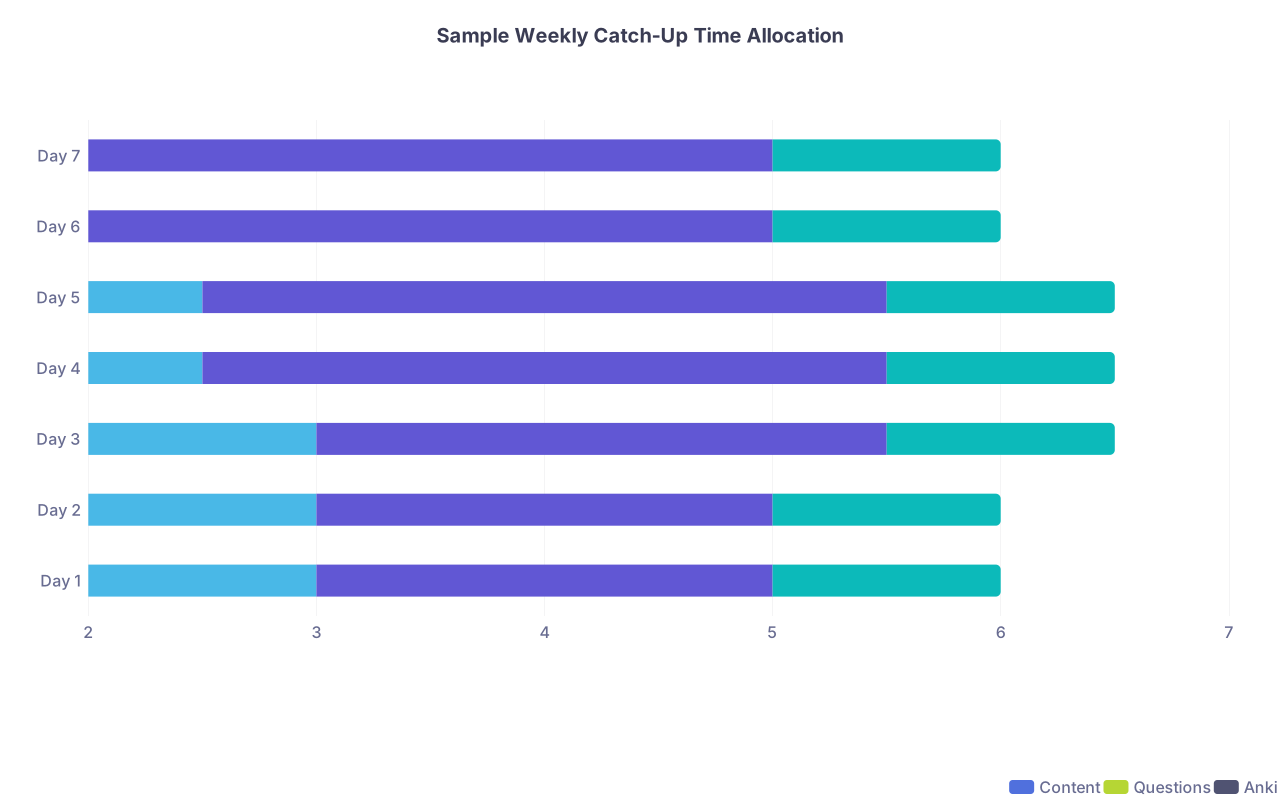
| Category | Content | Questions | Anki |
|---|---|---|---|
| Day 1 | 3 | 2 | 1 |
| Day 2 | 3 | 2 | 1 |
| Day 3 | 3 | 2.5 | 1 |
| Day 4 | 2.5 | 3 | 1 |
| Day 5 | 2.5 | 3 | 1 |
| Day 6 | 2 | 3 | 1 |
| Day 7 | 2 | 3 | 1 |
Do not obsess over the exact numbers. The point: content early, questions increasingly, Anki steady.
4.3 Write a brutal, specific 1-day plan
Test your system on tomorrow. It should look more like this:
- 7:00–7:30 – Breakfast, quick plan review
- 7:30–9:00 – Cardio lectures 5–6 at 1.75x; pause to annotate slides
- 9:00–9:15 – Short walk, water, no phone scroll
- 9:15–11:00 – 40 cardio questions (tutor mode), immediate review
- 11:00–11:30 – Anki: only due cards for cardio + high‑yield review
- 11:30–12:15 – Lunch, not at your desk
- 12:15–13:45 – Renal lectures 3–4, same approach
- 13:45–14:00 – Break
- 14:00–15:30 – 30 mixed questions (cardio + renal), review
- 15:30–16:00 – Anki: new cards only for today’s highest yield items
- Evening: Light pass over tomorrow’s topics, then stop by a fixed time
You should be able to point at every time block and say: “This is what I will produce.”
Step 5: Tame the Anki / Spaced Repetition Explosion
Two weeks off Anki usually means one thing: a terrifying red number that makes you want to delete the app.
Do not. But you also cannot brute‑force 2,000–4,000 overdue cards.
5.1 Apply the 3-layer approach to your backlog
Today’s Anki tasks, every day until the exam:
Must-do: Today’s due reviews for current exam content
- Focus on the topics covered in the past 5–7 days and in the upcoming exam section.
- If you have tags or filtered decks, use them aggressively.
Optional: Selective backlog cleanup
- Limit this to a fixed number (e.g., 100–150 extra cards).
- If a card is low-yield or you keep failing it and it is fringe content, suspend it.
New cards: Very limited
- Only add new cards for the fresh material you absolutely must know.
- Daily cap: something like 20–40 new cards total while you are behind.
If your deck is not tagged, manually create quick filtered decks for “this block / this exam” and ignore the rest until after the exam.
5.2 When you are really drowning: emergency Anki rules
If you open Anki and see 3,000+ due, follow this emergency rule set:
- Change daily review cap to something like 250–300
- Do not touch old, preclinical topics that are not on this exam
- Use “bury related” to avoid getting stuck on variants of the same fact
- Change leech settings: anything that fails 6+ times gets suspended automatically
The goal here is stabilization, not purity. Perfect spaced repetition is already gone. You are doing damage control.
Step 6: Adopt High-Yield Study Methods Only (No Pretty Notes)
You do not have time for inefficient learning. The method matters a lot when you are behind.
6.1 What you stop doing immediately
- Rewriting notes.
- Making elaborate digital notes “to organize everything later.”
- Watching lectures passively while scrolling your phone.
- Spending 45 minutes choosing the perfect Anki add‑on.
If your method does not involve retrieving information from memory, it is probably too slow right now.
6.2 What you do instead
Focus on active recall and exam-like tasks:
Fast lecture passes with active pauses
- Watch at 1.5–2x speed.
- Pause to:
- Answer your own “what is the main idea of this slide?” out loud.
- Predict what comes next before hitting play.
- Mark only truly confusing or high-yield slides for a second look.
Question-first learning
- For topics you are weak in, do 10–15 questions before the lecture review.
- Then watch the lecture or skim notes with the question patterns in mind.
- This forces your brain to build a framework, not just absorb.
Mini whiteboard drills
- End each block with a 10‑minute “teach it to the wall” session.
- Draw the pathway, outline the mechanism, list the side effects from memory.
- Check against your notes or video. Fix gaps. Move on.
Targeted Anki creation (only if truly needed)
- If you add cards, keep them brutal and simple.
- One fact per card. High-yield only.
- Example: “Drug X → major side effect?”; not “Explain mechanism of action in 5 steps.”
This is how you get exam points per hour to go up.
Step 7: Stress Management That Actually Helps Performance
You are probably stressed, maybe ashamed, maybe panicking. Fine. But panic destroys working memory and focus. You cannot afford that.
7.1 Minimum viable mental hygiene
You are not building a perfect wellness routine this week. You are preventing cognitive collapse.
Non‑negotiables:
- Sleep: 6.5–7 hours minimum. No “I’ll just study until 3 a.m.” That trade is usually negative.
- Movement: 10–20 minute walk once or twice a day. No phone. Just let your brain decompress.
- Bounded worry time: If you are spiraling, give yourself 10 minutes to write down every fear. Then close the notebook and return to the next block.

7.2 Kill the guilt loop
The guilt loop sounds like this:
- “I am so behind, I blew it, I am not cut out for this.”
- “Since I am behind anyway, what is the point of starting now?”
That loop is useless. It adds zero exam points.
You do not have to feel great about yourself this week. You just have to execute the next block.
Practical trick: When your brain starts that loop, say (out loud if you have to), “Not useful. Next block.” Then open the next task on your schedule and start a 5‑minute timer. Often the first 5 minutes are the whole battle.
7.3 Talk to one real person if needed
If your situation is worse than “I got lazy” – for example:
- Serious family crisis
- Health problem
- Major mental health symptoms (cannot get out of bed, panic attacks, suicidal thoughts)
Stop trying to brute-force this solo. Email your dean of students, a trusted faculty member, or counseling service. Brief, direct message:
“I have fallen about two weeks behind due to [X]. I am working on a catch‑up plan, but I am concerned about my ability to perform on the upcoming exam. Can we discuss options or support?”
You are not the first student to be here. The people in charge have actually seen this before.
Step 8: Adjust Expectations and Risk-Manage the Exam
You lost two weeks. The goal is not to pretend that never happened. The goal is to hit the best realistic outcome.
8.1 Set a realistic target
Ask yourself:
- “If I execute this plan at 80–90% for the next 7–10 days, what grade is realistically on the table?”
Maybe you were an A‑student and now you are aiming for B/B+. That is fine. Survival and passing with a solid base is better than burning out chasing perfection and crashing.
8.2 Lean into pattern recognition as you get closer
As the exam nears, start looking for repeated patterns:
- Topics that show up across:
- Lectures
- Question stems
- Anki
- Past exams
These are your anchor topics. Invest extra time to feel fluent in them. They are what you are most likely to see.
A few days before the exam, build a one‑page “panic sheet” for each major system:
- Top 5 diseases or mechanisms
- Top 5 drugs / treatments
- Top 5 lab or imaging findings
And review those daily.

Step 9: Protect the Next Block/Exam From This Happening Again
Two weeks off can happen to anyone. But if it becomes a pattern, you will pay for it on boards.
Use this as a data point and put some guardrails in place.
9.1 Simple weekly check-in
Once a week (same time each week), do a 15‑minute self-audit:
- What did I plan to cover?
- What actually got done?
- What is slipping (Anki, questions, lectures)?
- How many hours did I truly study (not counting fake studying)?
Quick visual can help for some students:
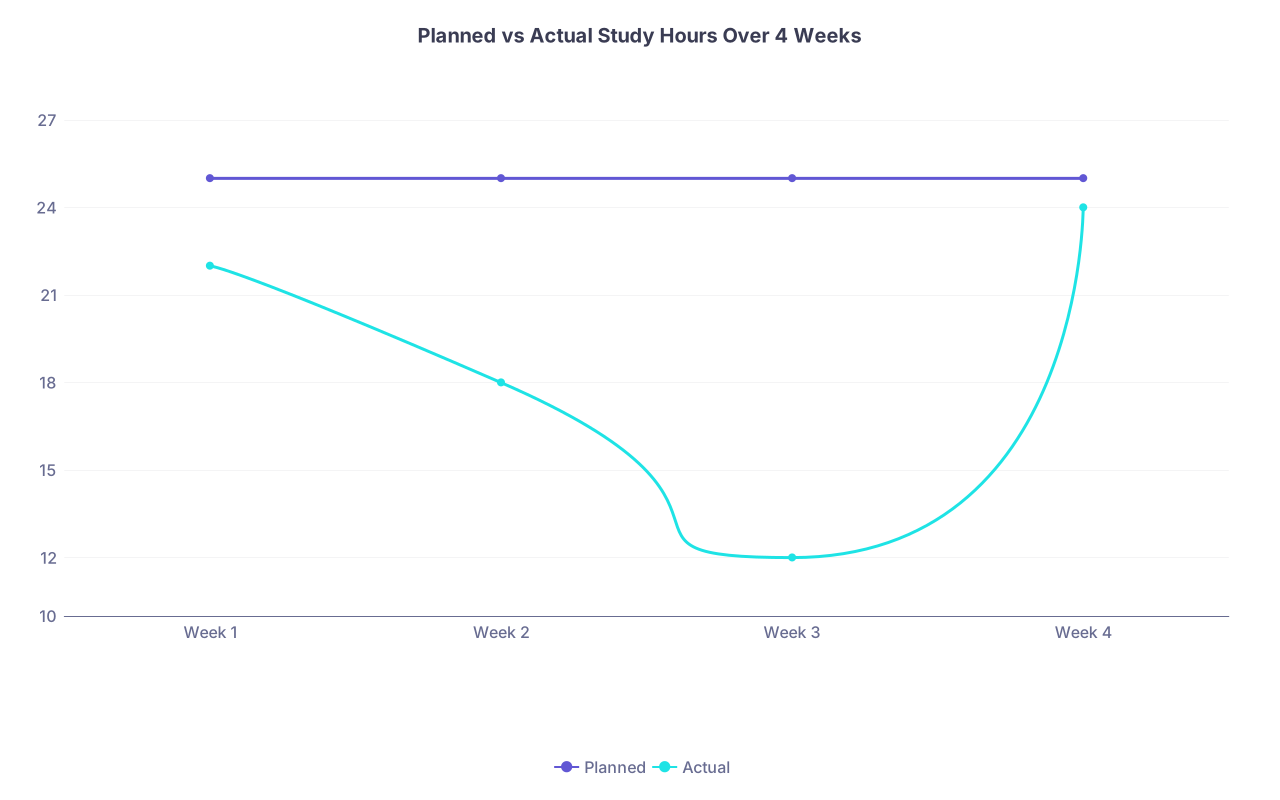
| Category | Planned | Actual |
|---|---|---|
| Week 1 | 25 | 22 |
| Week 2 | 25 | 18 |
| Week 3 | 25 | 12 |
| Week 4 | 25 | 24 |
If you see a big gap forming (like Week 3 above), that is your early warning.
9.2 Build “buffer days” into every block
Stop scheduling your life like nothing will go wrong. Something always goes wrong.
For every 2 weeks of content, plan:
- 1 light day where you only do:
- Anki
- Review
- A small number of questions
This becomes your catch‑up buffer if you fall slightly behind. If you are fully on track, you use it as a lighter consolidation day instead of jamming more new content.
9.3 Have a pre‑written “emergency plan”
When life hits you again (and it will), you should not be starting from zero. Use what you just read as a template.
Make a short note file called “Study Emergency Plan” with:
- Steps:
- Inventory missed material
- Convert to hours
- Rebuild 7‑day schedule
- Prioritize Tier 1 content
- A rough schedule template you can copy-paste
- Contact info for dean / counselor / trusted senior student
Next time you slip, you execute the protocol instead of spiraling.

| Step | Description |
|---|---|
| Step 1 | Realize you are behind |
| Step 2 | Inventory missed work |
| Step 3 | Estimate hours needed |
| Step 4 | Cut to Tier 1 topics |
| Step 5 | Plan full catch-up |
| Step 6 | Build 7-day schedule |
| Step 7 | Anki triage |
| Step 8 | Execute daily blocks |
| Step 9 | Weekly check-in and adjust |
| Step 10 | Hours > Time? |
Quick Summary: What You Actually Need To Do
- Get the numbers. List what you missed, convert it to hours, and compare it to your real daily capacity. No magical thinking.
- Prioritize ruthlessly. Tier 1 exam topics first, questions early and often, Anki selectively. Pretty notes and low-yield details do not make the cut.
- Run the plan, not your emotions. Build 7 days of specific, block‑based tasks. Then execute at 80–90%, protect your sleep, and adjust expectations to reality—not perfection.
You lost two weeks. That happened. Now your job is simple: do the next good block of work.