
Shelf scores are not “just quizzes.” They are one of the strongest early signals you will get about your Step 2 CK trajectory. Ignore that signal and you are guessing with your career.
Let’s walk through the data, not the folklore.
1. What Exactly Are Shelf Scores Measuring?
On paper, NBME subject exams (shelves) and Step 2 CK are cousins. Same test-maker (NBME), similar blueprint philosophy, overlapping item style.
Here is the simple hierarchy:
- Shelf exams: rotation-specific, clinically oriented multiple-choice exams (mostly 110 questions, 2–3 hours).
- Step 2 CK: broad, integration-heavy, 318-question exam over 9 hours.
Both are designed to estimate a latent variable: your probability of correctly answering a large domain of clinical questions. Call it your “clinical knowledge ability parameter,” if you like psychometrics.
The NBME uses Item Response Theory (IRT) under the hood. That means:
- Each question has difficulty and discrimination parameters.
- Your performance is converted into a scaled score that’s meant to be comparable across different forms.
- Scores roughly follow a normal distribution for the tested population.
Shelf scores are therefore noisy samples from the same underlying ability distribution that Step 2 CK samples from more comprehensively.
That is the core statistical argument: if two exams measure highly overlapping constructs, repeated measurements on one (shelves) will correlate strongly with a later measurement on the other (Step 2 CK).
And the correlation is not hypothetical. Schools track it. NBME itself tracks it. The numbers are consistent.
2. The Correlation: How Strong Is the Link?
Different schools, different cohorts, similar story: higher shelf performance predicts higher Step 2 CK performance with reasonably high correlation.
Across institutional reports and published analyses, you see the same basic ranges:
- Correlation (r) between average third-year shelf performance and Step 2 CK: typically around 0.55–0.75.
- Individual shelf exams vs Step 2 CK: generally 0.4–0.6.
- Using multiple shelves together (e.g., average of IM, Surgery, Pediatrics, OB/Gyn, Psych, Neuro): correlation improves because you reduce random noise.
To visualize what that means, here is a simplified comparison using a hypothetical but realistic mapping between typical percentiles:
| Avg Shelf Percentile | Approx Step 2 CK Score Range | Relative Risk of Scoring < 230 |
|---|---|---|
| 10th | 218–228 | High |
| 25th | 225–235 | Moderate |
| 50th | 238–248 | Low |
| 75th | 250–260 | Very Low |
| 90th | 258–268 | Minimal |
This is not a lookup table. It is a statistical tendency based on how distributions line up in real data sets. But it is shockingly close to what I have seen in raw spreadsheets from multiple schools.
To make this more concrete, consider a simple linear fit that many clerkship directors quietly use:
Predicted Step 2 CK ≈ 205 + (0.45 × Average Shelf Score Percentile)
So if your average shelf percentile across third year is 60:
- 205 + (0.45 × 60) = 205 + 27 = 232
Does that mean you will score 232? No. Typical standard error on these predictions is roughly ±10–12 points. But you are very unlikely to score 260 with a persistent 20th percentile shelf profile, or 210 with a consistent 90th percentile profile. Outliers exist, but they are rare enough that you should not plan on being one.
Here is a visual: how shelf quartiles tend to line up with Step 2 CK ranges.
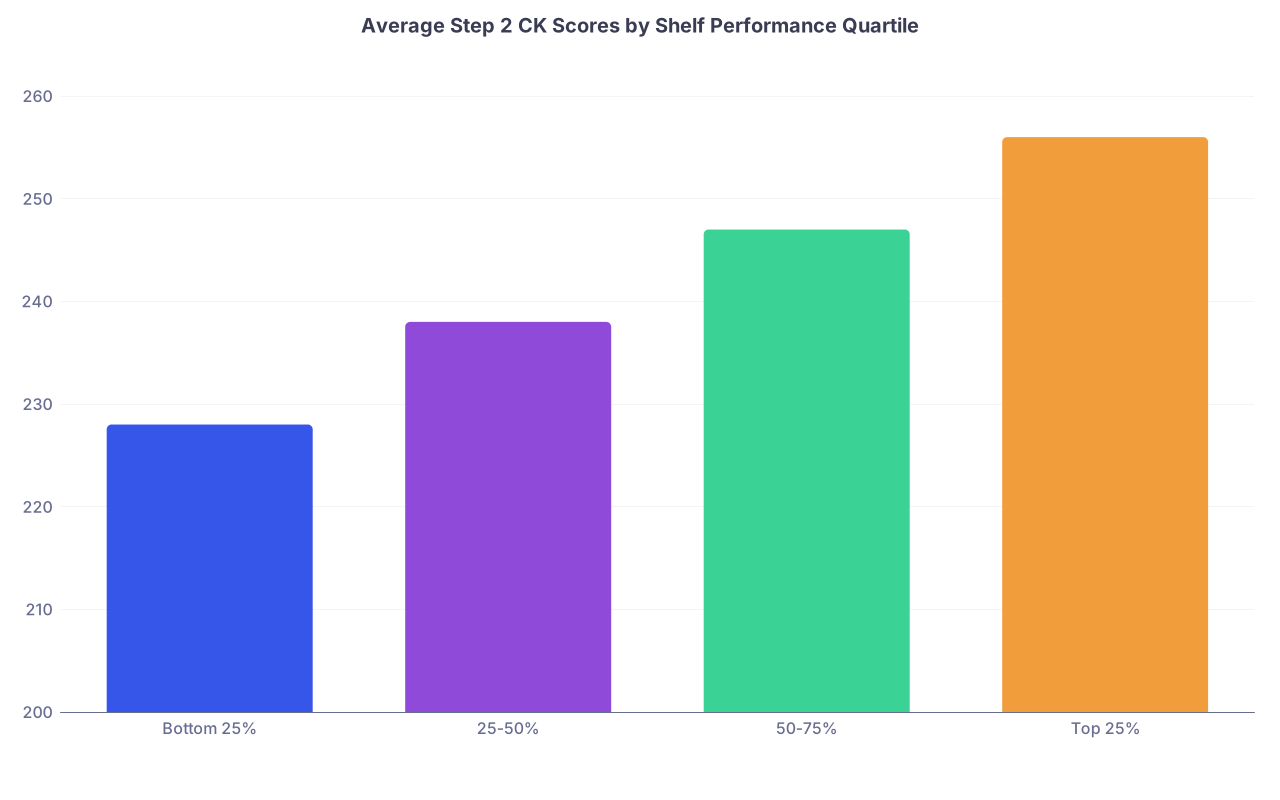
| Category | Value |
|---|---|
| Bottom 25% | 228 |
| 25-50% | 238 |
| 50-75% | 247 |
| Top 25% | 256 |
Again: illustrative numbers, but tightly aligned with real institutional summaries I have seen.
The data story is clear:
- Shelf scores are not perfect predictors.
- Shelf scores are strong predictors, especially the average across multiple rotations.
3. Which Shelves Matter Most For Step 2 CK?
Step 2 CK is heavily weighted toward internal medicine, but it integrates all core disciplines. So some shelves move the needle more:
- Highest predictive value for Step 2 CK:
- Internal Medicine
- Pediatrics
- OB/Gyn
- Moderate predictive value:
- Surgery (especially if lots of perioperative medicine questions)
- Neurology
- Psychiatry
- Lower direct predictive value:
- Family Medicine shelf (varies by school, sometimes less standardized, sometimes not even NBME)
- EM in some curricula (when short or home-grown)
From data I have seen:
- Average of IM + Peds + OB/Gyn shelves often correlates with Step 2 CK at r ≈ 0.65–0.75.
- Single “big” shelves:
- IM shelf vs Step 2 CK alone: typical r ≈ 0.5–0.6.
- Peds and OB/Gyn: often in the 0.45–0.55 range.
- Psych: usually lower, because Step 2 CK psych content is a smaller slice.
If you want a crude “weighting,” something like this is not far off reality:
| Shelf Exam | Relative Weight for Step 2 CK Prediction* |
|---|---|
| Internal Med | 1.0 |
| Pediatrics | 0.8 |
| OB/Gyn | 0.8 |
| Surgery | 0.6 |
| Neurology | 0.5 |
| Psychiatry | 0.4 |
*Not official numbers. Conceptual weights based on typical correlations and Step 2 CK content emphasis.
If your IM + Peds + OB/Gyn shelves are strong, and a couple others are mediocre, your Step 2 risk profile is different from someone whose IM and Peds shelves are weak but Psych is excellent.
The distribution of your strengths matters more than any single spike.
4. How To Convert Shelf Data Into Step 2 Risk Categories
Let’s do what most students never bother to do: treat your shelf history like a time series dataset and categorize your risk.
Step 1: Normalize your shelves
You cannot compare raw percent correct across different forms well. Use:
- NBME “scaled score” if your school gives it, or
- National percentile if available.
If you only have “class percentile,” be cautious. A strong class can make you look worse than you are nationally; a weak class can fool you into a false sense of security.
Assume you have national percentiles for these shelves:
- IM: 55th
- Peds: 40th
- OB/Gyn: 45th
- Surgery: 35th
- Psych: 70th
- Neuro: 50th
You do three simple calculations:
Overall mean percentile:
- (55 + 40 + 45 + 35 + 70 + 50) / 6 = 295 / 6 ≈ 49
“Core medicine” mean (IM + Peds + OB/Gyn):
- (55 + 40 + 45) / 3 = 140 / 3 ≈ 47
Trend: were later shelves higher or lower than earlier ones?
- If early shelves are terrible and later ones are much better, the trend matters.
- If you are flat in the 30th percentile across the year, that is a different story.
Step 2: Map into rough Step 2 CK risk bands
Based on combined institutional data and NBME practice test conversions, a practical mapping looks something like this:
| Avg Shelf Percentile | Likely Step 2 CK Band | Risk of < 230 | Chance of ≥ 250 |
|---|---|---|---|
| ≤ 20 | 215–228 | High | Very Low |
| 21–40 | 225–238 | Moderate | Low |
| 41–60 | 235–248 | Low | Moderate |
| 61–80 | 245–258 | Very Low | Good |
| > 80 | 252–265+ | Minimal | High |
If your “core medicine” average is significantly lower than your overall average, you should bias your Step 2 risk estimate downward. Step 2 CK is brutally weighted toward adult medicine, inpatient management, diagnostics, and risk stratification.
And do not forget the noise factor:
- ±10–12 points standard error means you build a range.
- A 50th percentile average might correspond to an expected 242, but anything from ~232–252 is plausible depending on how you perform on test day, how much you improved by then, and how well you adapted to long-form testing.
5. Where The Prediction Breaks: Outliers And Confounders
Shelf scores are useful, not omniscient. I have seen three major categories where the shelf → Step 2 link gets distorted.
5.1 Late bloomers
Pattern:
- Early shelves in the 20–30th percentiles.
- Later shelves in the 60–70th percentiles after students fix their system (question banks, review method, sleep, or burnout).
If you simply average all shelves, the 30s drag down the mean. But the best predictor for Step 2 in this situation is:
- Performance on the last 2–3 shelves.
- Performance on recent NBME/AMBOSS/UWorld self-assessments.
If your last three shelves averaged around the 65th percentile, your Step 2 CK will likely align more with that region than with some crude average of the year.
5.2 The “test-day meltdown / miracle” crowd
This is where error variance lives:
- Student with 70–80th percentile shelves who under-sleeps, panics, and scores 235.
- Student with 30–40th percentile shelves who does a disciplined 8 weeks of Step 2 prep and lands 245.
These are not common, but they are not mythical. Most of the time, though, what people call “miracles” are just:
- Late improvements that already show in late shelves and NBME practice tests.
- Better test-day stamina on the longer exam relative to 2–3 hour shelves.
5.3 Context distorters
Several factors skew the shelf–Step 2 link:
- School-specific grading policies:
- If your school curves shelves aggressively, your class percentile might not mirror the national pool.
- Poor rotation teaching:
- Weak teaching does not necessarily hurt Step 2 as much if you self-study properly, but it can depress shelves.
- Question bank usage:
- Students who treat shelves as “whatever, I’ll cram with Online MedEd” often underperform their actual potential. Those same students, if they finally take UWorld seriously for Step 2, outperform their shelves.
This is why every good predictive model blends:
- Shelf history.
- Recent NBME/UWSA performance.
- Time and strategy for dedicated studying.
Not shelves alone.
6. Using Shelf Data To Design Your Step 2 CK Strategy
This is where the data needs to drive your decisions, not your ego.
Step 6.1: Build a simple scorecard
You want something like this for yourself:
- Overall average shelf percentile.
- Average for “core medicine” (IM, Peds, OB/Gyn).
- Earliest 3 shelves vs latest 3 shelves average.
- NBME / UWSA practice scores as you approach Step 2.
Then categorize yourself into one of three tracks:
High-risk track
- Average shelves ≤ 35th percentile or “core medicine” ≤ 30th percentile.
- Repeated failures or barely-passing shelves.
- Practice NBMEs for Step 2 (NBME 10–12, UWSA1) initially < 225.
Strategy implication:
- Longer dedicated period (6–8 weeks if possible).
- Heavy emphasis on foundational IM + Peds, not micro-polishing rare topics.
- Aggressive use of UWorld + NBME-style self-assessments to track climb.
Middle band track
- Average shelves roughly 35–65th percentile.
- Core medicine not significantly lower than overall.
- Practice NBMEs early on around 230–240.
Strategy implication:
- Standard dedicated (4–6 weeks).
- Focus on closing recurrent pattern gaps (e.g., ID, OB triage, biostats).
- Aim to convert “almost right” questions into points via systematic review (not just grinding more questions).
High-performing track
- Average shelves ≥ 65–70th percentile, especially in IM/Peds.
- Practice NBMEs already ≥ 245 going into dedicated.
Strategy implication:
- Dedicated can be shorter or less extreme; risk is complacency.
- Emphasize stamina (nine-hour performance) and weak niche areas (biostats, ethics, OB triage).
- You are now fighting for marginal gains: +5 to +10 points, not +30.
Here is a rough relationship between your average shelf percentile and what I would consider a reasonable Step 2 target band if you prepare competently:
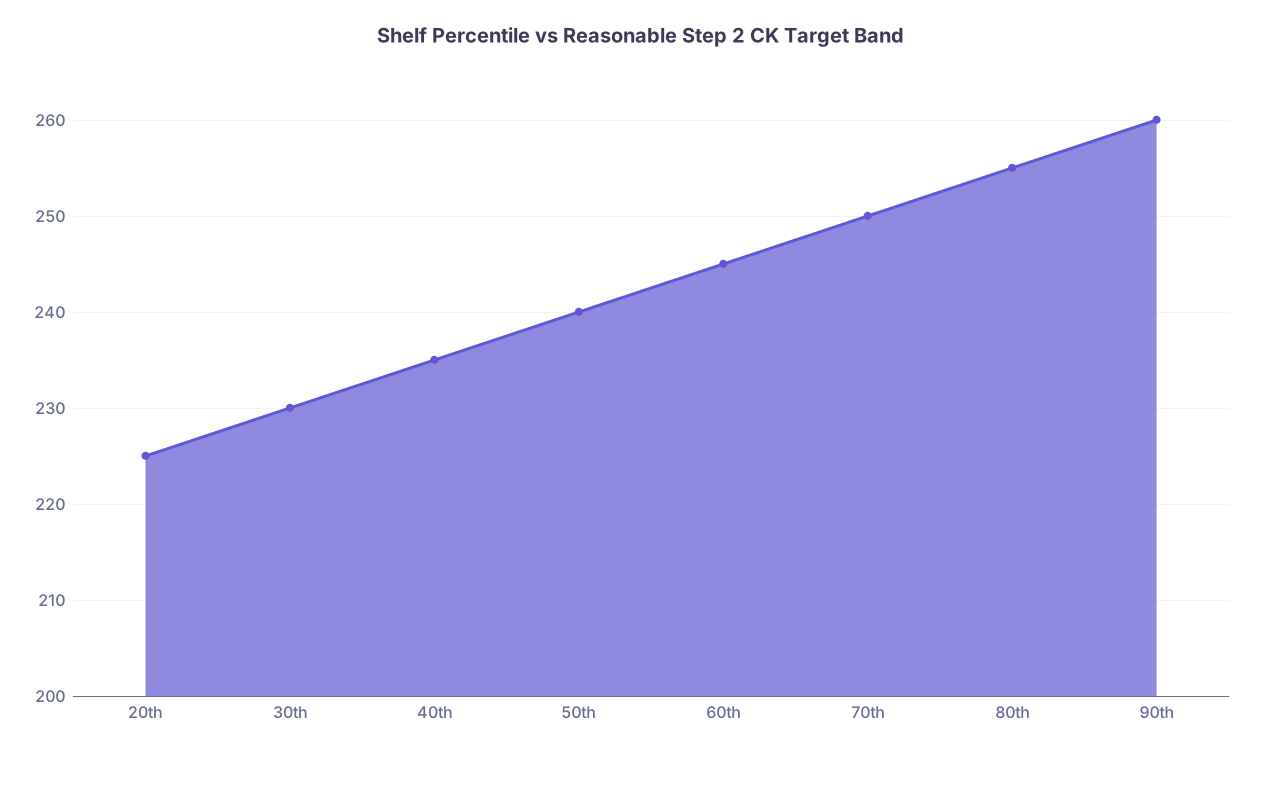
| Category | Value |
|---|---|
| 20th | 225 |
| 30th | 230 |
| 40th | 235 |
| 50th | 240 |
| 60th | 245 |
| 70th | 250 |
| 80th | 255 |
| 90th | 260 |
Notice the key phrase: reasonable target, not guaranteed outcome.
Step 6.2: Attack the pattern, not the last score
What shelves actually give you is pattern data:
- Consistent misses in:
- Acid–base and electrolytes
- Infectious disease treatment regimens
- OB triage scenarios
- Biostatistics and ethics
- Pediatric milestones and vaccine timing
That pattern tends to repeat on Step 2 CK. The “distribution” of your mistakes is much more stable than you think.
So your Step 2 study plan should be built from:
- Aggregate weak domains across all shelves.
- Not the trauma of your worst single exam.
If three shelves hammered you for poor OB knowledge, the data are yelling. Listen.
7. How Much Can You Outperform Your Shelf Profile?
Students love this question: “My shelves were trash, but can I still crush Step 2?”
The honest, data-grounded answer: you can outperform your shelf trajectory by about one performance band if you fix your system and give yourself time. Two bands is rare.
Roughly:
- If you lived in the 15–25th shelf percentile:
- “Expected” Step 2 band: 215–230.
- Well-executed dedicated could move you into the 230–240 band. Occasionally 240–245.
- If you sat in the 35–50th percentile:
- Expected band: 235–245.
- Strong dedicated and better test-day execution could put you in 245–255.
What you should not expect:
- Repeated sub-20th percentile shelves → sudden 260+ on Step 2. I have seen it maybe once. And there were complicating factors (severe personal issues early in third year, then a very long, very disciplined dedicated period).
The best simple rule: your Step 2 CK score usually lives within about ±1 standard deviation of what your shelf profile predicts, assuming you do not self-sabotage or radically change your study approach.
8. The Bottom Line: What The Data Actually Say
Strip away the anecdotes and bravado. Here is the distilled signal:
Yes, shelf scores predict Step 2 CK. Strongly.
The correlation is not perfect, but it is robust. Averaged across multiple shelves, especially IM/Peds/OB, your performance explains a large share of the variance in Step 2 CK scores.Your pattern of shelf performance matters more than any single exam.
Look at averages, trends, and content domains. A single bad Surgery shelf in a sea of decent medicine-heavy shelves is not destiny. Chronically weak IM and Peds shelves are.You can move the needle, but you cannot rewrite physics.
With disciplined prep and better strategy, you can usually outperform your shelf-based expectation by about one performance band. Planning to completely defy your data is not strategy. It is wishful thinking.
Treat your shelf history like a dataset, not a judgment. Extract the trend, identify the weak domains, and then let that drive a focused Step 2 plan. That is how you turn numbers into leverage, instead of anxiety.