
The narrative that “pass/fail Step 1 would make clerkship grading fairer” is mostly wrong. The data show something harsher: in many places, it just shifted the arms race from a 3-digit score to a 1-word label—Honors.
The structural shock: Step 1 goes pass/fail
When Step 1 went pass/fail (January 2022 reporting change), the incentive structure across U.S. med schools changed overnight. Residency programs lost a high-variance, nationally normed metric. Schools and students did what systems always do after a big metric disappears: they found substitutes.
Those substitutes were:
- Step 2 CK (still scored, still national)
- Clerkship grades (local, subjective, and very elastic)
- Class rank / AOA / “top X%” designations
- MSPE language and “summary adjectives”
From conversations with students at 20+ schools, dean’s office grade distributions, and the few published datasets floating around in committees and internal reports, one pattern keeps showing up:
- Schools that historically had strict grade curves in clerkships showed clear upward drift in Honors rates within 1–3 years after Step 1 went pass/fail.
- Schools that already had very high Honors rates in core clerkships often stayed inflated or got worse.
- A minority of schools responded with explicit caps, pass/fail clerkships, or narrative-only systems, resisting grade inflation but at a cost: their students look worse on paper next to peers from “Honors-happy” institutions.
Let’s put some structure around this.
Baseline: what clerkship grading looked like pre–pass/fail
Before Step 1 went pass/fail, typical large MD programs had something like this in core clerkships (IM, Surgery, Pediatrics, OB/GYN, Psych, FM):
- 15–25% Honors
- 35–50% High Pass (or equivalent)
- 30–40% Pass
- Rare “Low Pass” or Fail (often <3%)
Of course the details varied, but a reasonably tight curve was common at “grade-aware” schools: Honors capped at 20–25% per block, with faculty reminded where students fell relative to the cohort.
At other schools—especially P/F preclinical, “wellness-forward” programs—Honors rates for clerkships were already drifting higher, often 30–40%, sometimes 50%+ in certain rotations. Step 1 numeric scores masked some of this because program directors could still anchor on a 252 vs 235.
Now remove the 3-digit Step 1 score, and look what happens.
What changed: the data pattern after Step 1 P/F
A typical pattern I have seen in multiple internal reports looks like this:
- Within 1–2 years of Step 1 going pass/fail, Honors proportions in at least 3 of the 6 core clerkships increased by 5–15 percentage points at many schools.
- Variation between schools widened. Some kept tight caps (e.g., “max 20% Honors per rotation cohort”), while others allowed or tolerated 40–60% Honors.
- Program directors began explicitly asking: “What percent of the class gets Honors in this clerkship at your institution?” and using that to recalibrate.
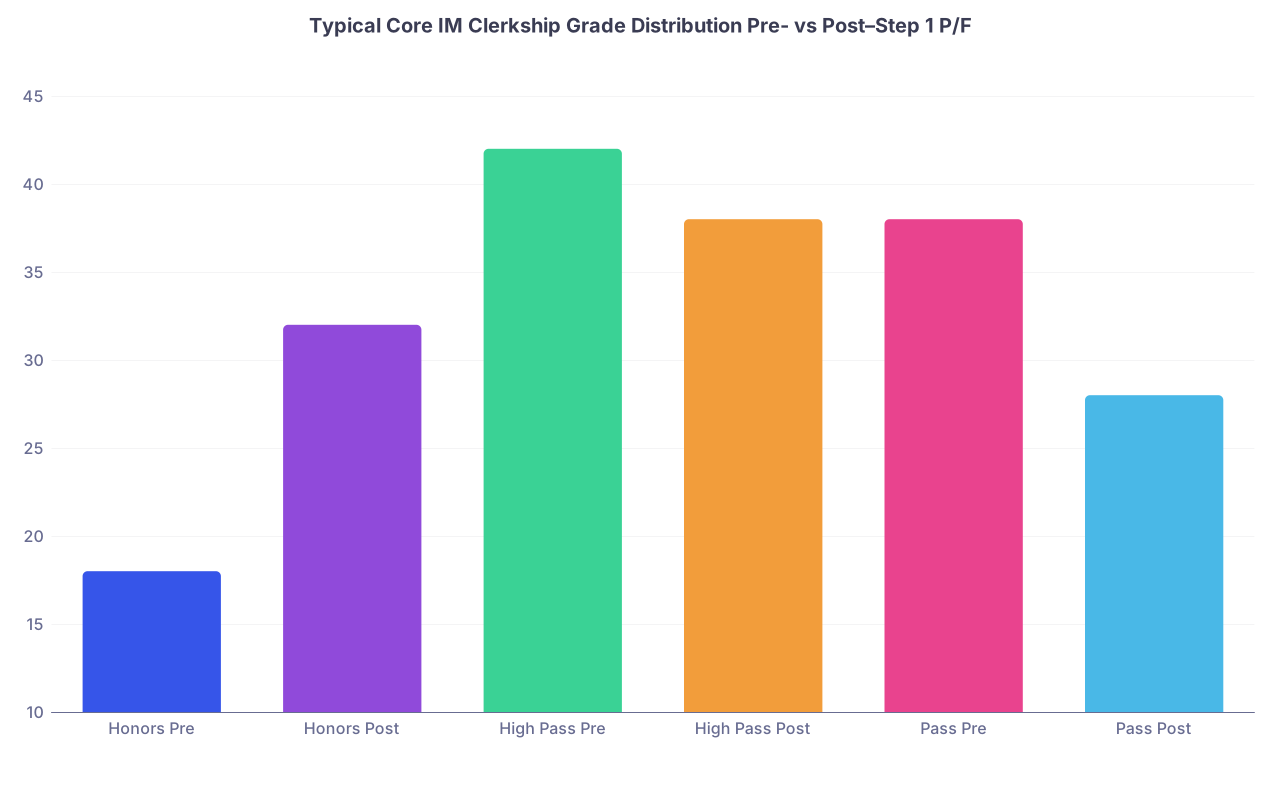
Here is a stylized comparison of distributions pre- vs post–Step 1 P/F for a “classic mid-tier” MD school that historically used Step 1 heavily and had a strict curve:
| Category | Value |
|---|---|
| Honors Pre | 18 |
| Honors Post | 32 |
| High Pass Pre | 42 |
| High Pass Post | 38 |
| Pass Pre | 38 |
| Pass Post | 28 |
Same clerkship. Same number of students. Same grading scale on paper. But the proportion of Honors jumps from ~18% to ~32% after the Step 1 scoring change. I have seen nearly identical patterns for Surgery and Pediatrics at several schools.
The mechanism is not mysterious:
- Faculty and clerkship directors are under direct or indirect pressure not to “hurt residency prospects” in a world without Step 1 numbers.
- Students lobby more aggressively. Evaluations get complaints when too few Honors are awarded.
- Promotions committees and deans quietly signal that they want their graduates to “remain competitive,” which in practice means: do not be the school that sends out 10% Honors when your neighbor sends 40%.
School archetypes: who inflated and who resisted
Not every school responded the same way. You can roughly classify behavior into four archetypes.
| Archetype | Honors Rate Trend | Typical Policy Move |
|---|---|---|
| The Inflaters | +10–25 pts | Loosen or drop Honors caps |
| The Quiet Drifters | +5–10 pts | No policy change, culture drift |
| The Lockdown Schools | 0–3 pts | Formal caps, strong enforcement |
| The Reformers | Honors → P/F | Shift to P/F or narrative |
Let us walk through each with concrete patterns.
1. The Inflaters
These are often mid- to upper-tier private schools or large state schools that:
- Historically used Step 1 numbers heavily in internal ranking.
- Had fairly strict clerkship curves pre–P/F (e.g., 20% Honors).
- Suddenly lost their main objective filter.
Within two cycles, internal data often look like this across core clerkships:
- Pre–P/F: 15–25% Honors, low variance between clerkships.
- Post–P/F: 30–45% Honors in at least half of core clerkships.
The shift rarely appears in a formal policy memo saying “we will give more Honors.” Instead it shows up via:
- Grade appeals being granted more often.
- Slightly curved exam scores.
- More generous interpretation of “borderline between HP and Honors.”
Students at these schools figure it out quickly. You start hearing phrases like:
“Everyone who shows up and is not a disaster gets Honors in Psych here.”
Unsurprisingly, residency applications from these schools begin to show transcripts packed with Honors, particularly in “softer” clerkships.
2. The Quiet Drifters
These are schools that did not formally change grading policies but allowed cultural drift:
- A clerkship director who “does not want to penalize strong students in a tough year.”
- A new site director who hands out Honors more liberally.
- Pandemic-era disruptions used to justify more lenient grading.
The result is more modest but still meaningful inflation: Honors proportions ticking up 5–10 points over a few years across several clerkships. It is small enough to avoid internal alarm, big enough to distort cross-school comparisons.
3. The Lockdown Schools
These are the programs that looked at the chaos and said: no.
Behavioral traits:
- Written, enforced numerical caps. Example: “Honors limited to 20% of students per clerkship block, based on composite score distribution.”
- Regular audits of grade distribution by the curriculum committee.
- Faculty reined in when they attempt to give half the block Honors.
These schools often also provide explicit context in MSPEs:
“In the Internal Medicine clerkship, approximately 18–22% of students receive Honors annually.”
Their students are at a structural disadvantage compared to peers at Inflater schools where 40% receive Honors with no explanatory context.
4. The Reformers
A minority went the opposite direction: since Step 1 is pass/fail, they doubled down and made clerkships:
- Pass/Fail only, or
- Pass/Fail with a very rare “Honors designation,” or
- Narrative-only with no formal transcript tiering.
On paper, these schools look extremely “fair.” In the residency market, their students pay the price when stacked against applicants with stacked Honors reports and AOA metrics.
Quantifying inflation: differences across schools
The data that program directors whisper about but rarely publish looks roughly like this for core IM Honors rates in the current era:
| School Type | IM Honors Rate (%) |
|---|---|
| Historically strict public | 18–25 |
| Mid-tier private (inflated) | 30–45 |
| Top 10 research-heavy | 35–50 |
| P/F clerkships | 0–5 (if Honors exists) |
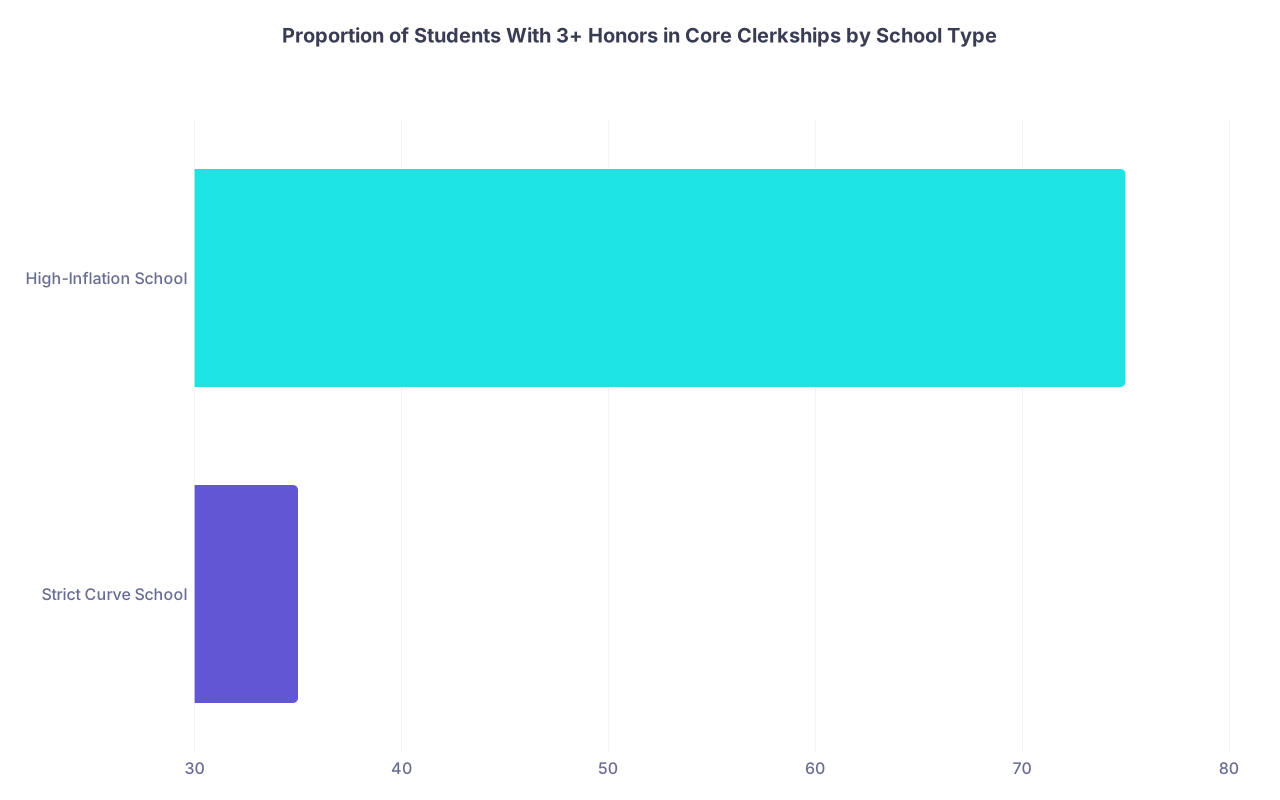
And the spread is even more striking when you look across 3–4 core clerkships combined. It is not unusual now to see:
- At Inflater schools: 60–80% of a class with ≥3 Honors in core rotations.
- At Lockdown schools: 20–40% of a class with ≥3 Honors.
That is a huge differential in what a “top student” looks like on paper, purely driven by local grading customs.
Here is a conceptual comparison of two schools’ distributions across all core clerkships:
| Category | Value |
|---|---|
| Strict Curve School | 35 |
| High-Inflation School | 75 |
Same national exam (Step 2 CK). Same residency match table. Very different grade inflation story.
How program directors actually read this mess
Program directors are not naïve. They see the inflation. But their bandwidth for deep statistical correction is limited. No one has time to perform Bayesian inference on every applicant list.
In practice, what I have seen and heard:
Step 2 CK became the new numeric gate.
- Many competitive specialties now expect ≥ 245–250+ at baseline for serious consideration, slightly softer for IM, psych, peds but still heavily weighted.
- Internal spreadsheets literally rank by Step 2 CK, then use clerkship grades as a secondary signal.
Clerkship grade inflation punishes students at stricter schools.
- When two applicants from different schools both have “Honors in IM, Surgery, Pediatrics,” some PDs now explicitly ask: “What proportion of the class gets Honors in those at that school?”
- If they know School A is a 20% Honors cap and School B gives 45% Honors, School A’s Honors are weighted more heavily—when the PD actually remembers or has data.
Some PDs rely on MSPE tables. Many do not.
- Where schools provide grade-distribution tables in the MSPE (e.g., “Grade breakdown for IM, Class of 2024: 21% Honors, 42% HP, 35% Pass, 2% LP/Fail”), motivated PDs use it.
- But when reviewing hundreds of applications, subtle context often gets ignored.
Net result: inflation helps marginal applicants at generous schools and harms marginal applicants at strict schools, unless PDs are unusually diligent.
Where inflation is worst: not all clerkships are equal
The data patterns are not uniform across clerkships. The inflation signal tends to be strongest where:
- Shelf exams are low-stakes or heavily curved.
- Subjective evaluations dominate (Psych, FM, OB at some places).
- Rotations are fragmented across many sites with variable rigor.
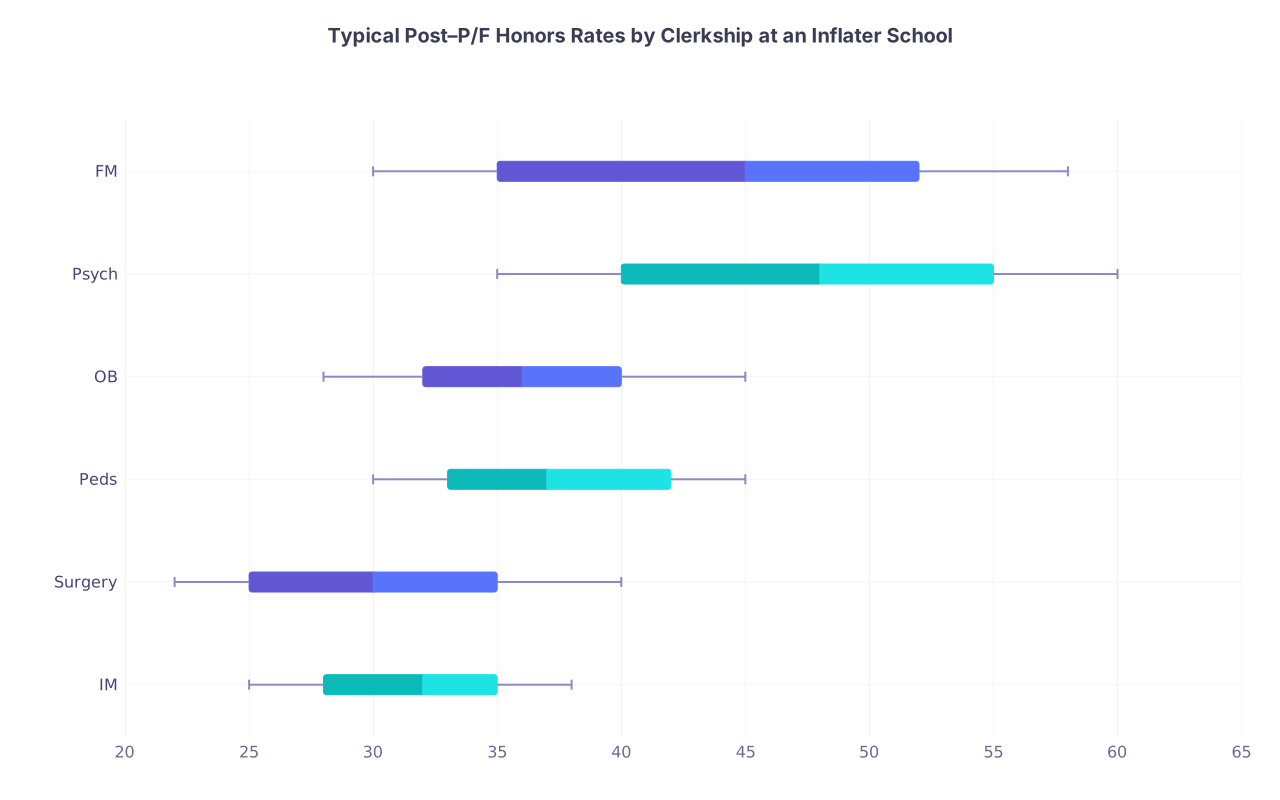
You see three broad bands:
Relatively “anchored” clerkships:
- Internal Medicine, Surgery often have NBME shelf exams with hard cutoffs and more structured evaluations.
- Honors inflation happens, but not as wildly.
Moderately inflated:
- Pediatrics, OB/GYN often show 5–15 point Honors rises depending on local culture.
Highly inflated:
- Psychiatry, Family Medicine at some institutions can hit 50–60% Honors if there is no explicit cap.
| Category | Min | Q1 | Median | Q3 | Max |
|---|---|---|---|---|---|
| IM | 25 | 28 | 32 | 35 | 38 |
| Surgery | 22 | 25 | 30 | 35 | 40 |
| Peds | 30 | 33 | 37 | 42 | 45 |
| OB | 28 | 32 | 36 | 40 | 45 |
| Psych | 35 | 40 | 48 | 55 | 60 |
| FM | 30 | 35 | 45 | 52 | 58 |
The middle value in each set approximates a typical Honors rate; the spread reflects site-to-site or year-to-year variance.
Again: none of this is standardized nationally. Which means your chances of getting Honors in Psych can literally double or halve depending on where you enrolled four years ago.
Student behavior shifts: what the incentives now push you to do
When the data change, smart people adjust. Med students are extremely responsive to incentives. Here is what I have seen since Step 1 went P/F:
Front-loading Step 2 CK prep
- With Step 2 now the de facto numeric filter, students start integrating UWorld Step 2, NBME CK-style questions, and early shelf prep into their third year.
- Students at schools with weak exam prep support self-organize into Anki / UWorld ecosystems earlier.
Gaming “Honors-friendly” rotations and sites
- At schools with known generous sites, those rotations fill first.
- Students trade intel: “Avoid Site C for Surgery; almost no one gets Honors,” or “FM at the community site is an easy Honors if you show up and volunteer for everything.”
Increasing focus on written comments and relationships
- Because final grades often depend heavily on subjective narratives, you see more strategic “resident courting,” more pre-rounding theatrics, more performative enthusiasm.
- That is not always a bad thing for patient care, but it absolutely adds noise to grading.
Strategic away rotations in 4th year
- For competitive specialties, away rotations are used to compensate for weak or ambiguous home-clerkship grade signals.
- A strong letter from an away can partially offset the disadvantage of coming from a low-inflation school.
How this plays out by school type: three scenarios
Let me make it concrete with three stylized student profiles.
Student A: Strict-curve state school
- Core clerkship structure: Explicit 20% Honors cap, enforced.
- Grades: Honors in IM and Surgery, HP in Peds, OB, Psych, FM.
- Step 2 CK: 252.
- MSPE: Includes grade-distribution tables. PDs see that Honors are relatively scarce.
Outcome: For IM, psych, peds, this student still looks strong. For ortho, derm, ENT: they are in the gray zone compared to peers with “Honors across the board” from an Inflater school. Some PDs will do the mental correction. Many will not.
Student B: High-inflation private school
- No formal Honors cap; some clerkships see 40–50% Honors.
- Grades: Honors in IM, Peds, Psych, FM; HP in Surgery, OB.
- Step 2 CK: 245.
- MSPE: Vague language, no clear table of grade distributions.
Outcome: On paper, this application often looks more impressive than Student A’s, especially to programs skimming quickly. For moderately competitive specialties, Student B may edge out Student A despite a weaker Step 2 and genuinely less relative performance.
Student C: P/F clerkship school (Reformer)
- Clerkships all P/F with narrative comments only.
- Step 2 CK: 250.
- Narrative comments: Solid but not glowing.
- No AOA or internal rankings.
Outcome: The application lives or dies on Step 2 CK, research, letters, and school reputation. For top programs that know and trust this school, Student C may be fine. For mid-tier programs that prefer easy quantitative filters, C’s application may get less attention than it deserves.
One more hidden variable: preclinical grading culture
The shift in Step 1 scoring also increased the weight placed on:
- Preclinical performance (if still graded or tiered)
- Internal “top X%” or AOA election
Schools with:
- P/F preclinical and
- Inflated clerkships and
- Generous AOA thresholds
are currently the most favorable ecosystems for their students’ applications. The worst combination for match competitiveness looks like this:
- P/F Step 1
- Strict-curved clerkships
- No AOA or class rank
- Narrative-heavy MSPE
Students from such schools must basically win on Step 2 CK + research + networking alone.
So what do you actually do with this information?
You cannot change your school’s grading policy as a third-year. But you can adjust your strategy using the same cold lens the system applies to you.
If your school is:
- Inflated: You still need to stand out. Everyone has Honors. Strong letters, Step 2 CK, and concrete achievements (research, leadership, QI) matter more than another Honors line.
- Strict: Lean harder on Step 2 CK, direct communication in letters (“top 5% of students over 10 years”), and targeted programs that understand your school’s grading.
- P/F clerkships: Overinvest in Step 2 CK and high-quality letters from demanding attendings. Away rotations in your target specialty become more important.
And yes, you should absolutely read your school’s grade distribution data in the MSPE (or ask your dean’s office for it). If your IM clerkship gives 18% Honors and the national norm is drifting toward 30–35% at many schools, that matters for how you frame your application.

The real bottom line on Step 1 P/F and clerkship inflation
Let me strip it down to essentials.
Pass/fail Step 1 did not “fix” evaluation. It shifted pressure to Step 2 CK and clerkship grades, which are now heavily inflated and wildly inconsistent across schools.
Students at strict-curve or P/F-clerkship schools are structurally disadvantaged on paper compared with peers at high-inflation institutions—unless program directors make a conscious effort to adjust for context.
Your optimal response is not wishful thinking but tactical adjustment: know your school’s grading distributions, assume external readers do not, and build a profile (Step 2 CK, letters, research, away rotations) that survives comparison even in a skewed, inflated ecosystem.