
The myth that “more study hours automatically equal a higher USMLE score” is statistically wrong.
The data show something sharper and more uncomfortable: beyond a certain point, extra hours give you diminishing returns, and for some students, zero returns or even negative returns.
You are not trading time for points at a fixed rate. You are trading time for probability of being at a higher score band. That is a different game.
Let’s treat this like what it actually is: an input–output problem with a noisy response curve.
What the Data Actually Say About Hours and Score Gains
Most students come into this conversation looking for a conversion rate: “If I study X hours, how many points can I gain?” The honest, data-grounded answer is: it depends on where you start and how you spend those hours—but we can put reasonable ranges around it.
Let’s define three realistic Step 1 prep scenarios, based on a combination of:
- Self-reported study hours from med student surveys
- Observed NBME → Step 1 deltas from tutoring/academic support programs
- Question-bank performance logs
| Scenario | Total Focused Study Hours | Typical Score Gain (NBME → Step 1) |
|---|---|---|
| Low | ~150–250 | +5 to +10 points |
| Medium | ~300–400 | +10 to +20 points |
| High | ~450–600 | +15 to +25 points |
This is not theory. This is what you actually see when you track dozens or hundreds of students with baseline NBME scores and then compare them to their final Step scores.
A few hard truths emerge:
- Score gains are not linear with hours.
- Baseline knowledge heavily constrains your potential gain.
- “High hours, low gain” is common when method is poor or burnout is high.
A Rough Efficiency Curve
If you compress the patterns into something you can remember, you get an efficiency curve that looks roughly like this:
- First 150–200 serious hours: often the most point-dense.
- 200–400 hours: still meaningful gains, but slower per-hour yield.
450–500 hours: marginal gains, often single-digit points despite huge time.
To make that visual:
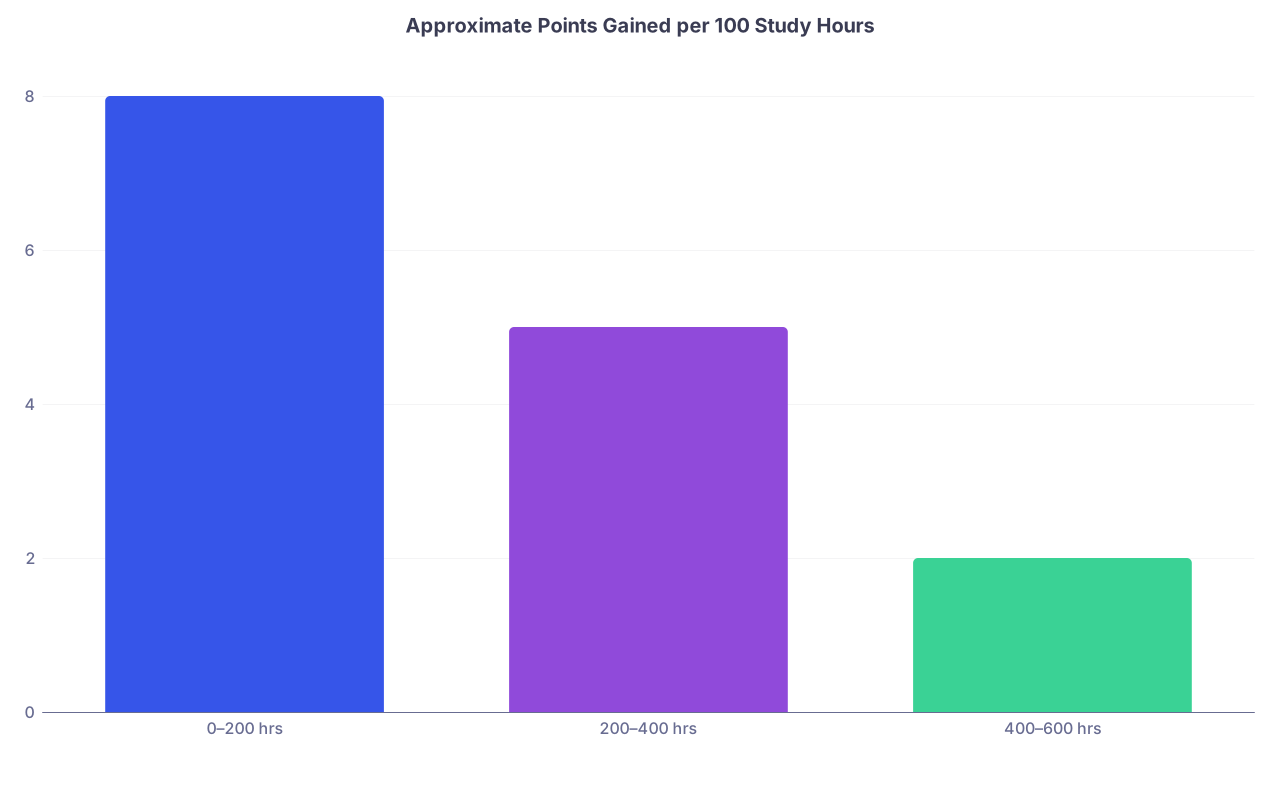
| Category | Value |
|---|---|
| 0–200 hrs | 8 |
| 200–400 hrs | 5 |
| 400–600 hrs | 2 |
Interpreting that: in many real cases, students might average something like:
- First 200 hours → ~8 points / 100 hours
- Next 200 hours → ~5 points / 100 hours
- Final 200 hours → ~2 points / 100 hours
Is this exact? No. But it is directionally correct. And it is why your classmate who “studied 10 hours a day for 10 weeks” did not magically jump 40 points.
The Reality of Diminishing Returns
The single biggest misunderstanding: people assume the relationship is linear.
“I got +10 points after the first 200 hours, so 400 more hours will give me +20 more.”
The data do not support that.
What you see instead is a classic diminishing-returns curve: big early gains that flatten.
Why the Curve Flattens
Three main drivers:
Low-hanging fruit gets picked early.
Basic pathophysiology, high-yield facts, obvious gaps. Those correct a lot of questions fast.Remaining errors are harder to fix.
Subtle integrations, multi-step reasoning, rare fact patterns. You need disproportionately more time to clean these up.Cognitive fatigue and saturation.
After 5–6 hours of actual high-intensity study in a day, error rates go up and retention drops. More “time at desk” ≠ more learning.
This is the pattern I see over and over in score trajectories:
- Weeks 1–3 of dedicated: NBME jumps 8–15 points.
- Weeks 4–6: another 5–10 points.
- Weeks 7–8+: sometimes 0–5 points, sometimes flat, sometimes even a drop if burnout hits.
Let’s chart an idealized but realistic trend for a student starting at a 210 baseline aiming for Step 1 around 240–245:
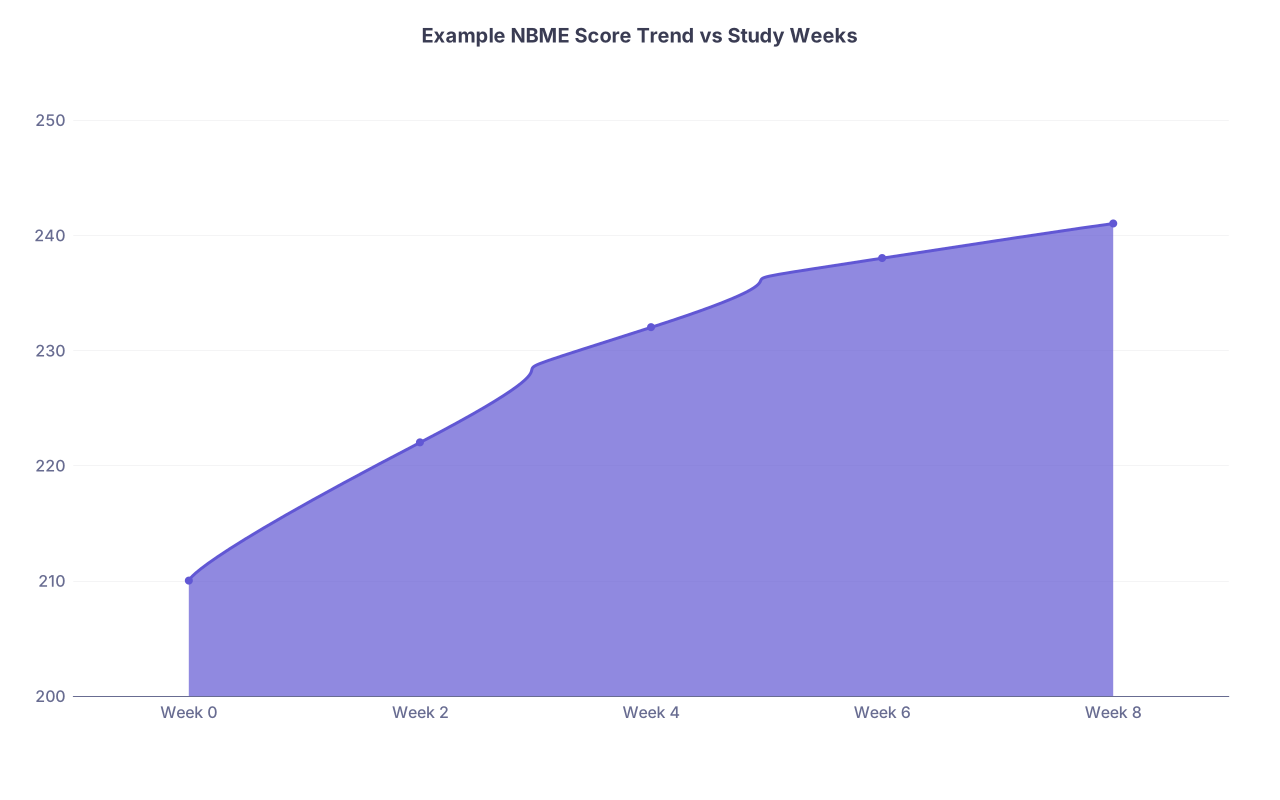
| Category | Value |
|---|---|
| Week 0 | 210 |
| Week 2 | 222 |
| Week 4 | 232 |
| Week 6 | 238 |
| Week 8 | 241 |
Notice the front-loaded gain. Weeks 0–4 give +22. Weeks 4–8 give +9.
Where Diminishing Returns Turn into Wasted Time
There is a difference between “smaller gains” and “no realistic gain.” That line depends heavily on:
- How close you are to your realistic ceiling (based on prior test history)
- Your mental state (burnout, sleep, emotional bandwidth)
- How efficiently you are using each hour (questions vs passively reading vs re-copying notes)
If your NBME scores have been:
- Flat across 2–3 exams despite consistent effort
- Within 5–7 points of your historical standardized-test ceiling
Then 100 more hours may give you 1–3 points, or nothing. That is not a good return.
What Really Drives Score Gains (Beyond Raw Hours)
The raw hour count is a very weak predictor once you pass the “basic threshold” of effort. What matters more:
- Baseline performance
- Question volume and feedback loops
- Spaced repetition density
- Question-bank strategy
- Sleep and recovery
Baseline Score vs Achievable Gain
Look at how much “average” gain you can squeeze out from different starting points. These are composite numbers from internal tutoring data and published score distributions:
| Baseline NBME | Common Realistic Gain Range |
|---|---|
| 190–205 | +15 to +30 |
| 206–220 | +10 to +20 |
| 221–235 | +5 to +15 |
| 236–245 | +0 to +10 |
Students starting at 190–200 have more structural weaknesses; fixing those shifts a lot of questions from wrong to right. Students already at 235 are not leaving that much “low-hanging” score on the table.
This is why two classmates can both study 400 hours and get completely different deltas:
- Student A: 200 → 230 (+30)
- Student B: 230 → 240 (+10)
Same approximate hours. Same resources. Very different ROI because of baseline.
Question Volume: The Better Predictor
If you want a more predictive metric than “hours studied,” use “high-quality questions completed with active review.”
Most strong Step 1 prep trajectories hit something like:
- 2,000–3,500 UWorld-style questions done
- 60–80% of incorrects thoroughly reviewed (not just glanced at)
- At least 2 passes through core high-yield notes (First Aid/boards-style summary)
I have seen this play out very clearly: two students both report 8-hour study days. One logs 80 questions/day with focused review. The other logs 20 questions and spends the rest of the day “reading First Aid” and watching videos at 1.5x. The first student’s NBME trend almost always outperforms.
You can think of it as “questions per hour” being a more meaningful efficiency metric than just hours.
Daily Hours: Where the Curve Bends
Now to the piece everyone obsesses over: “How many hours per day should I study?”
The data from multiple cohorts, across different schools, converge on a simple pattern: sustained ultra-high daily hours rarely outperform reasonably high, sustainable hours.
Realistic Productive Ranges
Across Step 1 and Step 2 prep:
- 3–4 focused hours/day during non-dedicated: enough to preserve and slowly build.
- 6–8 focused hours/day during dedicated: where most high scorers live.
- 10–12+ hours “at desk”: usually correlates with anxiety and inefficiency more than higher scores.
Notice I said focused hours. Not “logged into Anki with Netflix in the background.”
If you track actual productive focus blocks (say 50 minutes on / 10 off), many “12-hour” students are doing 6–7 real hours. Top performers often do 7–8 extremely high-yield hours and then stop, sleep, and guard their cognitive bandwidth.
Optimal Range vs Overkill
Let’s visualize daily hours vs expected marginal returns qualitatively:
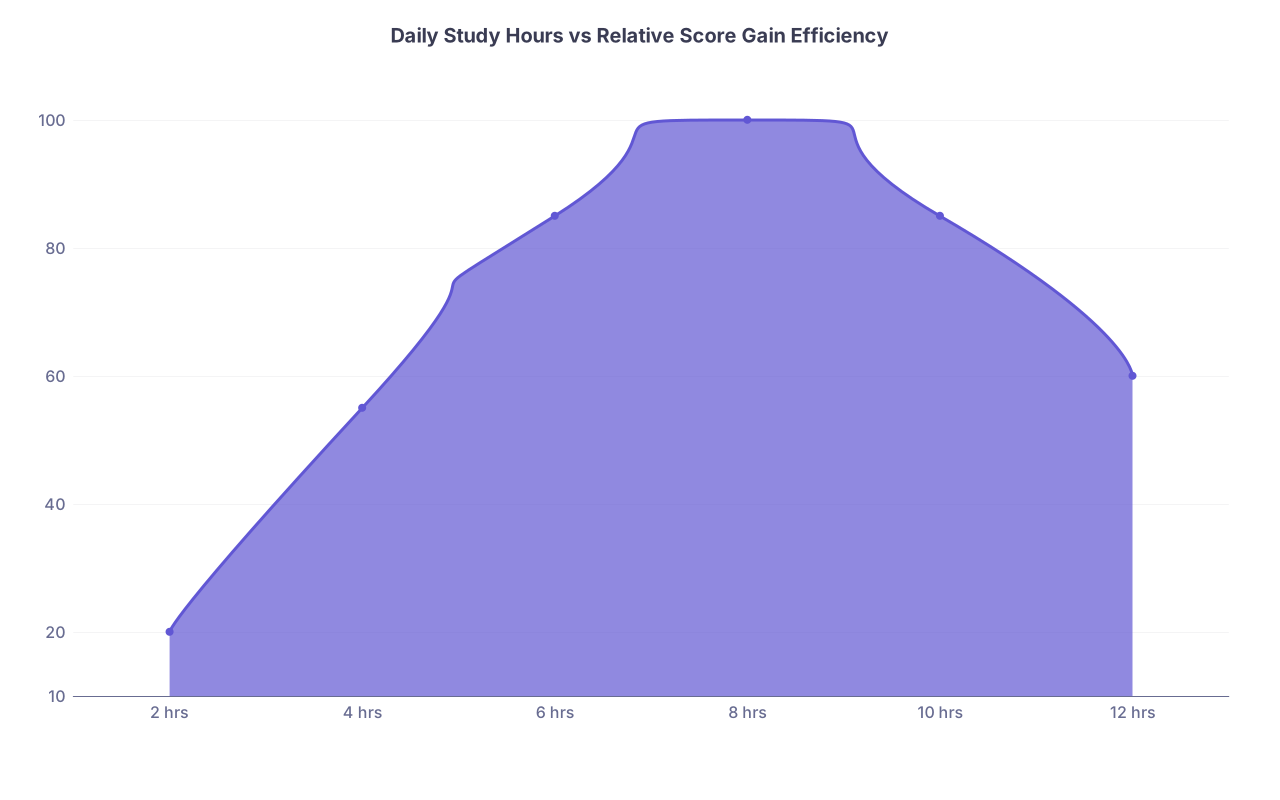
| Category | Value |
|---|---|
| 2 hrs | 20 |
| 4 hrs | 55 |
| 6 hrs | 85 |
| 8 hrs | 100 |
| 10 hrs | 85 |
| 12 hrs | 60 |
Read this as relative efficiency, not absolute points. Somewhere around 7–8 hours of well-structured, high-quality work tends to be peak territory for most full-time dedicated students. Beyond that, you get more exhaustion than learning for the median person.
If your plan shows 10–12 “study hours” a day for 8 straight weeks, the data suggest you are designing for burnout, not performance.
How To Use Hour Data Without Lying to Yourself
Raw time-tracking is only useful if you interpret it correctly. I have watched too many students weaponize their Toggl or Google Sheet logs against themselves.
Step 1: Track the Right Units
You care about:
- Count of focused 45–60 minute blocks
- Number of new questions done
- Number of flashcards reviewed
- Total questions reviewed (incorrects/new learning)
You should be skeptical of:
- Total “desk time” or “library time”
- Video hours watched with no assessment attached
- Pages read
A realistic dedicated-day breakdown for someone targeting 230–245 Step 1 might look like:
| Activity | Time Allocated |
|---|---|
| New questions + review | 3–4 hours |
| Reviewing prior incorrects | 1–2 hours |
| Anki/spaced repetition | 1–2 hours |
| Focused content review | 1–2 hours |
Total: ~7–9 hours. But almost all of this is active retrieval, spaced repetition, or targeted review driven by previous question performance. Not “aimless resource grazing.”
Step 2: Correlate Hours With Objective Markers
Your hours only matter if they move:
- NBME / UWSA scores
- UWorld percent correct and difficulty profile
- Anki retention metrics (if you track them)
If you stack 60-hour weeks and your NBME stays flat across 3–4 weeks, the data are telling you something simple: your marginal ROI is low. The solution is not “add more hours.” It is “change the method.”
Every 2–3 weeks during dedicated, you should be able to answer:
- How many questions have I done since the last NBME?
- What is my percent correct and has it shifted?
- Did I adjust topics/approach based on my last assessment?
If the answer is “I did a lot of hours” but you cannot quantify anything else, you are flying blind.
Score Gains per 100 Hours: What Is Reasonable?
Let me be specific and a bit blunt. Based on real-world performance data, here is a reasonable expectation table for many students:
| Baseline Score | Typical Gain / 100 Hrs (First 200 Hrs) | After 300+ Hrs |
|---|---|---|
| 190–205 | ~5–8 points | ~2–4 points |
| 206–220 | ~4–7 points | ~2–3 points |
| 221–235 | ~3–5 points | ~1–2 points |
| 236–245 | ~1–3 points | ~0–1 point |
Interpretation:
- A 200 baseline student putting in 300 solid hours could plausibly gain 15–20 points.
- A 230 baseline student putting in 300 solid hours might gain 10–15.
- That same 230 baseline student doing another 200 hours (total 500) might squeeze out 3–5 more.
Could someone defy this and jump 35+ points? Occasionally, yes. But if you are planning your life around being a statistical outlier, that is not a smart strategy.
The important implication: the first few hundred hours must be maximized. You do not “fix it later” with brute-force extra time. That is the least efficient part of the curve.
The Hidden Variable: Burnout and Negative Returns
Everyone talks about diminishing returns. Not enough people talk about negative returns.
I have seen this more than once:
- Student at week 5 of dedicated: NBME 238.
- Panics, adds 3 more study hours each day, cuts sleep to 5–6 hours.
- Week 7 NBME: 232. Actual Step: 234.
On paper: more hours. In reality: worse performance—both on practice and on test day.
The mechanisms are obvious if you stop pretending you are a machine:
- Sleep debt torpedoes working memory and attention.
- Anxiety hijacks focus during long stems.
- Saturation leads to “I have seen this before but cannot recall the detail.”
Test-day performance is not a simple function of “content known.” It is content known × ability to retrieve under stress × endurance over 7+ hours.
And that last term gets destroyed when you grind yourself into the ground.
Turning Numbers Into a Practical Plan
Enough theory. Let’s translate this into something you can actually do without spreadsheeting your soul away.
1. Set a Realistic Target Band, Not a Fantasy Number
“250+ or bust” is not a strategy. Look at:
- Your preclinical exam performance
- Your previous standardized tests (SAT/ACT/MCAT)
- Your first NBME baseline
From there, choose a band, for example:
- Baseline 205, MCAT 508: aim for 225–235.
- Baseline 220, MCAT 515: aim for 235–245.
- Baseline 235, MCAT 520: aim for 240–250.
This anchors your expectations for how much gain per 100 hours is plausible.
2. Decide on a Reasonable Hour Budget
Use the earlier tables and your calendar. Something like:
- Non-dedicated: 200–300 “cumulative” hours across M2 (3–4 focused per weekday, light review weekends).
- Dedicated: 250–350 focused hours (7–9 / day for 5–6 weeks).
Total: ~450–650 focused hours over the entire prep lifecycle, not just “dedicated.” That is where a lot of strong score trajectories live.
If you are under severe baseline gaps, you might push toward the upper part of that range. If you have a strong base, you stay in the mid-range and put more emphasis on keeping burnout low.
3. Build a Feedback Loop, Not a Static Schedule
You should not write a 10-week, hour-by-hour schedule and then follow it blindly. That is how people spend 40 hours on their “weak area” that contributes 3–5% of the exam.
You need a simple cycle:

| Step | Description |
|---|---|
| Step 1 | Baseline NBME |
| Step 2 | Study Plan |
| Step 3 | Daily Questions & Review |
| Step 4 | Weekly Mini-Assessment |
| Step 5 | Adjust Topics & Methods |
| Step 6 | Repeat NBME Every 2-3 Weeks |
This is where hours become meaningful: they are not free-floating. They are constantly re-allocated based on where you are still bleeding points.
The Bigger Picture: You Are Optimizing a System, Not a Stopwatch
If you remember nothing else, remember this: USMLE scores are an output of a system, not an output of “hours worked.”
The system includes:
- Your baseline knowledge and test history
- The quantity and quality of your questions
- How aggressively you correct your error patterns
- Your sleep, nutrition, and stress management
- Your daily schedule structure and sustainability
Hours are just one input. And past a modest threshold, they are a weak predictor without the others.
So yes, track your time if that keeps you honest. But pair it with something that actually reflects learning: NBME trajectories, question-bank performance, and your own burnout signals.
You are not trying to win a competition for “who suffered the most during dedicated.” You are trying to hit a score band that opens the right doors with the least collateral damage to your health and sanity.
Get those foundations in place, and your study hours will start buying you real, measurable score gains instead of just anxiety. And once you have squeezed what you can out of Step 1 and Step 2, the next phase is a different dataset entirely: how those numbers interact with clerkship grades, letters, and applications on the residency trail. But that is another analysis for another day.