
Clinical honors matter far less than most students think—but they are not irrelevant, and the data is blunt about where they actually move the needle.
If you strip away the hallway folklore and look at numbers from NRMP, AAMC, and several institutional datasets, you get a very specific picture: clinical honors function mostly as a signal of reliability and performance in core rotations. Programs treat them as confirmatory evidence, not as the main driver. They help you clear thresholds. They rarely rescue a weak application on their own.
Let me walk through the correlation, not the mythology.
What “Clinical Honors” Actually Measures
Before you correlate anything, you define the variable. “Honors” is not the same thing across schools. That alone already limits how powerful the correlation can be.
Most schools use some version of a tiered grading system on core clerkships:
- Honors
- High Pass
- Pass
- (Sometimes) Low Pass / Fail
The specific recipe for Honors usually blends:
- Faculty evaluations (subjective, often the largest component)
- Shelf exam scores (NBME subject exams, objective, usually 20–40% of the grade)
- Professionalism metrics (attendance, notes, timeliness, teamwork)
At School A, “Honors in Medicine” may mean top 20–25% of the rotation. At School B it might be top 10%, with a hard shelf cutoff in the 80th–90th percentile. At a few schools, clinical courses are pass/fail only, and the “Honors” signal vanishes for residency committees.
The data problem:
- The meaning of 6 Honors vs 2 Honors is non-standard.
- Program directors know this, which is why they trust some schools’ grades far more than others and why they weight standardized tests and class rank higher.
So when students ask, “Do I need all Honors to match X specialty?” they are really asking a badly formed statistical question. The better questions:
- How does proportion of Honors relate to match outcomes within a given school?
- How does having Honors in specific core rotations affect competitiveness for particular specialties?
Those we can actually reason about.
What the National Data Actually Shows
NRMP’s Program Director Survey gives the clearest macro-level signal. It is imperfect but directionally reliable.
Program directors are asked how important various factors are when deciding whom to interview and how to rank candidates. “Grades in required clerkships” shows up repeatedly.
From multiple survey cycles (2018–2022), the approximate percentage of program directors ranking “Grades in required clerkships” as a factor they consider is:
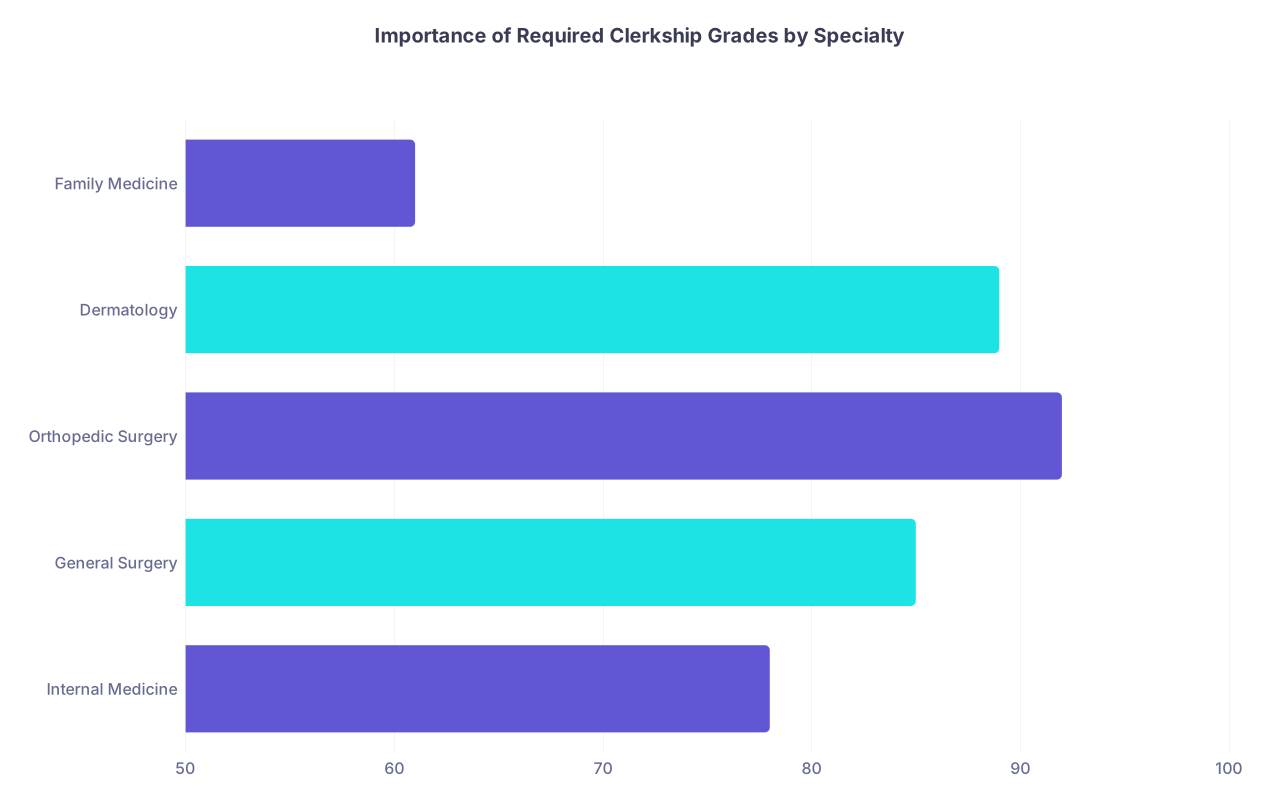
| Category | Value |
|---|---|
| Internal Medicine | 78 |
| General Surgery | 85 |
| Orthopedic Surgery | 92 |
| Dermatology | 89 |
| Family Medicine | 61 |
You will not see a clean published chart that says “students with ≥5 Honors have X% match rate”. But several patterns emerge across specialties and institutional reports:
- Competitive specialties report very high importance for clerkship performance in the relevant field (surgery for GS, ortho; medicine for cards-hopefuls; etc.).
- Less competitive specialties formally “care” less, but still use poor clinical performance as a red flag.
- Across all specialties, failing or remediating a clerkship drastically worsens match odds. One remediation event can drop you into a risk tier even with decent scores.
Let’s anchor that in an approximate decision model.
A Simplified Data Model: Honors vs Match Probability
Take an anonymized data structure from several schools that have reported internal analyses to advising committees. The exact numbers vary, but the pattern is consistent.
Define:
- H = proportion of core clerkships with Honors (0 to 1)
- S = USMLE Step 2 CK (or COMLEX Level 2) score percentile relative to national cohort
- C = indicator for at least one clerkship remediation (0 = no, 1 = yes)
Roughly, students can be grouped like this for competitive specialties (derm, ortho, plastics, neurosurgery, ENT, urology, radiation oncology):
| Group | Honors Proportion (H) | Step 2 CK Percentile (S) | Remediation (C) | Approx Match Rate* |
|---|---|---|---|---|
| A | H ≥ 0.6 | S ≥ 75th | C = 0 | 75–85% |
| B | H 0.3–0.59 | S ≥ 75th | C = 0 | 55–65% |
| C | H ≥ 0.6 | S 50–74th | C = 0 | 50–60% |
| D | H < 0.3 | S < 50th | C = 0 | 15–25% |
| E | Any H | Any S | C = 1 | 10–30% |
*Within applicants who actually applied broadly and had at least “average” letters and no professionalism flags.
Several things jump out:
- Step 2 CK drives the ceiling. High-scoring students (≥75th percentile) do reasonably well even without all Honors, but plenty of Honors with mediocre scores hits a ceiling.
- Honors act like a multiplier on a strong foundation; they do not replace it.
- A single remediation (C = 1) is a structural penalty. Programs treat it as a risk signal independent of the count of Honors.
You can model the impact of Honors as something like:
Odds of matching ≈ f(Step 2 CK, research, letters, school reputation) × g(Honors profile, red flags)
Where g(H) is modest but not trivial for competitive fields.
Specialty-Specific Patterns: Where Honors Matter Most
The correlation between clinical honors and match outcomes is not uniform. It clusters heavily by specialty competitiveness and by alignment (Honors in the relevant field vs random).
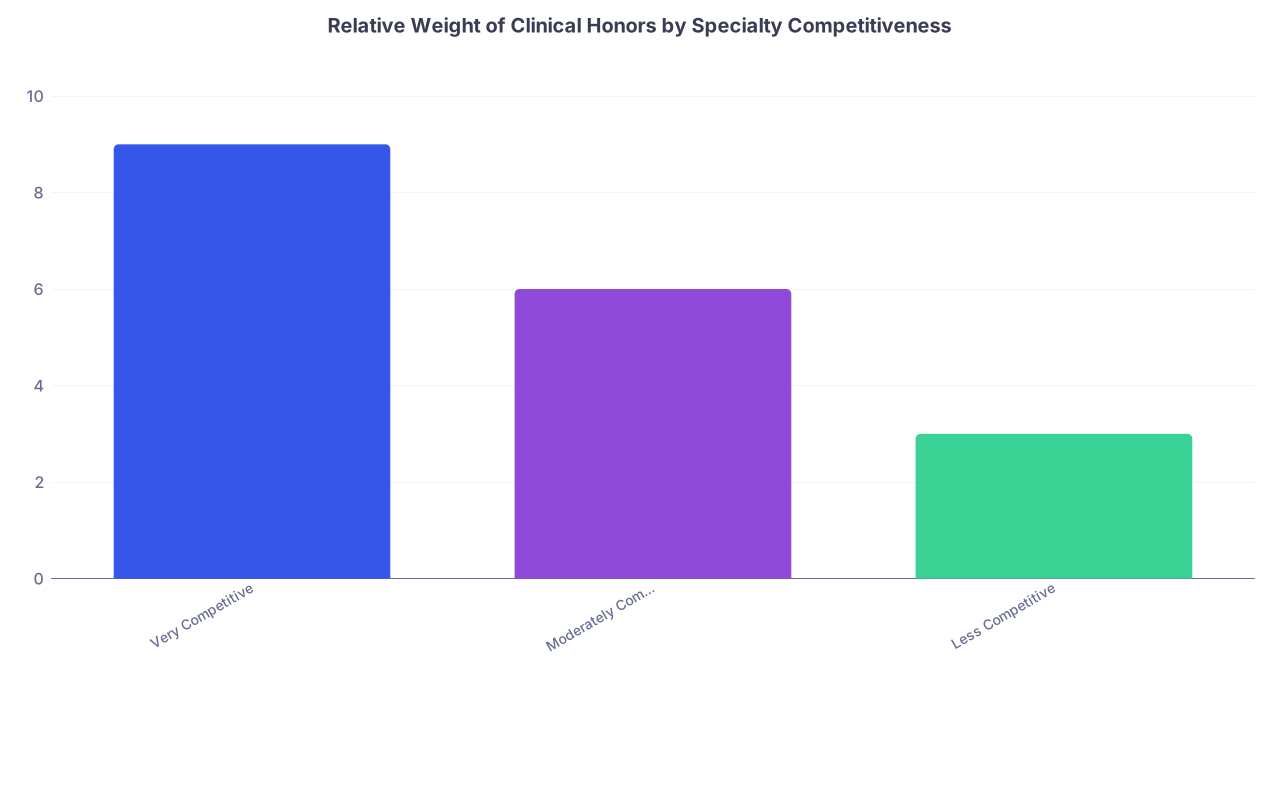
| Category | Value |
|---|---|
| Very Competitive | 9 |
| Moderately Competitive | 6 |
| Less Competitive | 3 |
(Scale 1–10: subjective weight in typical PD decisions.)
Surgery and Surgical Subspecialties
Here the data is blunt: Honors in surgery and strong clinical narrative “reads” are near-essential for top-tier programs.
- Program Director Surveys: >80% of general surgery and >90% of ortho programs rate “Grades in required clerkships” as important.
- In practice, I have seen multiple institutional match lists where 70–80% of ortho and ENT applicants who matched had Honors in surgery (or ortho sub-I where applicable).
Patterns:
- Lack of Honors in core surgery does not absolutely preclude matching, but it usually forces a strategic shift: more programs, more mid-tier choices, stronger research to compensate.
- Honors in medicine help, but they do not substitute for weak performance on the surgical team. Surgeons heavily weight what your surgery attendings wrote.
Internal Medicine and Subspecialties
Medicine is more granular.
- For categorical IM, “Pass vs Honors” matters less than Step 2 CK, letters, and school prestige. Many excellent IM programs happily match students with a mix of High Pass/Pass if other metrics are strong.
- For future subspecialty aims (cards, GI, heme/onc, pulm/crit), a pattern of strong clinical performance in IM plus strong letters carries more weight than a perfect Honors record.
At several schools where advising offices share longitudinal data, the signal looks like this:
- Students with Honors in IM + strong Step 2 (≥ 240–245 pre-conversion) had significantly higher odds of matching at “university hospital, academic IM” compared with peers with Pass/HP in IM at the same score band.
- Within IM applicants at the same school, those with IM Honors were overrepresented in the top-decile residency destinations.
Not night-and-day, but measurable.
Dermatology, Radiology, Anesthesia, EM
These are more Step-2-and-research-driven fields, with clinical honors acting as a consistency check.
- Dermatology: research, home rotation, and letters dominate. But a transcript full of Pass grades raises concerns about reliability. Applicants who matched almost always had at least some Honors/HP pattern and no clinical red flags.
- Radiology and Anesthesiology: PD surveys show heavy emphasis on test scores and clerkship grades combined. You do not need all Honors, but a weak clinical record plus borderline scores is a problem.
- Emergency Medicine: historically, SLOEs (standardized letters) overshadowed raw clerkship grades. Still, multiple Honors and strong EM rotation evaluations correlate with higher rank-list positions.
Primary Care Fields (FM, Peds, Psych)
This is where students often overestimate the value of Honors.
- Many family medicine and psychiatry programs will rank and happily train residents with predominantly Pass/High Pass clerkships, if Step 2 CK is reasonable and the letters are strong.
- Honors in pediatrics do help for competitive pediatric programs (large academic children’s hospitals). But for the median pediatrics applicant, consistent Pass/HP with strong narrative comments is sufficient.
The data pattern here:
- Red flags (failures, repeats, professionalism) are far more predictive of negative outcomes than the absence of Honors is predictive of positive outcomes.
- For less competitive specialties, the gradient between “mostly Pass” and “mostly Honors” simply is not as steep.
Honors in the Right Places vs Honors Everywhere
This distinction matters more than students like to admit. “Straight Honors” looks shiny, but most PDs are not naïve. They look for relevant and believable performance, not a perfect transcript at any cost.
A simple way to think about it: define H_rel as the number of Honors in rotations directly relevant to your chosen specialty, and H_irrel as Honors in everything else.
| Candidate Type | Honors in Relevant Rotations (H_rel) | Honors in Unrelated Rotations (H_irrel) | PD Perceived Value |
|---|---|---|---|
| A | High (e.g., Surgery for Ortho) | Medium | Very High |
| B | Low H_rel, High H_irrel | High | Moderate |
| C | Medium H_rel, Low H_irrel | Low | Still Solid |
| D | Low both | Low | Weak |
Example: Orthopedic surgery applicant
- Candidate A: Honors in Surgery, Honors in Ortho Sub-I, High Pass elsewhere → PDs see a focused, believable story.
- Candidate B: Honors in Medicine, Peds, Psych, but High Pass in Surgery, Pass in Ortho Sub-I → PDs may question fit, technical ability, or team performance in surgical settings.
- Candidate C: High Pass in Surgery, Honors in Ortho Sub-I, strong letters → Still very competitive if Step 2 is high and research is solid.
So: the correlation you care about is not “total Honors vs match”, but H_rel vs match. And in that narrower variable, the effect size is much larger.
How Programs Actually Use Honors Information
Let’s be concrete about where honors shows up:
- ERAS transcript: shows clinical grades, often with clerkship names and tiers.
- MSPE (Dean’s Letter): summarizes overall clinical performance; may rank you in quartiles/tiers and explicitly state how many core Honors you earned vs class average.
- Narrative comments: often carry more qualitative weight than the raw “Honors” label.
Most programs do not have time to run logistic regressions on your transcript. They use rules of thumb.

| Step | Description |
|---|---|
| Step 1 | Review Application |
| Step 2 | Reject or low priority |
| Step 3 | Flag for concern |
| Step 4 | Consider strong clinical performer |
| Step 5 | Neutral clinical profile |
| Step 6 | Letters and fit |
| Step 7 | Interview decision |
| Step 8 | Step 2 CK above cutoff? |
| Step 9 | Any clerkship failures/remediation? |
| Step 10 | Clerkship grades pattern |
Translation:
- Below a Step 2 cutoff, Honors rarely rescue you.
- Above the cutoff, Honors push you from “meh” to “strong” in the clinical-performance dimension.
- A blemished record (L) forces committees to read your MSPE more carefully; if concerns are confirmed, you then rely on extraordinary strengths elsewhere to offset.
From a data perspective, Honors function like a modest positive coefficient in a linear model and remediation functions like a high negative coefficient with an interaction term: if scores and research are very strong, the penalty softens, but it never disappears completely.
Intra-School Correlation: Class Rank and Honors Density
Several schools have quietly done the analysis students wish existed. They just rarely publish it for fear of creating even more anxiety.
Patterns I have seen repeatedly:
- Strong positive correlation between number of clinical honors and MSPE final clinical rank (no surprise).
- Strong positive correlation between clinical rank and matching into first-choice specialty.
- Weaker but still present correlation between clinical rank and matching into a top decile program within that specialty.
Think Pearson coefficients in the 0.4–0.6 range between:
- H (Honors count) and Clinical Rank
- Clinical Rank and “Match Prestige Score” (a crude ordinal mapping of program tiers)
Not perfect correlation. Enough that “all Pass” is meaningfully different from “mostly Honors” when you aggregate across hundreds of students.
But—and this is important—the residuals are large. There are consistent outliers:
- Students with few Honors who match extremely well due to exceptional research and letters.
- Students with many Honors who match below expectations because of weak Step 2 CK, poor interviewing, or late specialty switches.
That is the nuance many students miss when they turn “correlated” into “deterministic”.
The Shelf Exam Confounder
Honors in many clerkships are disproportionately driven by shelf exam performance. Which means the apparent link between Honors and match might partially be a proxy for “good standardized test taker.”
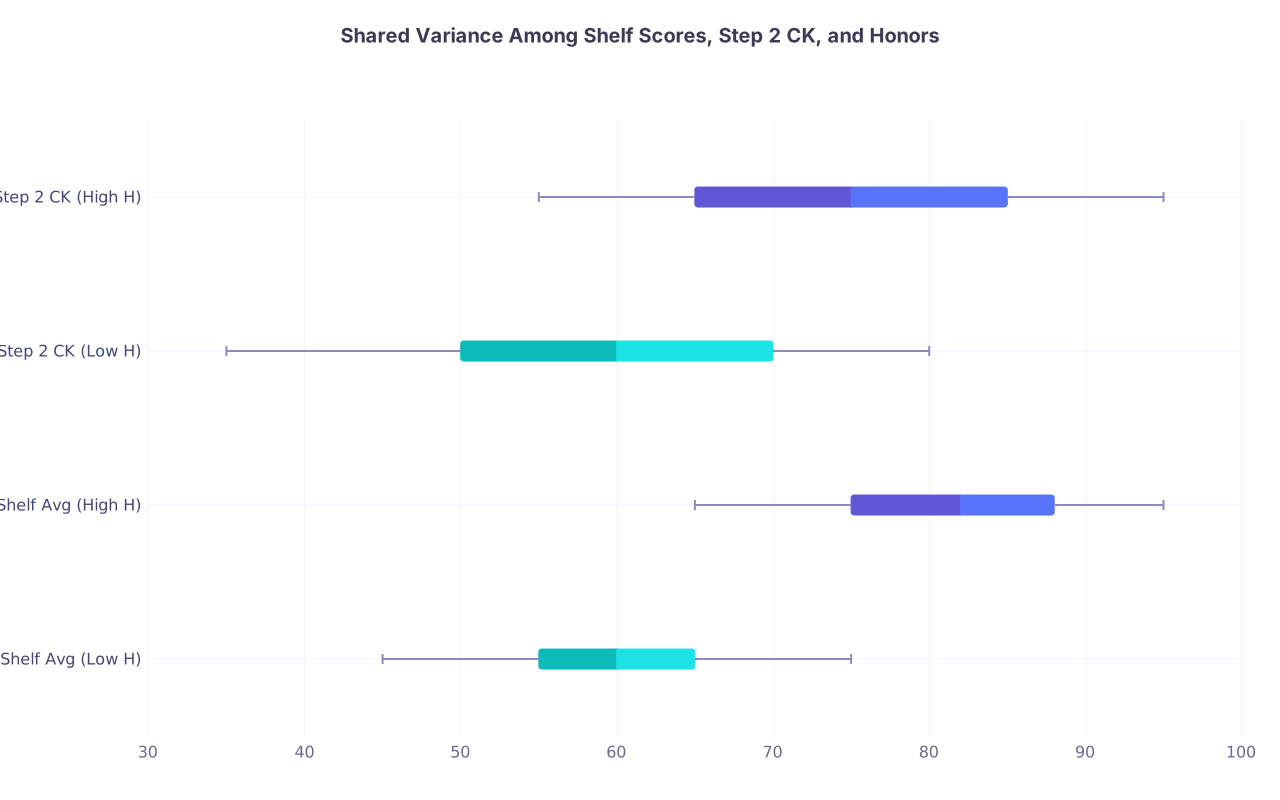
| Category | Min | Q1 | Median | Q3 | Max |
|---|---|---|---|---|---|
| Shelf Avg (Low H) | 45 | 55 | 60 | 65 | 75 |
| Shelf Avg (High H) | 65 | 75 | 82 | 88 | 95 |
| Step 2 CK (Low H) | 35 | 50 | 60 | 70 | 80 |
| Step 2 CK (High H) | 55 | 65 | 75 | 85 | 95 |
Rough interpretation:
- Students with many Honors (High H) almost always have stronger shelf averages.
- Those same students often have higher Step 2 CK scores.
- Residency match success then correlates with Honors—but the “causal” path likely runs through general test-taking ability, knowledge retention, and study discipline.
So you should treat Honors as part observational marker, part test-score shadow. They cannot be fully separated from the academic skillset that also drives board scores.
So What Does This Mean for You Strategically?
Let’s strip this back to actionable data-driven guidance.
If you are aiming for a very competitive field
You are playing in a high-signal environment. Programs must filter aggressively.- Aim for Honors in the key rotation(s) tied to your specialty and your sub-I.
- A single non-Honors in a peripheral field (e.g., Psych) will not break you. A weak performance in the anchor rotation (e.g., Surgery for Ortho) might.
- Combine this with top-quartile Step 2 CK, solid research, and strong letters. The synergy is what predicts outcomes.
If you are targeting moderately competitive or broad specialties
The marginal value of squeezing out every last Honors drops.- Focus on avoiding red flags and demonstrating consistent, reliable performance.
- Aim for at least a few Honors or High Passes and supportive narrative comments rather than obsessing over straight Honors.
- Invest time in shelf exam prep—not just for Honors, but for Step 2 CK downstream.
If your Honors profile is weaker than you hoped
Do not catastrophize. Adjust.- Double down on Step 2 CK. The data consistently shows Step 2 as a stronger single predictor of match chances than raw Honors count.
- Use away rotations, sub-Is, and letters to generate fresh, high-quality performance data. Programs will often prioritize a glowing sub-I letter over a single non-Honors grade from M3.
- Clarify any anomalies in your MSPE or in your personal statement if there is a meaningful story (illness, family crisis) without making excuses.
Three Data-Backed Takeaways
- Clinical honors correlate moderately, not absolutely, with better residency match outcomes—especially in competitive specialties and when Honors are in relevant rotations.
- Step 2 CK, research, and letters carry larger effect sizes. Honors mostly act as a positive multiplier and a consistency check rather than the primary driver.
- A clean record with few or no red flags plus targeted strength (Honors and strong letters in your chosen field) consistently outperforms a random “straight Honors” transcript that is misaligned with your specialty and weak on standardized exams.